 KOKorean
 ENEnglish
 JP日本語
JP日本語 CN中文(简体)
 TW中文(繁體)

Burn Scar Revision in Seoul: What Can Be Restored Once a Burn Scar Has Settled
Settled burn scars can still be treated. The aim, though, is not to recreate skin that was never burned. It is to release tightness, soften sunken and hardened areas, and make color and borders less noticeable. Redness, color and texture can be refined with lasers. But adhesions that hold the skin down, and lost volume, are not fixed by laser alone, so excision, adhesion release and fat grafting are considered alongside it. Surgery to release tightness is usually done once the scar has matured. Fat and stem cell treatment has reported benefits but still limited evidence, which is worth knowing before you choose. If you are considering treatment in Seoul, you can send photos and your burn history first.
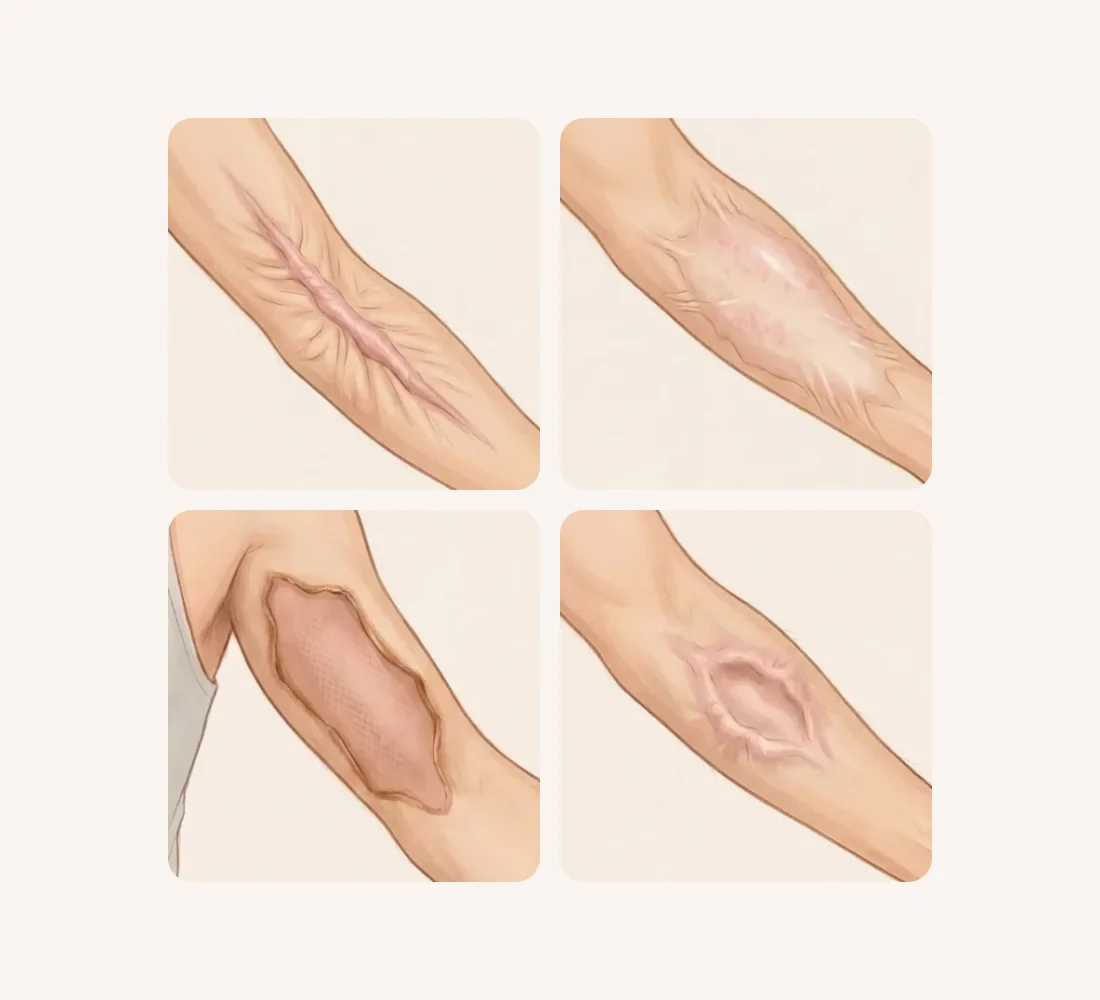
Why does every burn scar end up different?
Some burns go beyond the surface into the deep dermis (the thick layer under the skin's surface) or through the full thickness of the skin. These burns heal with a scar. Scars can be reduced with treatment and care but not removed completely. Even well-healed skin grafts, and the places the graft skin was taken from, remain scars from the patient's point of view.1 So the aim of burn scar treatment is not to recreate skin that was never injured. It is to release tightness so that movement is easier, soften sunken and hardened areas, and make color and borders less noticeable.
The same burn can leave very different scars. As the illustration shows, one scar can hold several problems at once.
Whether the scar is mature or still red and firm, and whether it is thin and sunken or thick and raised, changes the approach. So does whether it is unstable and keeps breaking down, and whether it has turned darker or lighter than the skin around it.1 At Bonita Clinic, too, we find that burn scars vary widely from person to person because the condition of the skin tissue differs, so the treatment differs as well.
Why is laser sometimes not enough?
Redness, color differences and rough texture in a burn scar can be refined with lasers. An international consensus of 26 experts from 13 countries regards lasers as a first-line therapy for traumatic scars and contractures (scars that shrink so a joint cannot straighten fully).2 Fractional CO2 laser delivers heat in tiny dots. A meta-analysis (a study that pools results from many studies) of this laser found meaningful improvement in burn scars with few reported side effects.3
Sunken scars, however, also have problems below the surface. At Bonita Clinic, we find that beneath a sunken scar there is adhesion tissue that holds the skin down, and it must be released for the skin to rise. Sunken areas are then filled with your own fat and stem cells, and once the base has come up, laser can do its part. Laser can smooth the surface, but it cannot release the bands pulling from below or replace lost volume.
When does a scar mature, and when is it restored?
Right after healing, a burn scar is immature: red and firm. At this stage the scar is kept out of the sun so it does not darken, and kept supple with moisturizer. Over deep burns, custom pressure garments (clothing that presses evenly on the scar) are used. A burn scar review (a paper that summarizes many studies) explains that pressure garments need to be worn around the clock for at least 9–12 months to help. They work less well once a hypertrophic scar (a red, thick, raised scar) has already formed.1
How burn scars mature, and when to restore them
- Just healedRed, firm, immature scar: sun protection, moisturizing
- Over monthsPressure garments and silicone help maturation
- About a yearSofter, less vascular, mature
- Once matureConsider excision, release, fat grafting
- At each stageRemaining redness, color, texture: laser
Surgery to release tightness (contracture) is generally not done while the scar is still red and full of blood vessels. It is done after the scar has matured and become soft and supple, which, according to the review, usually takes about a year. Immature scars bleed more during surgery, and grafts take less reliably, which can lead to more tightening. Some immature scars also improve with physical therapy alone.1
Sometimes surgery does not wait. When an eyelid is pulled out of place and threatens the eye, or tightness in the neck, hand or knee seriously disrupts daily life, surgery comes first.1
If an old burn scar keeps breaking down and does not heal well, it needs to be checked. Such unstable scars can, rarely, be linked to skin cancer (Marjolin's ulcer). The review shows a case that arose in an 18-year-old burn scar.1
What does each method address, and what are its limits?
Here is how we at Bonita Clinic match our methods to the state of a burn scar.
Bonita Clinic's methods by the state of the scar
1Thick and tight, limiting movement
The scar tissue is excised and the edges re-stitched so the skin can move again
Scar excision
2Hard, thinned skin
Stem cells and fat are injected, aiming to restore softness and thickness
Adipose stem cell regeneration
3A wide scar with clear borders
Excised and closed along the skin creases, closer to a thin line
Scar removal
4A sunken area
Adhesions holding it down are released and the base is filled with fat
Adhesion release · fat grafting
Here are the main problems each method addresses, and the limits to know.
| Approach | Main problem addressed | Limits to know |
|---|---|---|
| Scar excision and revision | Thick, tight scars; wide scars with clear borders | Leaves a new incision line; released areas may need a graft or flap1 |
| Adhesion release and fat grafting | Sunken, tethered scars | How much grafted fat stays and the result vary; risks include hematoma and fat necrosis4 |
| Adipose stem cell regeneration | Hard, thinned skin | Improvement is often reported, but mostly in studies without control groups, so evidence is limited45 |
| Combined lasers | Redness, pigmentation, texture | Borders, texture and deep depressions are not solved by laser alone |
In plain words: a flap moves nearby skin together with its blood supply to cover an area. A hematoma is blood collecting where surgery was done, and fat necrosis means some of the grafted fat does not survive and hardens. A control group is a group of people who did not get the treatment, used for comparison.
Excision and re-stitching
For thick, tight scars, the scar tissue is excised, or the point of greatest tension is released. The resulting gap is covered with a skin graft or flap. When scars are extensive, the focus is on releasing tension rather than cutting everything out. Small depigmented or raised areas, and unstable areas that keep breaking down, may be excised at the same time.1 Line-like, band-shaped contractures can be treated with local flaps such as Z-plasty, which changes the direction of the scar into a zigzag. This also helps when tight bands form along the border of a skin graft.1 At Bonita Clinic, we also excise scars with clear borders and close them along the direction of the skin creases. The aim is to turn a wide scar into something closer to a thin line.
Fat grafting and stem cells: hopes and evidence
Placing your own fat under a scar has been used in the hope that the stem cells in fat help soften scar tissue. One systematic review looked at 14 studies (885 patients) of fat grafting for burn scars. This kind of review searches for all relevant studies in a set way and sums them up. Every study reported improvement. However, only one was a randomized controlled trial (where people are assigned to groups by chance, like drawing lots). Twelve were case series without control groups, and many relied on subjective assessment. The reviewers advised reading the results with caution. They also pointed out that fat grafting requires anesthesia and carries risks such as fat embolism (fat entering and blocking a blood vessel), hematoma and fat necrosis. Direct comparisons with less invasive treatments are therefore needed.4
There is also a small randomized trial in eight children with mature burn scars that compared fat grafting with saline injection. In that trial, a single fat graft did not improve scar appearance.5
So adipose stem cell regeneration is not a way to make skin as it was. It is more accurately understood as an option used alongside other methods, with the aim of softening hardened, sunken scars and filling the base.
Lasers
When redness, pigmentation or texture remain, lasers are chosen to match the type. Lasers are recommended as a first-line therapy for traumatic scars, and the consensus treats laser use in darker skin as a separate consideration.2 Fractional CO2 laser treatment was mostly given as an outpatient procedure (without a hospital stay), with few reported side effects.3 Graft borders, texture and deep depressions still need separate restoration.
What should you know about surgery and recovery?
At Bonita Clinic, we perform burn scar restoration as surgery under local anesthesia or sedation, with same-day discharge and stitches. Recovery follows the course below, and its length and your follow-up visits vary with the extent of treatment and your condition.
| Stage | Common changes | What the clinic does |
|---|---|---|
| Right after treatment | Swelling, bruising; stitches or dressings | Wound cleaning, infection prevention |
| During recovery | After stitches come out, the new scar starts to settle | Scar care with sun protection and moisturizing begins |
| As it settles | Redness and firmness change | Laser or injections added if needed; remaining marks continue with restoration |
As with any surgery, bleeding, infection and inflammation can occur, and the new incision also leaves a scar. If fat is grafted at the same time, the area where fat is taken can bruise and swell too. After surgery near a joint, keeping up splinting and exercise helps stop tightness from returning. Keep in mind that grafted skin usually needs about a year of care before it matures.1
How we approach it at Bonita Clinic
Treatment options you can discuss in Seoul
Dr. Kwang-Seop Chung, a Brazilian board-certified plastic surgeon, has seen patients himself at the same location since Bonita Clinic opened in 1995. For settled burn scars, the options discussed in consultation are the ones on our treatment page:
- Scar excision with re-suturing of the edges for thick, tight scars
- Adipose stem cell regenerative treatment for hard, thinned skin, discussed with the evidence limits above in mind
- Scar removal closed along the skin creases for wide scars with clear borders
- Combined lasers, 2–3 types matched to remaining redness, pigmentation or texture
Our treatment page notes that you can consult even before a wound has fully healed. The combination and order that suit your scar are decided only once we have examined it.
Why the plan and cost differ from case to case
A palm-sized scar on the forearm and a scar running from the neck across the shoulder are very different projects. The extent of the work, not the name "burn scar", shapes the plan and the cost.
- Area and location of the scar
- Tightness that limits movement
- Depressions and adhesions
- Whether fat grafting is added
- Anesthesia: local or sedation
- Laser types and sessions
Final plan and quote after an in-person exam
A final estimate is given only after an in-person examination, once the methods, their combination and the number of stages are clear. Photos give a first impression; the final scope is confirmed in person.
What photos can show, and what needs an in-person exam
Photos help show where the scar is and how it looks. Adhesions, firmness and tightness in motion can only be judged in person.
Photos can show
- Size, location and outline
- Color differences and redness
- Visible graft borders
- Range of movement (bent and straight)
Needs an in-person exam
- Depth of depressions and adhesions
- Firmness and thickness by touch
- How tight the skin is in motion
- Fat available for grafting
- Areas that break down or will not heal
Helpful photos: the whole scar and close-ups in daylight without filters, and, if the scar crosses a joint, photos with the joint fully bent and fully straightened. Older photos from when the scar first healed help show how it has changed. You can send us a message with your photos, when and how the burn happened, and the treatments you have had so far, including any skin grafts.
Planning your visit and recovery
What is confirmed in advance is limited to the treatment information above: surgery under local anesthesia or sedation, same-day discharge and stitches. Restoration is often done in stages, with lasers added after watching how the scar settles. How many times you need to come to Seoul, how long to stay and when stitches come out are planned with you at consultation.
Between visits and after you return home, the basic care that supports a maturing scar continues: sun protection, moisturizing and, where advised, pressure garments.1 If a treated area becomes painful, red and hot, starts to discharge or opens up, see a local doctor promptly. Keeping dated photos makes it easier for any doctor to compare changes later.
Real treatment cases
These cases appear on Bonita Clinic's burn and keloid treatment pages. Results vary from person to person.
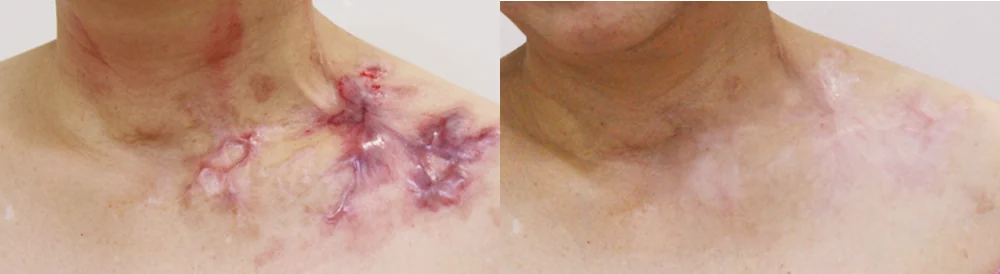
Red-purple, uneven raised scars from below the neck to around the collarbone
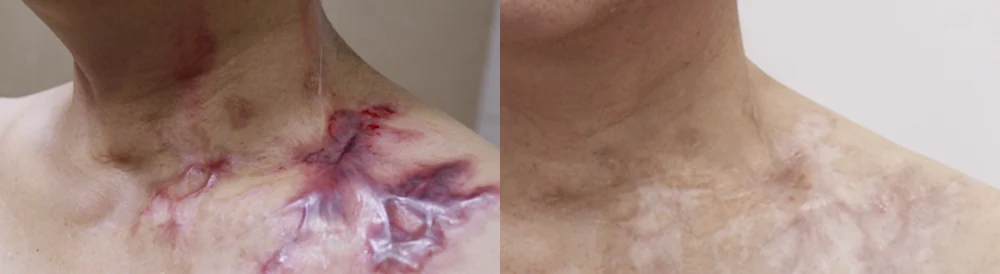
The same case seen from another angle
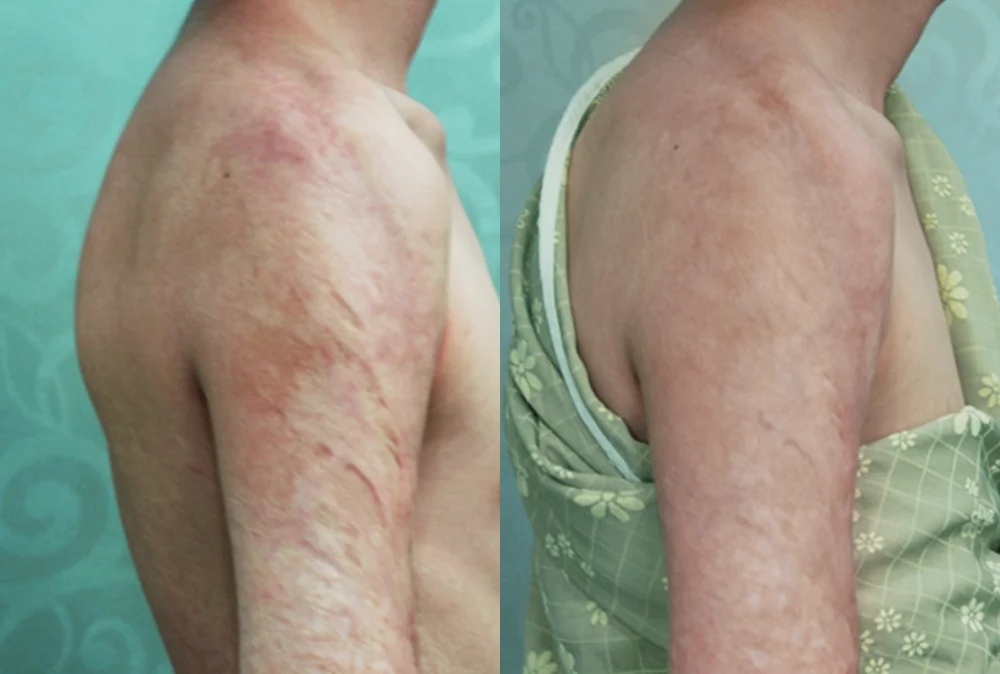
Wide area of red, uneven scarring from the shoulder to the upper arm
* Results vary from person to person. Side effects are possible, so please decide after a thorough consultation with a doctor.
Frequently asked questions
Will the color of a burn scar come back to normal?
Lasers can lighten redness and color differences. Graft borders and differences in texture, however, are handled with separate restoration such as excision or fat grafting. Darkening or lightening of the skin after burns is common, and an exact color match may not be possible.1 We check the extent in consultation.
My scar has already settled. Is it too late?
It is not too late. Settled scars are treated with restoration that releases tight tissue and fills depressed areas, and may need more steps than right after the injury. In fact, surgery to release tightness is usually done after the scar has matured.1
Will fat and stem cell treatment make my skin as soft as it used to be?
No study supports promising that. Improvement has been reported, but mostly in studies without control groups, and in a small randomized trial a single fat graft made no difference.45 How hard and sunken the scar is gets checked first, and then we decide whether to combine it with other methods.
Can the border line of a skin graft be improved?
It depends on the scar. If a tight band has formed along the graft border, local flaps can spread out the tension once the graft has matured.1 Differences in color and texture can be lightened with lasers. The border is unlikely to disappear entirely; the goal is to make it less noticeable.
My old burn scar keeps getting small wounds that will not heal.
Unstable scars that keep breaking down can, rarely, be linked to skin cancer, so an examination comes before any cosmetic treatment.1 If needed, a biopsy is part of that check before treatment is decided.
What to prepare before your consultation
- When and how the burn happened, and the treatment at the time (dressings, whether and where skin was grafted)
- What bothers you most now: tightness that limits movement, depressions, hardness, color, itching
- Scar treatment so far: pressure garments, silicone, type and number of laser sessions, injections, surgery
- Photos of the whole scar, and with nearby joints bent and straightened
- Whether you have areas where fat could be harvested, and your medicines and medical conditions
Bonita Clinic is on the 3rd floor of 565 Gangnam-daero, Seocho-gu, Seoul, about 100 m on foot from Exit 8 of Nonhyeon Station (Line 7). You can read more on our Burn Scars page. For raised scars and keloids, see Burn & Keloid Treatment and the guide to burn scar and keloid treatment. For care right after an injury, see Golden-Time Scar Care and the guide to early scar care after burns and wounds.
References (5)
Sources that support the explanations in this article. Study findings describe general trends and do not guarantee individual results.
- Goel A, Shrivastava P. Post-burn scars and scar contractures. Indian J Plast Surg. 2010;43(Suppl):S63-S71.doi:10.4103/0970-0358.70724Review of burn scars and contractures: deep burn scars can be reduced but not eliminated, sun protection and pressure garments (9–12 months), operating after maturation (usually about a year) and its exceptions, incision, excision, grafts, flaps and Z-plasty, unstable scars and Marjolin's ulcer, care of grafted skin
- Seago M, Shumaker PR, Spring LK, et al. Laser Treatment of Traumatic Scars and Contractures: 2020 International Consensus Recommendations. Lasers Surg Med. 2020;52(2):96-116.doi:10.1002/lsm.23201International consensus of 26 experts from 13 countries (Delphi; abstract): lasers as first-line therapy for traumatic scars and contractures, vascular and ablative or non-ablative fractional lasers, considerations for darker skin
- Choi KJ, Williams EA, Pham CH, et al. Fractional CO2 laser treatment for burn scar improvement: A systematic review and meta-analysis. Burns. 2021;47(2):259-269.doi:10.1016/j.burns.2020.10.026Meta-analysis of fractional CO2 laser for burn scars (abstract): laser alone significantly improved scar measures, few adverse effects, mostly outpatient treatment
- El Sewify O, Zhu XM, Tremblay C, et al. The Utility of Fat Grafting to Manage Burn Scars: A Systematic Review. J Burn Care Res. 2025;46(6):1269-1275.doi:10.1093/jbcr/iraf146Systematic review of fat grafting for burn scars (14 studies, 885 patients): all reported improvement, but one randomized trial and 12 case series, mostly subjective assessment; anesthesia, fat embolism, hematoma and fat necrosis risks; comparative studies needed
- Gal S, Ramirez JI, Maguina P. Autologous fat grafting does not improve burn scar appearance: A prospective, randomized, double-blinded, placebo-controlled, pilot study. Burns. 2017;43(3):486-489.doi:10.1016/j.burns.2016.09.019Double-blind randomized pilot trial in eight children with mature burn scars (abstract): a single fat graft did not improve scar appearance compared with saline injection
About this article
This article separates general medical information from Bonita Clinic's own approach. Because the right decision depends on each person's condition, it is not a substitute for a consultation.
