 KOKorean
 ENEnglish
 JP日本語
JP日本語 CN中文(简体)
 TW中文(繁體)

Early Scar Care After a Burn or Injury in Seoul: What the First Days and Weeks Change
The first step toward a smaller scar is a clean wound that heals as quickly as possible. Bleeding that will not stop, a deep or gaping wound, or a large burn needs the nearest emergency room first, wherever you are. A burn benefits from cooling under cool running water. Research shows that each extra day a burn takes to heal raises the chance of a thick, raised scar, so scar care should be planned early, alongside acute treatment. Once the wound has closed, sun protection and moisturizing begin, and lasers or injections are considered if the scar turns red and firm. If you are thinking about scar care in Seoul after your wound has been treated, you can send photos and your treatment history first.
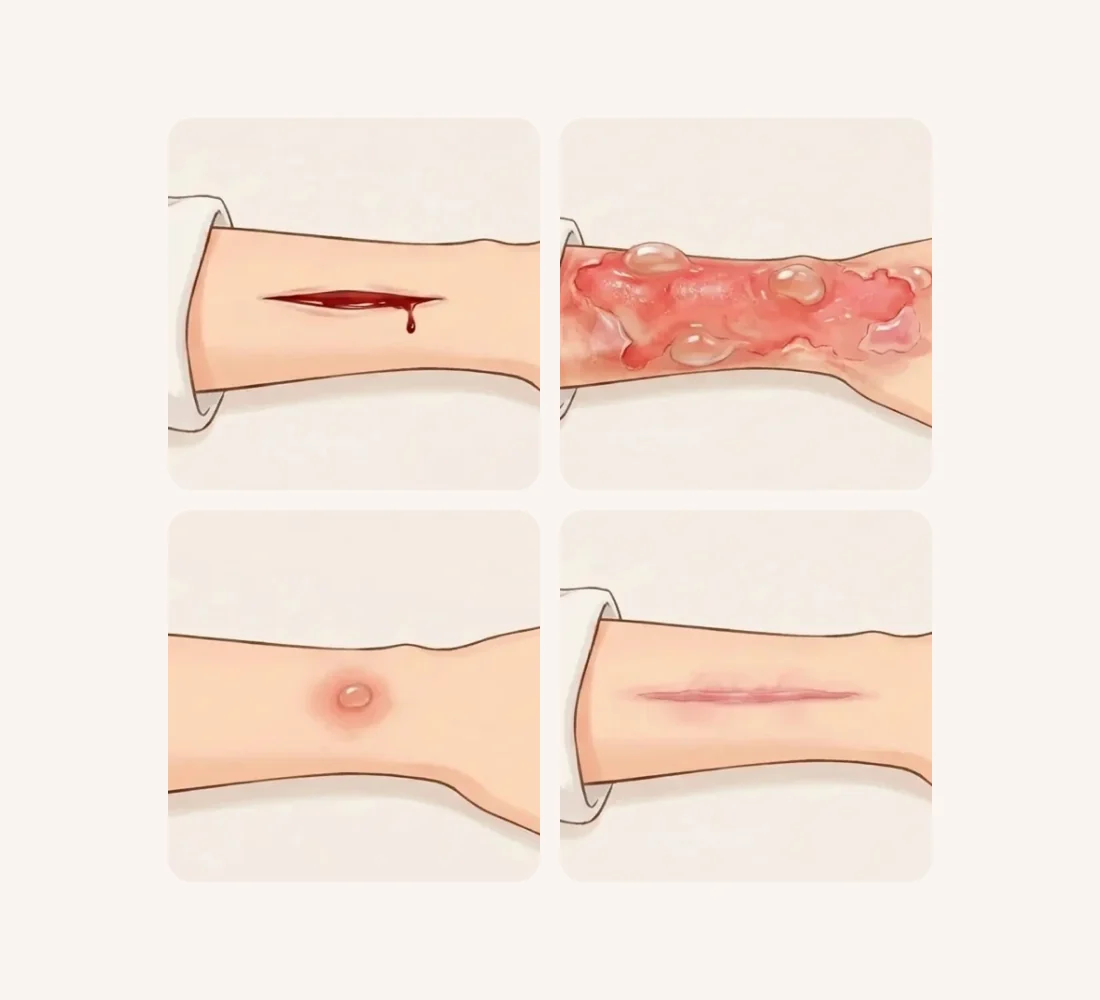
Which wounds need the emergency room first?
Before thinking about scars, there is one question to answer first: does the wound need emergency treatment now? Bleeding that will not stop, a deep or gaping wound, or a large burn should be treated at the nearest emergency room first. If you have just been injured, please get care where you are. A fresh wound should never wait for a trip abroad, and scar treatment can follow later without losing its chance.
First aid also differs by the cause of a burn. Burns from flames or hot liquids are cooled with water. Chemicals are rinsed off with plenty of water. With electrical injuries, the current must be switched off before anyone touches the person.1 What to do first can be sorted by the state of the wound, as below.
What to do first, by the state of the wound
1Bleeding will not stop, or a deep, gaping cut
Get bleeding control, cleaning and stitches at the nearest emergency room
Emergency room
2A large burn, or an electrical or chemical burn
First aid for the cause, then burn care, come first
Emergency and burn care
3A small burn or shallow cut
Cool or rinse and cover it, then see a doctor soon to check healing
Prompt medical care
4Healed, but turning red and firm
Scar care decides whether laser or injections are needed
Scar care
What you can do right away
- Cool a burn under cool running water. In a study of 2,495 children with burns, those who received 20 minutes of cool running water within 3 hours of injury had lower odds of needing a skin graft (odds ratio 0.6) and of a full-thickness burn, one that goes through the whole skin (odds ratio 0.4).2 Here, an odds ratio below 1 shows that the event was less likely. This was an observational study (people were compared as they were, not assigned to groups), so water alone cannot be credited with the whole difference. Still, it shows why first aid should not be delayed.
- Keep the person warm afterwards. Cooling a large burn for a long time can lower body temperature, so wrap the person in a clean, dry sheet afterwards. Remove clothing and jewelry. Do not apply home remedies such as butter, toothpaste or lemon, which can damage tissue further.1
- Rinse and cover a cut. Rinse a cut or tear under running water, cover it with clean gauze, and see a doctor as soon as possible.
How does burn depth change the scar?
Skin is made of the outer epidermis, the dermis beneath it, and the fat layer below that. Burns are graded from first to third degree (fourth when deeper tissues are involved) by how deep the damage goes. The deeper the burn, the harder it is to achieve a good scar.1
- First degree: only the epidermis is affected. These usually heal without scarring.
- Superficial second degree: blisters and pain. These heal without surgery but may scar.
- Deep second degree: less painful and drier-looking. These often need surgery and leave a scar.
- Third degree: the whole dermis is damaged. These often need surgery and leave a scar.1
One difficulty is that superficial and deep second-degree burns are hard to tell apart in the first days. The same review (a paper that summarizes many studies) notes that accurate methods to separate them are lacking, which makes it hard to know which wounds need surgery.1 That is why the first assessment is followed by watching how quickly the wound actually heals.
What does "golden time" really mean?
For burns, "golden time" is less a deadline measured in hours than the number of days a wound takes to heal.
In a prospective study (one that follows a set group of people forward in time) of 383 children with burns treated without surgery, raised, thick scars (hypertrophic scars) did not develop in any wound that healed within 8 days. They appeared in 6.4% of wounds that healed in 8–14 days, 13.5% in 15–21 days, and 56.0% when healing took longer than 21 days.3 Each extra day to healing multiplied the risk by about 1.14. The authors concluded that the traditional "heal within three weeks" target is too simple.3 They also saw a trend, not statistically significant, toward higher rates in darker skin types (Fitzpatrick types 4–6, which include many Asian skin tones).3 The faster a burn healed, the less likely a thick scar was.
From the day of injury until the scar settles
- Right awayCool burns under running water; rinse and cover cuts
- First daysCheck depth and infection; stitches or dressings
- Until healedThe longer healing takes, the higher the risk of thick scars
- Just healedSun protection, moisturizing, less tension
- Weeks to monthsIf red and firm, consider laser or injections
- Once settledRemaining color, borders and texture: restoration
For cuts and tears, people often speak of a golden period of a few hours for stitching. One study followed 2,663 patients from three emergency departments, and 2.6% developed an infection. But there was no clear difference in infection rates between wounds closed before or after 12 hours. Instead, diabetes, lower-leg wounds, dirty wounds and wounds longer than 5 cm were linked to infection. Infected wounds had worse appearance ratings and were 2.6 times more likely to be considered for scar revision.4
A few hours' delay is no reason to give up on care. Still, keep in mind that cleaning the wound and preventing infection are the basis of a smaller scar. An open wound is better stitched sooner for the sake of the scar.
What care starts once the wound has closed?
Newly healed skin is still forming a scar. International scar management guidelines recommend protecting early scar tissue from the start: reducing skin tension, taping, keeping the skin moisturized and protecting it from UV light. Silicone sheets or gel are widely used as the first step for preventing and treating hypertrophic scars and keloids. Pressure garments (clothing that presses evenly on the scar) may be used for widespread scarring, especially after burns.5
| Stage | What the wound looks like | Care at this stage |
|---|---|---|
| Right after treatment | Cleaned, then stitched or dressed | Preventing infection comes first |
| After stitches come out | Thin, pink new skin | Sun protection, moisturizing, less tension |
| As the scar settles | Redness and firmness change | Laser or injections added if needed |
| Later | Color differences, borders or texture may remain | Restoration continues |
If a healed area becomes redder, raised, firm or itchy, a hypertrophic scar may be starting. Hypertrophic scars are common after burns. They stay within the original wound, which sets them apart from keloids that grow beyond it.1 How these are treated is covered in our guide to burn scar and keloid treatment.
How does scar care differ before and after a skin graft?
At Bonita Clinic, we divide scar care around skin grafting. Before a graft, the aim is to help shallow burns recover without one and, for deep burns, to keep the grafted area smaller so that less scarring remains. After a graft, contraction (the skin pulling and shrinking) can leave the grafted skin a different color, with a visible border against the surrounding skin. Smoothing this takes more steps.
In general, whether a graft is needed is decided by the burn team from the depth, size and healing speed of the burn. Just as first aid was linked to grafting needs in research,2 care in the first days can widen later options. On the other hand, no study in people has yet shown that a particular regenerative treatment reduces the area that needs grafting.
What is known about stem cell regenerative treatment?
At Bonita Clinic, we present stem cell regenerative treatment as a way to help damaged tissue regenerate. Because material from your own bone marrow, fat or blood is used, we explain that rejection is of little concern and that the procedure is relatively short.
Here is where the research stands. A systematic review of mesenchymal stem cells (stem cells that can develop into bone, fat and similar tissues) for burn wounds found 21 animal studies, mostly positive for wound healing. But there were only three studies in people: one case-control study of 60 patients and two case reports of one or two patients.6 The reviewers rated the human evidence as very low with a high risk of bias. In the case-control study, infection was reported in 25–70% of stem-cell-treated patients compared with 25% of controls.6 They concluded that well-designed randomized trials (where people are assigned to groups by chance) are needed before drawing conclusions.6
So this treatment is not a replacement for standard burn care (covering the wound and grafting when needed). It is more accurately understood as an option to discuss after an examination.
How we approach it at Bonita Clinic
At Bonita Clinic, we provide this care as a procedure, with excision added if needed, under local anesthesia. You go home the same day, and stitches are used. Depending on the skin, vascular laser for redness, fractional laser for depressed scars and texture, pigment laser and laser toning for pigmentation, and CO2 laser for surface irregularities are combined. Device descriptions reflect general uses, and research on each specific device is limited. Recovery time and follow-up visits vary with the extent of treatment and your condition.
Treatment options you can discuss in Seoul
Bonita Clinic has treated patients at the same location since opening in 1995, with Dr. Kwang-Seop Chung, a board-certified plastic surgeon trained in Brazil, seeing patients himself. Once emergency treatment is done where you are, the options discussed in consultation are the ones on our treatment pages:
- Early scar care after the wound has closed, with lasers chosen for redness, pigmentation or texture
- Injection treatment for scars that become red, raised and firm
- Excision when a scar needs to be removed, with stitches
- Stem cell regenerative treatment, discussed with the evidence limits above in mind
- Restoration for scars that have already settled
Our burn and keloid pages note that you can consult even before the wound has fully healed. Which of these you need, and in what order, is decided only after an examination.
Why the plan and cost differ from case to case
Two people who were "burned on the arm" can need very different care. The extent of the work, not the name of the injury, shapes the plan and the cost.
- Size and depth of the wound or burn
- Whether it has fully healed or was grafted
- Types of laser and number of sessions
- Whether injections or excision are needed
- Whether regenerative treatment is added
- Anesthesia and treatment area
Final plan and quote after an in-person exam
A final estimate is given only after an in-person examination, once the depth, the healing status and the treatments needed are clear. Photos can suggest a direction but cannot fix the scope.
What photos can show, and what needs an in-person exam
Dated photos are especially useful for fresh wounds and early scars, because the speed of healing matters. They are not enough to judge depth or firmness.
Photos can show
- Location and size of the wound or scar
- Redness and color difference
- How it changed day by day (dated photos)
- Visible graft borders
Needs an in-person exam
- Depth and firmness
- Tightness and limited joint movement
- Condition of grafted skin
- Unhealed areas or signs of infection
- Skin thickness and texture by touch
Helpful photos: the whole area and a close-up, taken in daylight without filters, plus photos from the day of injury onward with the dates noted. Include the opposite, uninjured side if the area is on a limb or joint. You can send us a message with your photos, the date and cause of the injury and the treatment you have had so far.
Planning your visit and recovery
What is confirmed in advance is limited to the treatment information above: a procedure with excision if needed, local anesthesia, same-day discharge and stitches. How long you should stay in Seoul, whether one visit or several are needed and when stitches come out depend on the extent of treatment. These are planned with you at consultation.
Scar care is usually a process over months rather than a single visit. The basic care recommended by guidelines, such as sun protection, moisturizing, reducing tension, silicone products and, for wide burn scars, pressure garments, continues at home between visits.5 If redness, heat, pain or discharge increases instead of settling after you return home, see a local doctor promptly. Dated photos of your recovery help any doctor who sees you later.
Real treatment cases
These cases appear on Bonita Clinic's golden-time treatment page. Results vary from person to person.
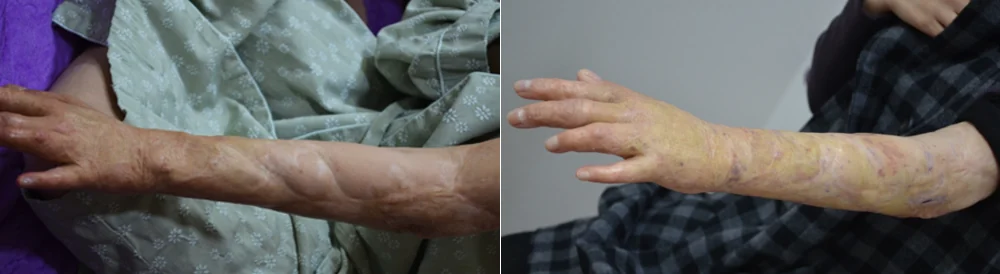
Burned area from the back of the hand to the forearm, with a thick, wrinkled surface
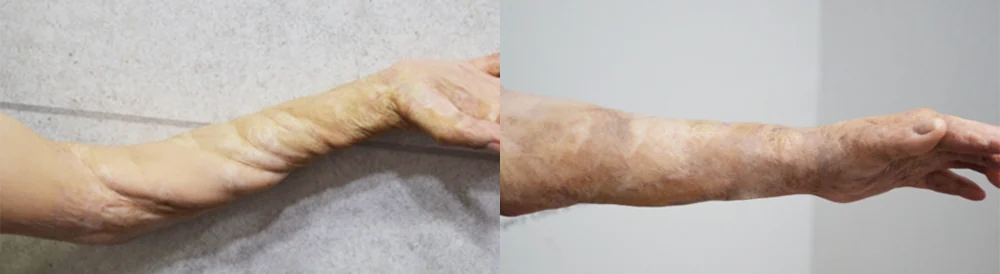
Forearm burn with raised, band-like ridges
* Results vary from person to person. Side effects are possible, so please decide after a thorough consultation with a doctor.
Frequently asked questions
What should I do right after an injury?
Rinse a cut or tear under running water, cover it with clean gauze and see a doctor as soon as possible. For a burn, cooling under cool running water comes first. If bleeding will not stop, the wound is deep and gaping, or the burn is large, go to the nearest emergency room.
Several hours have passed. Is it too late for stitches?
Not necessarily. In research, infection rates did not clearly differ between wounds closed before or after 12 hours; contamination, wound location and length, and diabetes mattered more.4 Whether to stitch now or leave the wound open is decided by the doctor after looking at it. Do not delay care because time has passed.
My wound has healed, but it is red, itchy and getting firm.
This can be the start of a hypertrophic scar. Keep up basic care such as sun protection, moisturizing and silicone products.5 If the redness and thickness increase, have it checked to see whether laser or injection treatment is needed.
My scar has already settled. Is it too late?
It is not too late. Settled scars can still be treated with restoration that releases tightness and fills depressions, although more steps may be needed than when treatment starts soon after the injury. See our guide to settled burn scars.
Can stem cell treatment help me avoid a skin graft?
There is no evidence that would allow such a promise. Whether a graft is needed depends mainly on the depth, size and healing speed of the burn. Studies of stem cell treatment in people are still few and of low quality.6 Whether to add it is discussed after the burn has been examined.
What to prepare before your consultation
- The date and time of the injury and its cause (hot liquid, flame, chemical, electricity, a sharp object)
- First aid given at the time: how long it was cooled, anything applied
- Treatment so far: emergency care, stitches, type of dressings, whether a skin graft was done
- Dated photos from the day of injury onward
- Conditions such as diabetes and medicines you take regularly
Bonita Clinic is on the 3rd floor of 565 Gangnam-daero, Seocho-gu, Seoul, about 100 m on foot from Exit 8 of Nonhyeon Station (Line 7). You can read more on our Golden-Time Scar Care page. For raised scars and keloids, see Burn & Keloid Treatment and the guide to burn scar and keloid treatment. For settled burn scars, see Burn Scars and the guide to settled burn scars. For scars left by accidents, see Accident Scars and the guide to accident scars.
References (6)
Sources that support the explanations in this article. Study findings describe general trends and do not guarantee individual results.
- Jeschke MG, van Baar ME, Choudhry MA, et al. Burn injury. Nat Rev Dis Primers. 2020;6(1):11.doi:10.1038/s41572-020-0145-5Review: burn depth categories (first to fourth degree), how depth relates to the need for surgery and scarring, the difficulty of separating superficial from deep second-degree burns, first aid by cause (cooling, keeping warm, avoiding home remedies), and the difference between hypertrophic scars and keloids
- Griffin BR, Frear CC, Babl F, et al. Cool Running Water First Aid Decreases Skin Grafting Requirements in Pediatric Burns: A Cohort Study of Two Thousand Four Hundred Ninety-five Children. Ann Emerg Med. 2020;75(1):75-85.doi:10.1016/j.annemergmed.2019.06.028Cohort study of 2,495 children (abstract): 20 minutes of cool running water within 3 hours was linked to lower odds of grafting (OR 0.6) and full-thickness depth (OR 0.4); observational, so not proof of cause
- Chipp E, Charles L, Thomas C, et al. A prospective study of time to healing and hypertrophic scarring in paediatric burns: every day counts. Burns Trauma. 2017;5:3.doi:10.1186/s41038-016-0068-2Prospective study of 383 children with non-surgically treated burns: hypertrophic scar rates by time to healing (0% under 8 days to 56.0% beyond 21 days), risk multiplied by 1.138 per day, trend by skin type
- Quinn JV, Polevoi SK, Kohn MA. Traumatic lacerations: what are the risks for infection and has the 'golden period' of laceration care disappeared?. Emerg Med J. 2014;31(2):96-100.doi:10.1136/emermed-2012-202143Prospective study of 2,663 lacerations (abstract): 2.6% infection, no clear difference by closure before or after 12 hours; diabetes, lower leg, contamination and length over 5 cm as risk factors; infection linked to scar revision
- Monstrey S, Middelkoop E, Vranckx JJ, et al. Updated scar management practical guidelines: non-invasive and invasive measures. J Plast Reconstr Aesthet Surg. 2014;67(8):1017-1025.doi:10.1016/j.bjps.2014.04.011Guideline by 24 international experts (abstract): early scar protection through reduced tension, taping, hydration and UV protection; silicone sheets or gel as first-line; pressure garments for widespread burn scars
- Henriksen JL, Sørensen NB, Fink T, et al. Systematic Review of Stem-Cell-Based Therapy of Burn Wounds: Lessons Learned from Animal and Clinical Studies. Cells. 2020;9(12):2545.doi:10.3390/cells9122545Systematic review: animal studies of stem cells for burn wounds were mostly positive, but only three human studies with very low evidence and high risk of bias; infection rates in the case-control study; randomized trials needed
About this article
This article separates general medical information from Bonita Clinic's own approach. Because the right decision depends on each person's condition, it is not a substitute for a consultation.
