 KOKorean
 ENEnglish
 JP日本語
JP日本語 CN中文(简体)
 TW中文(繁體)

Keloid and Raised Burn Scar Treatment in Seoul: Why Excision Alone Is Not Enough
A keloid often grows back if it is only cut out. So surgery is planned together with treatment that prevents it from coming back, rather than on its own. The first step is to tell whether the scar is a keloid or a hypertrophic scar that stays within the wound, and to check its size, site and tightness. Small, early lesions usually start with less invasive care (care that is gentler on the body), such as injections or tape. Large keloids in areas under tension, such as the ears, chest and shoulders, are cut out with low-tension stitching and then watched for recurrence. Wide burn scars are released first, and the remaining redness, color and texture are refined in stages. Because treatment does not end in one session, it is adjusted at intervals. If you are considering treatment in Seoul, you can send photos and your treatment history first.
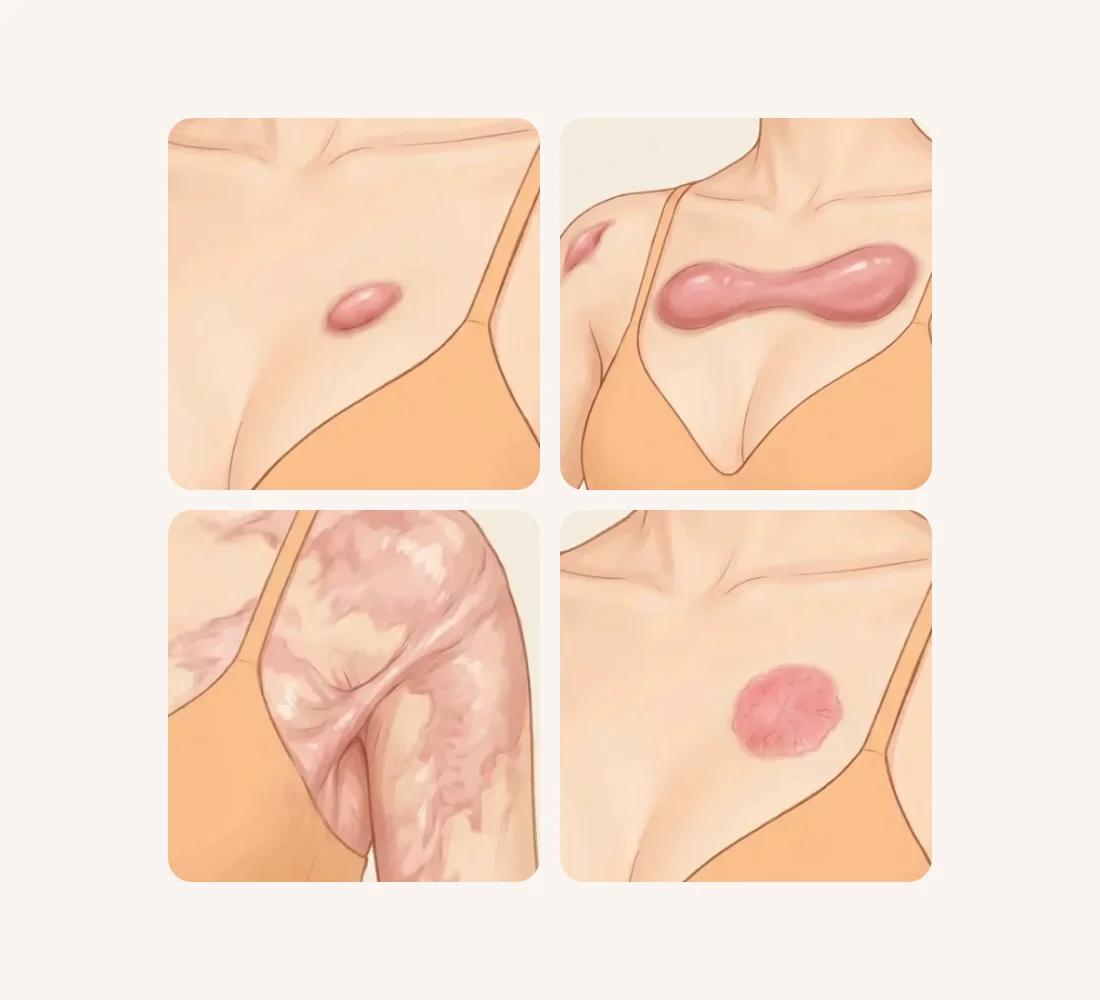
Where do keloids and hypertrophic scars tend to form?
Some scars turn red, firm and raised after a wound heals. If the raised scar stays within the original wound, it is called a hypertrophic scar. If it grows sideways beyond the edges of the wound, it is called a keloid. These scars favor places that are stretched by everyday movement: the large joints, the front of the chest, the shoulder blade area and the lower abdomen. They are rare on the scalp and the front of the lower leg, where tension is low. This is because stretching a wound makes its inflammation last longer and grow stronger.2
Scars tend to grow in the direction of skin tension. People who repeat the same movement at work or in sport often need longer treatment.1
Whole-body factors also matter. Pregnancy and high blood pressure can make these scars worse, and genetic factors, such as a family history of keloids, are known.2 Keloids are common in people of African descent and are reported in about 0.1–1% of Asian people.2
At Bonita Clinic, we treat keloids, hypertrophic scars and burn scars from accidents or procedural complications. We also treat scars after surgery, caesarean section scars, and keloids or hypertrophic scars that formed after implant or filler removal.
What is the difference between a keloid and a hypertrophic scar?
In general, a hypertrophic scar stays within the borders of the original wound, while a keloid grows sideways beyond them.1 Both are described as long-lasting inflammation in the reticular dermis, the deep part of the dermis (the thick layer under the skin's surface). This inflammation brings more blood vessels and collagen (the fibers that make up skin). In practice, many scars show features of both.2
At Bonita Clinic, we describe a keloid as a scar that forms when surgery or injury damages the deep dermis and the fibrous tissue within it grows abnormally. In the cross-section below, the papillary dermis is the shallow part of the dermis and the reticular dermis is the deep part.
| Hypertrophic scar | Keloid | |
|---|---|---|
| Extent | Stays within the original wound | Grows sideways beyond the wound1 |
| Course | Grows for 3–6 months, then plateaus and slowly settles when risk factors are few2 | Rarely settles on its own2 |
| After burns | Common (30–90% of burn patients)3 | Less common; may appear months or years later3 |
| After excision alone | Usually does not recur3 | Recurrence of 45% or more reported2 |
Telling them apart means looking at shape, growth pattern, body site and timing together. The Japan Scar Workshop consensus (recommendations agreed after expert discussion) uses a scoring scale for this. It also recommends a biopsy (taking a small piece of tissue to look at under a microscope) before treatment if a tumor is suspected. An example is a lesion that grows rapidly.1 A few skin tumors can look like keloids.
What comes first, and in what order?
The Japan Scar Workshop consensus advises starting every patient with the least invasive option.1 A small, single keloid can be managed conservatively (without surgery) with injections or tape. Thick, large or multiple keloids respond poorly to creams and similar treatments, so surgery with an added treatment is considered.2 The review also notes that scar massage, lasers that remove the whole skin surface (ablative lasers) and excision on its own should be avoided. They can stir up inflammation and make keloids worse.2
What is considered first, by the state of the scar
1A small, single keloid
Start with less invasive care such as injections or tape
Injections · tape
2Large, thick or several keloids
Excision with low-tension stitching, planned with recurrence control
Excision · recurrence control
3A wide burn scar pulling near a joint
Surgery to release the tightness (contracture), and pressure therapy
Contracture release · pressure (general info)
4Flat, but red and itchy
Vascular laser to ease redness and itch
Vascular laser
What to know about each method
The points below are general medical information about methods used for keloids and hypertrophic scars.
- Steroid injections: used for red, firm, raised lesions. They have been reported to reduce hypertrophic scars and keloids by 50% or more. However, they can cause pain at injection, whole-body effects such as menstrual irregularities, and local effects such as skin thinning, visible small vessels and lightened skin.2
- Injections combined with 5-FU: considered when steroid alone is not enough. 5-FU is a medicine that slows down fast-growing cells. A meta-analysis (a study that pools the results of many studies) looked at adding 5-FU to steroid injections. The combination did better than steroid alone for scar height, redness and satisfaction.4
- Steroid tape and silicone: used for small early lesions and for recurrence control. They cause little pain but must be worn for a long time. Silicone sheets have improved scar thickness and color in studies, but the research quality is low and the evidence is weak.5
- Excision with low-tension stitching: considered for large keloids or those that do not shrink with injections. After excision alone, recurrence of 45% or more has been reported.2
- Vascular laser: used for redness and itch, and suits flat scars.1
- Pressure therapy: used for wide burn scars. There is evidence that it reduces scar thickness, redness and hardness.2
- Radiotherapy after surgery: studied as an added treatment that lowers recurrence at sites with a high risk (general information).2
Why does tension matter when a keloid is cut out?
When a keloid is excised, closing the wound with as little tension on the dermis as possible is central. The dermis regains only about 80% of its strength by the third month after surgery. So stitches and fixation that hold the tension during that time help prevent recurrence.1
For large keloids at high risk of recurrence, radiotherapy after excision has been widely studied. In a meta-analysis of 72 studies, recurrence after surgery plus radiotherapy was 22%.2 Radiotherapy is not among the treatments listed on Bonita Clinic's page, so whether it is needed should be discussed separately at consultation.
Why do wide burn scars start with tightness?
Burn scars often cover a wide area and pull the skin tight enough to limit movement. When a scar shrinks so that a joint can no longer straighten fully, this is called a contracture. Hypertrophic scars rarely need surgery unless they contract near a joint and restrict movement. When they do, the contracture is released with surgery, which also helps the surrounding scar mature (settle) faster. Tension-reducing techniques such as Z-plasty, which changes the direction of the line into a zigzag, are used.2 For wide burn scars, a meta-analysis supports pressure therapy for reducing scar thickness, redness and hardness.2
The restoration of burn scars that have already settled, hardened and thinned is covered in our guide to settled burn scars.
When, and how, do lasers help?
Vascular lasers (pulsed dye laser, Nd:YAG laser) are used for redness and itch. Their main effect is to reduce the extra blood vessels in the scar, which eases redness and itching. They suit flat scars that the light can fully reach.1
Fractional lasers, which create tiny columns of heat injury, have been reported to help scars remodel, but study results are mixed. Fully ablative lasers that remove the whole skin surface are not recommended for keloids and hypertrophic scars because of high recurrence.12
So lasers are less a way to remove the keloid lump itself. They are more a way to refine the redness, pigmentation and texture left after injections or excision have reduced its size.
What happens after treatment, and what are the limits?
Keloid treatment rarely ends after one session. The review (a paper that summarizes many studies) recommends following patients for more than 18–24 months after treatment. The aim is to catch small recurrences early and treat them straight away with tape or injections. Follow-up can stop once the scar is flat and soft.2
The chance of recurrence depends on your constitution and the body site, and people respond differently to the same treatment. Rather than aiming to make the scar disappear, a realistic goal is to reduce its size, its symptoms (itch and pain) and its redness, and to keep recurrence under control.
How we approach it at Bonita Clinic
The order we follow
- 1Identify the scarHypertrophic or keloid; extent and tightness
- 2InjectionsRepeated at intervals for raised keloids
- 3Excision, low tensionEars, chest, shoulders and other tight areas
- 4Release and fat stem cellsTight, hardened burn scars
- 5Combined lasers2–3 types for redness, pigment, texture
- 6Follow-upRestoration usually split into 1–3 sessions
Laser is added only if marks remain after watching your progress
At Bonita Clinic, we provide burn and keloid scar care as a procedure, with excision if needed, under local anesthesia. You go home the same day, and stitches are used only if excision is done. Surgical and procedural restoration is usually split into 1–3 sessions, but recovery time and follow-up visits vary with the extent of treatment and your condition. We also keep in mind that evidence in people for stem-cell-based regeneration of burn scars is still limited.
Treatment options you can discuss in Seoul
Since opening in 1995, Bonita Clinic has stayed at the same location, where Dr. Kwang-Seop Chung, a plastic surgeon board-certified in Brazil, sees patients himself. For keloids and raised burn scars, the options discussed in consultation are the ones on our treatment page:
- Injection treatment for red, firm, raised keloids, repeated at intervals
- Excision with low-tension suturing, followed by recurrence management
- Adhesion release and fat stem cell treatment for tight, hardened burn scars
- Combined lasers for remaining redness, pigmentation and texture
Our treatment page notes that you can consult even before a wound has fully healed. The right combination and order for your scar can only be set after an examination.
Why the plan and cost differ from case to case
A small earlobe keloid and a burn scar across the shoulder are very different projects. The kind of scar and the extent of the work, rather than the diagnosis name, shape the plan and the cost.
- Keloid or hypertrophic scar
- Size, number and body site
- Injections, excision or both
- Laser types and number of sessions
- Tight burn scars that need release
- Previous treatment and recurrences
Final plan and quote after an in-person exam
A final estimate is given only after an in-person examination, once the type of scar, the methods and the likely number of sessions are clear. Photos help narrow down the options, but the scope is set in person.
What photos can show, and what needs an in-person exam
Photos are a useful start, especially older photos that show whether the scar has grown beyond the original wound. They cannot show firmness, tightness or symptoms.
Photos can show
- Location, size and shape
- Redness and color
- Spread beyond the original wound (older photos)
- How many scars, and where
Needs an in-person exam
- Firmness and thickness by touch
- Tightness and joint movement
- Itch, pain and tenderness
- Features that call for a biopsy
- Condition of the surrounding skin
Helpful photos: the whole scar and a close-up in daylight without filters, and any older photos that show how it has changed. If the scar is near a joint, add the scar with the joint bent and straightened. You can send us a message with your photos, the cause and date of the original wound, and the treatments you have had so far.
Planning your visit and recovery
What is confirmed in advance is limited to the treatment information above: a procedure with excision if needed, local anesthesia, same-day discharge, and stitches only if excised. Injections are repeated at intervals and restoration is usually split into 1–3 sessions. So how many times you need to come to Seoul, and how long to stay, are planned with you at consultation according to the type and size of your scar.
Keloids need long follow-up, often well beyond the treatment visits themselves.2 Before you leave, ask which signs of recurrence to watch for, such as new itch, redness or regrowth at the edge. Keep dated photos so that changes can be compared. If a treated area becomes painful, red and hot, or starts to discharge after you return home, see a local doctor promptly.
Real treatment cases
These cases appear on Bonita Clinic's burn and keloid treatment page. Results vary from person to person.
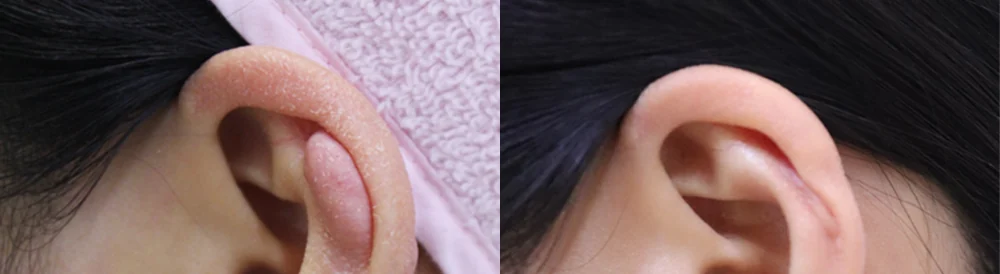
Raised, elongated lump on the inner rim of the ear
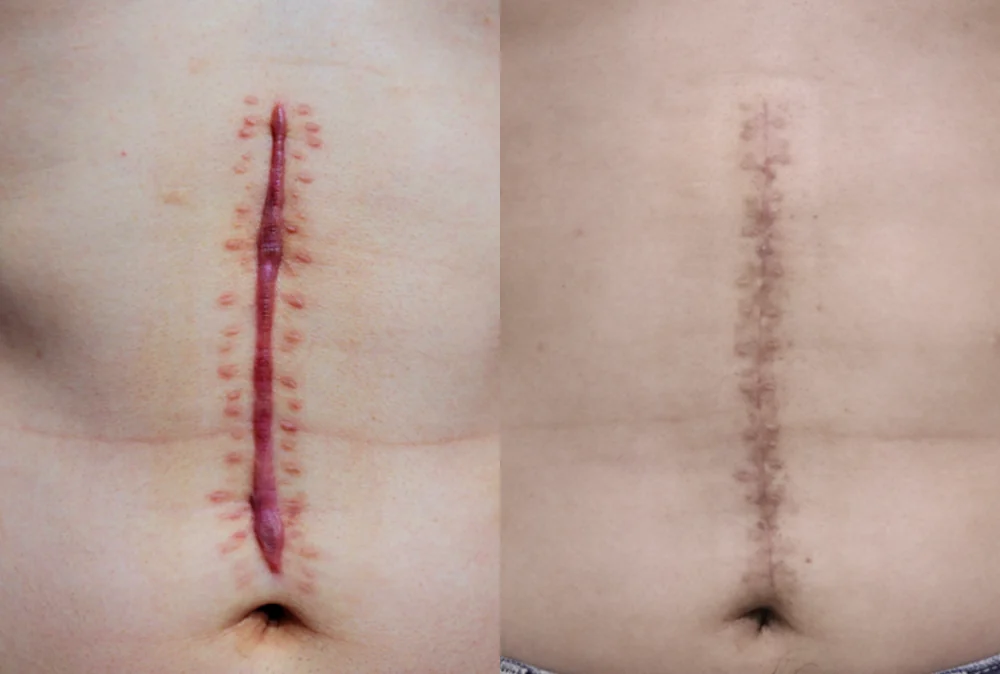
Red, thick, raised vertical surgical scar in the middle of the abdomen (front view)
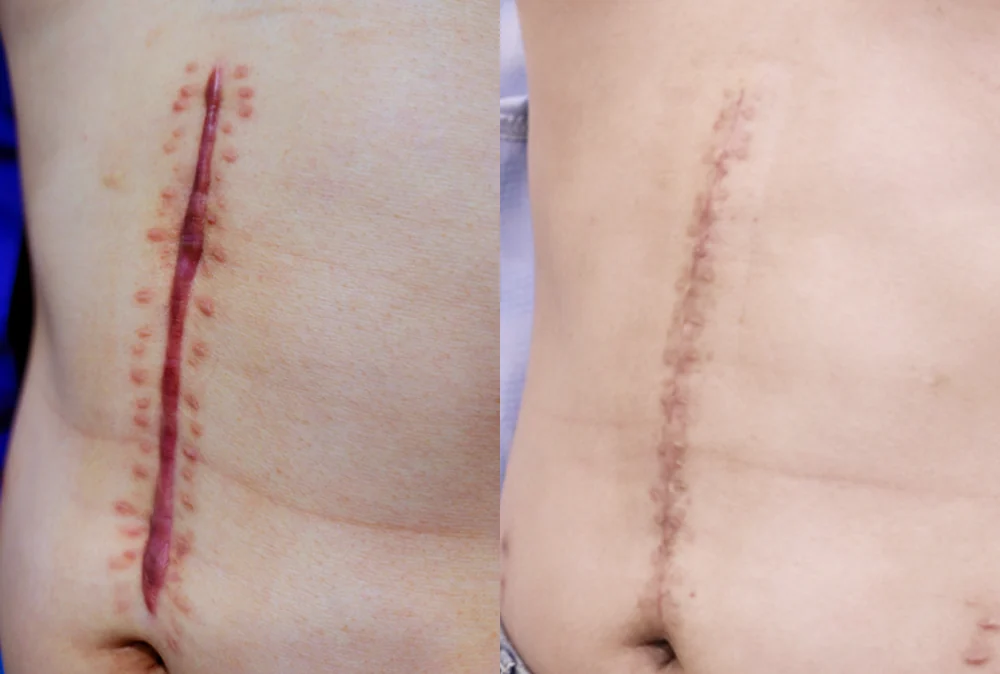
The same case seen from an angle
* Results vary from person to person. Side effects are possible, so please decide after a thorough consultation with a doctor.
Frequently asked questions
I heard keloids get bigger if you operate on them.
A keloid can grow back if it is only cut out. The review summarizes recurrence after excision alone as 45% or more.2 That is why surgery is not done on its own. Stitch tension is reduced, and recurrence management such as injections or laser is planned together. The approach depends on your constitution and the body site.
How many injections will I need?
It depends on the size of the scar and how it responds. Small lesions sometimes shrink a lot after one or two injections, while large keloids usually need several, given at intervals.1 More is not always better. The number and spacing are adjusted while watching for skin thinning or visible small vessels.2
My caesarean section scar keeps getting redder and more raised.
The lower abdomen is stretched with every movement, so hypertrophic scars and keloids form easily there.2 Whether it is spreading beyond the incision, and whether it itches or hurts, help decide whether to start with injections or laser, or whether excision is needed. Because these scars can worsen during pregnancy, it helps to mention any plans for another pregnancy at consultation.2
Will the color of a burn scar come back to normal?
Redness and color differences can be lightened with lasers. Skin borders and texture, however, need separate restoration. We check the extent in consultation.
My keloid has grown quickly over a few months. Should I worry?
A fast-growing lump may be a different skin tumor that looks like a keloid. So a biopsy before treatment is recommended in that situation.1 If the size is changing quickly, do not put off an examination.
What to prepare before your consultation
- The cause of the scar (burn, surgery, caesarean section, piercing, acne) and when it happened
- Whether it has grown beyond the original wound, and since when
- Itch or pain, and when it gets worse
- Treatments so far: number and date of the last injections, tape or silicone, excision, laser, radiotherapy
- Family history of keloids, high blood pressure, pregnancy plans
- Photos of the whole scar and close-ups, plus older photos if you have them
Bonita Clinic is on the 3rd floor of 565 Gangnam-daero, Seocho-gu, Seoul, about 100 m on foot from Exit 8 of Nonhyeon Station (Line 7). You can read more on our Burn & Keloid Treatment page. For care right after an injury and early scar management, see Golden-Time Scar Care and the guide to early scar care after burns and wounds. For settled burn scars, see Burn Scars and the guide to settled burn scars.
References (5)
Sources that support the explanations in this article. Study findings describe general trends and do not guarantee individual results.
- Ogawa R, Akita S, Akaishi S, et al. Diagnosis and Treatment of Keloids and Hypertrophic Scars-Japan Scar Workshop Consensus Document 2018. Burns Trauma. 2019;7:39.doi:10.1186/s41038-019-0175-yJapan Scar Workshop consensus: keloids grow sideways beyond the wound while hypertrophic scars stay within it, intermediate forms, biopsy when a tumor is suspected, least invasive treatment first, injection technique, low-tension closure, and the place of vascular, fractional and fully ablative lasers
- Ogawa R. The Most Current Algorithms for the Treatment and Prevention of Hypertrophic Scars and Keloids: A 2020 Update of the Algorithms Published 10 Years Ago. Plast Reconstr Surg. 2022;149(1):79e-94e.doi:10.1097/PRS.0000000000008667Review of treatment and prevention algorithms: reticular dermis inflammation, typical sites and aggravating factors, effects and side effects of steroid injections, recurrence of 45% or more after excision alone, 22% after surgery plus radiotherapy, pressure therapy, contracture surgery, and 18–24 months of follow-up
- Jeschke MG, van Baar ME, Choudhry MA, et al. Burn injury. Nat Rev Dis Primers. 2020;6(1):11.doi:10.1038/s41572-020-0145-5Review: hypertrophic scars are common after burns (30–90%), stay within the wound and do not recur after excision, whereas keloids appear months to years later and grow beyond the wound
- Ren Y, Zhou X, Wei Z, et al. Efficacy and safety of triamcinolone acetonide alone and in combination with 5-fluorouracil for treating hypertrophic scars and keloids: a systematic review and meta-analysis. Int Wound J. 2017;14(3):480-487.doi:10.1111/iwj.12629Meta-analysis (abstract): steroid (triamcinolone) injection alone versus combined with 5-FU; the combination improved scar height, redness and satisfaction
- O'Brien L, Jones DJ. Silicone gel sheeting for preventing and treating hypertrophic and keloid scars. Cochrane Database Syst Rev. 2013;(9):CD003826.doi:10.1002/14651858.CD003826.pub3Cochrane review of silicone gel sheeting (20 trials, 873 people; abstract): improvements in scar thickness and color and in prevention for high-risk people were reported, but study quality was poor and evidence weak
About this article
This article separates general medical information from Bonita Clinic's own approach. Because the right decision depends on each person's condition, it is not a substitute for a consultation.
