 KOKorean
 ENEnglish
 JP日本語
JP日本語 CN中文(简体)
 TW中文(繁體)

Accident Scar Treatment in Seoul: How Timing Changes the Options for Depressed and Sunken Scars
What can be done for an accident scar depends on when you seek care. While the wound is just starting to heal, the focus is on helping it leave less behind. Once the scar has settled, after several months to more than a year, the sunken shape is restored first and color and texture are refined afterwards. Scars whose floor is stuck down and casts a shadow are released, and broad dents are filled with your own fat. Widened or thickened lines are cut out and closed again more finely. If you have been told elsewhere that your scar is difficult, you can send photos first to see which approach may fit your case before planning a visit to Seoul.
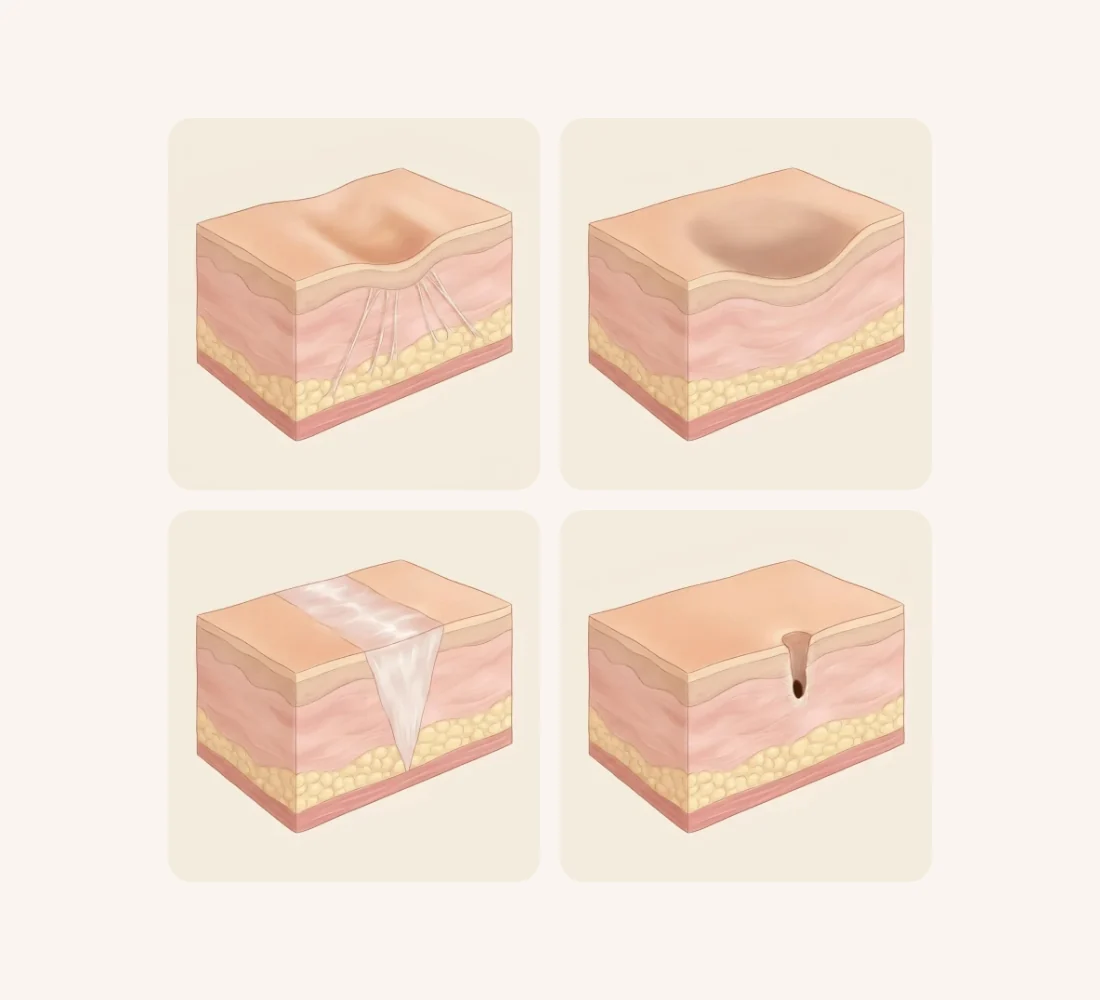
Why do accident scars sink and leave dents?
Car accidents, falls, cuts from sharp objects, and the pin sites left after a broken bone was fixed all leave different kinds of scars. When you look at why they show, though, the reasons usually come down to three:
- Lost volume: tissue under the skin has been lost, so a broad area has sunk.
- A tethered floor: scar tissue formed during healing holds the floor of the scar down and casts a shadow. This sticking-down to the tissue below is called tethering, or an adhesion.
- A widened line: the wound healed apart, leaving a line that has widened or thickened.
A depressed scar shows as a shadow
A scar is the end result of wound healing. Healed skin never fully regains the strength of uninjured skin, even with time.1 So the aim of accident scar treatment is not to return the skin to how it was before the injury. It is to make the hollow, the shadow, the width of the line, and the color and texture less visible, one by one.
At Bonita Clinic, we treat the following accident and procedure-related scars:
- A dent in the buttock after an impact or injury
- Depressed or sunken scars on the calf or thigh after pin fixation of a fracture
- Depressed scars on the face after trauma
- Hollows left after removal of an implant or filler
Which method suits which kind of scar?
Two accident scars can need different approaches depending on why each one shows. At Bonita Clinic, we pair scar types and methods as follows.
This kind of scar, this kind of method
1A tethered floor casts a shadow
The fibrous strands holding the floor down are cut to free it
Subcision (release)
2Broad volume has been lost
Your own fat is moved to fill the dent
Fat grafting
3The line has widened or thickened
The scar is cut out and closed again as a finer line
Excision and re-suturing
4Narrow, deep pits
A punch technique without stitches raises the floor
Punch technique
Here is a little more about each method.
- Subcision (releasing the tethering): a needle is passed under the scar to cut the fibrous strands holding the floor down. The release lifts the dip, and connective tissue (the tissue that fills and supports the spaces between other tissues) that forms during normal healing then supports the floor.4
- Fat grafting: your own fat is moved to fill a broad dent. A systematic review (a study that gathers all the research on one question) covered 26 studies and 905 patients. Every study reported improvement in scar appearance, skin quality, and volume and contour. However, it rated the level of evidence and methodological quality as low.5 A meta-analysis (a study that pools the results of many studies and recalculates them) covered 45 studies and 3,033 patients. It found significant improvement in scar assessment scores, most notably in stiffness and pliability. An average of 1.4 procedures was needed, and minor complications occurred in 4.8% of procedures.6 Many reports are positive, but it may take more than one session, and the quality of the research still needs to improve.
- Excision and re-suturing: a widened or thickened scar is cut out and closed again as a finer line. Surgeons often wait several months to more than a year for a scar to mature (finish settling) before considering surgical revision.1
- Laser: an international consensus of 26 experts from 13 countries regards lasers as a first-line treatment for traumatic scars and contractures (scars that shrink and pull). It focuses on vascular lasers and ablative and non-ablative fractional lasers.2 Lasers, however, work mainly on surface texture and color and cannot lift a deeply sunken floor on their own.
What each method does beneath the scar
Why does the time since the injury matter?
A wound keeps changing for a long time after it closes. Healing can be divided into three stages:1
- Inflammation: inflammatory cells peak 24–48 hours after injury and settle at around three days.
- Proliferation: new tissue fills the wound at around days 2–10.
- Remodeling: for months to more than a year after that, the scar is reorganized and its shape and color keep changing.
The wound's strength rises from about 20% of uninjured skin at three weeks to 70–80% at six weeks, but never reaches its original strength.1 Even when a wound looks closed on the outside, the scar underneath keeps rearranging itself for a long time.
How a wound becomes a scar
Because of this, what can be done depends on when you come in.
- When the wound has just started to heal: the scar has not settled yet, so the goal is to help it leave less depth, pigmentation (darkening) and thickening behind. A 2014 expert consensus suggested that laser, especially ablative fractional resurfacing, could possibly be included as early treatment to help prevent tightening and support healing. This conclusion was based mainly on expert opinion.3 Care in the first weeks after an injury is covered separately in our guide to the golden time for fresh wounds.
- A few months on, while the scar is still changing: if redness and thickening remain, surface treatment is used. Meanwhile we watch how the scar develops and judge whether its shape needs correcting.
- A scar that has settled, after about a year or longer: there is no need to wait for further change. Methods that restore the shape itself (subcision, fat grafting, excision and re-suturing) are considered first. Any remaining color and texture are refined with laser afterwards.
What do treatment and recovery involve?
At Bonita Clinic, we perform accident scar restoration as surgery under local anesthesia (numbing only the treated area) or sedation. You go home the same day, and stitches are used. Restoring the shape is usually spread over one to three rounds, and laser is added afterwards only where marks are still visible. Recovery time and follow-up visits depend on the extent of the scar and your condition.
| Period | Common changes | What the clinic does |
|---|---|---|
| Right after treatment | Swelling or bruising; swelling where fat was taken | Protecting the site; advice on when to resume washing, makeup and showering |
| During recovery | Redness and swelling settle gradually | Stitch removal; sun protection advice |
| Settling period | Filled volume and scar lines stabilize | Progress check and decision on further treatment |
What limits should you know about?
- Healed skin does not become the same as uninjured skin.1 The goal is to make the dent, the shadow and the width of the line less visible.
- Fat grafting may not be finished in one session. In scar treatment, an average of 1.4 procedures was needed to reach the desired result.6 Results have generally been reported as favorable, but the quality of the evidence is still low.5
- Cell-based scar treatments such as stem cells are still being researched. A truly effective cell-based treatment for scarring in people has not yet been established.1 The effect of adding stem cells to grafted fat also remains to be measured.6
- An excised and re-sutured scar leaves a new line that takes time to settle. Bleeding, infection and inflammation are possible after any surgery.
How we approach it at Bonita Clinic
The order we follow
- 1Timing and conditionEarly healing, or already settled?
- 2Restore the shapeRelease, fill, excise or punch, only as needed
- 3Refine the surfaceTwo or three lasers for redness, pigment, texture
- 4Progress checkUsually one to three rounds
Laser is used only if marks remain after the progress check
Treatment options you can discuss in Seoul
Since opening in 1995, Bonita Clinic has stayed at the same address, and patients are seen by Dr. Kwang-Seop Chung himself, a plastic surgeon board-certified in Brazil. For accident scars, the options we offer are:
- Assessment of timing and condition: early healing wound or settled scar
- Release of tethered scar tissue (subcision) for shadowed depressions
- Fat grafting with adipose-derived stem cells for broad dents
- Excision and fine re-suturing of widened or thickened scars
- A punch technique without stitches for narrow, deep pits
- Combined laser (two or three types) for remaining redness, pigment and texture, chosen from our fractional, CO2, pico and vascular lasers and RF microneedling
Which of these you need, and in what order, is decided only after an examination.
Why the method and cost differ from case to case
Two "accident scars" can need completely different plans. The size and type of the scar, more than the cause of the injury, shape the plan and the cost.
- How long since the injury
- Area and size: face, buttock, thigh, calf
- Tethering, lost volume or a widened line
- Whether fat grafting is needed
- Anesthesia: local or sedation
- Number of rounds and earlier surgery
Final plan and quote after seeing you in person
A final estimate is given only after an in-person examination, once the methods, the number of rounds and whether fat grafting is included are clear. A photo review can point to likely options; the actual scope is set only at the examination.
What photos can show, and what needs an in-person exam
Photos are a good first step, especially if you were told elsewhere that your scar is hard to treat. But they are not enough to judge what lies under the scar.
Photos can show
- Location, length and width of the scar
- Visible dents and shadows
- Redness or brown marks
- Change since the injury (older photos)
Needs an in-person exam
- Whether the floor is tethered
- How much volume has been lost
- Scar firmness and skin thickness
- Pins or plates still in place
- Where fat could be taken from
Helpful photos: the scar front-on and from the side, plus one with light coming from the side, which shows the shadow of a dent. Photos from right after the injury also help. You can send us a message with your photos, the date of the injury and the treatments you have had.
Planning your visit and recovery
What is confirmed in advance is limited to the treatment information above: surgery under local anesthesia or sedation, same-day discharge and stitches. Shape restoration may take one to three rounds, with laser only if marks remain. So the length of your stay in Seoul and any return visit are worked out with you at consultation, once the scope is clear.
The treated area is protected first. Redness and swelling then fade gradually, and from that stage onward sun protection becomes important. If fat grafting is done, the area where fat was taken may also bruise and swell. Because scars keep remodeling for months,1 the final appearance is judged over time rather than in the first weeks.
Once you are home, see a doctor without delay if the treated area becomes redder, warmer or more painful, or starts to discharge, rather than calming down. Photos with dates, taken as the scar settles, are useful to any doctor who checks it later and for follow-up with us.
Real treatment cases
These cases are from our accident scar page. Results vary from person to person.
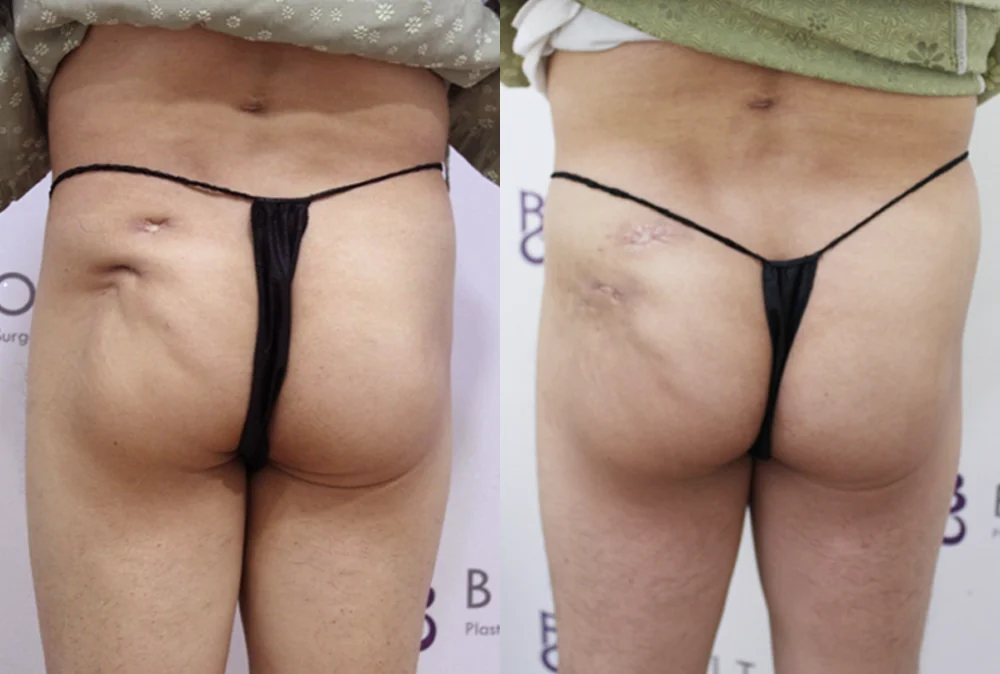
One side of the buttock deeply dented
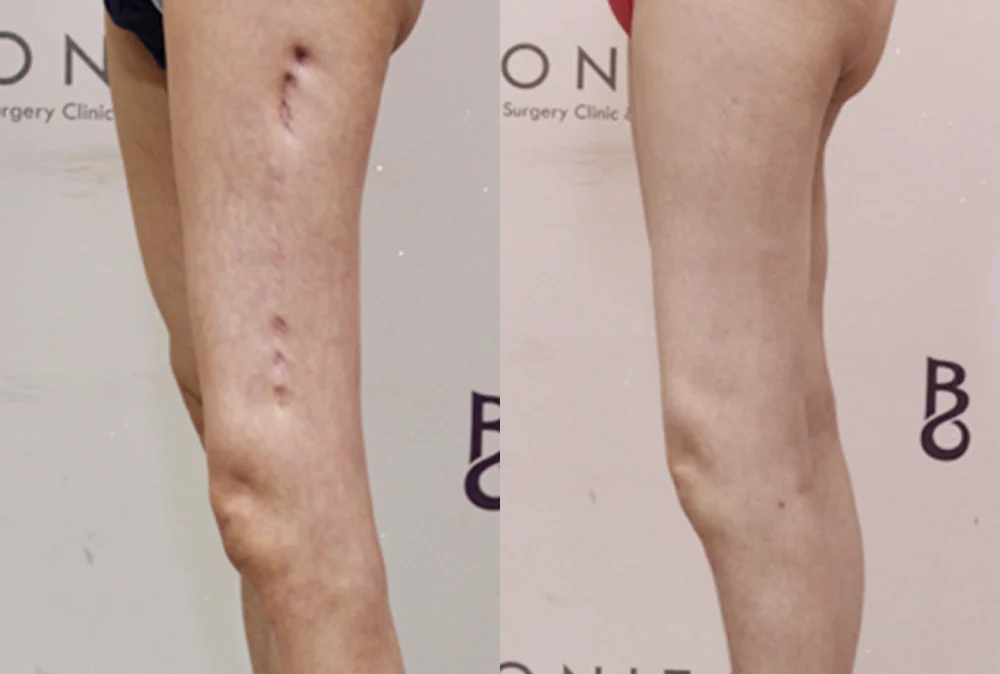
A row of depressed scars along the outer thigh
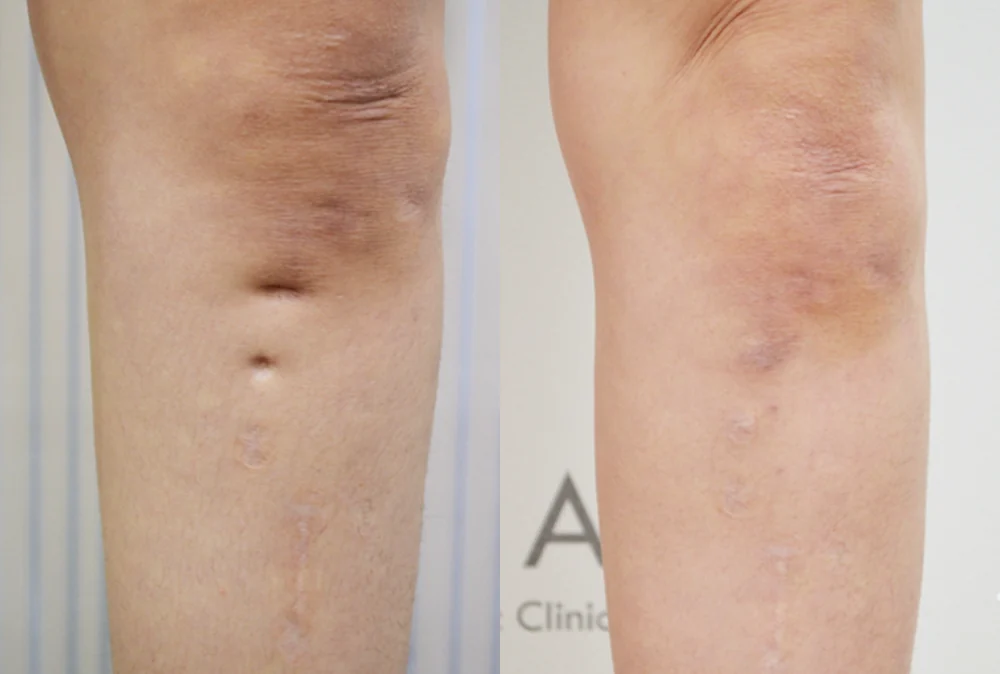
Round, deep dents below the knee
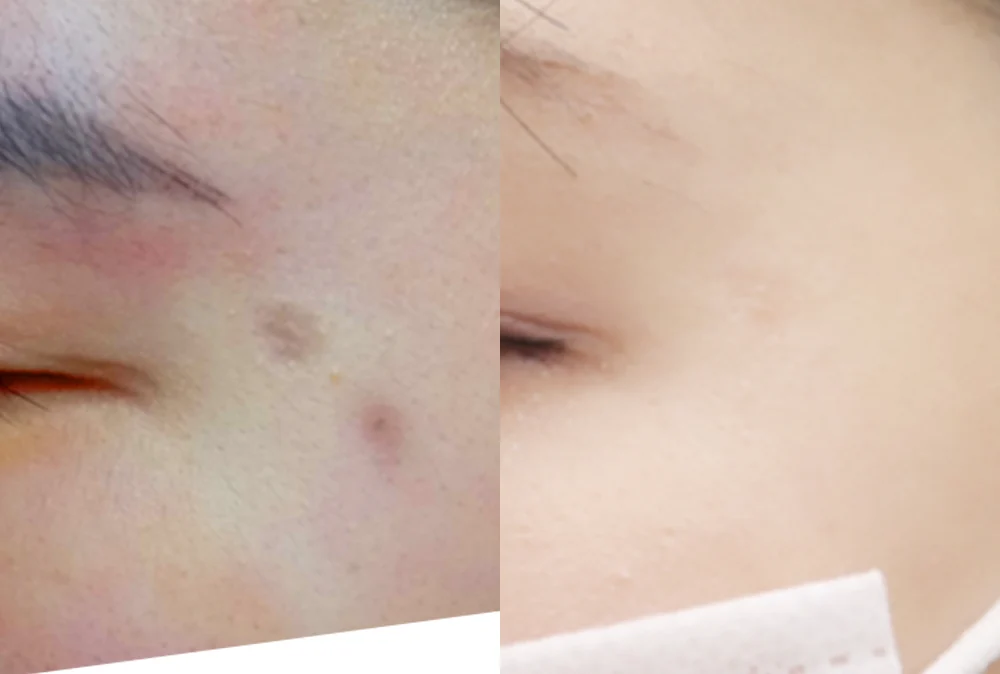
Small red and brown scars on the cheek beside the eye
* Results vary from person to person. Side effects are possible, so please decide after a thorough consultation with a doctor.
Frequently asked questions
When should I ask about scar treatment?
We recommend consulting early, when the wound has just started to heal, so that care can begin before the scar settles. Surgical correction by excision and re-suturing, however, is usually considered only after the scar has matured, which can take several months to more than a year.1 So an early consultation is a chance to separate what to do now from what to do later.
My scar is many years old. Can it still be treated?
Yes, older scars can be assessed too. What is possible depends on the size and depth of the scar, tethering of the floor and the condition of the surrounding tissue. With older scars, correcting the shape is usually considered first rather than waiting for further change.
I have several pin-site scars in a row. Are they treated at once?
It depends on the number, location and type of the scars. Similar scars in the same area may be treated together, while a mix of broad dents and line scars is usually divided into stages. At Bonita Clinic, we usually divide surgical and procedural restoration into one to three rounds.
Is one session of fat grafting enough?
Not always. In studies of fat grafting for scars, an average of 1.4 procedures was needed to reach the desired result.6 That is why fat is sometimes added in stages while watching how it settles.
Is stem cell treatment proven to work?
Cell-based scar treatments are still at the research stage, and a truly effective one has not yet been established in people.1 Bonita Clinic uses stem cells isolated from fat together with fat grafting, but results depend on the condition of the scar and the individual.
What to prepare before your consultation
- The date and cause of the injury (car accident, fall, cut, fracture surgery) and the treatment you received in the emergency room or operating room
- Treatments since then: laser, ointments or silicone sheets, scar injections, earlier revision surgery
- Whether pins or plates are still in place, and whether removal surgery is planned
- Whether any scar has become raised, thick or keloid (a scar that grows thick beyond the edges of the original wound)
- Medicines you take regularly
Bonita Clinic is on the 3rd floor of 565 Gangnam-daero, Seocho-gu, Seoul, about 100 m on foot from Exit 8 of Nonhyeon Station (Line 7). You can read more on our accident scar page. For recent wounds, see our emergency wound care page and the guide to the golden time for fresh wounds. For depressed incision scars, see the face depressed and incision scar page, the guide to depressed facial incision scars and the guide to depressed body incision scars.
References (6)
Sources that support the explanations in this article. Study findings describe general trends and do not guarantee individual results.
- Marshall CD, Hu MS, Leavitt T, et al. Cutaneous Scarring: Basic Science, Current Treatments, and Future Directions. Adv Wound Care (New Rochelle). 2018;7(2):29-45.doi:10.1089/wound.2016.0696Review of cutaneous scarring: phases and timing of wound healing (inflammation peaks at 24–48 h and settles by about day 3, proliferation days 2–10, remodeling for months to over a year), wound strength 20% at 3 weeks and 70–80% at 6 weeks but never full, surgeons often wait months to over a year before revision, no truly effective cell-based antiscarring treatment yet
- Seago M, Shumaker PR, Spring LK, et al. Laser Treatment of Traumatic Scars and Contractures: 2020 International Consensus Recommendations. Lasers Surg Med. 2020;52(2):96-116.doi:10.1002/lsm.23201International Delphi consensus of 26 experts from 13 countries (abstract): lasers are a first-line therapy for traumatic scars and contractures; vascular and ablative/non-ablative fractional lasers
- Anderson RR, Donelan MB, Hivnor C, et al. Laser treatment of traumatic scars with an emphasis on ablative fractional laser resurfacing: consensus report. JAMA Dermatol. 2014;150(2):187-193.doi:10.1001/jamadermatol.2013.7761Consensus of 8 experts, based mainly on expert opinion (abstract): possible inclusion of ablative fractional laser as early intervention to prevent contracture and assist wound healing
- Orentreich DS, Orentreich N. Subcutaneous incisionless (subcision) surgery for the correction of depressed scars and wrinkles. Dermatol Surg. 1995;21(6):543-549.doi:10.1111/j.1524-4725.1995.tb00259.xTechnique paper (abstract): subcision cuts the fibrous strands under a depressed scar; the depression is lifted by the release and by connective tissue formed during healing
- Negenborn VL, Groen JW, Smit JM, et al. The Use of Autologous Fat Grafting for Treatment of Scar Tissue and Scar-Related Conditions: A Systematic Review. Plast Reconstr Surg. 2016;137(1):31e-43e.doi:10.1097/PRS.0000000000001850Systematic review of 26 studies and 905 patients (abstract): fat grafting improved scar appearance, skin characteristics, volume and contour, but evidence level and methodological quality were low
- Krastev TK, Schop SJ, Hommes J, et al. Autologous fat transfer to treat fibrosis and scar-related conditions: A systematic review and meta-analysis. J Plast Reconstr Aesthet Surg. 2020;73(11):2033-2048.doi:10.1016/j.bjps.2020.08.023Meta-analysis of 45 studies and 3,033 patients (abstract): improved scar scores, especially stiffness and pliability; 1.4 procedures on average; minor complications in 4.8%; the effect of added stem cells still needs to be quantified
About this article
This article separates general medical information from Bonita Clinic's own approach. Because the right decision depends on each person's condition, it is not a substitute for a consultation.
