 KOKorean
 ENEnglish
 JP日本語
JP日本語 CN中文(简体)
 TW中文(繁體)

Sunken Scars on the Buttocks, Thighs or Calves in Seoul: Can They Be Filled Again?
In many cases refilling can be considered. But on the body, the fat layer under a sunken scar has often been damaged. This leaves the base stuck to the fascia or even toward the bone, so filling alone does not lift it. The stuck base is usually released first, and your own fat is used to restore both the gliding layer and the volume. Larger areas may be treated in stages rather than all at once. Studies often report that scars become softer after fat grafting, but color differences can remain, so remaining color and texture are refined separately with laser. If you are considering treatment in Seoul, you can send photos and your history first to see which approach may fit.
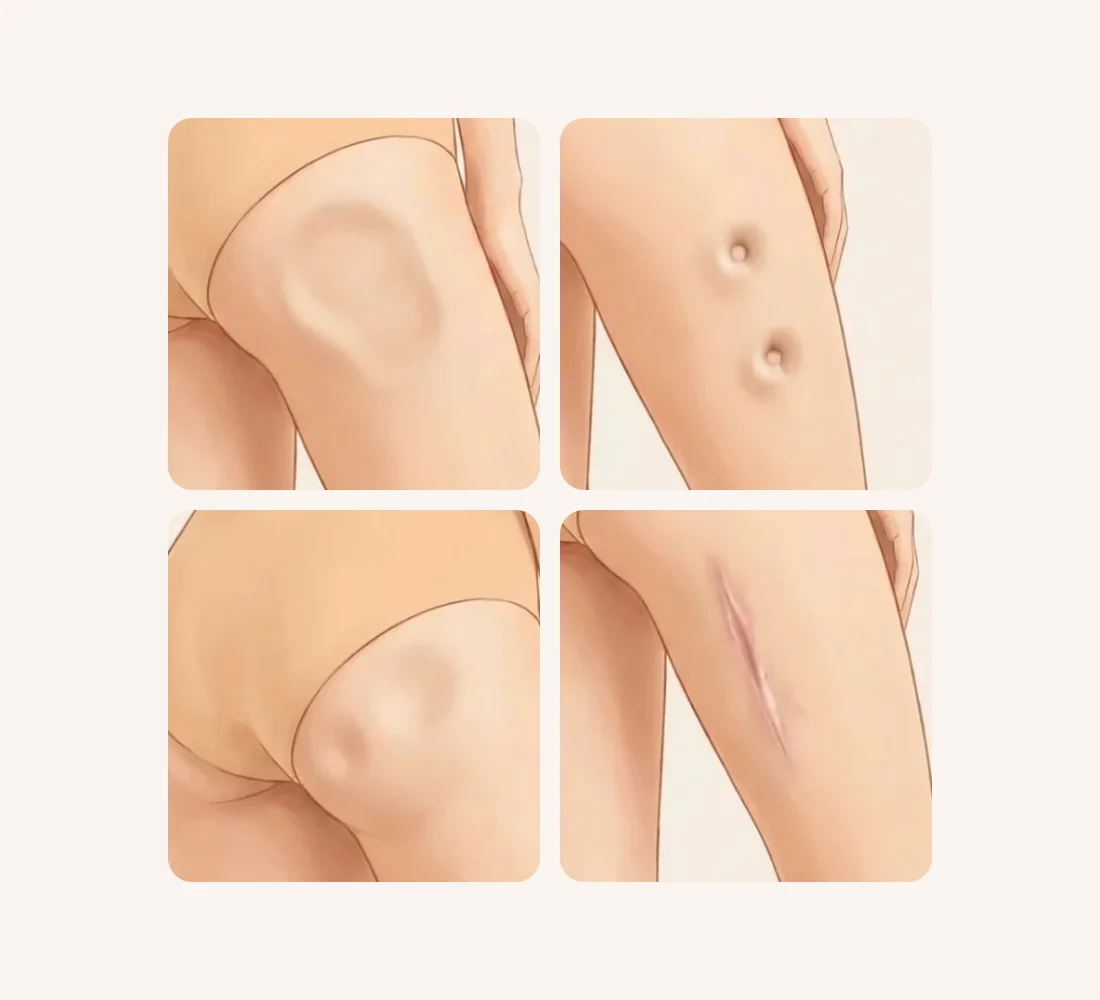
How is a sunken scar on the body different from one on the face?
Scars on the body tend to cover a larger area. The distance from the skin down to the fascia (the thin, tough sheet that wraps the muscle), muscle and bone also varies a great deal from one site to another.
Normally, the fat layer under the skin lets the skin glide over the muscle. When an accident or operation damages that fat layer, the scar can become stuck to the structures beneath it. Once the gliding layer is gone, the scar is tied down, pulls with every movement and casts a sunken shadow. Grafting your own fat (moving fat from another part of your body) is used to rebuild this lost gliding layer beneath the scar.1
The 'gliding layer' under the skin
On top of that, the skin of the body stretches every time you walk, sit or lift your arms, and it carries your weight. So scars on the body are under more force than those on the face, and they are more likely to leave a widened line or a base pulled deep down. This is why a sunken body scar is assessed not only for missing volume but also for how deeply it is stuck and how much tension acts on it.
How do different causes change the shape of the hollow?
Two scars that are both "sunken" can have very different structures underneath, depending on how they formed.
| Cause | Typical look | What is happening underneath | Checked first |
|---|---|---|---|
| Injury such as a traffic accident or fall | Broad dent with irregular edges | Fat layer damaged, scar stuck toward the fascia | Extent of tethering, lost volume |
| Former pin or external fixator site | Broad, round dent pulled inward | The base may be stuck deep along the track that reached the bone | Tethering toward bone, number of dents |
| Buttock dent after an injection or other procedure | One or two hollows | Fat may have been lost, or tissue hardened after inflammation may pull | Firmness, any remaining material |
| Site of implant or filler removal | Hollow in the shape of the empty space | Volume lost, with capsule or tethering left behind | Size of the space, skin thickness |
| Surgical incision | Widened line, sunken in the middle | The wound spread as it healed under movement and weight | Line width, direction of tension |
An external fixator is a frame outside the skin that holds a broken bone in place with pins. After external fixators are used, for example in fracture treatment or limb-lengthening surgery, broad, depressed pin-site scars are reported to remain often. One report described a revision technique used in 5 patients with 19 scars. It broke up the outline of such scars with a zigzag line (W-plasty) and buried a small island of dermis beneath them to improve the surface contour.3 A pin passes from the skin all the way to the bone. A scar that heals along that track can therefore end up with its base stuck deep down and drawn inward.
Because of these differences, the approach considered first also changes.
In cases like these, this is what we look at
1A broad dent after an injury
The stuck base is freed first, then the space is filled with your own fat
Release + fat grafting
2Pin sites drawn in toward the bone
The base is freed and supported with fat; several sites may be staged
Release + fat grafting
3A buttock dent after an injection
First we examine whether fat was lost, hardened tissue pulls, or material remains
Find the cause first
4A widened incision line
It is cut out and closed finely, with tension taken off so it does not spread again
Excision and re-suturing
Where is the "gliding layer" in a cross-section?
Free the stuck base first, then support it with fat
In the picture, the periosteum is the thin sheet that covers the bone. While the base is still tied down, added fat may not stop the center from being pulled in, and a shadow can remain. For sunken body scars, the usual order is therefore to free the stuck base first. Fat is then placed in the space to support it so that it does not re-attach. A study of adherent scars likewise describes fat grafting combined with release of adhesions as the main way to rebuild the layer under the skin.2
How much can fat grafting change?
Research on fat grafting for body scars has mostly involved adherent scars after burns or major injuries. The findings can be summarized as follows:
- In a study of 40 patients with adherent scars who had one fat grafting session, measured elasticity improved by 22.5% and maximal extension by 15.6% at 3 months. Both patient and observer scar scores improved too. The color difference between scar and normal skin, however, did not change.1
- In 46 patients whose adherent scars were on average 20 years old, followed for 12 months, patient-rated pliability (from 7.4 to 5.8 points), pain, itch and color improved. But objective measurements of pliability, redness and pigment showed no significant difference.2
- A meta-analysis (a study that pools the results of many studies) looked at 23 studies with 1,326 patients treated with fat grafting for post-burn and post-traumatic body scars. It found significant improvement in scar scores from both patients and observers. However, most studies were observational, and only 2 were randomized trials (studies that assign treatments at random, which are more reliable).4
Taken together, many reports suggest fat grafting can help soften adherent scars and fill sunken contours. But the degree of change varies between people, and it is not a treatment for color. Part of the grafted fat is absorbed, so a broad hollow is sometimes filled in stages, with the progress reviewed in between, rather than all at once.
Which method fits, and what is different on the body?
| Method | Typically suited to | What differs on the body |
|---|---|---|
| Releasing the tethering | Base stuck toward fascia or bone and drawn in | Depth and extent can be large, so checked first |
| Fat grafting | Broad hollows, lost gliding layer | More volume is needed, sometimes in stages |
| Excision and re-suturing | Widened lines, round pin-site dents | Movement and weight pull hard, so tension control matters |
| Combined laser | Color and texture left once the level is even | Large areas are treated in sections |
Laser does not change the cause of a height difference. Instead, once the level is even, it is used to refine remaining redness, color and rough texture. An expert consensus on laser treatment of traumatic scars regarded ablative fractional laser as one part of combined treatment for these scars. This consensus, however, was based largely on expert opinion.6
What extra care do body scars need?
Some sites are stretched often by daily movement: around the major joints, the front of the chest, the shoulder-blade area and the lower abdomen. These are where hypertrophic scars (thick, raised scars) and keloids (scars that grow beyond the original wound) tend to form. They are rare on the front of the lower leg and the scalp, where stretching is low.5
When a scar in such an area is excised and re-sutured, care is taken so that it does not widen or thicken again. Sutures take the tension (pulling force) off the skin from the deeper fascial layer, and techniques that spread tension out are used. After surgery, tape, gel sheets or compression are recommended to limit stretching of the wound. Scars at prone sites are monitored for 3 to 12 months, and people prone to such scars are advised to avoid massage that stretches the scar.5
Why scar lines widen on the body
The site from which fat will be taken also needs to be checked in advance. If a lot of volume is needed and there is little spare fat on the body, less can be grafted in one session and more stages may be needed. Recovery differs from the face as well. The buttocks and thighs take pressure and pull when you sit and walk, so surgical restoration may need a longer recovery depending on the area and extent.
What is recovery like, and what are the limits?
At Bonita Clinic, we perform restoration of depressed and incision scars on the body as surgery under local anesthesia (numbing only the treated area) or sedation. You can go home on the day of treatment, and stitches are used. How long recovery takes, and how often you need to come back, depends on how much is treated and on your own condition.
- Right after treatment: the treated area is protected. The site where fat was taken can also bruise and swell
- While healing: redness and swelling gradually settle, and sun protection matters from this point
- Settling period: progress is reviewed as the tissue settles, and the need for further treatment is decided
Bleeding, infection and inflammation are possible after surgery. A released base can be pulled down again during healing, and part of the grafted fat is absorbed. The aim of scar treatment is not to remove the scar. It is to reduce the hollow, the pull and the color difference so that the scar is less noticeable and less bothersome.
How we approach it at Bonita Clinic
Treatment options you can discuss in Seoul
Since Bonita Clinic opened in 1995, Dr. Kwang-Seop Chung, who is board-certified in plastic surgery in Brazil, has examined patients himself at the same location. We treat buttock dents after accidents or procedures and depressed scars on the calves and thighs after pin surgery. We also treat depressed scars on the arms, legs and trunk after injury, and hollows after implant or filler removal. The options discussed in consultation are:
- Assessment of depth, width, tethering and lost volume
- Adhesion release for scars with a stuck, sunken base
- Fat grafting, combined with stem cells separated from the fat, for broad hollows
- Excision and fine re-suturing for widened or thickened lines
- Combined laser treatment for remaining redness, pigment and texture
Which of these you need, and in what order, is decided only after an examination.
Why the plan and cost differ from case to case
Two people with "a dent on the buttock" can need very different procedures. The plan and the cost are not set by the name of the problem. They depend on how much needs releasing and filling, where the fat will come from, and how many stages are needed.
- Size of the area and number of dents
- How deep the base is stuck
- Volume of fat needed and the donor site
- Whether excision and re-suturing are added
- Anesthesia: local or sedation
- Number of staged sessions
Final plan and quote after an in-person exam
A final estimate is given only after an in-person examination. By then it is clear how far the tethering extends, how much volume is needed and whether the treatment will be staged.
What photos can show, and what needs an in-person exam
Photos are a good place to start. But on the body, the key questions (how deep the scar is stuck and how much spare fat there is) need an examination.
Photos can show
- Location, size and number of dents
- Shape of the hollow in side light
- Width and color of a scar line
- How the area looks standing and sitting
Needs an in-person exam
- How deeply the base is stuck (fascia or bone)
- Firmness, and any remaining material
- How much volume is missing
- Spare fat and where it could be taken
- Skin thickness and tension at the site
Helpful photos: the whole area and a close-up, taken in good light from the front and at an angle, plus one with light from the side so the hollow shows. For scars on the legs or buttocks, a photo standing and one with the muscles tensed can show how the dent changes. Send us a message with these photos and a few lines about the cause of the scar and any treatment so far.
Planning your visit and recovery
What is confirmed in advance is limited to the treatment information above: surgery under local anesthesia or sedation, same-day discharge and stitches. How long you should stay in Seoul, when you need to come back and when the stitches come out all vary. They depend on how much is released and grafted and whether the treatment is staged. So these are planned together with you at consultation. Because restoration of larger areas is often split into more than one session, it helps to discuss in advance how the stages could fit your travel plans.
Treated areas on the buttocks and thighs take pressure when you sit and pull when you walk. So it is worth asking at consultation how daily activities and long periods of sitting should be handled during early recovery. Back home, if redness, warmth, pain or discharge at the treated area or the fat donor site gets worse rather than better, seek medical advice promptly. A simple photo record with dates helps whoever examines you next, including us at a follow-up.
Real treatment cases
These cases are from our body depressed and incision scar page. Results vary from person to person.
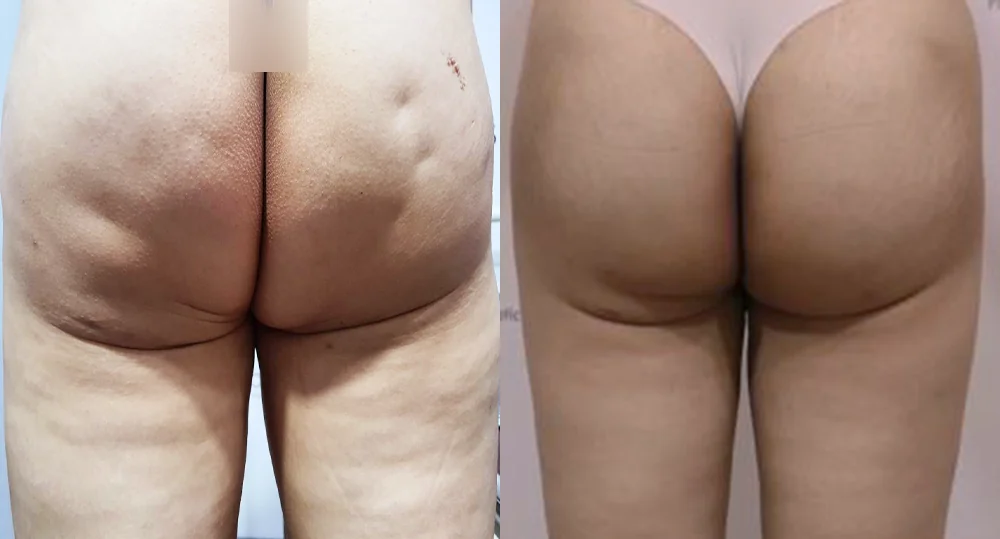
Several dents in the upper part of one buttock
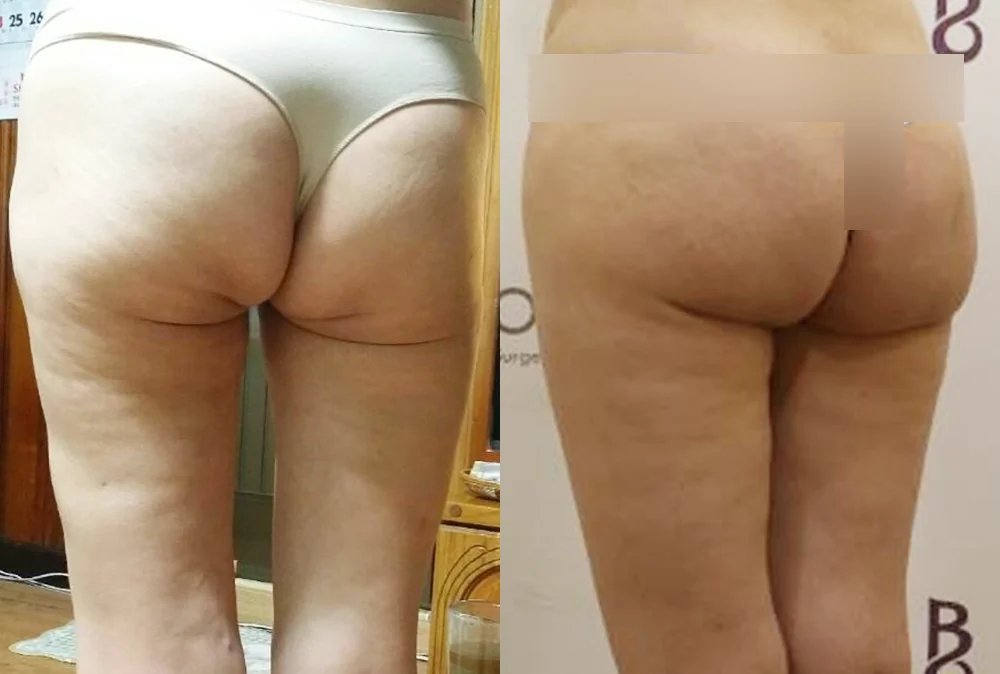
An uneven contour below the buttocks and on the back of the thighs
* Results vary from person to person. Side effects are possible, so please decide after a thorough consultation with a doctor.
Frequently asked questions
The site where a pin was removed looks stuck to the bone. Will filling alone fix it?
If the base is tied down toward the bone, filling alone tends to leave the center pulled in again. Releasing the stuck base first and then placing fat there to support it is usually considered together. With several pin sites, the number and position of the dents may mean the work is split into stages.
A spot on my buttock sank after an injection. Can that be treated?
Yes, buttock dents after accidents or procedures are among the scars we treat. The approach depends on whether the dent comes from lost fat, from tissue that hardened after inflammation and pulls the skin, or from material still left there. So firmness and extent are checked first.
I am slim. Can I still have fat grafting?
Fat can usually be taken from areas such as the abdomen or thighs. But if there is little spare fat compared with what is needed, less can be grafted at a time and the treatment may be split into stages. Where and how much fat can be taken is judged in person at consultation.
Does recovery take longer on the body than on the face?
It depends on the method and extent. Laser care has a relatively short recovery, while surgical restoration needs more recovery time depending on the area and extent. For areas used when sitting and walking, such as the buttocks and legs, the pressure of daily activity is also taken into account. If you have important dates, tell us at consultation.
What to prepare before your consultation
- How the scar happened (traffic accident, fall, pin or external fixator surgery, an injection or other procedure, implant or filler removal) and when
- For pin surgery, when the pins were removed and how many sites there were
- Treatments so far: re-suturing, laser, filler or fat grafting, scar injections
- Whether the scar feels tight or painful, or bothers you when sitting or walking
- Medicines you take regularly
Bonita Clinic is on the 3rd floor of 565 Gangnam-daero, Seocho-gu, Seoul, about 100 m on foot from Exit 8 of Nonhyeon Station (Line 7). You can read more on our Body Depressed & Incision Scars page. For scars and irregularities left after cosmetic surgery on the body, see Body Surgical Scars and the guide to body surgical scar revision. For depressed scars on the face, see the guide to depressed facial scars, and for accident scars, see Accident Scars.
References (6)
Sources that support the explanations in this article. Study findings describe general trends and do not guarantee individual results.
- Jaspers MEH, Brouwer KM, van Trier AJM, et al. Effectiveness of Autologous Fat Grafting in Adherent Scars: Results Obtained by a Comprehensive Scar Evaluation Protocol. Plast Reconstr Surg. 2017;139(1):212-219.doi:10.1097/PRS.0000000000002891Prospective study (abstract): scars become adherent when the subcutaneous fat layer is damaged, and fat grafting is used to rebuild a gliding layer; in 40 patients, one session improved elasticity by 22.5% and maximal extension by 15.6% at 3 months, with better scar scores but unchanged color difference
- Rijpma DD, Jaspers ME, Pijpe A, et al. A one year follow-up on quality of adherent scars after autologous fat grafting processed by a filtration technique. Burns. 2024;50(9):107252.doi:10.1016/j.burns.2024.08.018Cohort (abstract): fat grafting combined with adhesiolysis as the main way to rebuild the subcutaneous layer; in 46 patients with scars about 20 years old, patient-rated pliability, pain, itch and color improved at 12 months, but objective measurements showed no significant difference
- Saleh M, Howard AC. Improving the appearance of pin-site scars. J Bone Joint Surg Br. 1994;76(6):906-908.doi:10.1302/0301-620X.76B6.7983116Case series (abstract): broad, depressed pin-site scars often remain after external fixators; revision combining W-plasty with a buried dermal island reported in 5 patients (19 scars)
- Abu Alqam R, Alshammari AJ, Alkhwildi LA, et al. Effectiveness of Autologous Fat Grafting in the Treatment of Scars: A Systematic Review and Meta-Analysis. Aesthetic Plast Surg. 2024;48(19):3945-3961.doi:10.1007/s00266-024-04131-wSystematic review and meta-analysis (abstract) of fat grafting for post-burn and post-traumatic body scars, 23 studies and 1,326 patients: patient and observer scar scores improved; mostly observational studies, 2 randomized trials
- Ogawa R. The Most Current Algorithms for the Treatment and Prevention of Hypertrophic Scars and Keloids: A 2020 Update of the Algorithms Published 10 Years Ago. Plast Reconstr Surg. 2022;149(1):79e-94e.doi:10.1097/PRS.0000000000008667Review: sites stretched by daily movement (major joints, anterior chest, scapular area, lower abdomen) are prone to hypertrophic scars and keloids, which are rare on the anterior lower leg; tension-reducing sutures, tape or gel sheets after surgery, monitoring for 3 to 12 months, and avoiding massage in high-risk patients
- Anderson RR, Donelan MB, Hivnor C, et al. Laser treatment of traumatic scars with an emphasis on ablative fractional laser resurfacing: consensus report. JAMA Dermatol. 2014;150(2):187-193.doi:10.1001/jamadermatol.2013.7761Expert consensus (abstract): ablative fractional laser as one part of combined treatment for traumatic scars; based largely on expert opinion
About this article
This article separates general medical information from Bonita Clinic's own approach. Because the right decision depends on each person's condition, it is not a substitute for a consultation.
