 KOKorean
 ENEnglish
 JP日本語
JP日本語 CN中文(简体)
 TW中文(繁體)

Depressed Facial Scars After Surgery or Injury in Seoul: Release, Fill or Revise?
To raise a depressed scar, the first step is to find out what is pulling it down. If the base is stuck (tethered) to deeper tissue, the tethering is released. If volume is missing, it is filled with your own fat. If the line has widened, the scar is cut out and re-sutured along the skin creases, and if it is narrow and deep, the base is lifted to skin level. Many scars have more than one cause, so two or three methods are often combined in order, with laser used last to refine remaining color and texture. If you are considering treatment in Seoul, you can send photos and your history first to see which approach may fit your scar.
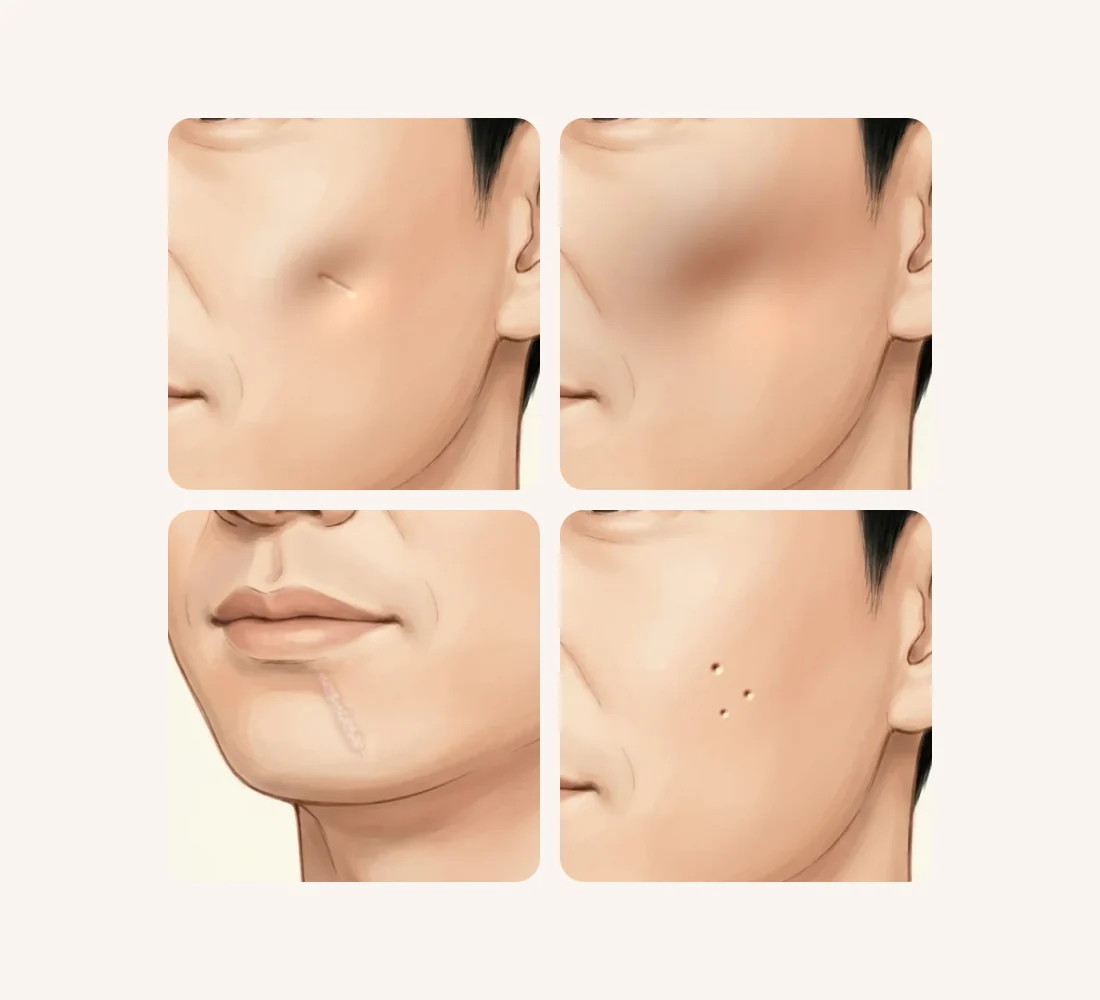
Where on the face is the scar?
After an accident, surgery, or removal of an implant or filler, depressed scars can be left on places such as the cheek, forehead and chin. Skin thickness, the structures underneath and movement differ across the face. So two scars of the same size can call for a different first step depending on where they are.
What to look at in each area of the face
The area matters most when a scar is cut out and re-sutured. An inconspicuous facial scar is described as narrow, flat, and level with and similar in color to the surrounding skin. It also runs parallel to the lines along which the skin naturally folds (relaxed skin tension lines). Scars that have widened, thickened or become atrophic (sunken) are the ones for which revision is considered.6
A review of scar surgery matches suture techniques to areas like this:2
- Forehead and nasolabial fold: incisions can follow the skin creases, so Z-plasty (reshaping the incision into a Z to turn the scar toward the creases) suits these areas.
- Cheek and the area between the lower lip and the jaw: these are flat areas, so W-plasty suits them. It breaks a straight line into a zigzag that is harder to see.
What is holding a depressed scar down?
When a wound reaches the deep part of the dermis (the reticular dermis), it leaves a lasting scar. If, during healing, more collagen (the protein fibers that support the skin) is broken down than is made, the scar ends up lower than the surrounding skin. This is called an atrophic, or depressed, scar.2 Put simply, the wound healed without enough material to fill it, so it sank.
Depressed scars on the face from an accident or an operation can look alike on the surface, yet what is happening underneath usually falls into four patterns.
| What it looks like | What is happening underneath | Approach usually considered |
|---|---|---|
| Soft edges, base looks pulled down | The base is tethered to deeper tissue by fibrous bands | Releasing the tethering |
| A broad area sunken as a whole | Volume, such as fat under the skin, has been lost | Fat grafting |
| A line scar that has widened or thickened | The scar is wide and runs against the skin creases | Excision and re-suturing |
| A narrow opening that goes deep | A small base is fixed far below the surface | Punch elevation |
Two or more patterns often overlap in one scar. For example, a cut from an accident may heal wide, with its base stuck down and the fat around it reduced. Re-suturing the line alone then leaves the hollow, and filling alone leaves the pull. The same applies after an implant or filler has been removed. If the area has lost volume and the surrounding tissue is stuck to deeper layers, it may need to be released before it is filled.
The bands that tether the base can be cut with a needle passed under the skin, without a large incision. The report that first described this technique, subcision, explains that the dip rises because the base is released. Connective tissue formed during normal healing then supports the space.1 If volume is genuinely missing, however, a shadow remains even after release. That is why tethering and volume are assessed separately.
Lasers mainly work on the surface and the dermis, refining texture, color and shallow unevenness. When a dip comes from a tethered base or lost volume, repeating laser alone tends to improve the skin texture while the shadow stays. We explain why the same happens with acne scars in a separate guide, Why acne scars can remain after several laser sessions.
How is the first step chosen?
The order of treatment for a depressed scar is set by checking these points in turn:
- Depth and width: narrow and deep, or broad and shallow
- Tethering: whether the base is stuck to the muscle or bone underneath and pulled down, and whether it deepens with facial expression
- Lost volume: whether the area around the scar is sunken too, casting a wider shadow
- Width and direction of the line: whether an incision or tear line has spread, or runs against the creases
- Surface: whether redness, brown pigment or rough texture remain
- Age of the scar and previous treatment: whether it is still red and changing, and whether you have had implant or filler removal, re-suturing or laser
Depending on what is causing the dip, the approach usually considered divides as follows.
Approaches considered for each cause of the dip
1Base pulled down
The fibrous bands holding the base are cut to release it
Releasing the tethering
2Volume lost over a broad area
Your own fat is moved to replace the lost volume
Fat grafting
3Line widened or thick
The scar is cut out and closed finely along the creases
Excision and re-suturing
4Narrow and deep
The small base is cut round and lifted to skin level
Punch elevation
If the scar is recent and still red and firm, cutting or filling is timed according to how it is maturing. We cover timing in When to start treating a surgical scar.
What does each method do, and what should you know?
| Method | What it does | Typically suited to | Good to know |
|---|---|---|---|
| Releasing the tethering | Cuts the fibrous bands holding the base down | Scars whose base looks pulled down | Bruising and swelling are possible; follow-up checks that it does not re-tether1 |
| Fat grafting | Moves your own fat to replace lost volume | Broad hollows, sites of implant or filler removal | Part of the fat is absorbed, so another session may be needed4 |
| Excision and re-suturing | Removes the scar and closes it finely along the creases | Lines that have widened or thickened | The new incision line also goes through its own settling period |
| Punch elevation | Frees a small base and lifts it to skin level | Narrow, deep scars | Done one scar at a time |
| Laser | Refines texture, redness and color | Marks left once the level is even | Cannot change a tethered base or missing volume |
What has research found about fat grafting?
Fat grafting is widely used for scars, but the evidence is still of modest quality. A systematic review (a study that gathers all the research on one question) covered 26 studies with 905 patients. Every study reported improvement in scar appearance, skin characteristics and pain, along with volume and contour. However, it rated the level of evidence and methodological quality as quite low.3
Not all of the grafted fat stays, either. A meta-analysis (a study that pools the results of many studies and recalculates them) of facial fat grafting covered 31 studies and 1,572 patients. In acquired atrophic deformities, it estimated that about 43% of the volume remained at 12 months, compared with about 64% in other deformities. It concluded that grafting may be less effective where tissue has atrophied.4 Less fat may stay where a scar has thinned the tissue, which is why a hollow is sometimes filled in stages rather than all at once.
Fat remaining after 12 months
Grafts enriched with cells taken from the fat (stem cell-enriched fat grafting) are also being studied. In a meta-analysis of 8 facial reconstruction studies with 275 patients, enriched grafts retained more volume on average than routine fat grafts. Other outcomes such as infection and satisfaction were similar, and operating time was shorter with routine grafting.5 The studies are few and mainly measured how much volume remained, so evidence on how much the scar tissue itself changes is still limited.
What is recovery like, and what are the limits?
At Bonita Clinic, we perform restoration of depressed and incision scars on the face as surgery under local anesthesia (numbing only the treated area) or sedation. It is a same-day procedure, and stitches are used. How long you need to recover, and how many follow-up visits it takes, depends on what was done and on your own healing.
| Stage | Common changes | What the clinic does |
|---|---|---|
| Right after treatment | Swelling and bruising at the site | Protecting the area; telling you when washing and makeup can start |
| While healing | Redness and swelling gradually settle | Advising on sun protection |
| Settling period | Added volume and the new line stabilize | Reviewing progress and deciding whether more treatment is needed |
If fat is grafted, the area it was taken from can also bruise and swell. Bleeding, infection and inflammation are possible after surgery, and a re-sutured line goes through a period of being red and firm before it gradually fades.
The aim of scar treatment is not to erase the scar but to reduce the difference in level, width and color so it is less noticeable. How much it improves depends on the scar's depth and extent, your skin type and previous treatment.
How we approach it at Bonita Clinic
Treatment options you can discuss in Seoul
Bonita Clinic opened in 1995 and has stayed at the same address since; Dr. Kwang-Seop Chung, a plastic surgeon certified by the Brazilian board, sees patients in person. For depressed and incision scars on the face, the options discussed in consultation are the ones described above:
- Assessment of depth, width, tethering and lost volume
- Adhesion release for scars with a tethered, sunken base
- Fat grafting, combined with stem cells separated from the fat, for broad hollows
- Excision and fine re-suturing along the creases for widened or thickened lines
- Sutureless punch elevation for narrow, deep scars
- Combined laser treatment for remaining redness, pigment and texture
Which of these you need, and in what order, is decided only after an examination.
Why the plan and cost differ from case to case
Two people with a "depressed scar on the cheek" can need very different procedures. What shapes the plan, and therefore the cost, is the combination of methods and how many stages are needed rather than the name of the problem.
- What pulls the scar down: tethering, lost volume or a wide line
- Size, depth and number of scars
- Which methods are combined
- Anesthesia: local or sedation
- Number of staged sessions
- Previous treatment, implant or filler removal
Final plan and quote after an in-person exam
A final estimate is given only after an in-person examination, once it is clear which methods are needed and whether the treatment will be staged. Photos help us outline possible approaches, but the actual scope is set only when the scar has been examined.
What photos can show, and what needs an in-person exam
Photos are a good place to start. But a depressed scar changes with light and movement, and some of the key questions can only be answered by touch.
Photos can show
- Location, length and shape of the scar
- Redness or brown marks
- Shadow and contour in side light
- How it looks at rest and with expression
Needs an in-person exam
- Whether the base is tethered to deeper tissue
- How much volume is missing underneath
- Skin thickness and how firm the scar is
- Whether the scar is still maturing
- Where fat could be taken from
Helpful photos: the face front-on and from both sides at 45 degrees in good light, without makeup over the scar. Add one with light coming from the side so the shadow shows. If the scar deepens when you smile or raise your eyebrows, a photo of that helps too. You can send us a message with your photos and a short note on how the scar happened and what treatment you have had.
Planning your visit and recovery
What is confirmed in advance is limited to the treatment information above: surgery under local anesthesia or sedation, same-day discharge and stitches. How long you should stay in Seoul, when you need to come back and when the stitches come out all vary. They depend on which methods are combined and whether the treatment is staged. These are therefore planned together with you at consultation. Because restoration is often split into more than one session, it helps to discuss in advance how the stages could fit around your travel.
At Bonita Clinic, we protect the treated area right after the procedure. Redness and swelling then settle gradually, and sun protection matters from then on. Once you are home, see a doctor without delay if the area becomes redder, warmer or more painful, or starts to discharge, instead of calming down. Taking dated photos from time to time makes it easier for any doctor, in Seoul or at home, to judge how the scar is settling.
Real treatment cases
These cases appear on Bonita Clinic's facial depressed and incision scar page. Results vary from person to person.
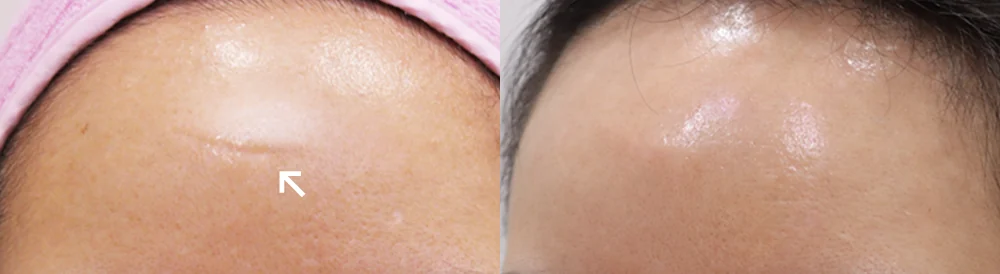
A long horizontal depressed line on the forehead
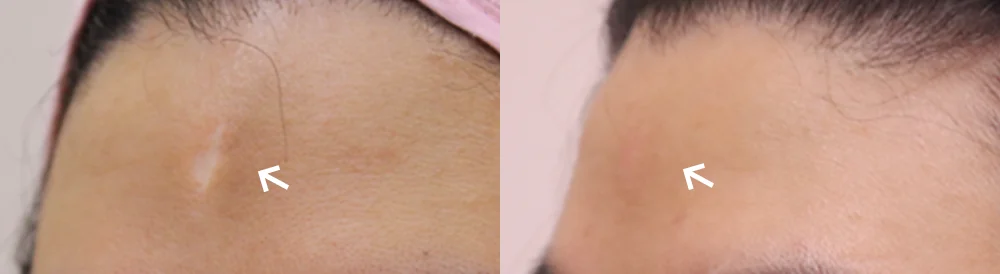
A pale depressed scar near the edge of the forehead
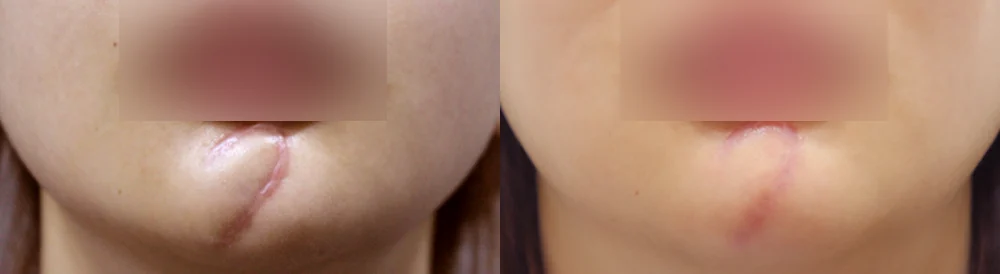
A scar running diagonally from below the lower lip to the chin
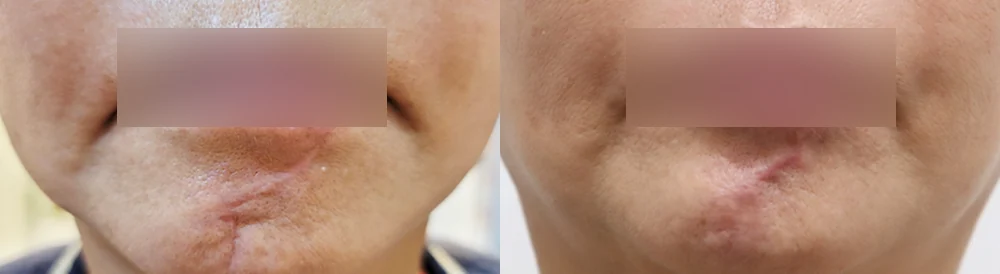
An angled line scar on the chin
* Results vary from person to person. Side effects are possible, so please decide after a thorough consultation with a doctor.
Frequently asked questions
The area where an implant or filler was removed has sunk. Is that treated as a scar?
Yes. A hollow left after implant or filler removal is assessed in the same way as a depressed scar. It depends on whether only volume is missing, or whether the surrounding tissue is also stuck down. In the first case filling is considered; in the second, tethering is released first.
Is one fat grafting session enough?
Sometimes, but part of the grafted fat is absorbed, and an analysis suggests less remains where tissue has atrophied. Filling is therefore sometimes planned in stages. At Bonita Clinic, surgical and procedural restoration is usually split into one to three sessions, depending on the scar.
If the scar is cut out, won't that leave a new scar?
Yes, excision creates a new incision line. The purpose of revision is to turn a wide, noticeable scar into a finer, less visible line. So it makes sense when the line can be aligned with the creases and narrowed. The new line also needs time to settle, with care during that period.
Can an old scar from childhood still be raised?
Old scars can be treated too. In a long-settled scar the base may be firmly stuck down or the surrounding tissue thinned. Release and filling are then needed, and there may be more steps than with a recent scar. Depth and tethering are checked at consultation before a plan is made.
What to prepare before your consultation
- How the scar happened (accident, surgery, implant or filler removal) and when
- Treatments so far: re-suturing, laser type and number of sessions, filler or fat grafting, scar injections
- Whether the scar deepens with expression, or feels tight or painful
- Any important dates you need to plan around, so the recovery schedule can be discussed
- Medicines you take regularly
Bonita Clinic is on the 3rd floor of 565 Gangnam-daero, Seocho-gu, Seoul, about 100 m on foot from Exit 8 of Nonhyeon Station (Line 7). You can read more on our Facial Depressed & Incision Scars page. For scars left after cosmetic surgery on the face, see Facial Surgical Scars. For accident scars, see Accident Scars and the guide to accident scar treatment. For sunken scars on the body, see Body Depressed & Incision Scars and the guide to depressed scars on the body.
References (6)
Sources that support the explanations in this article. Study findings describe general trends and do not guarantee individual results.
- Orentreich DS, Orentreich N. Subcutaneous incisionless (subcision) surgery for the correction of depressed scars and wrinkles. Dermatol Surg. 1995;21(6):543-549.doi:10.1111/j.1524-4725.1995.tb00259.xTechnique report (abstract): the principle of subcision; cutting the tissue that tethers the base lifts the depression, both by release and by connective tissue formed during healing
- Ogawa R. Surgery for scar revision and reduction: from primary closure to flap surgery. Burns Trauma. 2019;7:7.doi:10.1186/s41038-019-0144-5Review: wounds reaching the reticular dermis leave lasting scars, and atrophic scars form when collagen breakdown exceeds synthesis; Z-plasty suits the forehead and nasolabial area, W-plasty flat areas such as the cheek and between the lower lip and jaw
- Negenborn VL, Groen JW, Smit JM, et al. The Use of Autologous Fat Grafting for Treatment of Scar Tissue and Scar-Related Conditions: A Systematic Review. Plast Reconstr Surg. 2016;137(1):31e-43e.doi:10.1097/PRS.0000000000001850Systematic review (abstract) of fat grafting for scars, 26 studies and 905 patients: improvements in appearance, skin quality, pain and volume were reported, but the level of evidence and study quality were low
- Ma X, Huang J, Long X, Wang X. Quantifying outcomes of autologous fat transplantation in different facial deformities: A systemic review and meta-analysis. J Plast Reconstr Aesthet Surg. 2023;87:117-130.doi:10.1016/j.bjps.2023.09.007Meta-analysis (abstract) of facial fat grafting, 31 studies and 1,572 patients: estimated 12-month retention of 43% in acquired atrophic deformities versus 64% in mixed deformities; complication rate 3.4%
- Karam M, Abul A, Wood B, et al. Stem Cell-Enriched Fat Grafts Versus Autologous Fat Grafts for Facial Reconstruction: A Systematic Review and Meta-analysis. Ann Plast Surg. 2023;90(5):487-493.doi:10.1097/SAP.0000000000003553Meta-analysis (abstract) of stem cell-enriched versus routine fat grafts in facial reconstruction, 8 studies and 275 patients: higher mean volume retention with enrichment, similar infection and satisfaction, shorter operating time without it; few studies, mainly measuring volume
- Newberry CI, Thomas JR, Cerrati EW. Facial Scar Improvement Procedures. Facial Plast Surg. 2018;34(5):448-457.doi:10.1055/s-0038-1669400Review (abstract): features of an inconspicuous facial scar (narrow, flat, level, color-matched, parallel to relaxed skin tension lines) and revision for widened or atrophic scars
About this article
This article separates general medical information from Bonita Clinic's own approach. Because the right decision depends on each person's condition, it is not a substitute for a consultation.
