 KOKorean
 ENEnglish
 JP日本語
JP日本語 CN中文(简体)
 TW中文(繁體)

Surgical Scar Revision in Seoul: When Is the Right Time to Treat a Scar?
Surgical scars keep changing in color and thickness for more than a year, even after the skin has closed. That is why revision, which means cutting out the scar and stitching it again, is usually considered once the scar has settled to some degree. You do not have to simply wait until then. Once the wound has healed, you can start care such as silicone products and sun protection. If the scar keeps getting thicker, itches, hurts or pulls, it is a good idea to be seen early, whatever the timing. If you are planning treatment in Seoul, sending dated photos first helps decide when a visit will be most useful.
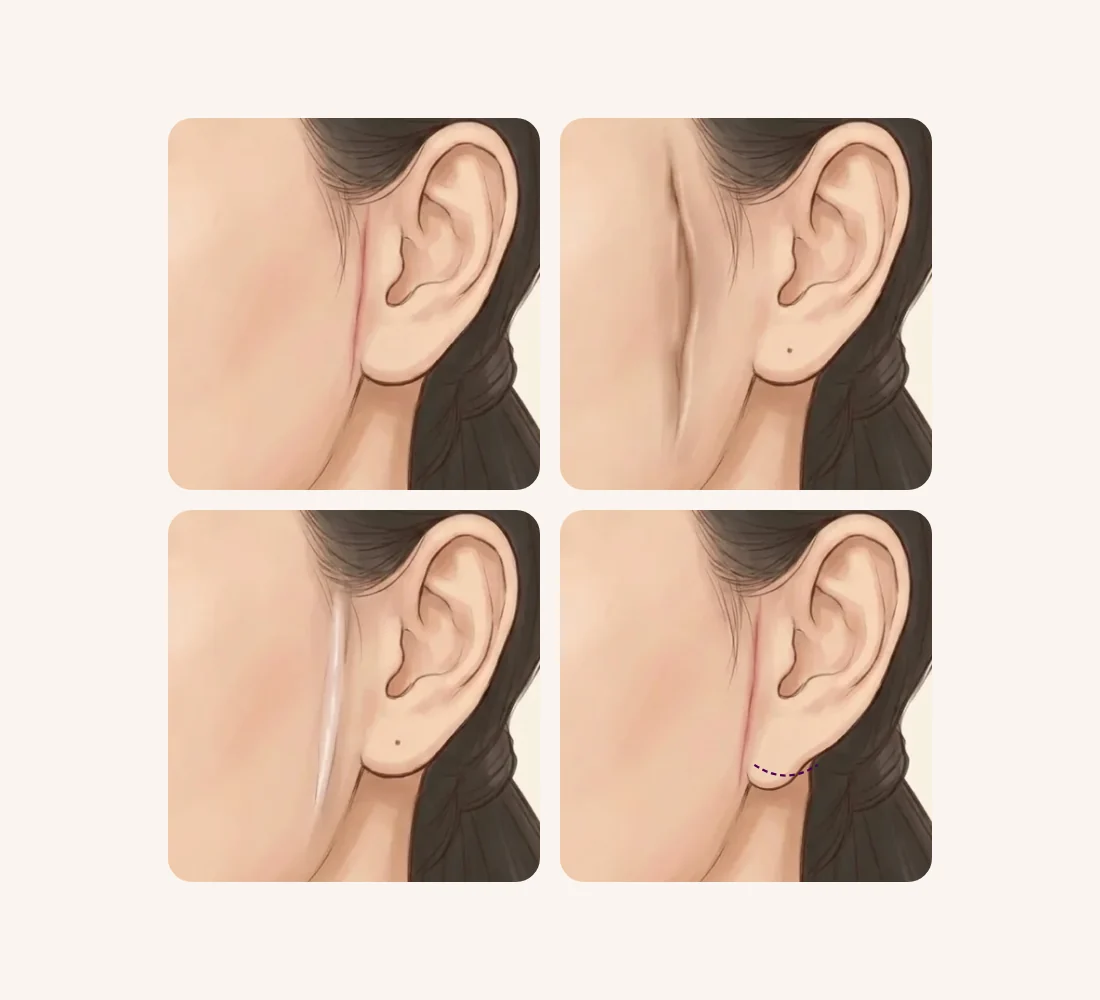
Where do surgical scars form, and why?
A surgical scar forms where the skin was cut and stitched closed (the incision). So two scars on the face can sit in very different places and look very different, depending on the operation. Common examples after facial cosmetic surgery are marks from nostril (alar) reduction and double-eyelid incision lines. Others are the scar in front of the ear and "pixie ear" after a face lift (surgery that lifts sagging facial skin). For scars like these, the cause only becomes clear once you know where and how the incision was made.
Where scars can form after facial surgery (example)
This guide focuses on one question: when is the right time to have a surgical scar looked at? Scars change over time, so when you act matters as much as what is done.
Do scars keep changing after they heal?
Yes. Once a wound has closed, it can look finished from the outside. Inside the scar, though, the tissue keeps reorganizing for quite a while. A review on scar revision (a paper that gathers and summarizes many studies) explains that scars take around 12–18 months to mature. Over that time they slowly regain 70–80% of the strength of uninjured skin.1 This means that for a year or more after surgery the scar is still taking shape.
During this period scars usually follow the course below. It varies a great deal by person, body area and type of surgery.
How a surgical scar settles
The same review warns that immature scars thicken easily and tend to give poor results if revised too early.1 That is why revision is not rushed. It does not mean doing nothing while you wait, though.
What can you do while you wait?
International guidelines on scar management (advice agreed by experts from several countries) list some basic care for all scars. It covers reducing skin tension around the time of surgery, taping, moisturizing and sun protection. They regard silicone sheets or gels as the first-line option for preventing and treating hypertrophic scars and keloids.2 A hypertrophic scar is red, thick and raised but stays within the original wound. A keloid grows sideways beyond the edges of the wound.
Here is what the evidence for each kind of care looks like. Some of it is fairly clear, and some is still uncertain.
- Taping to reduce tension: one trial randomly assigned 70 women after cesarean section into two groups (like drawing lots). None of those who used paper tape for 12 weeks after stitch removal had a hypertrophic scar at 12 weeks, compared with 41% of those who did not. However, only 39 women completed the study, and some scars thickened or stretched after the tape was stopped.3
- Silicone sheets and gels: these are widely used. But a Cochrane review that pooled 20 trials concluded that the evidence for preventing abnormal scars in people prone to them is weak and of poor quality. A lot of uncertainty remains.4 It is more accurate to see silicone as low-burden basic care whose benefit is still uncertain.
- Sun protection: keeping a red scar out of the sun is part of basic care while the redness lasts.2
- Early laser: a systematic review looked at 25 studies that started laser within 3 months of the wound. This kind of review searches for all relevant studies in a set way and sums them up. Early laser may reduce scar formation, but the differences were not always significant, and better studies are needed.5 Vascular laser, which targets the tiny blood vessels that make a scar look red, is sometimes started around the time stitches are removed.1
A randomized trial of tape to reduce tension
When to start each of these depends on how your wound is healing, so follow the advice of the team who operated on you first. Even three months after surgery, the dermis (the layer under the surface that gives skin its strength) has regained only about 80% of its original strength.6 That is why care that reduces tension on the scar keeps mattering for several months.
Which changes mean you should be seen early?
If you notice any of the following, it is better to have the scar checked now rather than wait for it to settle.
- The scar keeps getting thicker, or spreads beyond the original wound
- It itches or hurts
- On a part of the body that moves, such as near a joint or on the neck, the scar pulls and makes movement uncomfortable
- The wound has opened, or inflammation or oozing keeps coming back
- The scar is pulling on the shape of the eye, mouth or nostril
Hypertrophic scars usually stay within the original wound, while keloids grow sideways beyond its edges. Both tend to worsen under skin tension and to grow in the direction of that pull. People of Asian and African descent are known to be more prone to them.6
What is your scar doing now?
- Getting thicker, itchy or painfulBe seen earlyCalming treatment comes first
- Spreading beyond the woundCheck for a keloidExcision alone may let it return
- Red but gradually flatteningKeep caring and watchTape, silicone, sun protection
- Wide, sunken or pullingPlan the revision timingAdults: from 8–12 weeks on
In these cases, check the scar first instead of waiting. Calming treatments such as injections or silicone can be started first, or revision can be planned for the right time.
When is a scar cut out and re-stitched?
Revision is usually put off until the scar has matured (settled) to some degree. International guidelines also describe invasive treatments, those that cut the skin such as surgery, as a later step for correcting long-standing scars.2
The review mentioned above also gives a point from which early revision can be considered: 8–12 weeks after surgery in adults, and 6 months in children under 7.1 So for scars that are unlikely to improve in shape with waiting, such as widened scars, a plan is sometimes made earlier.
Scars with strong keloid features are a different matter. According to the Japan Scar Workshop consensus (recommendations agreed after expert discussion), cutting them out alone can lead to recurrence. A keloid that comes back may be larger than before. So it recommends planning radiotherapy or steroid treatment after surgery. On high-tension areas such as the chest and shoulders, stitching methods that spread out the tension are used as well.6
What improves with time, and what does not?
Some parts of a scar improve with time, and some stay the same however long you wait.
- Usually improves with time: redness, firmness
- Stays the same with waiting: width, a sunken area, the direction the scar runs
Telling which is which requires seeing the scar in person.
Revision surgery has limits too. It creates a new wound, so the new scar also goes through its own settling period. It makes a scar less visible rather than erasing it.1 If you are prone to keloids, the scar may come back after excision alone, so excision is planned together with other treatments.6 Side effects such as bleeding, infection and inflammation are also possible.
How we approach it at Bonita Clinic
Bonita Clinic's methods by scar type
1If it is a thin red line
Vascular and regenerative lasers to refine redness and texture
Laser
2If it is sunken or pulled down
Tissue stuck underneath is released, and fat is moved in to fill
Adhesion release · fat grafting
3If the incision line has widened
The scar is cut out and stitched again along the skin creases
Excision · re-suturing
4If the shape has changed, as in pixie ear
The earlobe's shape is corrected together with the scar
Scar and shape correction
Whichever method is used, any remaining color and texture are refined after a review, with combined laser if needed (several lasers chosen and combined for the purpose). In plain words, adhesion release frees a scar that is stuck to deeper tissue and pulled downward. Fat grafting moves some of your own fat to fill a sunken area.
Bonita Clinic has long treated both cosmetic surgery and scar restoration. For some scars, the cause only becomes clear once you know where and how the incision was made. Examples are alar reduction marks, pixie ear after a face lift or double-eyelid incision lines. For these, we trace the scar back to the surgery itself. At Bonita Clinic, we perform facial surgical scar revision as surgery under local anesthesia or sedation; you go home the same day, and stitches are used. How long recovery takes and how often you need to come back depend on the extent of treatment and your own condition.
Treatment options you can discuss in Seoul
Bonita Clinic opened in 1995, and Dr. Kwang-Seop Chung, a board-certified plastic surgeon trained in Brazil, has seen patients at the same location since then. Scars from surgery done elsewhere, including in other countries, can be assessed. The restoration process on our facial surgical scar page covers:
- A review of your previous surgery: what was done, when, where the incisions were and any treatment since
- Vascular and regenerative lasers for scars left as thin red lines
- Adhesion release and fat grafting for scars that are sunken or pulled downward
- Excision and re-suturing along the skin creases for widened incision lines
- Shape correction, such as for pixie ear, together with the scar
- Follow-up, with combined lasers for remaining color and texture if needed
How many of these steps your scar needs, and when, is decided after an examination.
Why the plan and cost vary for scar revision
Two scars from the same operation can need different work. Size, location, how much the area moves and whether the scar behaves like a keloid all shape the plan, and the cost follows from the plan.
- Length and width of the scar
- Face or body, and how much the area moves
- Laser, adhesion release, fat grafting or excision
- Shape correction such as pixie ear
- Anesthesia: local or sedation
- Keloid tendency and care after excision
Plan and estimate after an in-person exam
A final estimate is given after the in-person examination, once the methods and the number of stages are clear. If a scar is still maturing, part of the plan may be confirmed only at a later review.
What photos can show, and what needs an exam in person
For a scar that is still changing, a series of dated photos tells us more than a single picture. Photos still cannot show how firm the scar is, whether it is stuck to the tissue underneath, or how it behaves when you move.
Photos can show
- Length, width and color of the scar
- Visible raised or sunken areas
- How it has changed (dated photos)
- Pull on the eye, mouth or ear
Needs an in-person exam
- Firmness and thickness
- Tethering to deeper tissue
- Tension when you move
- Signs a keloid is still active
- Condition of the skin around it
Helpful photos: the scar in good light from straight on and at an angle, with a ruler or coin beside it for scale. If the scar pulls, add one photo taken while you move the area. If you have photos from different stages since surgery, include them with the date. You can send us a message with your photos, the name and date of the surgery, and the care you have tried.
Timing your visit to the scar's stage
For a surgical scar, when you come matters as much as what is done. If your surgery was only weeks ago, the scar is still changing. It can be more useful to send photos now and plan a visit for the stage when revision or laser makes sense, rather than coming straight away. If the scar is thickening, itching, painful or spreading, though, do not wait for a later trip: see a doctor where you are, or send photos promptly.
What is confirmed in advance is our treatment information: facial surgical scar revision is surgery under local anesthesia or sedation, with same-day discharge and stitches. How long to stay in Seoul, when stitches come out and whether you need to return depend on the extent of treatment. These are planned together with you at consultation. Right after treatment the area is protected. Redness and swelling ease little by little, and from then on sun protection is important.
After returning home, keep up the basic care described above (reducing tension, sun protection and, if advised, silicone) while the new scar settles. Contact a doctor promptly if the wound opens, or if redness, pain or discharge gets worse instead of settling.
Real treatment cases
These are cases of facial surgical and incision scars treated at Bonita Clinic. Results may vary from person to person.
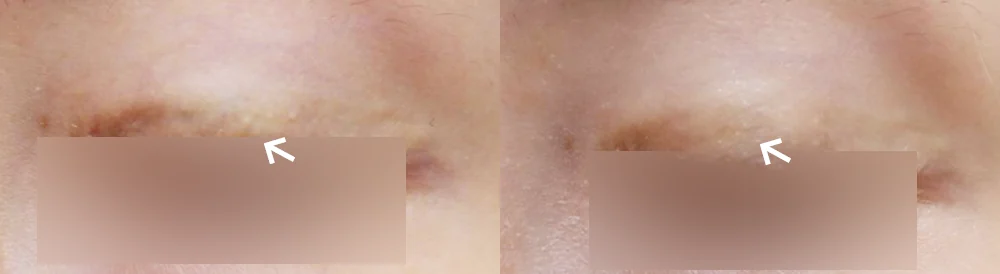
Incision-line scar above the eye
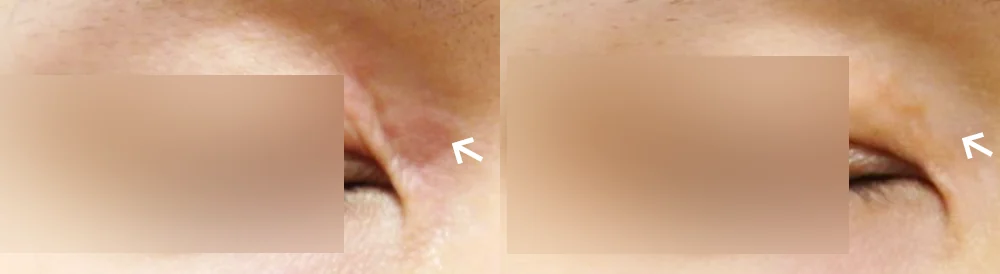
Incision scar around the eye
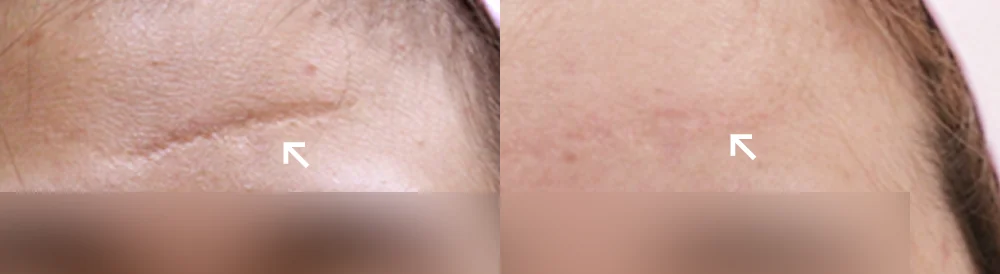
Linear scar on the forehead
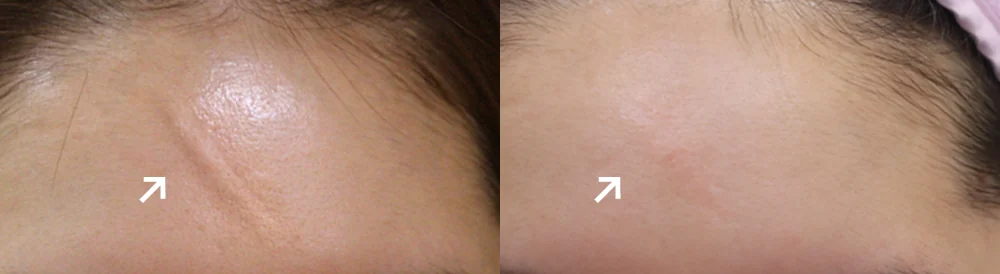
Depressed scar on the forehead
* Results vary from person to person. Side effects are possible, so please decide after a thorough consultation with a doctor.
Frequently asked questions
Can I be treated here if my surgery was done at another clinic?
Yes. Knowing which surgery you had and when helps us judge where the incision was and what caused the problem, so please tell us as much as you remember. Surgical records or dated photos are useful if you have them.
My surgery was recent. Can I start scar treatment now?
It depends on how well the wound has healed. If it is too early, the scar is managed while we watch its progress, and treatment is planned around when it settles. If the scar is getting thicker, itchy or painful, though, have it checked whatever the timing.
How long should I use silicone or tape?
There is no fixed period; it depends on the product and the wound. In the randomized trial above, tape was used for 12 weeks after stitch removal, and a few people had a mild red rash under it.3 Keep going while the scar is red and firm. If the skin breaks down or a rash appears, take a break and ask your doctor.
Can pixie ear be corrected?
We consider ways to correct the ear's shape along with the scar. Pixie ear is a change in the earlobe's shape caused by the incision in front of the ear and the direction of pull. The extent is confirmed at consultation.
How many sessions will I need?
It depends on the scar. Surgical restoration is done once and then reviewed. Remaining color and texture are often refined with lasers over several sessions.
What to prepare before your consultation
- The name and date of the surgery and the clinic where it was done (as much as you remember)
- Care you have tried so far: silicone products, tape, laser, injections
- Any past experience of scars thickening or keloids forming, and similar cases in your family
- Any discomfort: itching, pain, pulling
Bonita Clinic is on the 3rd floor of 565 Gangnam-daero, Seocho-gu, Seoul, around 100 m on foot from Exit 8 of Nonhyeon Station (Line 7). You can read more on our Facial Surgical Scars, Body Surgical Scars and Facial Depressed & Incision Scars pages. Treatment by scar type is covered in separate guides: facial depressed and incision scars, depressed and incision scars on the body, scars after body and breast surgery and nose scars.
References (6)
Sources that support the explanations in this article. Study findings describe general trends and do not guarantee individual results.
- Garg S, Dahiya N, Gupta S. Surgical scar revision: an overview. J Cutan Aesthet Surg. 2014;7(1):3-13.doi:10.4103/0974-2077.129959Review (full text): scars take 12–18 months to mature and regain 70–80% of normal strength; immature scars thicken easily and revise poorly; early revision after 8–12 weeks in adults and 6 months in children under 7; silicone and steroid injections meanwhile; vascular laser from stitch removal; revision makes scars less noticeable rather than erasing them
- Monstrey S, Middelkoop E, Vranckx JJ, et al. Updated scar management practical guidelines: non-invasive and invasive measures. J Plast Reconstr Aesthet Surg. 2014;67(8):1017-1025.doi:10.1016/j.bjps.2014.04.011International guideline by 24 experts (abstract): basic care for all scars (tension reduction, taping, hydration, UV protection); silicone sheets or gel as first-line prevention and treatment for hypertrophic scars and keloids; invasive surgery as a later step for persistent scars
- Atkinson JA, McKenna KT, Barnett AG, et al. A randomized, controlled trial to determine the efficacy of paper tape in preventing hypertrophic scar formation in surgical incisions that traverse Langer's skin tension lines. Plast Reconstr Surg. 2005;116(6):1648-1656.doi:10.1097/01.prs.0000187147.73963.a5Randomized trial in 70 cesarean patients, 39 completed (abstract): 12 weeks of paper tape; hypertrophic scars at 12 weeks in 41% of controls vs none with tape; some scars thickened or stretched after tape removal; mild rash under the tape
- O'Brien L, Jones DJ. Silicone gel sheeting for preventing and treating hypertrophic and keloid scars. Cochrane Database Syst Rev. 2013;(9):CD003826.doi:10.1002/14651858.CD003826.pub3Cochrane review of 20 trials, 873 people (abstract): weak, poor-quality evidence for prevention in high-risk people; treatment studies showed thinner, paler scars but were highly susceptible to bias
- Karmisholt KE, Haerskjold A, Karlsmark T, et al. Early laser intervention to reduce scar formation - a systematic review. J Eur Acad Dermatol Venereol. 2018;32(7):1099-1110.doi:10.1111/jdv.14856Systematic review of 25 studies starting laser within 3 months of wounding (abstract): early laser may reduce scar formation, not always significantly; higher-quality studies needed
- Ogawa R, Akita S, Akaishi S, et al. Diagnosis and Treatment of Keloids and Hypertrophic Scars-Japan Scar Workshop Consensus Document 2018. Burns Trauma. 2019;7:39.doi:10.1186/s41038-019-0175-yJapan Scar Workshop consensus (full text): hypertrophic scars stay within the wound while keloids spread beyond it; tension worsens both and they grow along it; more common in Asian and African patients; tape and gel sheets reduce tension; the dermis regains only about 80% of its strength by 3 months; keloid excision needs radiotherapy or steroid treatment to limit recurrence
About this article
This article separates general medical information from Bonita Clinic's own approach. Because the right decision depends on each person's condition, it is not a substitute for a consultation.
