 KOKorean
 ENEnglish
 JP日本語
JP日本語 CN中文(简体)
 TW中文(繁體)

Scars and Irregularities After Liposuction or Breast Surgery in Seoul: Can They Be Revised?
Many can be improved. But scars and irregularities that look alike are treated differently depending on which surgery, and which step of it, caused them. A dent after liposuction is first sorted into over-removal of fat just under the skin, fibrous adhesion to the muscle, or loose skin. An incision scar after breast or body surgery is assessed for whether it is still maturing or has widened or thickened under tension. Tissue that has already been operated on stretches less, so revision is usually staged to what the tissue can take rather than done all at once. If you are considering treatment in Seoul, you can send photos and details of your previous surgery first to see which approach may fit.
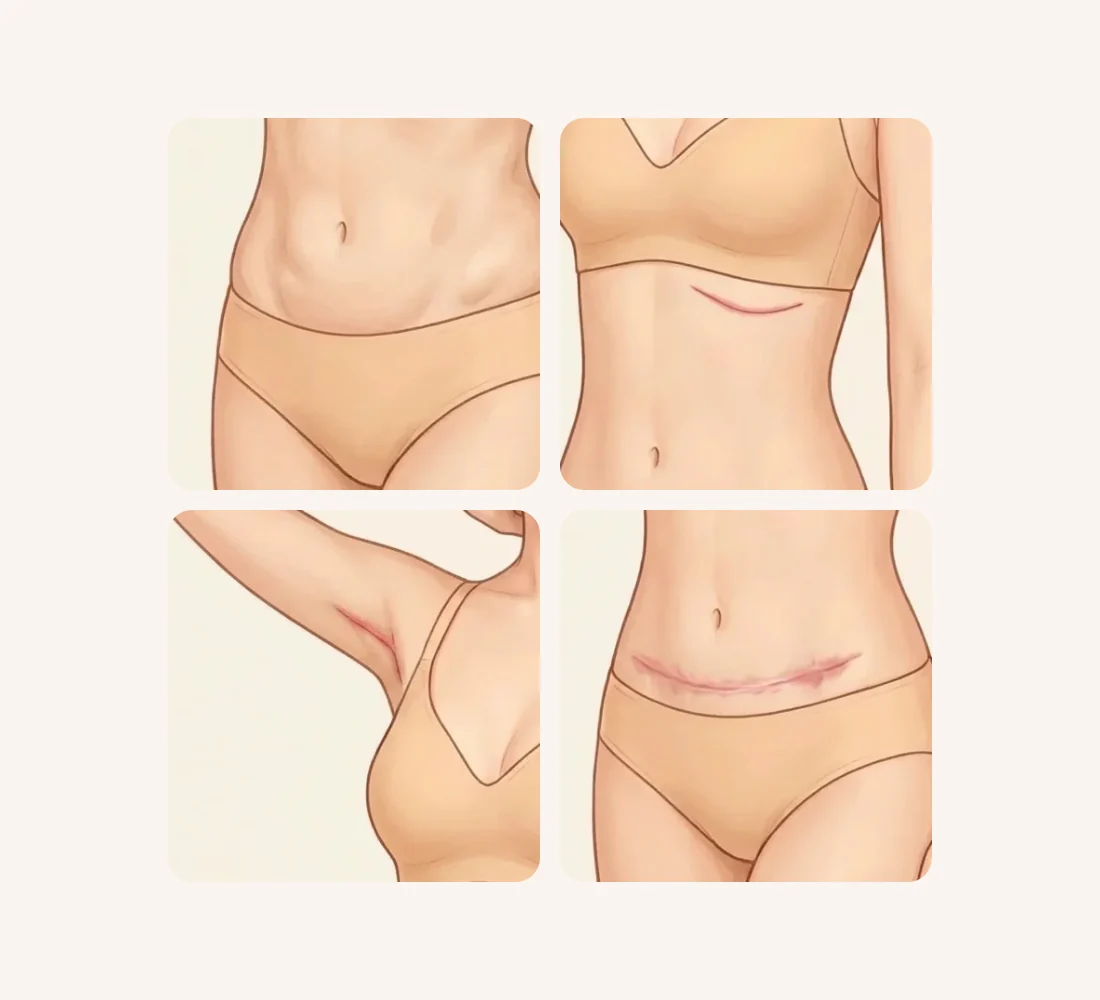
Why start with which surgery it was?
Scars and irregularities left after body contouring or breast surgery tend to appear in predictable places and patterns for each operation.
- Liposuction: unevenness shows up as differences in the level of the fat that was removed.
- Fat grafting: problems appear where the fat did not settle evenly.
- Incisional surgery: the line widens or thickens along the direction in which the incision is pulled.
That is why two people with "an uneven abdomen" can have different causes and need different fixes, depending on what surgery they had, when and how.
Which surgery, and where it left its mark
1Lumpy or dented after liposuction
First we tell whether it is superficial over-removal, adhesion or loose skin
Liposuction unevenness
2A red or widened line in the breast fold
The scar changes a lot in the first year, so we first watch how it settles
Breast augmentation · fold incision
3A red, raised line in the armpit
It tends to be redder and more raised early on; arm movement is also considered
Breast augmentation · armpit incision
4A body-contouring incision that widened or thickened
Re-suturing is considered together with ways to reduce the pull
Excision and re-suturing
Pairing each surgery with the problems it commonly leaves looks like this.
Which surgery → common problems
How is the cause of a dent after liposuction worked out?
Unevenness after liposuction is not rare. In a review of more than 600 cases, 8.2% of patients reported surface irregularities after surgery.1 The same review lists three main causes: over-removal of fat just under the skin, fibrous adhesions (scar tissue stuck to the underlying muscle), and leftover loose skin. It explains how body position and movement help tell them apart.1
When the dent changes tells you the cause
Here is a little more about each:
- Superficial over-removal: where too much fat was taken from just under the skin, the dent persists both lying down and when the skin is pulled taut.1 Replacing the lost volume is central. The review notes that touch-up liposuction of the surrounding fat may be combined with fat transfer.1
- Fibrous adhesion: a dent stuck to the muscle below gets deeper when the muscle is tensed.1 It needs to be released before filling will lift it.
- Loose skin: the dent may improve lying down and smooths out when the skin is pulled taut.1 Here skin laxity, rather than volume, needs separate assessment.
Timing matters too. For both over- and under-correction, the review recommends waiting at least about 6 months after the first operation, so the swelling can settle, before planning revision.1 In other words, until the swelling has gone down, it is hard to tell how uneven the area really is.
The small entry incisions (ports, where the suction tube went in) used in liposuction can also scar. They can darken from bruising caused by repeated passes of the cannula, or sink where fat near the incision was over-suctioned. In that review's patients, 1.3% developed hypertrophic scars (thick, raised scars).1
For incision scars after breast and body surgery, what should you wait for and what should be revised?
Breast augmentation incision scars change a lot during the first year. One study compared inframammary fold and armpit incisions in 163 patients at 1, 6 and 12 months. Armpit scars were redder and more raised at 1 and 6 months. But by 12 months the two sites had the same total scar score, and patients in both groups were highly satisfied.2
Breast augmentation scars over the first year
So if a recent scar is red and raised, watching how it matures usually comes before cutting it out again. Timing is discussed in more detail in When to start treating a surgical scar.
Scars that do not improve with time are handled according to their type:
- Thick, red, itchy or painful scars (hypertrophic scars): these are described as ongoing inflammation in the deep dermis. They are treated with methods that calm the inflammation, such as corticosteroid injection or tape, compression, stabilization and tension-reducing surgery.4
- Widened scars: these result from a wound healing under pulling force. Tension prolongs inflammation and thickens scars, and vertical scars running along the long axis of the body bear more tension than horizontal ones.3 So re-suturing needs a plan to reduce that force.
- The area itself: W-plasty, which breaks a line into a zigzag, is used on flat surfaces but is described as unsuitable for major joints such as the armpit and elbow.3 For armpit scars, the movement of raising and lowering the arm also has to be taken into account.
Why is previously operated tissue harder to work on?
Revising a scar after cosmetic surgery is more demanding than the first operation. Scar tissue stretches less than normal skin. So moving or pulling skin that includes scar is described as raising the risk of damage at the edges.3 Areas that have had several operations may have thinner skin or tissue stuck to the layers below. So rather than changing a lot at once, the work is split into releasing, filling and refining in stages, as far as the tissue can take.
Fat grafting, used to fill sunken areas, does not give uniform results either. A meta-analysis (a study that pools the results of many studies) looked at 16 reconstructive surgery studies with 686 patients. It compared fat grafts enriched with cells taken from the fat (stem cell-enriched grafts) and routine fat grafts. Enriched grafts retained more volume on average, but redness and swelling were more frequent and operating time was longer. Complications such as fat necrosis, infection and cysts, as well as satisfaction and scar assessment, were similar between the two.5 These possible complications also need weighing when lumps or unevenness after an earlier fat graft are being revised.
| Remaining problem | Approach often considered | Good to know |
|---|---|---|
| Dent from superficial over-removal | Fat grafting, evening out the surroundings | Part of the fat is absorbed, so filling is sometimes staged |
| Dent stuck to the muscle | Release, then filling | Progress is checked for re-tethering during healing |
| Thick, red incision scar | Treatment to calm inflammation, excision if needed | Excision alone can let it thicken again |
| Widened incision scar | Excision and re-suturing with reduced tension | Areas under strong pull can widen again |
| Remaining redness, pigment, texture | Laser | Cannot change height differences or pull |
What is recovery like, and what are the limits?
At Bonita Clinic, we perform restoration of surgical scars on the body as surgery under local anesthesia (numbing only the treated area) or sedation. Discharge is on the same day, with stitches. The length of recovery and the follow-up schedule differ with the scope of the revision and with each person. Right after treatment the area is protected. While it heals, redness and swelling settle, and sun protection matters from then on. As the tissue settles, progress is reviewed to decide whether further treatment is needed.
Bleeding, infection and inflammation are possible after surgery. A newly sutured line also goes through its own settling period, and in areas under strong pull or in people prone to thick scars, it can widen or thicken again. Returning the body to how it was before cosmetic surgery is not the goal. A realistic goal is to reduce noticeable height differences, pull and color so they bother you less in daily life.
How we approach it at Bonita Clinic
The order we follow
- 1Review previous surgeryWhich operation, when, incision sites, later treatment
- 2Adhesion releaseScars whose sunken base casts a shadow
- 3Fat grafting and stem cellsBroad hollows that have lost volume
- 4Excision and re-suturingLines that widened or thickened
- 5Combined laserRemaining redness, pigment and texture
- 6Follow-upUsually split into one to three sessions
Only the steps you need are used; laser only if marks remain
Treatment options you can discuss in Seoul
Dr. Kwang-Seop Chung, board-certified in plastic surgery in Brazil, has treated patients himself at the same address since Bonita Clinic opened in 1995. He practices cosmetic surgery and scar restoration side by side. We treat incision scars that widened or thickened after body contouring, and dents and unevenness after liposuction or fat grafting. We also treat scars after breast surgery (under the breast or in the armpit), and hollows after implant or filler removal. The options discussed in consultation are:
- Review of the previous surgery and assessment of the scar
- Adhesion release for scars with a sunken, tethered base
- Fat grafting, combined with stem cells separated from the fat, for broad hollows
- Excision and fine re-suturing for widened or thickened lines
- Combined laser treatment for remaining redness, pigment and texture
Which of these you need, and in what order, is decided only after an examination.
Why the plan and cost differ from case to case
Two people unhappy with their liposuction result can need very different procedures. What shapes the plan, and the cost, is the cause and extent of the problem and how much previous surgery the area has had.
- Which surgery caused it, and at which step
- Size of the area and number of problem spots
- Release, filling, excision: which are combined
- Fat volume needed and the donor site
- Anesthesia: local or sedation
- Previous revisions and number of stages
Final plan and quote after an in-person exam
A final estimate is given only after an in-person examination, once the cause, the extent and the number of stages are clear. Photos and surgical records help, but they cannot fix the scope.
What photos can show, and what needs an in-person exam
Photos and records of the earlier surgery are very helpful. But whether a dent is stuck down, and how firm a scar is, can only be judged in person.
Photos can show
- Where the scars and dents are, and how many
- Color and width of incision lines
- Contour standing, and from the side
- How it looked before and after surgery
Needs an in-person exam
- Whether a dent is stuck to the muscle
- Lumps or firmness under the skin
- Loose skin and skin thickness
- Spare fat and where it could be taken
- Tension and movement at the scar
Helpful photos: the whole area and a close-up in good light from the front and both sides, standing, plus one with light from the side so the unevenness shows. If you have photos from before your original surgery or from the months after it, include them, along with the name and date of the operation if you know them. You can send us a message with your photos and a short note on your previous surgery and treatment.
Planning your visit and recovery
What is confirmed in advance is limited to the treatment information above: surgery under local anesthesia or sedation, same-day discharge and stitches. How long you should stay in Seoul, when you need to come back and when the stitches come out all vary. They depend on which steps are combined and whether the treatment is staged. So we plan these together with you at consultation. Because revision of previously operated tissue is often split into more than one session, it helps to discuss in advance how the stages could fit your travel plans.
If your original surgery was recent, the timing of revision itself may need to wait for swelling to settle and the scar to mature, which is also discussed at consultation. Should redness, heat, pain or discharge build up instead of easing after you are back home, have it checked by a doctor promptly. Photos dated through your recovery also help a doctor compare the result with how things looked after your earlier surgery.
Real treatment cases
These cases are from our body surgical scar page. Results vary from person to person.
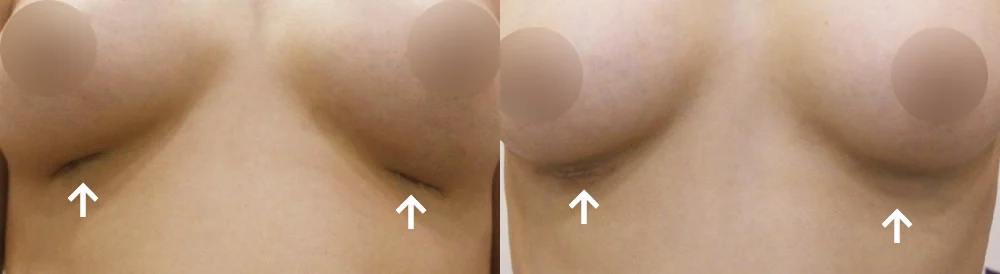
Line scars in both breast folds
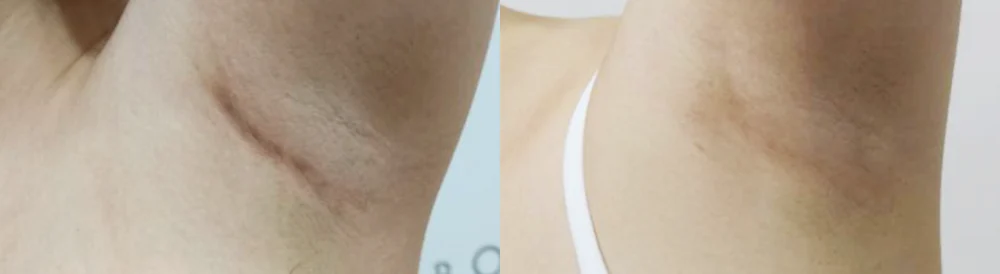
A diagonal line scar in the armpit
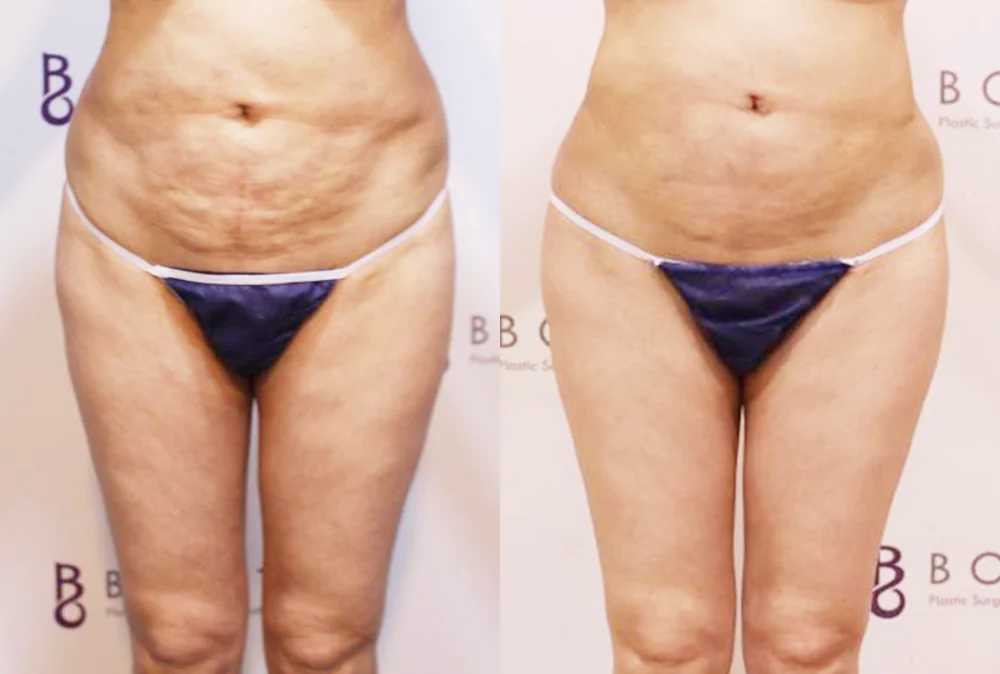
Widespread unevenness on the abdomen and front of the thighs
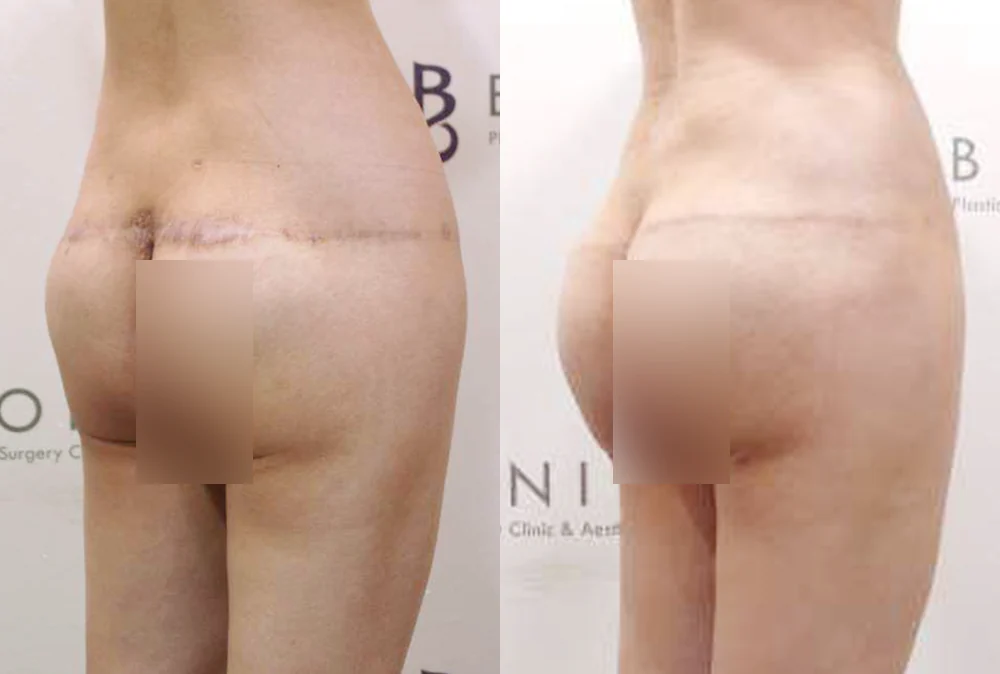
A long horizontal incision scar below the waist
* Results vary from person to person. Side effects are possible, so please decide after a thorough consultation with a doctor.
Frequently asked questions
My surgery was done at another clinic. Can the scar still be treated?
Yes. Knowing which operation you had and when, where the incisions were and what treatment followed helps identify the cause, so tell us as much as you remember. Surgical records and before-and-after photos are useful if you have them.
It has been 3 months since liposuction and the area is lumpy. Should it be fixed now?
Swelling may still be present at that stage. A review of liposuction complications recommends waiting at least about 6 months after the first operation before planning revision. In the meantime, how the unevenness changes and whether there are firm lumps are followed before the timing is decided.
The scar under my breast has become red and thick.
Breast augmentation scars are often red and raised in the first year and then settle. But if a scar keeps getting thicker, or is itchy or painful, it may be a hypertrophic scar and is worth having checked early. Such scars are usually first treated to calm the inflammation, and any shape that remains is revised at a suitable time.
Won't revising the scar leave another scar?
A new incision line is created, and it too needs time to settle. The purpose of revision is to make a wide, thick or sunken scar less noticeable. So it makes sense when there is a way to reduce the pulling force. Where an area has already had several operations, the work is staged according to the condition of the tissue.
What to prepare before your consultation
- The name and date of your surgery and the clinic where it was done, as far as you remember
- For liposuction or fat grafting, the areas and number of sessions; for breast surgery, the incision site and whether implants were used
- Photos from before surgery and at different times after it
- Treatments so far: scar injections, silicone products, laser, revision surgery
- Whether the scar itches, hurts or pulls when you move
Bonita Clinic is on the 3rd floor of 565 Gangnam-daero, Seocho-gu, Seoul, about 100 m on foot from Exit 8 of Nonhyeon Station (Line 7). You can read more on our Body Surgical Scars page. For sunken scars on the body after accidents or pin surgery, see Body Depressed & Incision Scars and the guide to depressed scars on the body. For scars after facial cosmetic surgery, see Facial Surgical Scars, and for breast revision surgery, see the guide to breast revision surgery.
References (5)
Sources that support the explanations in this article. Study findings describe general trends and do not guarantee individual results.
- Dixit VV, Wagh MS. Unfavourable outcomes of liposuction and their management. Indian J Plast Surg. 2013;46(2):377-392.doi:10.4103/0970-0358.118617Review: three causes of contour irregularities after liposuction (superficial over-removal, fibrous adhesion to muscle, redundant skin) told apart by lying down, skin retraction and muscle contraction; correction after about 6 months; touch-up liposuction combined with fat transfer; port-site scars (pigmentation, depression, hypertrophic in 1.3%); 8.2% of patients in a series of over 600 cases reported surface irregularities
- Sun J, Mu D, Liu C, et al. The Comparison of Scars in Breast Implantation Surgery with Inframammary Fold Incision Versus Axillary Incision: A Prospective Cohort Study in Chinese Patients. Aesthetic Plast Surg. 2019;43(2):328-335.doi:10.1007/s00266-018-1299-3Prospective cohort (abstract) of 163 breast augmentation patients: axillary scars were redder and more raised than inframammary scars at 1 and 6 months, but total scar scores were equal at 12 months with high satisfaction in both groups
- Ogawa R. Surgery for scar revision and reduction: from primary closure to flap surgery. Burns Trauma. 2019;7:7.doi:10.1186/s41038-019-0144-5Review: scar tissue is less extensible, so including it in flaps raises the risk of edge necrosis; tension prolongs inflammation and thickens scars; scars along the long axis of the body bear more tension; W-plasty is not suited to major joints such as the axilla and elbow
- Ogawa R. Keloid and Hypertrophic Scars Are the Result of Chronic Inflammation in the Reticular Dermis. Int J Mol Sci. 2017;18(3):606.doi:10.3390/ijms18030606Review (abstract): hypertrophic scars and keloids as chronic inflammation of the reticular dermis, treated with methods that reduce inflammation such as corticosteroid injection or tape, compression, stabilization and tension-reducing surgery
- Karam M, Abul A, Rahman S. Stem Cell Enriched Fat Grafts versus Autologous Fat Grafts in Reconstructive Surgery: Systematic Review and Meta-Analysis. Aesthetic Plast Surg. 2023;47(6):2754-2768.doi:10.1007/s00266-023-03421-zMeta-analysis (abstract) of stem cell-enriched versus routine fat grafts in reconstructive surgery, 16 studies and 686 patients: better mean volume retention with enrichment but more redness and swelling and longer operating time; no difference in fat necrosis, infection, cysts, satisfaction or scar assessment
About this article
This article separates general medical information from Bonita Clinic's own approach. Because the right decision depends on each person's condition, it is not a substitute for a consultation.
