 KOKorean
 ENEnglish
 JP日本語
JP日本語 CN中文(简体)
 TW中文(繁體)

Nose Scar Treatment in Seoul: When Laser Helps and When Excision Is Needed
If the problem is the scar's color, such as redness or rough texture, laser may be able to improve it. But if the scar has widened, is sunken and casts a shadow, or is raised so that the nose looks a different shape, laser alone rarely changes it. In that case, cutting out the scar and stitching it again, or filling the sunken area, is considered as well. The skin of the nose differs in thickness between the bridge, the tip and the alae (nostril wings). So even the same kind of scar may need a different approach depending on where it is. If you are thinking of treatment in Seoul, you can send photos first to see which approach may fit your scar.
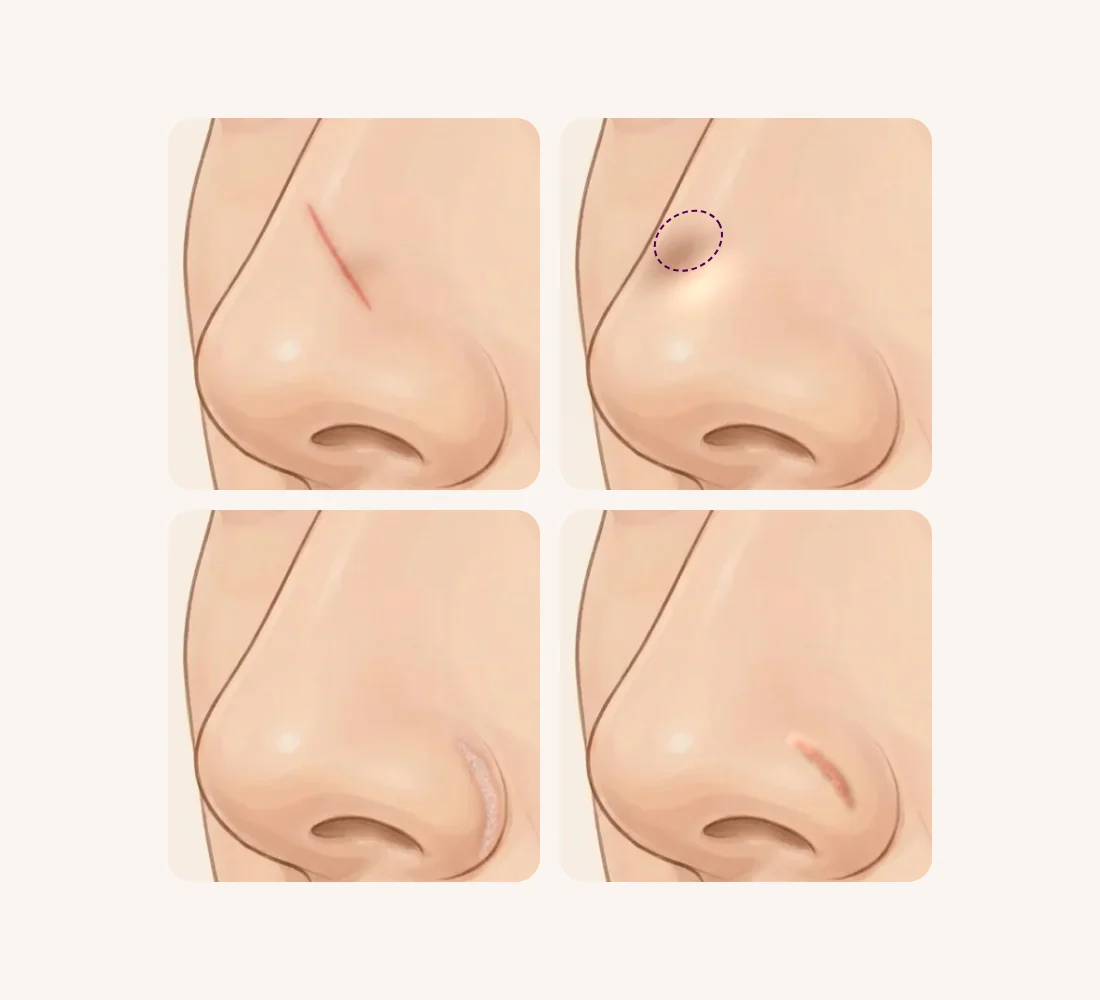
How do nose scars differ from one spot to another?
The thickness of nasal skin varies a lot by location. One study measured the skin of 77 rhinoplasty patients at a university hospital in Seoul using CT (a scan that shows the body in cross-sections). The skin averaged 3.3 mm at the root of the nose, just below the space between the brows. It thinned to 2.4 mm in the middle of the bridge, where bone meets cartilage, and thickened again to 2.9 mm at the tip. It was 2.3 mm at the columella (the small column between the nostrils). People with thicker skin at the tip and columella also had poorer results from tip surgery.2
Different skin in different parts of the nose
Why a scar stands out also differs a little from spot to spot.
- The bridge has thin skin, so the structures underneath can show through. If there is an implant, its effect needs to be considered as well.
- The tip tends to have thick skin with many oil (sebaceous) glands. So a stitched line sometimes looks sunken or widens. For oily skin, reviews describe stitching techniques in which the wound edges are bevelled to interlock and reduce scarring.1
- The columella is where the incision for open rhinoplasty (surgery that opens the nose through a cut across the columella) runs. In the study above its skin averaged only 2.3 mm.2
- The alae are often where incision lines from procedures such as alar reduction run. Because they are rounded, differences in the direction or height of a line tend to show. At Bonita Clinic, we regard the alae as an area where thickness and blood flow vary a great deal.
The nose sits in the middle of the face, so even a small scar is seen first. A review of nasal scarring (a paper that summarizes many studies) explains that each part of the nose has its own anatomy and underlying framework of bone and cartilage. This limits the surgical options compared with other areas of the face.3
Is it the color of the scar, or its shape?
There are two main reasons a scar bothers people.
- Color and texture: redness, brown discoloration, a rough surface
- Shape: widening, a sunken area, a raised area, pulling
A review on scar revision lists four features of a scar that does not stand out. It is a thin line running parallel to the skin's natural creases. Its color and height are similar to the surrounding skin, and it does not pull on nearby structures.1
Color and texture are mainly handled by laser. Shape is handled by surgery that cuts out the scar and stitches it again (excision and re-suturing), or by filling a sunken area. The two problems often occur together, so the order of treatment matters. Here is what is usually considered for each problem you can see.
Treatment depends on the problem you see
1A red line, brown marks or rough texture
Vascular laser and pigment or fractional laser to refine color and texture
Laser
2Sunken and casting a shadow
Adhesions are released and the hollow is filled; excision if needed
Adhesion release · filling
3The line has widened
The widened scar tissue is removed and closed again as a finer line
Excision · re-suturing
4Raised or thickened
Flattening injections first, then excision if needed
Injections · excision
Here is the reasoning behind each card in plain words. Vascular laser reduces the red blood-vessel part of a scar, and pigment or fractional laser refines the color and texture of the surface. A sunken scar has a base that has dropped, so smoothing only the surface does not change its height. A widened scar becomes a finer line only once that tissue is removed, and a thickened scar needs to be reduced first before the next step can be planned. That is why deciding what to do first, and what to leave until later, often matters more than choosing between laser and surgery.
How does previous nose surgery change things?
Nose scars often remain after surgery such as open rhinoplasty, alar reduction or implant removal, or after an injury. The tissue under the scar differs depending on where the incisions were made and how many operations there have been. In a nose that has had several operations, the skin and the tissue below may have become thin or firm. So the amount cut out is sometimes kept smaller. We also check whether an implant is still in place and whether there has been any inflammation.
The nose has little spare skin. When a wide or rounded scar cannot be removed in one go, it can be reduced step by step through several excisions spaced 6–12 weeks apart. This approach is described as especially useful on the face, where healthy skin should be saved as much as possible.1
What can laser, injections, excision and filling each do?
Each method changes something different. Knowing the evidence and limits of each makes it easier to understand the order you may be offered in consultation.
Laser: color and texture
Vascular lasers used on red scars reduce the blood vessels in the scar, and with them the redness. Reviews note that treatment can start around the time stitches are removed.1 One systematic review looked at 25 studies in which laser was started within 3 months of the wound. This kind of review searches for all relevant studies in a set way and sums them up. Early laser may reduce scar formation, but differences were not always significant, and better studies are still needed.4 A review of lasers for hypertrophic scars (red, thick, raised scars) found that the pulsed dye laser, a type of vascular laser, has been studied most. However, the evidence is not yet strong enough to recommend one laser over another.5
Injections: flattening a raised scar
Thickened scars can be treated with steroid injections, which put a medicine that calms scar tissue directly into the scar. They help flatten it, but they do not narrow its width. They can also cause thinning of the skin, loss of color or visible small vessels.1 On the thin skin of the bridge, this needs particular care.
Excision and re-suturing: width and shape
Cutting out a scar and stitching it again can change its width or an uneven shape directly. In exchange, a new stitch line is created, and that line also needs time to settle. It helps to start with the understanding that revision makes a scar less visible rather than erasing it.1
Filling: a sunken base
Sunken scars can be filled with your own fat. Across the 26 studies gathered in a systematic review, scar appearance, skin quality, volume and contour were reported to improve. The level of evidence is still low, though.6 If the base of the scar is stuck to the tissue below (an adhesion), it needs releasing first for the filling to lift the area evenly.
When does treatment start?
Surgical scars keep changing for quite a long time, even after they have healed on the surface. The review mentioned above notes that scars take around 12–18 months to mature. In adults, early revision is considered once 8–12 weeks have passed since surgery.1
So a red scar from recent surgery is often managed while watching its progress, rather than cut out right away. If it is judged unlikely to improve in shape with time, the timing is decided separately. Some treatments, such as laser for redness, can start early,14 so waiting does not mean doing nothing. Timing is covered in more detail in Surgical scars: when is the right time to seek treatment advice?
What can you expect, and what are the limits?
Scar revision does not remove a scar; it makes it less visible.1 Cutting out a scar creates a new stitch line, and that line also needs time to settle. Laser is often given over several sessions, and temporary redness or discoloration may appear during treatment. Nasal scars commonly need several stages, close follow-up and repeat procedures.3 Side effects such as bleeding, infection, inflammation or asymmetry are possible, so decisions need to be tailored to each person's condition.
How we approach it at Bonita Clinic
Bonita Clinic's nose scar restoration sequence
- 1Review surgery and scarLocation, depth and skin thickness set the order
- 2Flatten or exciseRaised or thickened scars
- 3FillSunken scars, by grafting
- 4Vascular and combined laserRedness, remaining color and texture
- 5Follow-upShape correction in 1–3 sessions
Nose scars vary widely, so the process may differ for you
Treatment options you can discuss in Seoul
Bonita Clinic opened in 1995, and Dr. Kwang-Seop Chung, a board-certified plastic surgeon trained in Brazil, has seen patients at the same location ever since. Since that time the clinic has treated marks left by alar reduction, implant removal and open-approach incisions. Because cosmetic nose surgery and scar treatment are handled in the same clinic, assessment starts with why the scar formed. Options discussed in consultation include:
- Flattening raised scars, and excision when the shape needs correcting
- Grafting to fill sunken scars
- Vascular laser for red scars, then combined lasers for remaining color and texture
- A review of any implant and the tissue over it before the scar is treated
Which of these suit your scar, and in which order, can only be decided once your nose has been examined.
What shapes the plan and cost for a nose scar
Two nose scars that look similar in a photo can need quite different work. Location, the type of problem and the number of stages shape the plan, and the cost follows from the plan.
- Where the scar is: bridge, tip, ala or columella
- Whether the problem is color, width or height
- Excision, grafting, laser, or a combination
- Previous nose surgery and any implant
- Anesthesia: local
- Number of stages needed
Plan and estimate after we examine you
A final estimate is given after the in-person examination, once it is clear which methods are needed and in how many stages. Photos alone can point to a likely direction, but they cannot fix the scope.
What photos can show, and what needs an exam in person
Photos are a useful start for a nose scar, especially because the alae and columella are hard to describe in words. They cannot show skin thickness or what lies under the scar.
Photos can show
- Where the scar is and how long it is
- Redness and brown discoloration
- Visible widening or raised edges
- Nose shape from the front, side and below
Needs an in-person exam
- Skin thickness over the scar
- Whether the base is tethered or sunken
- How firm a raised scar is
- Implant position and the tissue over it
- Any effect on breathing
Helpful photos: the front, both sides, and a view from below looking up, in good light and without makeup. Scars on the alae show up well from a low angle. If you had nose surgery, photos from before and soon after it help us see how the scar has changed. You can send us a message with your photos and your surgery history.
Planning your visit and recovery
What can be confirmed in advance is this: at Bonita Clinic, we treat nose scars as a procedure, with excision if needed, under local anesthesia. You go home the same day, and stitches are used if the scar is excised. Shape correction is usually split into 1–3 sessions, so more than one visit may be needed. How long to stay in Seoul, when to return and when stitches come out depend on which methods are used, so these are planned together with you at consultation.
If your nose surgery was recent, the scar may still be changing. In that case it can be more useful to send photos first and plan the visit around when the scar has settled, rather than travelling straight away. Early treatments such as laser for redness are discussed as part of that plan.14
Right after treatment the area is protected, and you are told when you can start washing your face and wearing makeup. Redness and swelling settle gradually, and sun protection matters from that point. After returning home, keep taking dated photos in similar light. Contact a doctor promptly if redness, pain, swelling or discharge gets worse instead of settling.
Real treatment cases
These are nose scar cases treated at Bonita Clinic. We chose cases in different locations; results may vary from person to person.
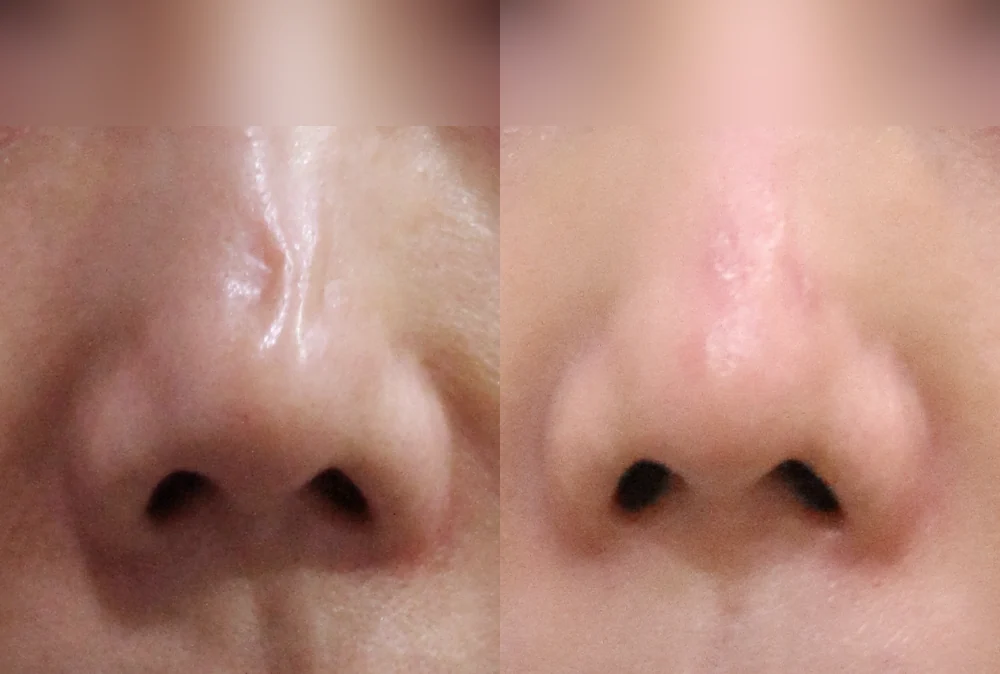
Linear scar on the nasal bridge
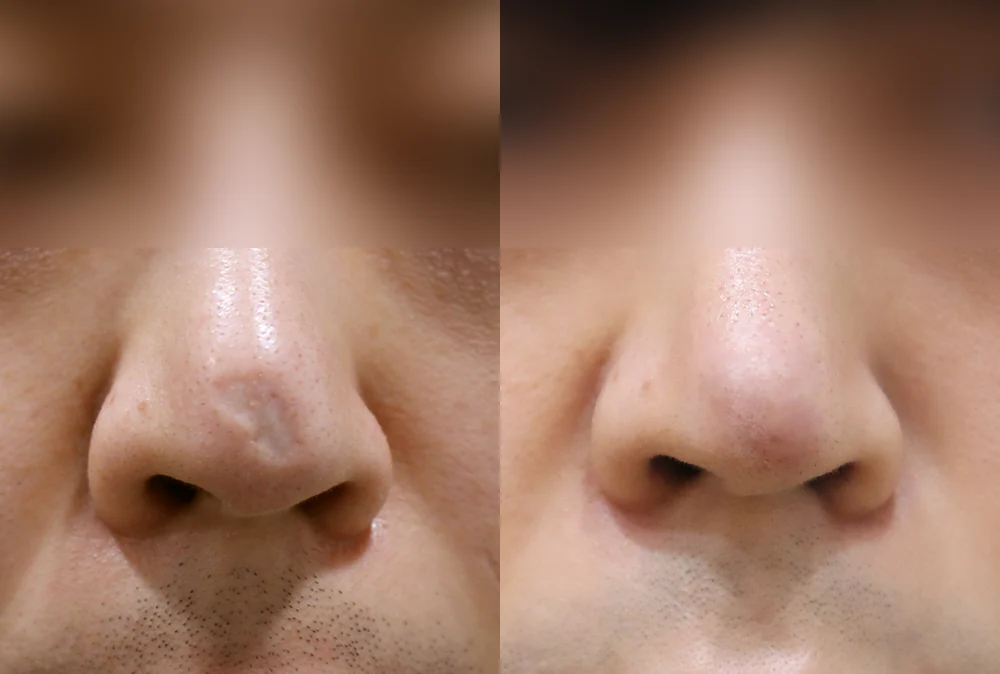
Scar on the nasal tip
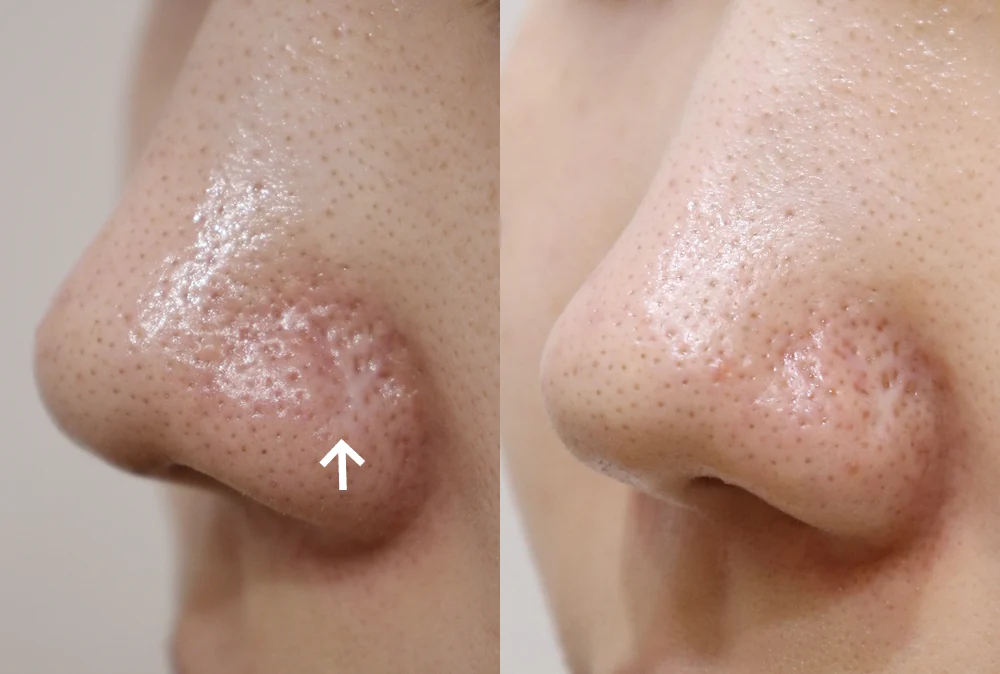
Depressed skin on the ala (nostril wing)
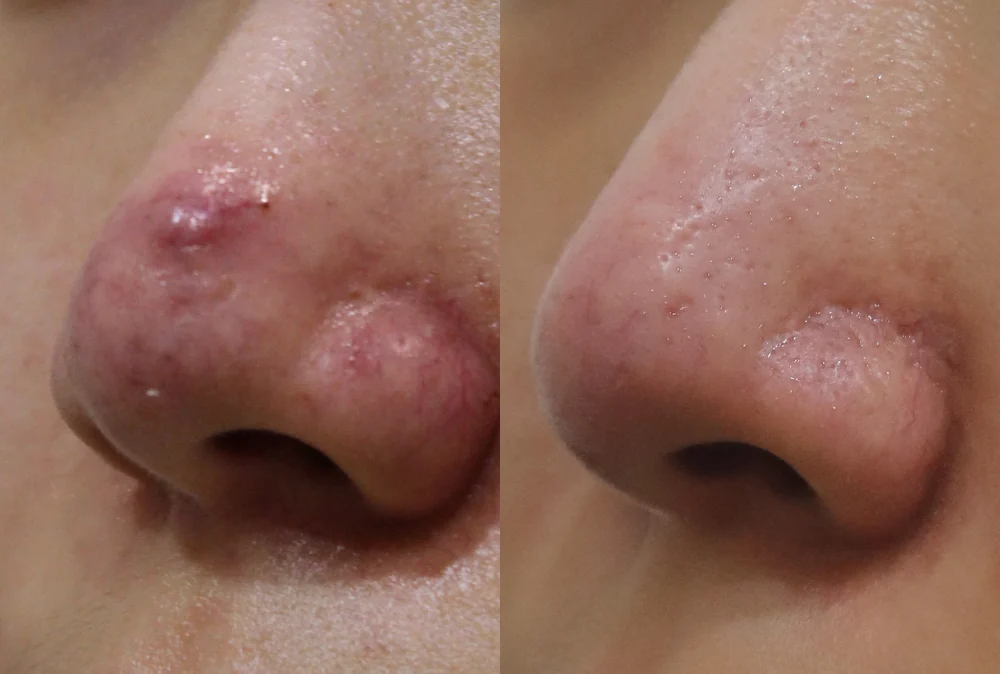
Raised scar and redness near the ala
* Results vary from person to person. Side effects are possible, so please decide after a thorough consultation with a doctor.
Frequently asked questions
I have had laser many times, but the depression is still there.
Scars whose base is stuck to deeper tissue, or that have lost volume, can still cast a shadow after laser resurfacing. This is because lasers mainly work on texture and color at the surface and in shallow layers. So we first check whether releasing adhesions or filling is needed. The relationship between depressed scars and laser is explained further in our acne scar guide.
Can scars from alar reduction be improved?
Bonita Clinic has treated scars left by alar reduction, implant removal and open-approach incisions since 1995. Incision lines on and around the alae sit on a curved surface, where differences in direction and height show easily. So we first work out whether the problem is redness, a sunken area or a raised line, and then choose the method.
I still have a nasal implant. Can the scar be treated?
You can have a consultation. We first check whether an implant is in place, how thin the skin over it has become and whether there has been any inflammation. Then we decide the order and extent of scar treatment. When implant problems and scars occur together, which to deal with first is decided at the same time.
My scar is old. Can it still be treated?
Old scars can be treated too. Settled scars need tissue to be released and filled, so they may need more steps than new ones. We plan after checking depth and adhesion at consultation.
Can I return to daily life right after treatment?
It depends on the method. Laser care has a relatively short recovery, while surgical restoration such as excision or grafting needs more recovery time depending on the extent. If you have important plans or a fixed return date, tell us at consultation so we can plan around them.
What to prepare before your consultation
- Your nose surgery history: type of surgery (open approach, alar reduction, implant), number of operations, and when the last one was
- Treatments you have had since the scar formed (laser, injections) and how the scar changed after them
- Whether you have any breathing problems, such as a blocked nose
- Medicines you take regularly
Bonita Clinic is on the 3rd floor of 565 Gangnam-daero, Seocho-gu, a walk of about 100 m from Exit 8 of Nonhyeon Station on Line 7. You can read more on our Nose Scars page and Facial Surgical Scars page. Timing for surgical scars is covered in the surgical scar timing guide, and depressed scars elsewhere on the face in the guide to facial depressed and incision scars.
References (6)
Sources that support the explanations in this article. Study findings describe general trends and do not guarantee individual results.
- Garg S, Dahiya N, Gupta S. Surgical scar revision: an overview. J Cutan Aesthet Surg. 2014;7(1):3-13.doi:10.4103/0974-2077.129959Review (full text): features of an inconspicuous scar, scar maturation over 12–18 months and early revision from 8–12 weeks in adults, vascular laser from suture removal, steroid injections flatten but do not narrow scars and can cause atrophy or color loss, closure in sebaceous skin, serial excision 6–12 weeks apart, revision makes scars less noticeable rather than erasing them
- Cho GS, Kim JH, Yeo NK, et al. Nasal skin thickness measured using computed tomography and its effect on tip surgery outcomes. Otolaryngol Head Neck Surg. 2011;144(4):522-527.doi:10.1177/0194599811398936CT study of 77 rhinoplasty patients at Asan Medical Center, Seoul (abstract): mean skin thickness 3.3 mm at the root, 2.4 mm mid-bridge, 2.9 mm at the tip and 2.3 mm at the columella; thicker tip and columella skin linked to poorer tip surgery results (the alae were not measured)
- Caughlin BP, Barnes C, Nelson JS, Wong BJ. Unique Clinical Aspects of Nasal Scarring. Facial Plast Surg Clin North Am. 2017;25(1):45-54.doi:10.1016/j.fsc.2016.08.004Review of nasal scarring (abstract): nasal subunit anatomy and framework limit surgical options compared with other facial areas; multiple techniques and lasers are combined; several stages, close follow-up and repeat procedures are often needed
- Karmisholt KE, Haerskjold A, Karlsmark T, et al. Early laser intervention to reduce scar formation - a systematic review. J Eur Acad Dermatol Venereol. 2018;32(7):1099-1110.doi:10.1111/jdv.14856Systematic review of 25 studies starting laser within 3 months of wounding (abstract): early laser may reduce scar formation, not always significantly; higher-quality studies needed before standard protocols
- Vrijman C, van Drooge AM, Limpens J, et al. Laser and intense pulsed light therapy for the treatment of hypertrophic scars: a systematic review. Br J Dermatol. 2011;165(5):934-942.doi:10.1111/j.1365-2133.2011.10492.xSystematic review of 13 studies of laser for hypertrophic scars (abstract): pulsed dye laser studied most, but evidence is insufficient to compare lasers (585 nm low, 595 nm moderate efficacy)
- Negenborn VL, Groen JW, Smit JM, et al. The Use of Autologous Fat Grafting for Treatment of Scar Tissue and Scar-Related Conditions: A Systematic Review. Plast Reconstr Surg. 2016;137(1):31e-43e.doi:10.1097/PRS.0000000000001850Systematic review of 26 studies (905 patients) of fat grafting for scars (abstract): improvements in appearance, skin quality, pain, volume and contour reported, but the level of evidence is low
About this article
This article separates general medical information from Bonita Clinic's own approach. Because the right decision depends on each person's condition, it is not a substitute for a consultation.
