 KOKorean
 ENEnglish
 JP日本語
JP日本語 CN中文(简体)
 TW中文(繁體)

Acne Scar Treatment in Seoul: What to Consider When Laser Results Are Limited
Laser treatment smooths the texture and evens the color of the skin's surface and the shallow layer just below it. Some scars have a base stuck to the tissue underneath and pulled down, some are narrow and deep, and in some volume has been lost. In these, the shadow of the dip tends to stay even when your skin texture improves. In these cases, it is worth checking first before having more of the same laser. You may need treatment that releases what is stuck, lifts the base of the scar, or fills the empty space. If you are considering treatment in Seoul, you can send photos of your scars first to see which approach may fit your case.
What do acne scars look like?
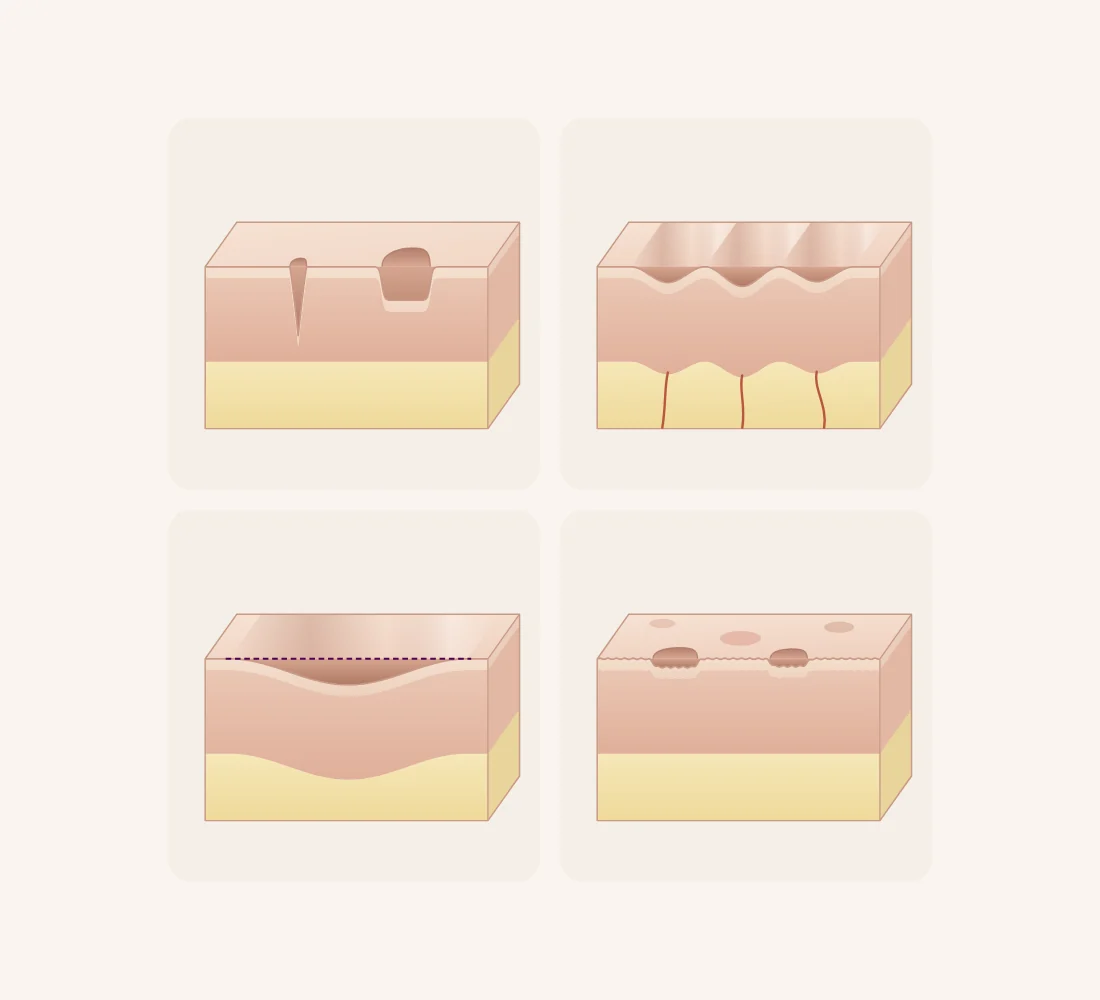
Where acne inflammation was severe or lasted a long time, the skin is more likely to be left with a dip, or depressed scar.1 These scars are not all the same shape. Some are narrow and deep, as if the skin had been pricked with an awl. Some have a flat floor with sharp edges. Others sink gently, like a wave. Many faces have a mix of these shapes.12
Acne scar types mixed on one face
Each shape sits at a different depth and forms for a different reason, so each one needs a different kind of treatment. This guide first looks at how far a laser reaches into the skin, and then at what each scar shape needs.
How deep can a laser reach?
You can think of skin as three layers. There is the thin outer layer (the epidermis), the layer below it that supports the skin (the dermis), and the fat layer under that (subcutaneous fat).
Lasers such as fractional and CO2 lasers act mainly on the skin's surface and the layer just beneath it. That makes them good at smoothing rough texture, softening the edges of shallow dips, and reducing redness or pigmentation. An international consensus is a set of recommendations agreed by experts from many countries. In one such consensus, 24 dermatologists and plastic surgeons from 12 countries took part. They regarded energy-based devices, including fractional lasers, vascular lasers and radiofrequency, as a first-line treatment (one to consider first) for many types of acne scar.5 So laser is not useless; it simply has a specific job.
The problem comes when the cause of the dip lies deeper than that. There are two common situations:
- Tough fibrous tissue under the scar is holding its base and pulling it down (this kind of sticking-down is called tethering, or an adhesion)
- Tissue was lost where the inflammation used to be, so the volume itself has shrunk
In either case, the difference in height remains no matter how smooth the surface becomes. Rolling scars, for example, are described as shadows created when the dermis is anchored to the fat layer below by abnormal fibrous bands.1 Imagine a piece of cloth tied down from underneath by a thread in the middle: only that spot sinks. If you feel your skin has improved after several laser sessions but the scars have not, this is usually why.
How are the scar types different?
Depressed acne scars are usually divided into three types by their appearance.12 When several types are mixed, as in the picture above, working out which scars are present, and in what proportion, is the starting point for a treatment plan.
| Type | Appearance | Why laser alone struggles |
|---|---|---|
| Ice pick | Narrow opening under 2 mm, deep as if pierced by an awl | The base can reach the deep dermis or even the fat below1 |
| Boxcar | Sharp edges with a flat base, most often 1.5–4 mm across | If shallower than about 0.5 mm, laser can soften the edges; if deeper, the low base remains1 |
| Rolling | 4–5 mm or wider, gently sloping and wave-like | Fibrous bands connected to the tissue below pull the skin down, so surface treatment alone does not lift it1 |
As the table shows, if the base of a scar is deeper than where lasers mainly work, or is tied to the tissue below, laser alone has a hard time levelling it.
Flat red or brown marks without any dip are a problem of color rather than contour, and are assessed separately.1 If some of what you think of as scars turn out to be marks like these, the treatment plan changes as well.
A simple check in the mirror
Gently stretch the skin beside a scar with two fingers. If the dip fades when stretched, it is likely a scar with gently sloping edges, such as a rolling scar. If it stays the same, it is likely a scar with a deep base, such as an ice pick or deep boxcar scar. This is only a rough guide; an accurate assessment is made at the clinic.
Gently sloped scar
Fades when stretched
Scar with a deep base
Stays when stretched
Which treatment suits which scar?
Because each scar shape forms for a different reason, each one is fixed in a different way. Look at the pairs in the picture first, then check the table for what each method does and what to keep in mind.
Treatments mainly used for each scar shape
1Narrow, deep scars
A punch removes the scar or frees its base and lifts it to skin level
Ice pick, deep boxcar → punch
2Broad, gently sunken scars
The fibrous bands pulling the base down are cut to release it
Rolling → subcision
3Hollows from lost volume
The lost volume is replaced with fat grafting, fillers or similar
Broad hollows → filling
4Shallow dips, texture or color
Laser or RF microneedling refines the surface
Shallow scars → laser
| Treatment | What it does | Typically suited to | Good to know |
|---|---|---|---|
| Subcision (adhesion release) | Cuts the fibrous bands under the skin, freeing a base that has been pulled down | Rolling scars, scars whose base is pulled down | Bruising and swelling may occur, and the area is watched in case it sinks again4 |
| Punch excision / punch elevation | Uses a small round tool (a punch) to remove a narrow, deep scar, or to free its base and raise it to skin level | Ice pick, deep boxcar | Done one scar at a time, so more scars mean more stages |
| Filling (fat grafting, fillers, etc.) | Replaces lost volume | Broad sunken areas that cast shadows | How long it lasts varies from person to person, and if the base is still tethered the spot may not lift evenly13 |
| Laser / RF microneedling | Refines surface texture, shallow edges, redness and color | Shallow boxcar, remaining texture and color | Has difficulty changing a deep base or tethering |
Research points the same way. A classification published in 2001 divided acne scars into these three types. Once the scar type has been identified, it proposed choosing between punch excision, punch elevation, subcision and laser resurfacing (using a laser to renew the skin surface).2
A later systematic review (a study that gathers all the research on one question and looks at it together) found that subcision was used mainly for rolling scars. The degree of improvement varied widely between studies. Side effects such as swelling and bruising were mostly short-lived, and some studies added aftercare specifically to stop released scars from sinking back down.4 Subcision is a common choice for rolling scars, but how much it will help is hard to predict in advance.
In practice, two or three methods are often combined in sequence rather than relying on just one.1 The American Academy of Dermatology also notes that several treatments are often used together to improve results. It explains that most fillers are temporary, lasting roughly 3 months to 2 years depending on the type.3
Why does the order of treatment matter?
If you are still breaking out, new scars can keep forming, so the first step is to calm the acne. The American Academy of Dermatology notes that scar treatment typically begins once acne is under control.3 Reviews also point out that the longer and more intense the inflammation, the more likely scarring becomes, which makes acne treatment itself the first step in preventing scars.1
There is an order within scar treatment as well. Where tethering still holds the base down, injected fat may not raise that spot evenly.1 It is like filling underneath the cloth without untying the thread: the tied spot still stays sunken. So the usual flow is:
- Release deep tethering and raise the base first (adhesion release, punch)
- Fill the lost volume next
- Refine surface texture and color last (laser)
Repeating the same laser from the start can leave the surface smoother while the deep scars stay as they were, and the number of sessions simply grows.
What can you expect, and what are the limits?
The goal of scar treatment is to make scars less noticeable, not to make them disappear. Some trace may remain even after several methods, and how much they improve depends on the depth and extent of the scars and on your skin type. A systematic review of acne scar treatments concluded that each method has its pros and cons and that there is no easy and definitive solution. Larger trials are still needed to pin down how well each works.4
Any procedure can cause side effects such as bruising, swelling, redness, pigment changes or infection. If your skin tends to darken after inflammation (post-inflammatory hyperpigmentation), laser intensity and intervals need to be set more carefully. A study looked at patients in Hong Kong treated with fractional laser. This risk depended on the energy (strength) and density of the treatment (how closely the laser spots are packed). Cooling the skin also mattered.6 That is why most treatment is done in several stages spaced apart rather than all at once.
How we approach it at Bonita Clinic
- 1Check the scardepth · width · adhesions · lost volume
- 2Raise the basepunch · adhesion release
- 3Fillyour own fat (fat stem cells)
- 4Refine the surfacelaser: texture · pores · redness
Progress checked every 4 weeks · more only if marks remain
Treatment options you can discuss in Seoul
Bonita Clinic opened in 1995 and has stayed at the same location since, with Dr. Kwang-Seop Chung, a board-certified plastic surgeon trained in Brazil, seeing patients himself. For depressed and pore-type acne scars, we offer the following methods. Only the ones your scars need are used:
- An assessment of depth, width, tethering and lost volume before anything else
- Punch techniques that free and lift the base of narrow, deep scars
- Adhesion release for scars tethered from below
- Filling broad hollows with your own fat (fat stem cells)
- Combined laser care with two or three lasers for remaining texture, pores and redness, reviewed every 4 weeks
The combination and the order are set only after your scars have been examined in person.
Why plans and costs vary between faces
Acne scar treatment is rarely a single procedure. What shapes the plan, and therefore the cost, is the mix of scar types on your face and how many steps they need, rather than the label "acne scars" itself.
- Mix of ice pick, boxcar and rolling scars
- How many scars, over how wide an area
- Whether tethered bases need releasing
- Whether hollows need filling with fat
- Anesthesia: topical cream or local
- Laser sessions added after each review
Plan and estimate once we have seen you
A final estimate is given after the in-person exam, once the scar types and the number of stages are clear. Because laser sessions are added only when marks remain at each 4-week review, the later part of the plan is confirmed as treatment goes on.
What your photos can tell us, and what needs an exam in person
Photos are a good way to start the conversation. But they cannot show how deep a scar goes or whether its base is tethered, and those two things decide most of the plan.
Photos can show
- Where the scars are and roughly how many
- Redness and brown marks
- Broad shadows in side lighting
- Changes since earlier treatment (older photos)
Needs an in-person exam
- How deep each scar goes
- Whether the base is tethered
- How much volume is lost
- Skin thickness and pigment tendency
- Active acne to treat first
Helpful photos: your face from the front and at 45 degrees on each side, without makeup, in good light. Depressed scars look different depending on the direction of light, so one photo lit from above and one lit from the side are especially useful. If you still have photos from before earlier laser sessions, include them. You can send us a message with your photos and a list of the treatments you have had so far.
Planning your visit and recovery
What we can confirm in advance is this: at Bonita Clinic, acne scar treatment is done as a procedure, with excision if needed, under topical cream or local anesthesia (numbing only the area being treated). You go home the same day, and stitches are used only if a scar is excised.
Because treatment is usually staged and laser care is reviewed every 4 weeks, it often involves more than one visit. How many visits you need, how far apart they are and how long to stay in Seoul each time depend on which steps your scars need. These are planned together with you at consultation.
Right after treatment the area is protected, and you are told when you can start washing your face and wearing makeup. Redness and swelling then settle gradually, and sun protection matters from that point. Bruising and swelling can follow adhesion release.4 If your skin tends to darken after inflammation, tell us; laser settings and intervals are chosen with that in mind.6
After returning home, keep treated skin protected from the sun and take dated photos in the same lighting, which makes the next review more accurate. Contact a doctor promptly if redness, pain or discharge increases instead of settling.
Real treatment cases
These are acne scar cases treated at Bonita Clinic. We chose cases with a mix of scar types; results may vary from person to person.
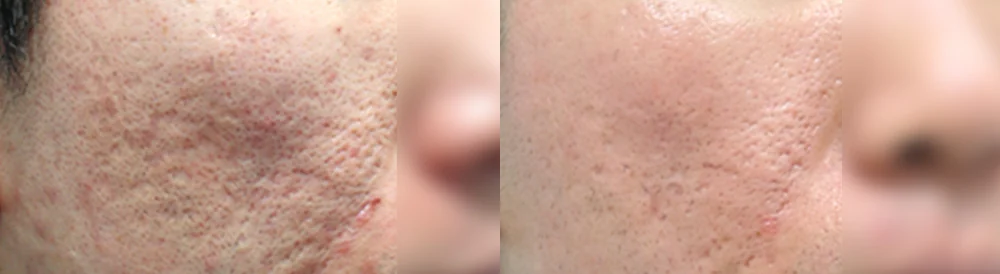
Depressed scars spread widely across the whole cheek
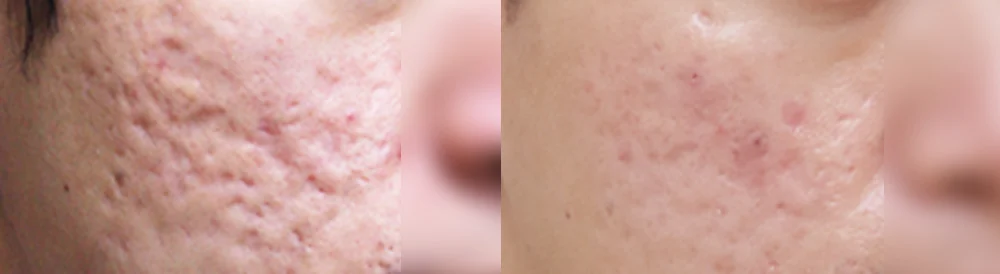
Many large, deep depressions
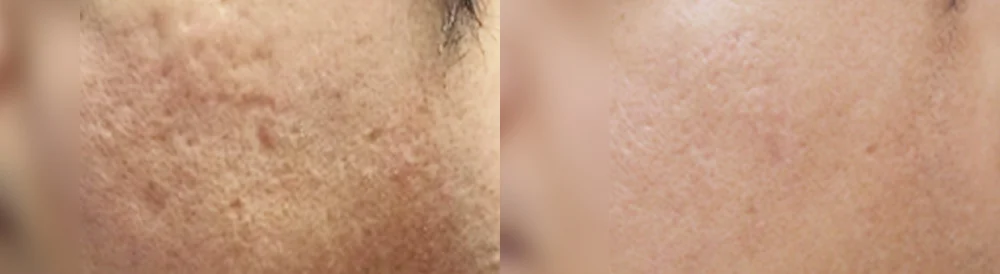
Shallow depressions and rough texture over a wide area
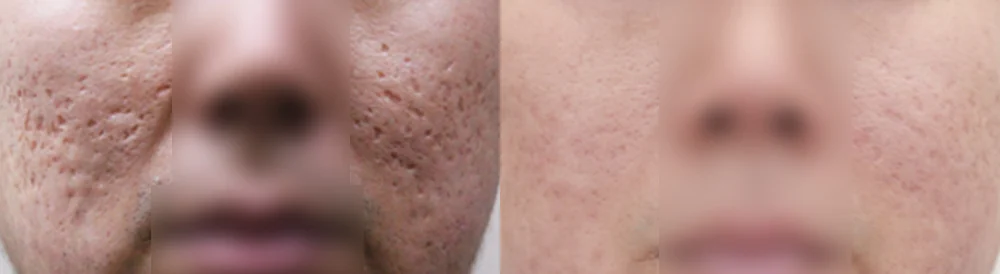
Depressed scars spread evenly over both cheeks
* Results vary from person to person. Side effects are possible, so please decide after a thorough consultation with a doctor.
Frequently asked questions
My scars are many years old. Can they still be treated?
Yes, old scars can be treated too. Settled scars are often firmly tethered at the base, so the tissue needs to be released and filled. That can mean more steps than for newer scars. The plan is made after the depth and degree of tethering have been checked in consultation.
How many sessions will I need?
It depends on the depth and extent of the scars and on your skin type. At Bonita Clinic, surgical restoration such as punch techniques or adhesion release is usually done once and then reviewed. Laser care is reviewed every 4 weeks and added only if marks remain.
Can I go back to normal life right after treatment?
It depends on the method. Laser care has a relatively short recovery, while surgical restoration of the scar base needs more recovery time depending on the area and extent. Bruising and swelling can follow adhesion release.4 If you have important plans or a fixed return date, tell us at consultation so the order and timing can be arranged around them.
Are red or brown marks scars too?
Flat red or brown marks without a dip are classified as a problem of color rather than contour.1 They are treated with methods that target color, not with treatments that lift the base. When they sit alongside depressed scars, Bonita Clinic deals with the dips first and refines the color last.
If I have the scars filled, how long will it last?
The American Academy of Dermatology explains that most fillers are temporary, lasting from about 3 months to 2 years depending on the type.3 Scars whose base is tethered to the tissue below may also not lift evenly when filled.1 At Bonita Clinic, broad hollows are filled with your own fat (fat stem cells), and whether tethered areas need releasing first is decided at the same time.
What to prepare before your consultation
- Whether you still get acne, and when your last bad breakout was
- Treatments you have had so far (type of laser and number of sessions, when you had the last one, and whether you have had fillers or fat grafting)
- Whether your skin has darkened after laser or peels before, and any acne medication you are taking
- The areas that bother you most, and how much time you can set aside for recovery
The clinic is about 100 m on foot from Exit 8 of Nonhyeon Station on Seoul Subway Line 7, on the 3rd floor of 565 Gangnam-daero, Seocho-gu. You can read more about the treatment process on our Acne & Pore Scars page. Depressed scars on the face from injury or surgery are covered on our Facial Depressed & Incision Scars page and in the guide to facial depressed and incision scars. Scars on the nose are covered in the nose scar guide.
References (6)
Sources that support the explanations in this article. Study findings describe general trends and do not guarantee individual results.
- Fabbrocini G, Annunziata MC, D'Arco V, et al. Acne scars: pathogenesis, classification and treatment. Dermatol Res Pract. 2010;2010:893080.doi:10.1155/2010/893080Review (full text): ice pick (under 2 mm, reaching the deep dermis or fat), boxcar (shallow 0.1–0.5 mm / deep 0.5 mm or more) and rolling (4–5 mm or wider, dermis anchored to the fat by fibrous bands) scars; flat red or brown marks as a color problem; acne treatment as the first step in prevention; fat may not lift tethered areas evenly; combined treatment
- Jacob CI, Dover JS, Kaminer MS. Acne scarring: a classification system and review of treatment options. J Am Acad Dermatol. 2001;45(1):109-117.doi:10.1067/mjd.2001.113451Classification (abstract): three types of depressed acne scar (ice pick, rolling, boxcar) and a treatment algorithm choosing between punch excision, punch elevation, subcision and laser resurfacing by type
- Acne scars: Consultation and treatmentAmerican Academy of Dermatology patient page (updated December 2023): scar treatment usually begins once acne is under control; several treatments are often combined; most fillers are temporary, lasting 3 months to 2 years
- Kravvas G, Al-Niaimi F. A systematic review of treatments for acne scarring. Part 1: Non-energy-based techniques. Scars Burn Heal. 2017;3:2059513117695312.doi:10.1177/2059513117695312Systematic review of 36 studies from the previous ten years: subcision mainly used for rolling scars with widely varying improvement; mostly short-lived swelling and bruising; aftercare to prevent re-depression; no easy, definitive solution and larger trials needed
- Salameh F, Shumaker PR, Goodman GJ, et al. Energy-based devices for the treatment of Acne Scars: 2022 International consensus recommendations. Lasers Surg Med. 2022;54(1):10-26.doi:10.1002/lsm.23484International Delphi consensus of 24 experts from 12 countries (abstract): energy-based devices such as fractional, vascular lasers and radiofrequency considered first-line for many acne scar types; combinations and skin of color discussed separately (detailed settings not used here)
- Chan HH, Manstein D, Yu CS, et al. The prevalence and risk factors of post-inflammatory hyperpigmentation after fractional resurfacing in Asians. Lasers Surg Med. 2007;39(5):381-385.doi:10.1002/lsm.20512Retrospective study of 37 patients in Hong Kong plus volunteer tests (abstract): the risk of post-inflammatory hyperpigmentation after fractional laser depends on energy and density, cooling matters, and suitable settings can reduce the risk
About this article
This article separates general medical information from Bonita Clinic's own approach. Because the right decision depends on each person's condition, it is not a substitute for a consultation.
