 KOKorean
 ENEnglish
 JP日本語
JP日本語 CN中文(简体)
 TW中文(繁體)

Chickenpox, Smallpox and Cleft Lip Scars in Seoul: Treating Old Depressed Scars When Laser Is Not Enough
Old scars can still be treated, but laser alone often leaves the dips looking much the same. Narrow, deep chickenpox or smallpox pits usually need their floor raised separately. Broad sunken areas need the tethering (where the floor is stuck down) released or the lost volume filled. Cleft lip scars are assessed for whether the thickened or widened line and the uneven lip border should be revised. The realistic goal is a scar whose shadow and edges show less, not one that disappears. If you are considering treatment in Seoul, you can send photos and your treatment history first to see which approach may fit your scars.
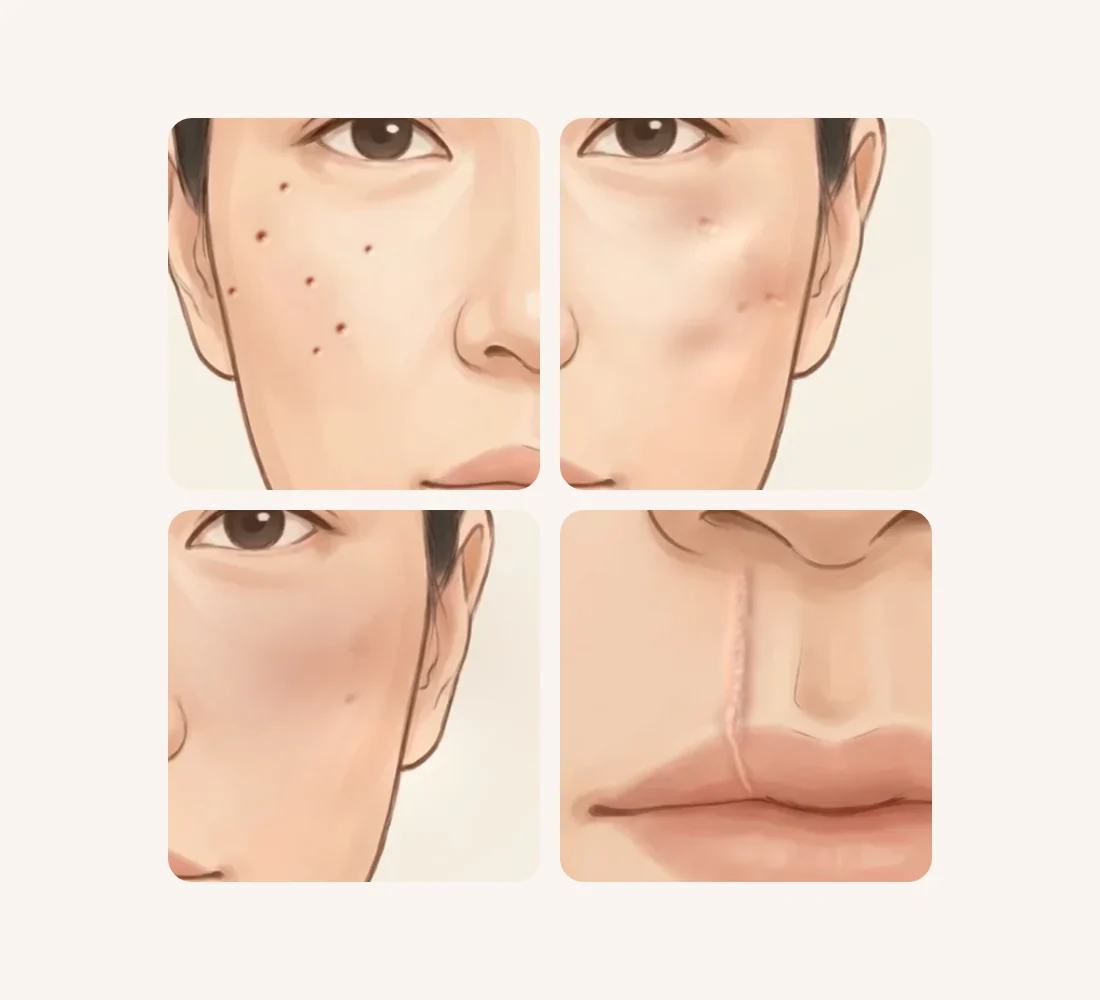
Why do these three scars stay?
Chickenpox, smallpox and cleft lip have nothing in common as conditions, but the scars they leave share one feature: most were formed in childhood and have been there for decades. The redness fades and the color softens over time, yet a dip whose floor has sunk rarely fills back in on its own. So the useful question is not whether the scar will improve with more time, but what the floor of the scar looks like now.
An old scar: what remains
Chickenpox (varicella) scars
Lasting depressed scars have been reported in 7–18% of people after chickenpox.1 Acne scars come in several distinct shapes (narrow and deep, box-like with steep edges, or broad and rolling). Chickenpox scars, by contrast, tend to look alike.1 Even so, the width and depth of individual pits can differ on the same face, so each scar's floor is assessed separately before a method is chosen.
Smallpox scars (pockmarks)
Smallpox has long been eradicated, so the pockmarks people ask about today are scars from infections many decades ago. Why smallpox left such deep scars is still not fully understood. A review of 150 years of textbooks and journal articles looked for the cause. It judged the destruction of sebaceous glands (the small glands that release oil onto the skin) to be the most plausible explanation. But it noted that the virus has never actually been found in the sebaceous glands or even in the dermis, so the mechanism remains speculative.2 At Bonita Clinic, we treat depressed smallpox scars on the body as well as the face.
Cleft lip repair scars
A cleft lip (an upper lip that is split at birth) is usually repaired in early childhood. But scarring on the philtrum and upper lip, and a mismatch along the lip line, can remain into adulthood. One study looked at 108 adults who had lip revision alone (without nose surgery). Scar excision was performed in 80.6% and reconstruction of the ring muscle around the mouth (orbicularis oris) in 59.3%. Philtral reconstruction was done in 47.2% and revision of the red part of the lip (vermilion) in 35.2%.5 That is, revision is often about more than the scar line itself. The most common reason for seeking revision was a life transition such as education, work or marriage (41%).5
What adult cleft lip revision included
| Scar | What it usually looks like | What is checked first |
|---|---|---|
| Chickenpox | Scattered pits of different sizes on the face | Width and depth of each pit, whether the floor is tethered |
| Smallpox | Widespread pits on the face and body | Extent, skin thickness, lost volume |
| Cleft lip repair | Vertical scar on the philtrum, uneven lip line | Width and thickness of the scar, muscle pull, lip line and nose shape |
Why does laser alone often fall short?
Lasers are used to refine texture, redness and color at the skin surface and in the shallow dermis. But in these three situations, the surface can become smoother while the shadow stays:
- The floor of the scar is deep
- The floor is held down by the tissue beneath
- Volume is missing
If several laser sessions have left your pits looking much the same, one of these three is usually still there.
Scar shapes are described in the most detail in acne scar research. It divides them into three kinds, with a different method suited to each. There are narrow scars under 2 mm that tunnel deep, and round 1.5–4.0 mm dips with steep vertical edges. There are also broader scars up to about 5 mm whose floor is anchored to deeper tissue and casts a shadow.3 Few studies have applied this classification directly to chickenpox or smallpox scars. But the principle that the method depends on the floor carries over.
Which method suits which kind of scar?
Reviews conclude that combining methods according to scar shape works better than relying on any one technique.3 Look at the pairs in the picture first, then read what each method does below.
Methods matched to scar shape
1Narrow, deep pits
A punch removes them, or frees the floor in a small circle and lifts it
Punch excision, punch elevation
2A tethered floor casts a shadow
The fibrous strands holding the floor down are cut to release it
Subcision
3Broad volume loss
Your own fat is moved to fill the sunken area
Fat grafting
4A thick or widened surgical scar
The scar is cut out and closed again as a finer line
Excision and re-suturing
- Punch excision: a round blade about the size of the scar removes a narrow, deep scar, and the opening is closed. For scars larger than 3.5 mm, an elliptical excision may be the better choice.3
- Punch elevation: for broad dips without hardened tissue underneath, only the floor is freed and fixed slightly higher than the surrounding skin.3
- Subcision (releasing the tethering): a needle passed under the scar cuts the fibrous strands holding the floor down. It suits broad, rolling dips and works less well for narrow deep scars. The dip can recur, and swelling, bruising, bleeding and infection are possible.3
- Fat grafting: your own fat fills areas that have lost volume. A meta-analysis (a study that pools the results of many studies) looked at 52 studies (1,568 patients) of fat transfer in facial reconstruction. It found that an average of 1.5 sessions was needed. At one year, 50–60% of the injected volume remained, and complications occurred in 4.8% of procedures.4 Roughly speaking, about half of the fat stays, and the rest may be absorbed.
- Excision and re-suturing: a thick or widened surgical scar is cut out and closed again as a finer line. This is mainly used for cleft lip scars.5
- Laser: refines surface texture, redness and color. After ablative fractional laser, redness can last about 3–14 days.3
What is the evidence for chickenpox scars in particular?
For chickenpox scars specifically, the evidence is still thin. A review covered 14 studies on treating chickenpox scars. The most frequently used method was a chemical peel in which high-strength TCA (an acid that peels the skin) is applied only inside each scar (the CROSS technique). Moderate or better improvement was generally reported.1 The other methods were tested in only a handful of chickenpox patients or reported together with other scar types. The authors concluded there was not enough evidence to compare them.1 A combination of punch elevation, fat injection and fractional laser showed clear improvement after two years, but in a single patient.1 Study results therefore set the direction, while the actual plan is made scar by scar after an examination.
Why are the line and the lip shape looked at together for cleft lip scars?
What makes a cleft lip scar noticeable is not only the width or thickness of the line. The height and curve of the philtrum and how far the border between the red lip and the skin is out of line both show. So does how the muscle pulls when you move your mouth. So the first decision is whether to re-close the scar alone or to correct the muscle and lip line as well.
In the study of 108 adults above, no complication required hospital admission or reoperation. But irregularities such as notching at the edge of the red lip or thickened scars remained in 31%.5 Because several corrections were usually done together, the authors could not tell how much each technique contributed to the result.5
Lasers are also being studied for cleft lip scars. One meta-analysis combined two randomized trials (studies that assign treatments at random, which are more reliable), four non-randomized studies and three case series. The fractional CO2 laser was used most often. The Vancouver Scar Scale scores a scar's color, thickness, firmness and so on. Scores on this scale fell by an average of 4.05 points after treatment, and no severe complications were reported.6 Starting one month after surgery gave lower scores than starting at three months, so earlier treatment appeared more beneficial.6
Most of those studies, however, followed relatively recent scars for 6–12 months, so the same effect cannot be expected for a scar that is decades old. For an old cleft lip scar it is more realistic to reshape the line first and then refine any remaining texture and color with laser.
Asymmetry of the nostrils and nasal tip often shows alongside the lip scar but is corrected differently. Nose concerns are covered on our cleft lip nose correction page and in the guide to cleft lip nose correction.
What do treatment and recovery involve, and what are the limits?
At Bonita Clinic, we treat chickenpox, smallpox and cleft lip scars as a procedure, with excision added when needed. It is done under local anesthesia (numbing only the treated area), and you go home the same day. Stitches are used only when tissue is excised. Surgical and procedural restoration is usually divided into one to three rounds, and laser is used only if marks remain after the progress check. Recovery time and follow-up visits depend on the extent of treatment and your condition.
| Period | Common changes | What the clinic does |
|---|---|---|
| Right after treatment | Swelling and redness at the treated site | Protecting the site; advice on when to resume washing and makeup |
| During recovery | Redness and swelling gradually settle | Sun protection advice |
| Settling period | Tissue stabilizes and any remaining dip shows | Progress check and decision on further treatment |
There are limits to keep in mind:
- The goal is not to erase the scar but to make its shadow and edges less visible. The more numerous and widespread the pits, the more stages are needed.
- A released dip can sink again, and bruising and swelling can occur.3
- Part of the grafted fat can be absorbed, so another session may be needed.4
- An excised and re-sutured scar leaves a new line that takes time to settle.
- After cleft lip revision, small mismatches in the lip line or thickened scars can still remain.5
How we approach it at Bonita Clinic
Treatment options you can discuss in Seoul
Bonita Clinic has treated patients at the same location since opening in 1995, with Dr. Kwang-Seop Chung, a board-certified plastic surgeon (Brazil), seeing patients himself. For chickenpox, smallpox and cleft lip scars, the options discussed in consultation are those listed on our treatment page:
- Assessment of each scar's depth and width, tethering and lost volume
- Punch technique without stitches for narrow, deep pits
- Release of tethered scar tissue (subcision) for shadowed dips
- Fat grafting with adipose-derived stem cells for broad volume loss
- Excision and fine re-suturing of thickened or widened cleft lip incision lines
- Combined laser treatment (two or three types) for remaining redness, pigment and texture, chosen from our fractional, CO2, pico and vascular lasers and RF microneedling
Which of these you need, and in what order, is decided only after an examination.
Why the method and cost differ from case to case
Two people with "chickenpox scars" can need very different plans. The number of scars and the condition of their floors, more than the diagnosis name, shape the plan and the cost.
- How many scars and how widespread
- Width, depth and tethering of each pit
- Whether fat grafting is needed
- Cleft lip: muscle, lip line or nose too
- Anesthesia and number of rounds
- Previous surgery or laser history
Final plan and quote after seeing you in person
A final estimate is given only after an in-person examination, once the methods, the number of rounds and whether fat grafting is included are clear. Photos help narrow down the options, but which pits need which method is only settled in person.
What photos can show, and what needs an in-person exam
Photos are a good way to start. But they are not enough to judge how deep a pit really is or whether its floor is tethered.
Photos can show
- Number and spread of the pits
- Scar color: redness or brown marks
- Left-right difference of lip line and philtrum
- Change over time (older photos)
Needs an in-person exam
- True depth and the state of the floor
- Whether a pit flattens when the skin is stretched
- Skin thickness and elasticity
- How the muscles around the mouth move
- Structure behind cleft nose asymmetry
Helpful photos: front-on and both sides at 45 degrees, plus a photo with light coming from above or from the side, which shows the shadow of the pits. For cleft lip scars, add one with the mouth closed and one smiling, and childhood photos from before and after surgery if you have them. You can send us a message with your photos and what you know about earlier treatment.
Planning your visit and recovery
What is confirmed in advance is limited to the treatment information above: a procedure with excision if needed, local anesthesia, same-day discharge, and stitches only when tissue is excised. Restoration is usually divided into one to three rounds, and laser is added only if marks remain. So how long you stay in Seoul and whether you need to return are planned with you at consultation, according to the scope of treatment.
Right after treatment, the treated site is protected. Redness and swelling then fade little by little, and from that point sun protection matters. Redness after ablative fractional laser can last about 3–14 days.3 If fat grafting is done, the area where fat was taken may also bruise and swell.
Back home, if a treated pit or incision becomes redder, hotter or more painful, or starts to weep instead of calming down, have it checked by a doctor soon. A simple photo diary of the healing, with dates, makes later assessments easier, whether here or with your local doctor.
Real treatment cases
These cases appear on Bonita Clinic's chickenpox, smallpox and cleft lip scar page. Results vary from person to person.
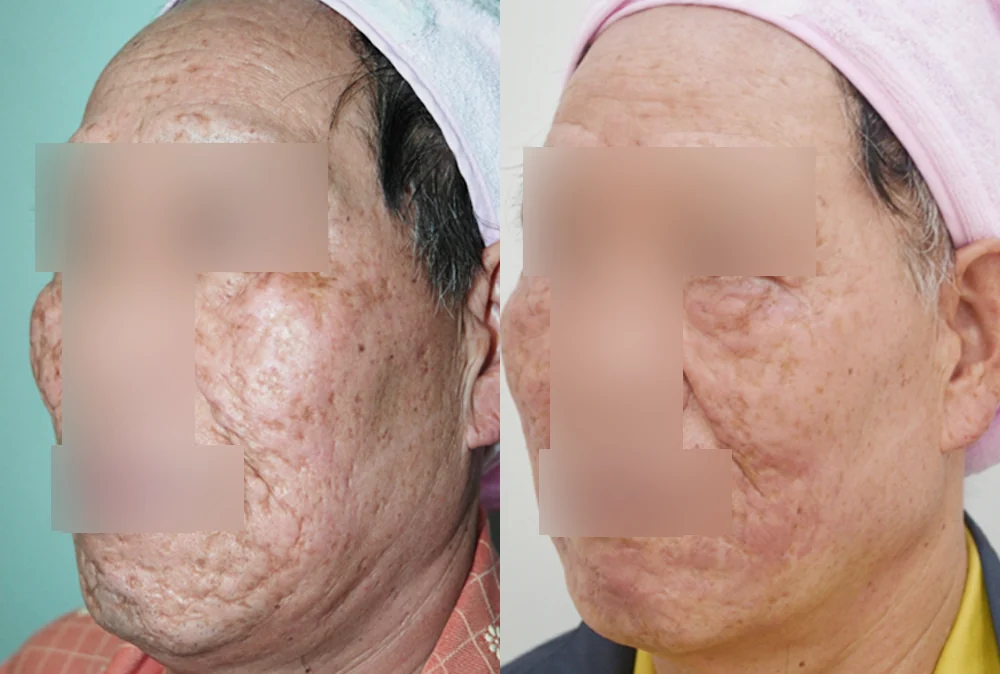
Pits of different sizes spread over the forehead, cheeks and jaw
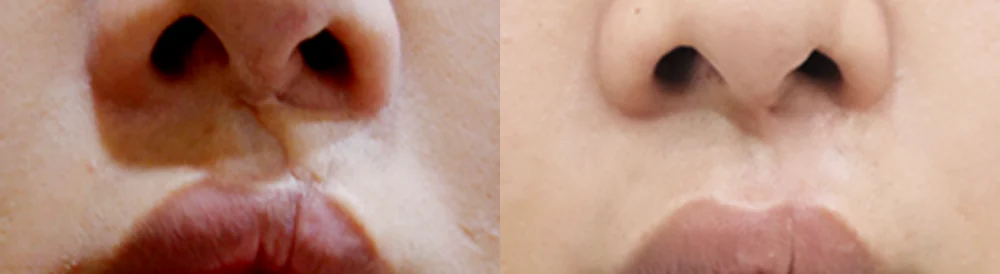
A vertical scar along the philtrum with an uneven upper lip line
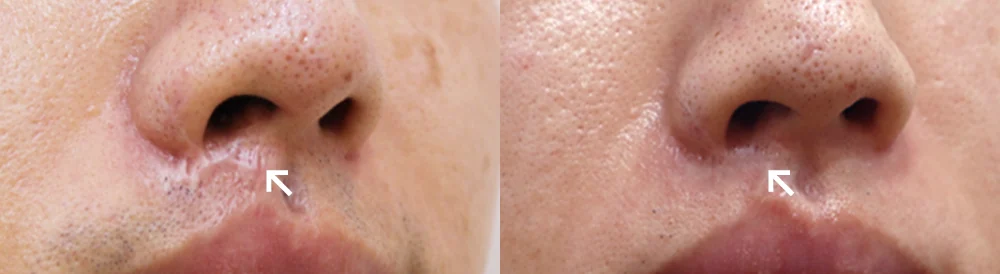
A scar running from below the nostril into the upper lip (arrow)
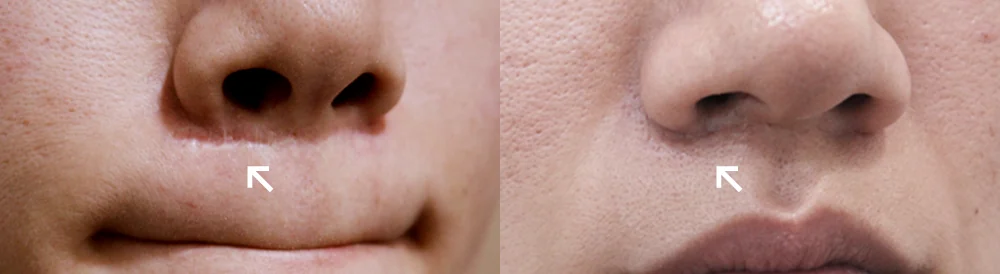
A scar on the upper lip just below the nose (arrow)
* Results vary from person to person. Side effects are possible, so please decide after a thorough consultation with a doctor.
Frequently asked questions
I have had laser many times, but my chickenpox scars look the same.
Lasers treat texture and color at the surface and in shallow layers. Scars whose floor is tethered to deeper tissue or that have lost volume can keep their shadow even when the surface becomes smoother. In that case, rather than adding more laser sessions, the first step is to check whether the floor needs to be raised with a punch technique, released, or filled.
Can smallpox scars that are decades old still improve?
Old scars can be treated too. Settled scars need tissue to be released and filled, so they may take more stages than newer ones. If the pits cover the whole face, treatment may be divided by area. Depth, tethering and skin thickness are checked at consultation before a plan is made.
Does cleft lip scar revision have to be combined with nose surgery?
Not necessarily. The lip scar and lip line can be corrected on their own, and if the nose is clearly asymmetric, nose correction is considered together or separately. A study of 108 adults who had lip revision alone without nose surgery5 shows that lip and nose can be planned according to each one's condition.
How many sessions will I need?
It depends on the depth and extent of the scars and your skin type. At Bonita Clinic, surgical and procedural restoration is usually split into one to three rounds. Laser is continued at intervals only if marks remain after the progress check.
Can I return to daily life right after treatment?
It depends on the method. Recovery after laser is relatively short, although redness can last about 3–14 days after ablative fractional laser.3 Excision or fat grafting adds swelling and stitches and needs more time. If you have important plans, let us know at consultation.
What to prepare before your consultation
- What caused the scars and when: your age when you had chickenpox or smallpox, and your age at cleft lip surgery and how many operations you had
- Treatments so far: type and number of laser sessions, fillers, earlier scar revision
- Whether any scar has ever become raised, thick or keloid (a scar that grows beyond the original wound)
- Medicines you take regularly
Bonita Clinic is on the 3rd floor of 565 Gangnam-daero, Seocho-gu, Seoul, about 100 m on foot from Exit 8 of Nonhyeon Station (Line 7). You can read more on our chickenpox, smallpox and cleft lip scar page. For depressed acne scars, see our acne and pore scar page and the guide on why acne scars may not improve after repeated laser. For depressed incision scars on the face, see the guide to depressed facial incision scars.
References (6)
Sources that support the explanations in this article. Study findings describe general trends and do not guarantee individual results.
- Pour Mohammad A, Ghassemi M. Varicella-Zoster Scar Treatments: A Tertiary Review. Med J Islam Repub Iran. 2021;35:136.doi:10.47176/mjiri.35.136Review of 14 studies: lasting depressed scars in 7–18% after chickenpox; chickenpox scars look more alike than acne scars; TCA CROSS was used most often, other methods lack comparative evidence; punch elevation with fat injection and fractional laser reported in one patient
- Regan TD, Norton SA. The scarring mechanism of smallpox. J Am Acad Dermatol. 2004;50(4):591-594.doi:10.1016/j.jaad.2003.10.672Review of 150 years of literature (abstract): destruction of sebaceous glands fits best as the cause of smallpox scarring, but the virus has never been found in the glands or dermis, so the mechanism is speculative
- Connolly D, Vu HL, Mariwalla K, Saedi N. Acne Scarring-Pathogenesis, Evaluation, and Treatment Options. J Clin Aesthet Dermatol. 2017;10(9):12-23.Review: classification of depressed scars by shape and size; indications and side effects of punch excision (ellipse above 3.5 mm), punch elevation and subcision; 3–14 days of redness after ablative fractional laser; combining methods. Evidence comes from acne scars and is applied to chickenpox and smallpox scars as a principle only
- Krastev TK, Beugels J, Hommes J, et al. Efficacy and Safety of Autologous Fat Transfer in Facial Reconstructive Surgery: A Systematic Review and Meta-analysis. JAMA Facial Plast Surg. 2018;20(5):351-360.doi:10.1001/jamafacial.2018.0102Meta-analysis of 52 studies and 1,568 patients (abstract): facial fat transfer needed 1.5 sessions on average, 50–60% of the volume remained at one year, complications in 4.8%
- Allam K, Albadry A, Merza AM. Adult secondary cleft lip revision: Operative patterns and exploratory patient-reported outcomes. J Stomatol Oral Maxillofac Surg. 2026;127(6):103007.doi:10.1016/j.jormas.2026.103007Retrospective study of 108 adults with lip-only cleft revision (abstract): scar excision 80.6%, muscle reconstruction 59.3%, philtral reconstruction 47.2%, vermilion revision 35.2%; no complications requiring admission or reoperation; irregularities remained in 31%
- Sun Y, Li Z, Qi X, et al. Laser therapy for treating cleft lip or/and palate scarring-a systematic review and meta-analysis. Lasers Med Sci. 2024;39(1):160.doi:10.1007/s10103-024-04082-3Meta-analysis of 9 studies on laser for cleft lip and palate scars: fractional CO2 used most, Vancouver Scar Scale down by 4.05, starting at one month better than three months, no severe complications, follow-up only 6–12 months
About this article
This article separates general medical information from Bonita Clinic's own approach. Because the right decision depends on each person's condition, it is not a substitute for a consultation.
