 KOKorean
 ENEnglish
 JP日本語
JP日本語 CN中文(简体)
 TW中文(繁體)

Cleft Lip Nose Correction for Adults in Seoul: What Can Still Be Changed After Childhood Surgery
Yes. Once facial growth is complete, a cleft lip nasal deformity can be corrected again, and adulthood is usually when the definitive correction is done. Narrowing the wider nostril alone is rarely enough. The displaced nostril cartilage is moved back into place, and cartilage grafts (cartilage moved from elsewhere) add support where needed. A bent septum (the wall inside the nose), nasal blockage and the balance with the lip scar are planned together. The realistic goal is not a mirror-image nose but less visible asymmetry, a straighter tip and better airflow. If you are considering surgery in Seoul, you can send photos and your surgical history first to see which approach may fit your case.
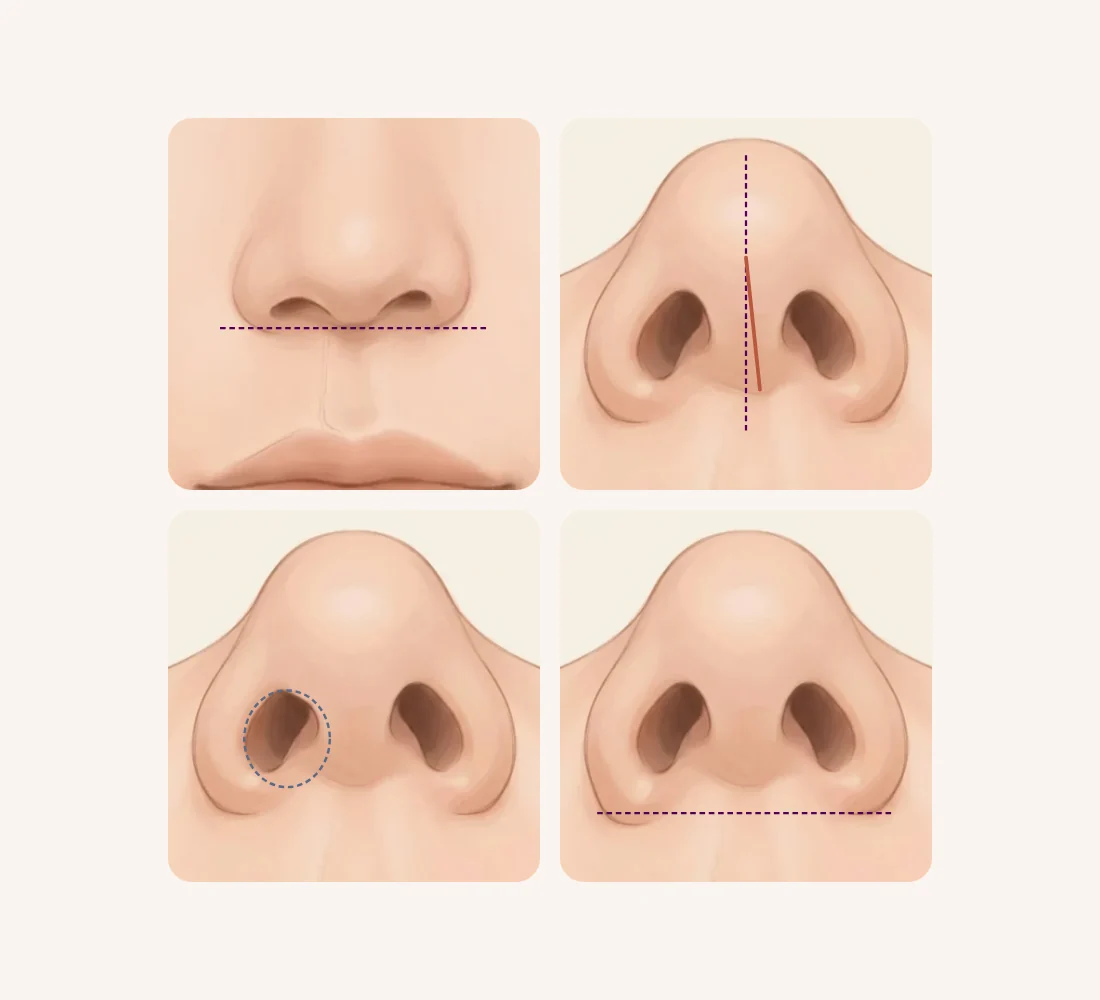
How is a cleft lip nose different?
A cleft lip is a split in the upper lip that is present at birth. The nose shape that comes with it is called a cleft lip nasal deformity. From the outside it can look like one nostril is simply wider. But it involves several layers at once: skin, cartilage, the lining inside the nose and the bone that supports it all.1 Many people had their lip repaired in infancy and childhood, yet the difference in the nose remains a concern as they grow. Some adults go on to consider a further operation such as a secondary rhinoplasty.5
Why do the two sides differ in a one-sided cleft?
In a one-sided (unilateral) cleft, the ring of muscle around the mouth (orbicularis oris) heals with a break. So only the pull from the non-cleft side remains. As a result, the columella (the strip between the nostrils) and the front part of the septum are drawn toward the non-cleft side. The base of the nostril on the cleft side is pulled outward and downward. Where the upper jaw gives too little support, that nostril also sits further back.1
A one-sided cleft nose seen from below
The alar cartilage that shapes the nostril differs between sides too. On the cleft side, its inner leg tends to be shorter and its outer leg longer, and the dome of the tip wider and less defined. The upper edge of the cartilage can curl into the nostril, making the nostril wing look thick and hooded. A web-like fold can also form inside the nostril.1 The picture below marks these features on a front view of the nose.
How the cleft-side alar cartilage differs
What about a two-sided cleft?
In a two-sided (bilateral) cleft, the two sides are more similar. But the columella is short and the cartilages sit further apart, so the tip tends to look low and broad. The septum is usually in the midline, but it can be wide enough to narrow the airway.1
How it tends to show up
| What you notice | What lies underneath | What is checked at the clinic |
|---|---|---|
| One nostril lower and wider | Cleft-side alar cartilage displaced down and outward | Position and shape of both cartilages |
| Tip leaning to one side | Columella and front of the septum pulled to the other side | Difference from the facial midline |
| Hollow look at the nostril base | Weak upper-jaw support, nostril base set back | Previous alveolar bone grafting or jaw surgery |
| Nostrils shaped differently | Curled cartilage, web inside the nostril, old scars | Lining inside the nostril and scar condition |
| One side blocked | Bent septum, narrower nasal passage on the cleft side | Examination inside the nose, which side and how much |
Why does one side often feel blocked?
The problem is often not only how the nose looks. A systematic review (a study that gathers and sums up all the research on one question) looked at 26 studies.2 It found that:
- the nasal passage on the cleft side was smaller;
- the front of the septum was bent toward the non-cleft side;
- air had a harder time passing through the cleft side (higher airflow resistance).
In one study, 91.5% of inhaled air passed through the non-cleft side and only 8.5% through the cleft side.2 Put simply, almost all of the breathing went through one nostril. The review also notes reports of adults who still have a blocked nose after the full series of childhood operations.2
Another review of 29 studies on breathing after secondary cleft rhinoplasty found that better nasal airflow was consistently reported after surgery.3 Both reviews point out, though, that most of the studies were low-level evidence that measured breathing in different ways. So there is no firm agreement yet.23
That is why the septum and the inside of the nose are examined along with the shape. Symptoms that come from the nasal lining itself, such as allergic rhinitis, may need separate care whatever is done to the structure.
When is correction done?
Cleft care is usually split into stages that follow growth, rather than finished in one operation. The nose may be shaped at the first lip repair. Several studies found that moving the cartilage into place early did not hold back growth of the nose and middle of the face.1 Septal surgery is generally put off until after adolescence. The definitive correction with cartilage grafts is done once facial growth has finished.1
The usual order of cleft nose treatment
- First lip repairLip repaired; the nose may be shaped at the same time
- Around age 4–6Intermediate correction before school, in some cases
- Around age 9–11Alveolar bone graft supports the nostril base
- After growth endsAbout 14–16 in women, 16–18 in men: definitive correction
- If jaw surgery is neededUpper jaw positioned first, then the nose
Where does an adult fit in?
As an adult you have finished growing, so you are at the definitive stage of this sequence. But if the upper jaw sits well back and needs to be moved forward surgically, the order changes. That operation changes where the nostril base sits. So the rule is to complete jaw surgery before correcting the nose.1 Some adults with a cleft still have dental and jaw issues that need jaw correction.5 So if orthodontic treatment or jaw surgery is planned, mention it at the start.
The more operations a nose has had in childhood, the more scar tissue builds up inside and around it. That makes the next operation harder.1 So correction in adulthood starts with a closer look at previous surgical records and tissue condition than a first-time rhinoplasty would need.
How is the direction of correction decided?
Two noses that both "look crooked" may need work on different structures. The cards below pair common concerns with what is examined and considered.
What is examined, by concern
1If one nostril is lower and wider
Alar cartilage position and shape are examined; repositioning is considered before narrowing
Cartilage repositioning
2If the tip leans to one side
The axis of the columella and front septum is examined; septal correction is considered
Septal correction
3If one side is often blocked
Septal deviation and the nasal passage are examined; rhinitis may need separate care
4If the nostril base looks hollow
Upper-jaw support and nostril base position are examined; bone grafting or jaw surgery may come first
Why not just narrow the wider nostril?
Narrowing only the wider nostril looks simple. But it leaves the displaced cartilage where it is. At Bonita Clinic, we find that reducing the nostril width alone may let the asymmetry show again over time, so we consider moving the cartilage back into place first. Tightening the nostril base too much can also shorten the nostril sill or leave a nostril that is too small. An over-narrowed nostril is known to be very difficult to correct later.1
The nose and lip are looked at together
The nose is not judged on its own either. The tip axis may be straightened, but a lip scar or philtrum (the groove between the nose and upper lip) may be pulled to one side. That can still make the centre of the face look off. So how much to change is decided within the proportions of the nose, lip and whole face.
What does each method do?
Cleft nose correction is less a single operation than a combination of techniques matched to each person's anatomy. For definitive correction in adults, an open approach is commonly used together with cartilage grafts.1 In an open approach, a small cut across the columella lets the surgeon lift the skin and see the tip cartilages directly.
What correction involves (example)
| Method | What it does | Good to know |
|---|---|---|
| Alar cartilage repositioning | Releases the displaced cartilage, moves it into place and evens the tip height | The cleft-side cartilage is weak, so support is often added too1 |
| Cartilage grafts (septum, ear, rib) | Columella strut, tip support, reinforcement of a weak nostril wing | The source depends on how much support is needed and what is available4 |
| Septal correction | Straightens the front of the septum for both the tip axis and the airway | The front and top supporting parts are kept so the nose does not collapse1 |
| Nostril base position and size | Matches the height of the nostril bases and nostril size | Over-reduction can leave a small nostril that is hard to fix1 |
| Nostril base augmentation | Supports the side where the upper jaw is lacking, with bone, cartilage or other material | If the bone problem is large, bone grafting or jaw surgery may come first1 |
A meta-analysis (a study that pools many studies and calculates them again) looked at secondary rhinoplasty for one-sided clefts using septal, rib or ear cartilage to support the tip. It included 23 studies and 842 patients aged over 12. The rate of remaining deformity was low (0.7%). But the revision rate was 6.7%, and it differed between graft types.4 The authors also note large differences between studies and small numbers.4 So no single cartilage source can be called better in every case.
Of the methods in the table, we use four at Bonita Clinic. They are alar cartilage repositioning and grafts of your own cartilage such as ear cartilage. The others are balancing the size and height of the nostril wings, and septal correction considered alongside where needed. Rib cartilage, nostril base bone augmentation, alveolar bone grafting and jaw surgery are included as general medical information.
What are recovery and the limits like?
At Bonita Clinic, we perform cleft lip nose correction as surgery under general anesthesia or sedation, with same-day discharge and stitches. Recovery time and follow-up visits vary with the extent of surgery and your individual condition.
| Stage | Common changes | What the clinic does |
|---|---|---|
| Right after surgery | Swelling, bruising, a nasal splint | Splint care and cold-pack guidance |
| During recovery | The main swelling goes down | Splint and stitches removed; advice to avoid pressure on the nose, such as from glasses |
| Settling period | Leftover swelling at the tip fades | Final shape and left-right balance checked |
As with any surgery, swelling, bleeding, inflammation, infection and nerve injury can occur. A cleft nose has some further limits:
- The cleft-side cartilage is small and weak, so tip support tends to be limited.1
- Where earlier surgery has left the inside of the nostril shrunken, narrowing of the airway is a problem often dealt with in secondary operations.1
- Differences in skin thickness, scarring and the jaw bone are also hard to change completely with surgery.
So a mirror-image nose is not a realistic target. The aim is to reduce visible differences, straighten the tip axis and airway, and find a balance that suits the lip. If some difference remains once the result has settled, a touch-up can be considered.4
How we approach it at Bonita Clinic
Treatment options you can discuss in Seoul
Bonita Clinic has treated patients at the same location since opening in 1995. Dr. Kwang-Seop Chung, a board-certified plastic surgeon in Brazil, sees patients himself. For a cleft lip nose, the options discussed in consultation are those on our treatment page:
- Analysis of alar cartilage position and shape, septal deviation, nostril size and height, and proportions with the lip and philtrum
- Repositioning of the displaced alar cartilage
- Grafts of your own cartilage, such as ear cartilage, where more support is needed
- Balancing the size and height of the nostril wings
- Septal correction, considered where a bent septum causes blockage
- Treatment of cleft lip scars around the mouth and philtrum at our Scar Clinic
Which of these you need, in what combination and order, is decided only after an examination.
Why do the plan and cost differ from case to case?
Two people with "a cleft lip nose" can need quite different operations. The scope of the work, rather than the name of the condition, shapes both the plan and the cost.
- Unilateral or bilateral, and how marked
- Repositioning alone or with cartilage grafts
- Graft source: septum or ear
- Whether septal correction is needed
- Scar tissue from earlier operations
- Anesthesia: general or sedation
Final plan and quote after seeing you in person
A final estimate is given only after the in-person examination. By then the cartilage, septum and scar tissue have been assessed and the scope is clear. Photos can suggest a direction, but they cannot fix the scope.
What can photos show, and what needs an in-person exam?
Photos are a useful first step. But the decisions that matter most in a cleft nose lie under the skin.
Photos can show
- Difference in nostril height and width
- How the tip and columella lean
- Nostril shape seen from below
- Lip scar and philtrum balance
Needs an in-person exam
- Cartilage position, strength and shape
- Septal deviation and the airway inside
- Scar tissue and skin flexibility
- Cartilage available for grafts
- Upper-jaw support at the alar base
Helpful photos: front view, both sides, both 45-degree angles, and a view from below showing both nostrils, in even light without makeup. If you have records of previous operations (lip repair, nose surgery, bone grafting, jaw surgery), a short summary of when they were done helps. You can send us a message with your photos and history.
Planning your visit and recovery
What is confirmed in advance is the treatment information above: surgery under general anesthesia or sedation, same-day discharge, stitches and a nasal splint for the first period. How long you should stay in Seoul, when the splint and stitches come out, and how many follow-up visits you need depend on the scope of surgery. So these are planned with you at consultation. If you also need jaw surgery, the order of the operations is part of that plan.
Swelling and bruising are expected right after surgery, and the splint is kept on with cold packs. The splint and stitches are removed as the main swelling settles, and pressure on the nose, such as from glasses, should be avoided for a while. Leftover swelling at the tip takes longer to fade, so the final shape becomes clear only later. After you return home, contact a doctor promptly if redness, heat, pain or discharge increases instead of settling. Keep dated photos of your recovery to share at follow-up.
Frequently asked questions
I had several operations as a child. Can my nose still be corrected?
If you have finished growing, correction can be considered. More previous operations usually mean more scar tissue, which makes the tissue harder to work with. So the timing and content of earlier surgery are reviewed, and the cartilage and scars are examined before the scope is decided. Even a partial history helps.
Isn't it enough to match the size of the nostrils?
On the more uneven side, the alar cartilage has settled in a different position and shape. So reducing only the nostril width may let the asymmetry show again over time. Narrowing the nostril too much can also leave it too small, so moving the cartilage back into place is considered first.
Can my breathing improve as well?
If the blockage comes from a bent septum or a narrow nasal passage, septal correction is considered at the same time. Studies often report better breathing after secondary cleft rhinoplasty. But the evidence is not strong, and symptoms from the nasal lining, such as rhinitis, may need separate care. Tell us which side is blocked and when.
Where will the scars be?
Scars from the nose surgery are mostly inside the nostrils and on the columella, and they are managed so that they fade over time. How visible they become depends on your skin and any existing scars.
Can the scar on my lip and philtrum be treated too?
Incision scars around the mouth and philtrum from cleft lip surgery are treated at Bonita Clinic's Scar Clinic, on the Chickenpox, Smallpox & Cleft Lip Scars page. Whether the nose and the scar are treated together or one after the other is decided at consultation after looking at both.
What to prepare before your consultation
- When and what operations you had: lip repair, nose surgery, alveolar bone grafting, jaw surgery (operative notes if you have them)
- If your nose is blocked, which side and when it is worse, and whether you are treated for rhinitis
- Whether orthodontic treatment or jaw surgery is planned
- Photos: front, both sides, both 45-degree angles, and from below
- What you would like to change, and what you would like to keep
Bonita Clinic is on the 3rd floor of 565 Gangnam-daero, Seocho-gu, Seoul, about 100 m on foot from Exit 8 of Nonhyeon Station (Line 7). You can read more on our Cleft Lip Nose Rhinoplasty page. For scars around the lip, see Chickenpox, Smallpox & Cleft Lip Scars and the guide to chickenpox, smallpox and cleft lip scars. For rebuilding the structure of a nose that has had several operations, see Full Revision Rhinoplasty and the full revision rhinoplasty guide.
References (5)
Sources that support the explanations in this article. Study findings describe general trends and do not guarantee individual results.
- Kaufman Y, Buchanan EP, Wolfswinkel EM, et al. Cleft Nasal Deformity and Rhinoplasty. Semin Plast Surg. 2012;26(4):184-190.doi:10.1055/s-0033-1333886Review (full text): anatomy of unilateral and bilateral cleft noses (alar cartilage shape, columella and caudal septum pulled to the non-cleft side, displaced alar base, maxillary hypoplasia, vestibular webbing), the staged timing of treatment (intermediate at 4–6, alveolar bone graft at 9–11, definitive after growth, jaw surgery before rhinoplasty), graft and septal principles, and limits such as micronostril, vestibular stenosis and weak tip support
- Chiang H, Shah R, Washabaugh C, Frank-Ito DO. Nasal airway obstruction in patients with cleft lip nasal deformity: A systematic review. J Plast Reconstr Aesthet Surg. 2024;92:48-60.doi:10.1016/j.bjps.2024.02.061Systematic review of 26 studies (full text): smaller nasal space and higher resistance on the cleft side, anterior septal deviation toward the non-cleft side, 91.5% vs 8.5% airflow split in one study, persistent obstruction reported in adults, and mostly poor-quality evidence (24 of 26 studies)
- Yuan J, An Y. Improvement in nasal airway obstruction after secondary rhinoplasty for cleft lip: A systematic review. J Plast Reconstr Aesthet Surg. 2024;90:130-148.doi:10.1016/j.bjps.2024.01.023Systematic review of 29 studies (abstract): breathing consistently reported as improved after secondary cleft rhinoplasty, but evidence is mostly low-level and there is no consensus
- Deng R, Wang Y, Zhang C, et al. Deformity and revision rates after secondary unilateral cleft lip rhinoplasty with different cartilage grafts: A systematic review and meta-analysis. J Craniomaxillofac Surg. 2025;53(7):873-880.doi:10.1016/j.jcms.2025.02.030Meta-analysis of 23 studies, 842 patients over 12 (abstract): with septal, rib or ear cartilage grafts, residual deformity was low (0.7%) but the revision rate was 6.7% and differed by graft type; heterogeneous studies
- Mahendran G, Cullinane RR, Shaye DA. The adult cleft lip and palate patient: beyond primary repair. Curr Opin Otolaryngol Head Neck Surg. 2026;34(4):265-270.doi:10.1097/MOO.0000000000001133Review (abstract): adults with cleft lip and palate may still face nasal obstruction and jaw problems needing orthognathic surgery, and may consider further procedures such as secondary rhinoplasty; satisfaction differs by cleft type
About this article
This article separates general medical information from Bonita Clinic's own approach. Because the right decision depends on each person's condition, it is not a substitute for a consultation.
