 KOKorean
 ENEnglish
 JP日本語
JP日本語 CN中文(简体)
 TW中文(繁體)

Revision Rhinoplasty in Seoul: How a Second Nose Surgery Differs from the First, and What to Check Before You Decide
Revision rhinoplasty starts from a nose that has already been changed, so the conditions are not the same as in a first operation. Scar has formed between the tissue layers and made them stick together (adhesions). The cartilage that was available may already have been used or weakened. And the blood flow to the skin may be reduced. So the first step is to pin down what the problem is, what is left to work with, how many operations you have had and what you hope for. Then a reconstruction is planned that stays within what the remaining tissue can safely allow. If you are considering revision in Seoul, you can send photos and your surgical history before planning your trip.
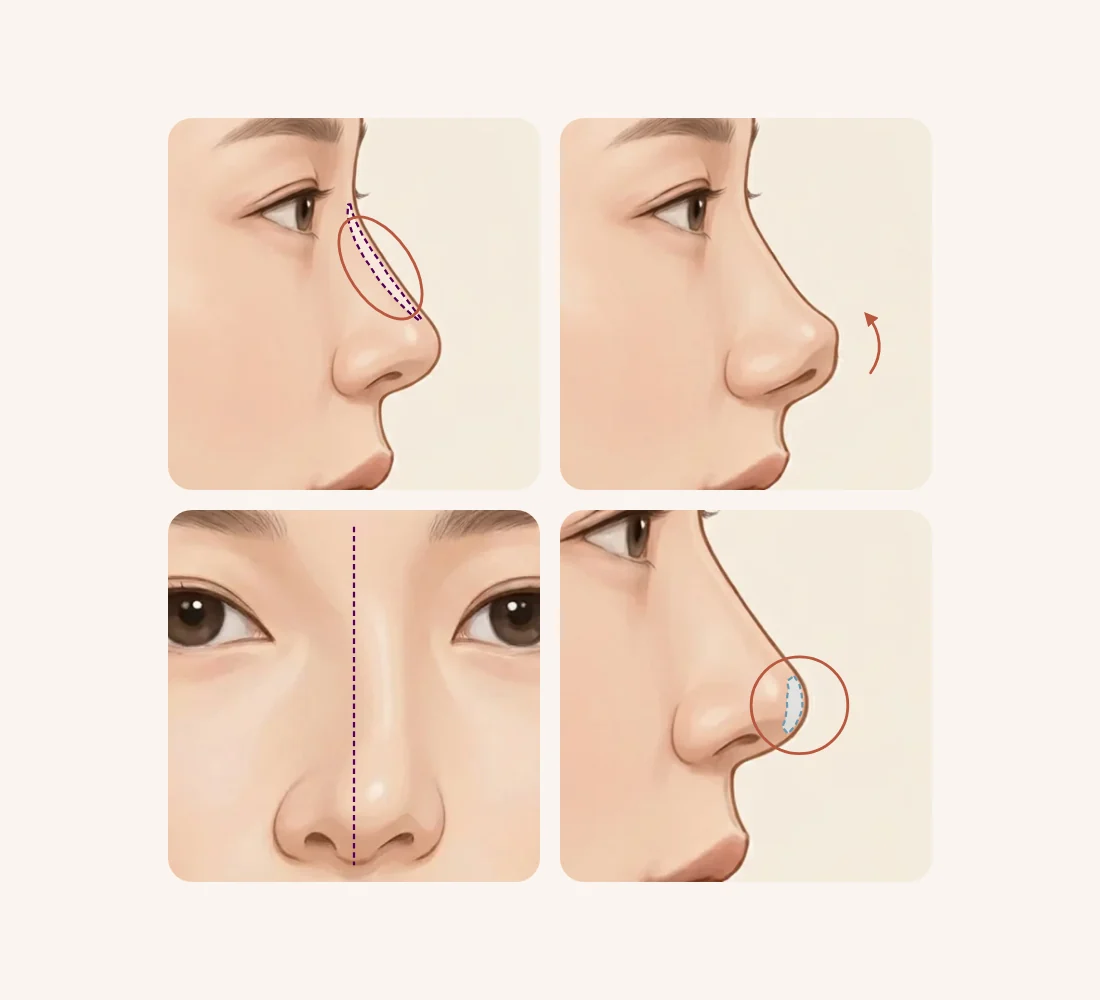
What is looked at in a revision rhinoplasty?
Rhinoplasty is one of the more demanding cosmetic operations. The reported revision rate (the share of people who have a second operation) is 5% to 15%.2 That is, about 5 to 15 of every 100 people who have rhinoplasty go on to have it again. The reasons range from small irregularities that can be treated in the clinic to major problems with shape or breathing that need more than one operation.2
A full revision is not about fixing just one spot. A problem in one area is often linked to another, so the whole nose is assessed together at consultation. The picture below shows the areas that are checked.
Areas examined together in full revision
Why are the conditions different from a first operation?
Common reasons for revision
In Asian patients, many revisions are related to grafts (cartilage moved into the nose) or implants. Common reasons include:3
- an implant in the bridge that has shifted, sits out of place, is pushing out toward the skin, or keeps becoming inflamed or infected
- a nose that became short after silicone surgery
- a crooked nose that stayed crooked or became crooked again
- a hump that was not fully corrected
- problems with cartilage grafts in the tip
The cards below show four of these and what is checked first for each.
What is checked first, by common reason for revision
1If a bridge implant shifts, shows or gets inflamed
Its position, capsule and covering tissue are checked together
Implant revision
2If the nose became short after silicone surgery
How short and upturned it is, and the remaining tissue, are checked
Contracted nose revision
3If the nose is crooked, or crooked again
How far its central axis is off the face's midline, and the septal cartilage left, are checked
4If a tip cartilage graft is the problem
Tip height, support and the graft are checked
Revision tip surgery
Cartilage and skin are different too
Asian septal cartilage (the cartilage in the wall dividing the nose) tends to be weak and small. So it is easily damaged in a first operation, and revision often calls for a major rebuild of the septal framework.3
The skin is different too. Earlier surgery often leaves scar in the skin and soft tissue covering the nose (soft tissue means the layers under the skin). Scar reduces the blood supply and lowers the quality of the tissue. The outcome of revision depends heavily on how well this covering is protected.5
The table below sets the conditions of a first operation and a revision side by side.
First surgery and revision: different starting points
| Aspect | First surgery | Revision |
|---|---|---|
| Tissue planes | Layers fairly distinct | Blurred by scar and adhesions |
| Cartilage | Septal cartilage available | May be used up or weakened |
| Skin, blood supply | Usually intact | May be reduced by scarring |
| Earlier implants | None | Implant, grafts, capsule to manage |
| Basis of the plan | The shape you want | What remaining tissue allows |
How is "what needs fixing" sorted out?
A revision consultation begins by breaking "what I don't like" into specific parts. One proposed system rates how difficult a revision will be by three elements. The first is the problem (which structure has gone wrong). The second is the number of grafts needed. The third is the number of previous operations. The patient's expectations are added on top.2 The authors describe it as a way to help patients understand how complex the repair will be and to keep expectations realistic.2
| Element | What it covers | What we check at consultation |
|---|---|---|
| Problem | What has gone wrong in shape or function | Bridge, tip, septum or nostrils; any breathing difficulty |
| Grafts | How much material is needed to rebuild | Septal cartilage left; whether ear or rib cartilage is needed |
| Previous surgery | How many operations, and how they were done | Records; type of implant and cartilage used |
| Expectations | The change you hope for | What you want to change and what you want to keep |
Why are breathing and expectations part of the plan?
The rhinoplasty guideline of the American Academy of Otolaryngology–Head and Neck Surgery (a guideline is a set of recommendations doctors follow, built from the available evidence) recommends asking patients why they want surgery and what they expect, and telling them whether those expectations can be met by surgery.1
It also advises checking for conditions that may change the plan or make it better not to operate.1 For example:
- body dysmorphic disorder (being overly preoccupied with small or imagined flaws in appearance)
- bleeding disorders, where bleeding does not stop easily
- sleep apnea, where breathing stops during sleep
- long-term use of decongestant nasal sprays
It also advises assessing nasal blockage, and explaining recovery, possible effects on breathing, complications and the chance of needing further nasal surgery in the future.1
Expectations are also built into the revision rating system above.2 In revision, disappointment with the earlier result easily feeds into what you hope for. Yet scar and the remaining tissue limit what can change. That is why this conversation is taken carefully. If you have breathing problems as well as concerns about shape, their cause is looked for and included in the plan.
What happens when cartilage runs short?
In revision there is often too little material left to rebuild with. Cartilage may have been used in earlier surgery, or the septum may have weakened. In Asian revision rhinoplasty, your own ear and rib cartilage play a central role. They are used as a new material for the bridge or to rebuild the septum.3
Rebuilding with your own cartilage
Rib cartilage: plenty of material, with its own risks
Rib cartilage is plentiful enough for major reconstruction (rebuilding the nose on a large scale). But it brings its own risks. A meta-analysis (a study that pools many studies and calculates them again) of 20 studies and 1,648 patients reported:4
- warping (bending) of the rib cartilage in 3.05%
- resorption (the graft being partly absorbed by the body) in 1.2%
- infection in 1.45%
- uneven contour in 1.53%
- further surgery for these problems in 2.25%
- thick raised scars at the chest donor site in 2.08%; pneumothorax (air collecting outside the lung) was not reported (0%)
Problems reported with rib cartilage
Warping was the most common problem, and including chest-side complications raised the overall complication rate.4 So rib cartilage gives plenty of material, but the chance of bending and a chest scar has to be weighed too.
The pros and cons of cartilage used in the tip are covered in our revision tip guide. Which cartilage is used depends on the support needed, how much septum is left and which donor sites were used before.
Skin and blood supply: why does safety come first?
Under the skin of a revised nose, scar has formed and the blood supply may be reduced. Forcing too much change on tissue like this can raise the risk of tissue damage. Reviews also stress preventing harm to the covering (the skin and tissue over the nose), and spotting and treating problems early.5
So how much height to add and how much to change in one operation should be set within what the skin can tolerate. For a nose that has had several operations, splitting the goals into stages can be the safer route.
A scarred cover and its blood supply
Recovery: how long does swelling take to settle?
At Bonita Clinic, we perform full revision rhinoplasty under general anesthesia or sedation. There is no overnight stay, and stitches are removed afterwards. How long recovery takes and how many follow-up visits you need depend on how much is done and on your own healing.
How swelling settles after nose surgery
- Right afterSwelling and bruising at their peak
- 1 monthAbout two-thirds of swelling gone
- 6 monthsAbout 95% gone
- 1 yearAbout 97.5% gone; time to judge the result
When swelling was measured with 3D imaging in 40 people after a first open rhinoplasty (an approach that uses a small cut across the columella to lift the skin), about two-thirds of it had gone at 1 month, 95% at 6 months and 97.5% at 1 year.6 Revision patients were excluded, so these figures cannot be applied directly. But the message is the same: the shape has to be judged over months, not weeks.
Bleeding, infection, inflammation and nerve injury can occur after surgery. Warping of cartilage or asymmetry can also lead to further surgery.
How we approach it at Bonita Clinic
Treatment options you can discuss in Seoul
Bonita Clinic has worked from the same location since 1995. Dr. Kwang-Seop Chung, who trained in plastic surgery and became board-certified in Brazil, performs nose surgery himself. For a nose that needs revision in several areas, the options discussed are those on our full revision page:
- Analysis of the earlier technique, implant, remaining cartilage, adhesions, skin thickness and blood supply, symmetry and proportions
- Clearing scar tissue that has stuck the layers together
- Rebuilding structure with your own ear, septal or rib cartilage where needed
- Designing the tip and bridge in balance, with fine adjustment of symmetry
If the problem is mainly the implant, see our implant revision page. If the nose has become short and upturned, see the contracted nose revision page.
Why do the plan and cost differ from case to case?
Revision covers anything from a single area to the whole nose. The amount of work and the material needed, not the label "revision", shape the plan and the cost.
- How many areas need correcting
- Implant removal or replacement
- Cartilage source: septum, ear or rib
- Scar release and skin condition
- Number of previous operations
- General anesthesia or sedation
Final plan and estimate once you have been examined in person
A final estimate is given only after the in-person examination. By then it is clear which areas will be corrected, what cartilage is needed and whether the work should be staged. Photos alone cannot settle that.
What can photos show, and what needs an in-person exam?
Photos help us see your concerns. But they cannot show the condition of the tissue under the skin.
Photos can show
- Overall shape and proportions
- A bridge off the midline
- Tip height and shape
- Nostril asymmetry from below
- Change since before the first surgery
Needs an in-person exam
- Skin thickness and scarring
- Septal cartilage left
- Implant and capsule condition
- Breathing and the inside of the nose
- Ear or rib donor sites
Helpful photos: front, both profiles, both 45-degree views and a view from below, in even light, together with photos from before your first surgery. If you have operative records or scan images, keep copies ready. You can send us a message with your photos and a short history of your previous operations.
Planning your visit and recovery
What is confirmed in advance is the treatment information above: general anesthesia or sedation, no overnight stay, and stitches that are removed later. How long to stay in Seoul, when to come back and whether surgery should be split into stages depend on the extent of revision. These are decided with you after the examination.
Because swelling settles over months, the final result is judged long after you have returned home. Ask at consultation how follow-up will be arranged once you are back. In the meantime, contact a doctor promptly if redness, warmth, pain or swelling increases, if there is discharge, or if the skin over the nose changes color. Dated photos taken at regular intervals make it easier to judge the result later.
Real treatment cases
This case appears on Bonita Clinic's full revision page. Results vary from person to person.
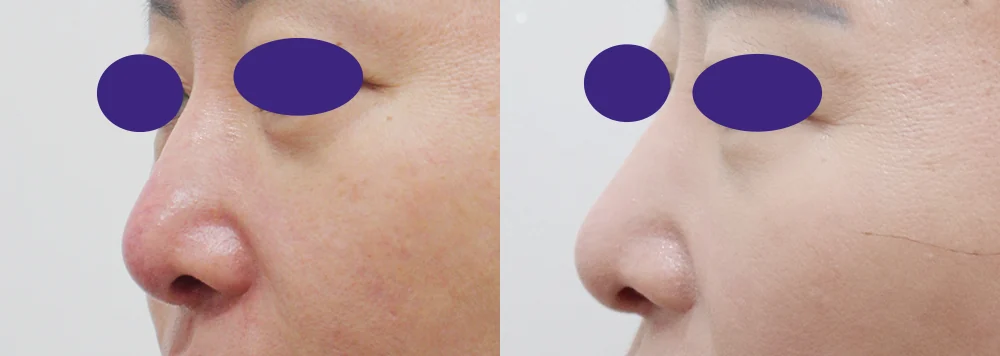
A red, rounded, swollen-looking nasal tip (angled view)
* Results vary from person to person. Side effects are possible, so please decide after a thorough consultation with a doctor.
Frequently asked questions
How long after my first surgery can I have revision?
There is no single waiting period that applies to everyone. Remaining deformity can only be judged accurately once most swelling has gone and the tissue has settled. In one study, swelling was about 95% resolved at 6 months and 97.5% at 1 year, and a guideline recommends recording satisfaction after 12 months. With that in mind, it is sensible to wait at least several months before deciding.61 If a problem is getting worse, such as inflammation, infection or an implant pushing through the skin, do not wait: have it examined promptly.
Can I have a consultation without records of my earlier surgery?
Yes. Records help because they show which implant, cartilage and technique were used. Without them, the remaining cartilage and implant can still be assessed by examination. Tell us when and how many times you had surgery, and anything you remember.
Will rib cartilage leave a scar on my chest?
Yes, taking rib cartilage leaves an incision scar on the chest. In the meta-analysis, thick raised scars at the chest occurred in about 2% of patients.4 Whether rib cartilage is actually needed depends on how much septum remains and how much support is required.
I have had several operations already. Can I have another?
The number of previous operations is one of the factors that makes revision harder.2 But on its own it does not rule surgery out. Skin thickness, blood supply and the cartilage left decide what can be done safely, and sometimes the work is split into stages.
Where will the scars be?
Incisions on the nose are mainly inside the nostrils and across the columella, the strip of skin between the nostrils. The scars are cared for so they become less visible over time. The place where your own cartilage is taken, ear or chest, also leaves a mark.
What to prepare before your consultation
- When, how often and where you had surgery, and the implant and cartilage used (with any records or scans)
- Photos from before your first surgery and current photos (front, profile, 45 degrees, from below)
- Breathing problems such as blockage or rhinitis, medicines you take and any bleeding tendency
- When you had redness, discharge or inflammation after surgery
- What you want to change, what you want to keep, and what disappointed you about earlier results
Our clinic is a short walk, about 100 m, from Exit 8 of Nonhyeon Station (Line 7), on the 3rd floor of 565 Gangnam-daero, Seocho-gu, Seoul. The process is described on our full revision page. If the problem centres on an implant, see the nasal implant revision guide; for the tip, see the revision tip guide. If the nose has become short and upturned, see the contracted nose revision guide.
References (6)
Sources that support the explanations in this article. Study findings describe general trends and do not guarantee individual results.
- Ishii LE, Tollefson TT, Basura GJ, et al. Clinical Practice Guideline: Improving Nasal Form and Function after Rhinoplasty. Otolaryngol Head Neck Surg. 2017;156(2 Suppl):S1-S30.doi:10.1177/0194599816683153US clinical practice guideline on rhinoplasty (abstract): ask about motivations and expectations and say whether they are realistic, check conditions such as body dysmorphic disorder or bleeding disorders, assess nasal obstruction, explain complications and the possible need for further surgery, and record satisfaction after 12 months or more
- Rodman R, Kridel R. A Staging System for Revision Rhinoplasty: A Review. JAMA Facial Plast Surg. 2016;18(4):305-311.doi:10.1001/jamafacial.2016.0249Review (abstract): rhinoplasty revision rate of 5–15%, and a staging system that rates revision difficulty by problem (P), number of grafts (G) and previous surgeries (S), plus patient expectations (E)
- Jang YJ, Kim DY. Treatment Strategy for Revision Rhinoplasty in Asians. Facial Plast Surg. 2016;32(6):615-619.doi:10.1055/s-0036-1594254Review of revision rhinoplasty in Asians (abstract): weak, small septal cartilage is easily damaged; implant displacement, extrusion, inflammation and infection, short nose after silicone, residual deviation, undercorrected hump and tip-graft problems are common reasons for revision; ear and rib cartilage are central to reconstruction
- Chen H, Wang X, Deng Y. Complications Associated with Autologous Costal Cartilage Used in Rhinoplasty: An Updated Meta-Analysis. Aesthetic Plast Surg. 2023;47(1):304-312.doi:10.1007/s00266-022-03075-3Meta-analysis of rib cartilage in rhinoplasty (abstract, 20 studies, 1,648 patients): warping 3.05%, resorption 1.2%, infection 1.45%, contour irregularity 1.53%, revision 2.25%, hypertrophic chest scar 2.08%, pneumothorax 0%
- Deot N, Nassif PS. Salvaging the Compromised Soft-Tissue Envelope in Revision Rhinoplasty. Facial Plast Surg Clin North Am. 2026;34(2):237-244.doi:10.1016/j.fsc.2026.01.005Review (abstract): in revision rhinoplasty the skin and soft tissue envelope often has reduced blood supply, scarring and poorer quality, and protecting it is central to the result through prevention, early recognition and timely treatment
- Pavri S, Zhu VZ, Steinbacher DM. Postoperative Edema Resolution following Rhinoplasty: A Three-Dimensional Morphometric Assessment. Plast Reconstr Surg. 2016;138(6):973e-979e.doi:10.1097/PRS.00000000000027603D imaging study of 40 first-time open rhinoplasties (abstract): about two-thirds of swelling resolved by 1 month, 95% by 6 months and 97.5% by 1 year; revision patients were excluded
About this article
This article separates general medical information from Bonita Clinic's own approach. Because the right decision depends on each person's condition, it is not a substitute for a consultation.
