 KOKorean
 ENEnglish
 JP日本語
JP日本語 CN中文(简体)
 TW中文(繁體)

Nasal Implant Revision in Seoul: If an Implant Shows Through or Has Shifted, Is Replacing It Enough?
Usually not. When an implant shows through or drifts to one side, the cause is often the tissue around it rather than the implant itself. The skin and soft tissue covering it may have thinned, or the capsule (the layer of tissue your body built around the implant) may have thickened and tightened. So a revision means deciding several things together. These are whether to choose a different implant size or material, whether to add your own cartilage, and how much of the capsule to remove. If there has been inflammation, it also means deciding when to operate. If you are thinking about revision in Seoul, you can send photos and your surgical history first to see which approach may fit your case.
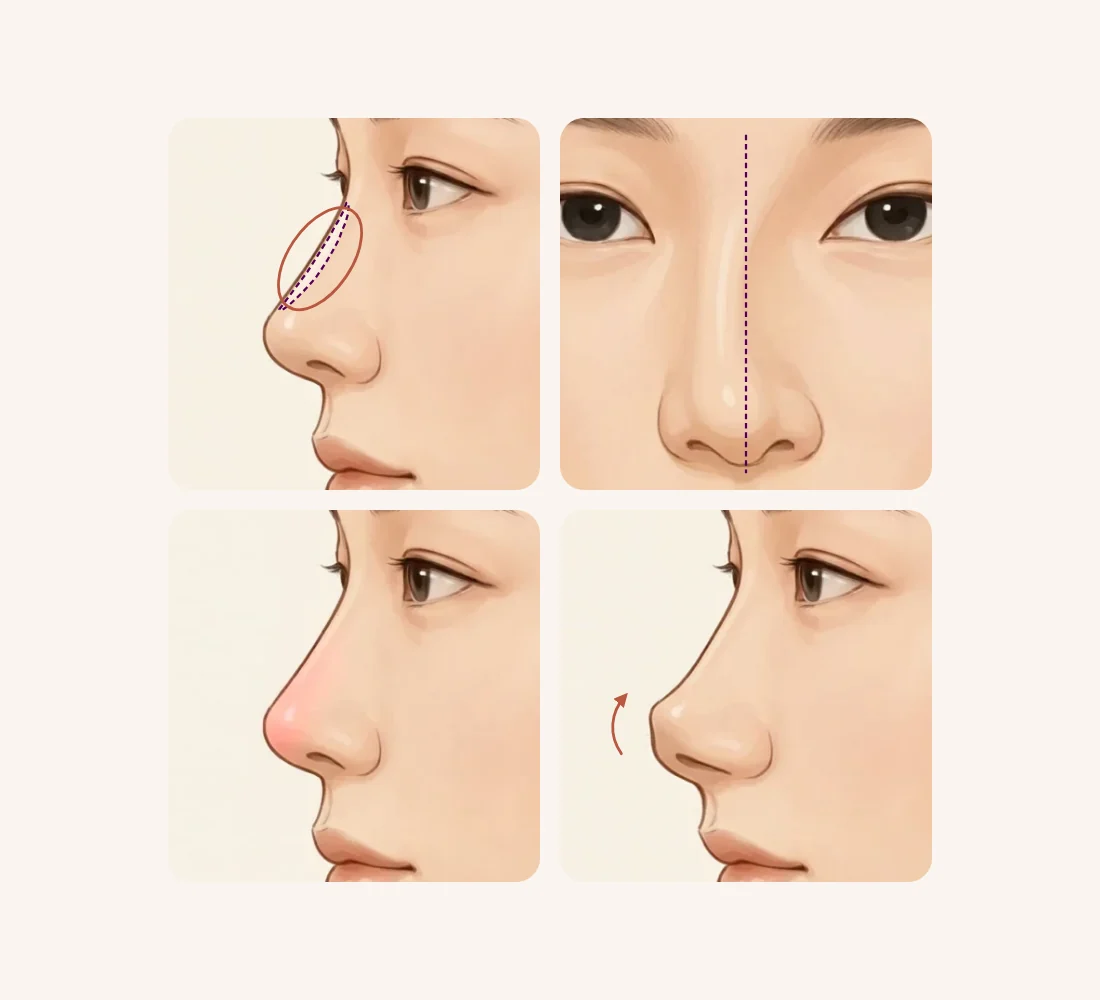
Why does an implant start to show or shift?
A nasal implant does not simply sit unchanged after surgery. Your body recognizes it as something that is not part of you (a foreign object). It then wraps it in a thin layer of fibrous tissue. This layer is called a capsule. The picture below shows where the implant sits and which areas change when problems start.
The nose from the side: the implant and what surrounds it
Silicone has no tiny holes on its surface. So tissue cannot grow into it, and a fibrous capsule forms around it instead.2 The capsule can help hold the implant in place. But when it thickens and hardens, it becomes a problem. It can push the implant to one side so the bridge looks crooked, or pull the nose shorter.
The skin and soft tissue covering the implant matter too. Soft tissue means the fat and muscle under the skin. When this cover thins, the edge of the implant can show through or be felt with a finger. The same can happen when the implant's size or material does not suit that nose.
How common are implant problems?
Implant problems are not rare. A meta-analysis is a study that pools the results of many studies and calculates them again. In a meta-analysis of synthetic nasal implants (man-made materials), 6.5% of silicone implants were eventually removed. For Gore-Tex and Medpor, two other synthetic materials, the figure was 3.1% each.1 Put simply, about 6 or 7 of every 100 silicone implants were taken out again.
Another meta-analysis pooled 27 studies and 3,803 dorsal augmentations (operations to raise the bridge) using synthetic implants. It found a revision rate of about 6.4%. It named infection and displacement (the implant moving out of place) as the main reasons silicone implants are revised.2 The same authors note that thicker skin covers synthetic implants better than thin skin does.2
How often implants were removed
The picture below shows the bridge of the nose as if cut through and seen from the side (a cross-section). From the skin at the top down to the nasal bone, layers of tissue cover and support the implant. The thicker the skin and the tissue beneath it, the better the implant is hidden.
Nasal bridge cross-section: what covers and supports the implant
- 1Implant, wrapped in a capsule
- 2Thinned skin: the outline shows
- 3Capsule thickness and firmness are checked
Does an implant change after many years?
How long it has been in place also matters. One study examined 221 silicone implants removed during revision surgery. After about 4 years, small fragments of calcification could be seen under the microscope. Calcification means calcium deposits building up and hardening the tissue. In implants that had been in place for more than 9 years, half showed focal calcification. The capsule around these deposits also showed more inflammatory cells.3 This helps explain why an implant that looked fine for years can slowly change shape.
What is checked when you notice these changes?
Implant problems show up in a few typical ways. The cards below pair each common change with what is checked first at the clinic.
What is checked first, by the change you notice
1If the implant's outline shows or can be felt
The cover may be thin or the implant unsuited; skin and implant are checked
Implant revision
2If the bridge leans to one side
The implant may have moved or the capsule may pull; both are checked
Implant revision
3If redness and swelling keep coming back
Possible inflammation or infection; heat, discharge, when it began and how often are checked
4If the nose looks shorter and upturned
Possible capsular contracture (a shrinking capsule); its degree is checked
Contracted nose revision
If the skin over the bridge looks stretched and shiny, the implant may have been pressing on it for a long time, or the capsule may be old. Then the doctor also checks how much more the skin can tolerate. A nose that has become short and upturned is explained in detail in our contracted nose guide.
Should the capsule be kept or removed?
In implant revision, the capsule is where opinions differ most. If it is left, it can tighten again. If all of it is removed, the cover over the implant can become thin.
Leaving the capsule · removing it all
If it is left: it can tighten again
One study compared patients whose silicone implants were removed and replaced with cartilage grafts (cartilage moved from another place). In the 12 patients whose capsule was left in place, an index of nasal length fell by 6.2%, and the angle between the nose and upper lip grew by 5.7%. That is, the nose became a little shorter and the tip turned slightly upward. In patients whose capsule was mostly removed, the nasal length index increased instead.4 This suggests that a capsule left behind can contract again.
If it is all removed: the cover can thin
Removing all of it has a cost too. In one series of 95 patients, surgeons kept the capsule and used it as a covering layer for the new implant. They warned that removing the capsule aggressively can thin the skin and soft tissue over the bridge and make its thickness uneven.5 However, that series left out patients with infected or calcified capsules from the start.5
So how is it decided?
The two studies looked at different patients for different purposes, so neither one settles the question. It is more accurate to say that how much capsule is removed depends on three things:
- whether the capsule is thick and contracted
- whether there is inflammation or calcification
- how thin the skin above it has become
What changes if you have had inflammation or infection?
If the nose has turned red and swollen more than once, or there has been discharge (pus), the order of surgery changes. Safe sequencing comes before shape.
One study followed 21 patients whose infected synthetic implant was removed and replaced with their own cartilage (autologous cartilage) in the same operation. They were followed for an average of 35 months. One patient developed an infection again, and it settled with antibiotics. One patient needed further surgery because a rib cartilage graft warped.6
This shows that an infection history does not always mean a long wait. But it is a small series from one university hospital, so it cannot be applied to every case. Depending on how active the inflammation is and what tissue remains, removal and reconstruction (rebuilding the nose) are done in one operation or split into two.
What state is your nose in now?
- Active redness or dischargePlan removal and revision timing carefullyOne stage or two, depending on inflammation
- Past infectionConsider rebuilding with your own tissue firstEar or septal cartilage, for example
- Showing or shifted, no inflammationA new implant choice plus supportSize and material reselected
- Thin, stretched skinSize matched to the available coverYour own cartilage considered alongside
How do the options differ?
Revision approaches fall into about four groups. The table shows when each one tends to fit and what to know in advance.
| Approach | Typically suited to | Good to know |
|---|---|---|
| A new implant (different size or material) | No inflammation; position or visibility is the main issue | If the capsule and the cover are not addressed, the same concern can return |
| Implant plus your own cartilage | Weak tip support or thin cover | Adds a place where cartilage is taken from |
| Rebuilding mainly with your own tissue | Past infection, or markedly thinned skin | Rib cartilage can warp, so follow-up is needed6 |
| Implant removal | You no longer want an implant | Hollowing or shortening afterwards needs planning (see our nasal implant removal guide) |
The studies above describe general treatment evidence. Which combination suits one person can only be decided after the tissue has been examined.
What are surgery, recovery and the limits like?
At Bonita Clinic, we perform implant revision under sedation or general anesthesia. You go home the same day, and the incisions are closed with stitches. Recovery time and the follow-up schedule vary with the extent of surgery and your individual condition.
Swelling, bleeding, inflammation and infection can occur after revision. A new implant can also shift in the early period. In the 95-patient capsule series mentioned above, 4 implants moved out of position within 30 days, 3 patients were unhappy with the tip shape, and 4 had further surgery.5
Skin that has already thinned is hard to thicken again with revision alone. So a realistic target height is set by how much tissue is available to cover the implant. When the skin is thin, even a small implant can show its outline.
How we approach it at Bonita Clinic
Three things are examined closely:
- The existing implant: its position, the capsule and the surrounding tissue
- The skin and soft tissue: how thick they are and how far they have stretched
- The height of the bridge: how it flows into the area between the eyebrows
Treatment options you can discuss in Seoul
Bonita Clinic opened in 1995 and has stayed at one location since. Dr. Kwang-Seop Chung, who qualified as a plastic surgeon in Brazil, has seen patients there himself throughout. For a problem implant, the options discussed in consultation are those on our implant revision page:
- Assessment of the implant, the capsule, any infection history and the thickness of the skin covering the bridge
- Removal of the existing implant and the contracted capsule
- A new implant of a reselected size and material, or your own cartilage (ear, septum and similar) used alongside or instead
- Rebalancing the tip and bridge, with fine adjustment for symmetry
Which of these you need is decided only after an examination. If removal alone is what you have in mind, our nasal implant removal page explains that procedure.
Why do the plan and cost differ from case to case?
Two people with a "visible implant" can need very different operations. The scope of the work, not the name of the problem, shapes both the plan and the cost.
- Replacement, removal only, or reconstruction
- New implant, your own cartilage, or both
- How much capsule must be removed
- Active or past infection, and staging
- Sedation or general anesthesia
- Whether the tip also needs work
Final plan and quote after an in-person exam
A final estimate is given only after the in-person examination. By then it is clear how much capsule must be addressed, whether cartilage is needed and whether the work can be done in one stage. Photos can point to a direction but cannot fix the scope.
What can photos show, and what needs an in-person exam?
Photos are a useful first step. But they cannot show how thin the skin is or how firm the capsule has become.
Photos can show
- A visible implant edge or outline
- A bridge that leans or curves
- Redness or shiny skin over the bridge
- Tip and bridge proportions
- Changes over time (older photos)
Needs an in-person exam
- Skin and soft tissue thickness
- How mobile the implant is
- Capsule firmness and contracture
- Signs of active infection
- Septum and breathing, if cartilage is needed
Helpful photos: front, both profiles, both 45-degree views and a view from below, in even light without makeup on the nose. If redness comes and goes, add a photo taken during a flare. If you have photos from before your first surgery, include them. You can send us a message with your photos and what you know about your previous operations.
Planning your visit and recovery
What is confirmed in advance is only the treatment information above: sedation or general anesthesia, going home the same day, and stitches. How long to stay in Seoul, when to come back and when stitches are removed depend on the extent of surgery. These are decided with you at consultation. If there is active inflammation, removal and reconstruction may be split into separate stages. In that case, the number of visits is planned once the doctor has seen the tissue, not before.
Swelling and bruising are expected in the first period after surgery. After you return home, contact a doctor promptly if redness, warmth, pain or swelling increases instead of settling, or if there is any discharge. Keeping dated photos of your recovery helps any doctor who sees you later.
Real treatment cases
These cases appear on Bonita Clinic's implant revision page. Results vary from person to person.
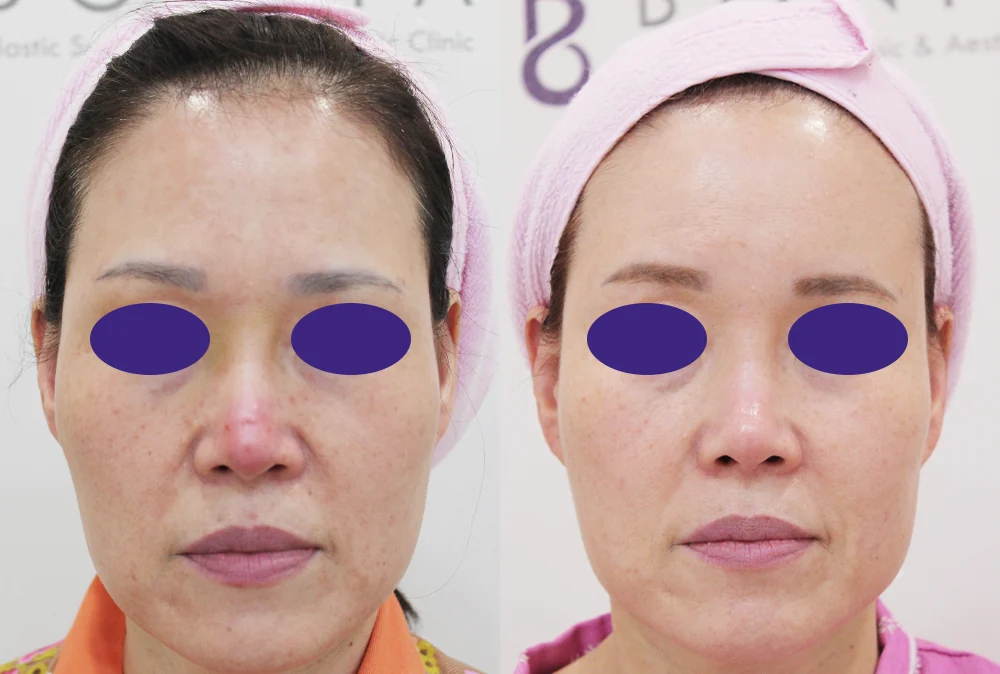
Red skin at the nasal tip (front view)
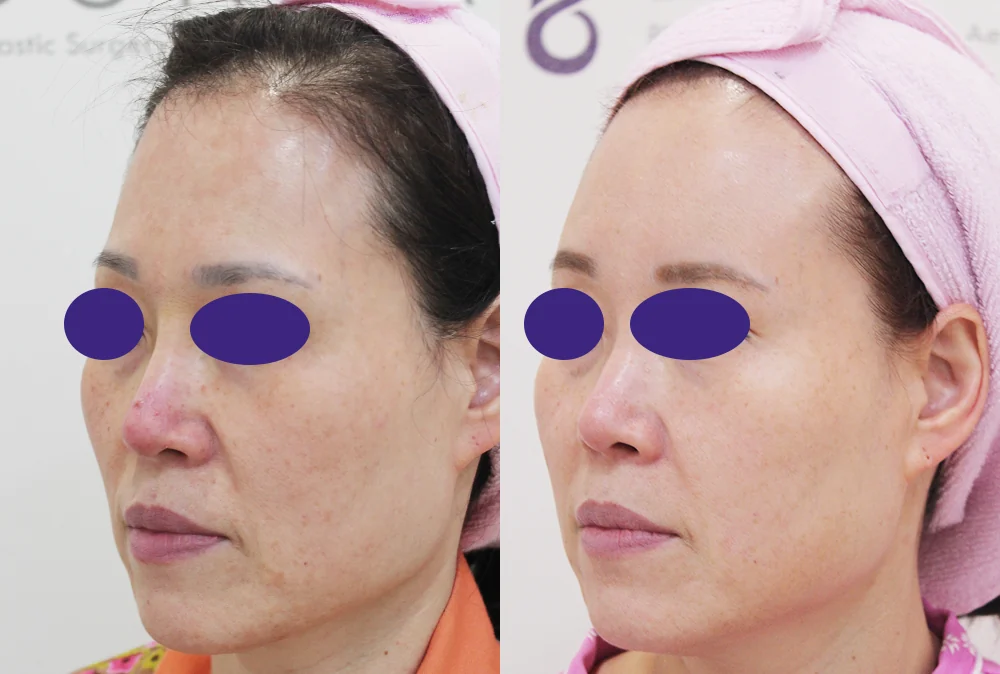
The same case seen from an angle
* Results vary from person to person. Side effects are possible, so please decide after a thorough consultation with a doctor.
Frequently asked questions
Can't the old implant simply be swapped for a new one?
If the problem lies only in the implant, replacing it can help. But if the cover has thinned or the capsule is tight and pulling, things are different. A new implant placed in the same pocket can recreate the same problem. That is why choosing a new implant is considered together with managing the capsule and reinforcing the supporting tissue.
My implant shows through. Will a smaller one solve it?
A smaller implant sometimes helps. But when the skin is thin, even a small implant can show its outline. So the thickness of the cover is checked first, and adding your own cartilage is weighed as an option.
I have had inflammation. Can the revision be done straight away?
It depends on how severe the inflammation or infection is. Immediate rebuilding with the patient's own cartilage has been reported.6 But while inflammation is still active, it may be safer to plan removal and revision separately. The decision is made after examining the redness, any discharge and the skin.
Does an old implant always have to be replaced?
There is no rule that an implant must be changed after a set number of years. However, calcification and capsule changes have been reported in silicone implants that have been in place for a long time.3 So a change in shape or any inflammation is a reason to have it examined.
Where will the scars be?
Scars are mostly inside the nostrils and on the columella, the strip of skin between the nostrils. They are managed so they fade over time.
What to prepare before your consultation
- When and where your first surgery was done, and the implant type and size if you have records
- Any later revisions, fillers or thread procedures
- When redness, swelling or discharge occurred, how often, and what treatment you received
- Photos before your first surgery, if available
- What you want to change, and what you would rather keep
You will find Bonita Clinic on the 3rd floor of 565 Gangnam-daero, Seocho-gu, Seoul, roughly 100 m on foot from Exit 8 of Nonhyeon Station (Line 7). More details are on our implant revision page. For a nose that has become short and upturned, see the contracted nose revision guide. If several areas need correcting together, see full revision rhinoplasty and the full revision rhinoplasty guide.
References (6)
Sources that support the explanations in this article. Study findings describe general trends and do not guarantee individual results.
- Peled ZM, Warren AG, Johnston P, et al. The use of alloplastic materials in rhinoplasty surgery: a meta-analysis. Plast Reconstr Surg. 2008;121(3):85e-92e.doi:10.1097/01.prs.0000299386.73127.a7Meta-analysis of alloplastic nasal implants: removal rate 6.5% for silicone versus 3.1% for Gore-Tex and Medpor, showing how often implant problems lead to further surgery
- Keyhan SO, Ramezanzade S, Yazdi RG, et al. Prevalence of complications associated with polymer-based alloplastic materials in nasal dorsal augmentation: a systematic review and meta-analysis. Maxillofac Plast Reconstr Surg. 2022;44(1):17.doi:10.1186/s40902-022-00344-8Meta-analysis of 27 studies (3,803 cases) of dorsal augmentation with synthetic implants: revision rate about 6.4%, silicone's non-porous surface leads to a fibrous capsule, and infection and displacement are the main reasons for silicone revision
- Jung DH, Kim BR, Choi JY, et al. Gross and pathologic analysis of long-term silicone implants inserted into the human body for augmentation rhinoplasty: 221 revision cases. Plast Reconstr Surg. 2007;120(7):1997-2003.doi:10.1097/01.prs.0000287323.71630.e6Analysis of 221 silicone implants removed at revision (abstract): calcification increased with time in place (focal calcification in half of implants after 9 years) with inflammatory cells in the surrounding capsule
- Kook WS, Yang CE, Lew DH. Removal of Nasal Silicone Implant and the Impact of Subsequent Capsulectomy. Plast Reconstr Surg. 2019;144(4):575e-585e.doi:10.1097/PRS.0000000000006095Retrospective comparison (abstract): when the capsule was left after silicone removal, the nasal length index fell by 6.2%, whereas it increased when most of the capsule was removed, suggesting retained capsule can contract
- Jeong JY, Oh SH, Suh MK, et al. Effective Use of a Silicone-induced Capsular Flap in Secondary Asian Rhinoplasty. Plast Reconstr Surg Glob Open. 2014;2(6):e172.doi:10.1097/GOX.0000000000000126Series of 95 secondary Asian rhinoplasties: why revision is difficult (thin skin, capsule formation), why complete capsule removal can thin the dorsal skin, use of the capsule as a flap (infected or calcified capsules excluded), and early malposition in 4 patients
- Won TB, Jin HR. Immediate reconstruction with autologous cartilage after removal of infected alloplast in revision rhinoplasty. Otolaryngol Head Neck Surg. 2012;147(6):1054-1059.doi:10.1177/0194599812459026Case series of 21 patients (abstract): immediate reconstruction with autologous cartilage after removing an infected implant, with one reinfection settled by antibiotics and one revision for rib cartilage warping over a mean 35 months
About this article
This article separates general medical information from Bonita Clinic's own approach. Because the right decision depends on each person's condition, it is not a substitute for a consultation.
