 KOKorean
 ENEnglish
 JP日本語
JP日本語 CN中文(简体)
 TW中文(繁體)

Nose Implant Removal in Seoul: Will Your Nose Go Back to How It Was?
Often the nose will not simply return to how it was before the implant. Over the years, a capsule (a thin layer of tissue the body builds) forms around an implant. The skin and soft tissue over it may become thin or stretched, and silicone implants can calcify (harden as calcium builds up). So a removal plan decides several things at the same time. These are whether to treat the capsule and whether the tip needs support from your own tissue. If there is inflammation or infection, it also decides when reconstruction should happen. If you are considering removal in Seoul, sending your surgical history and photos first helps us see which approach may fit.
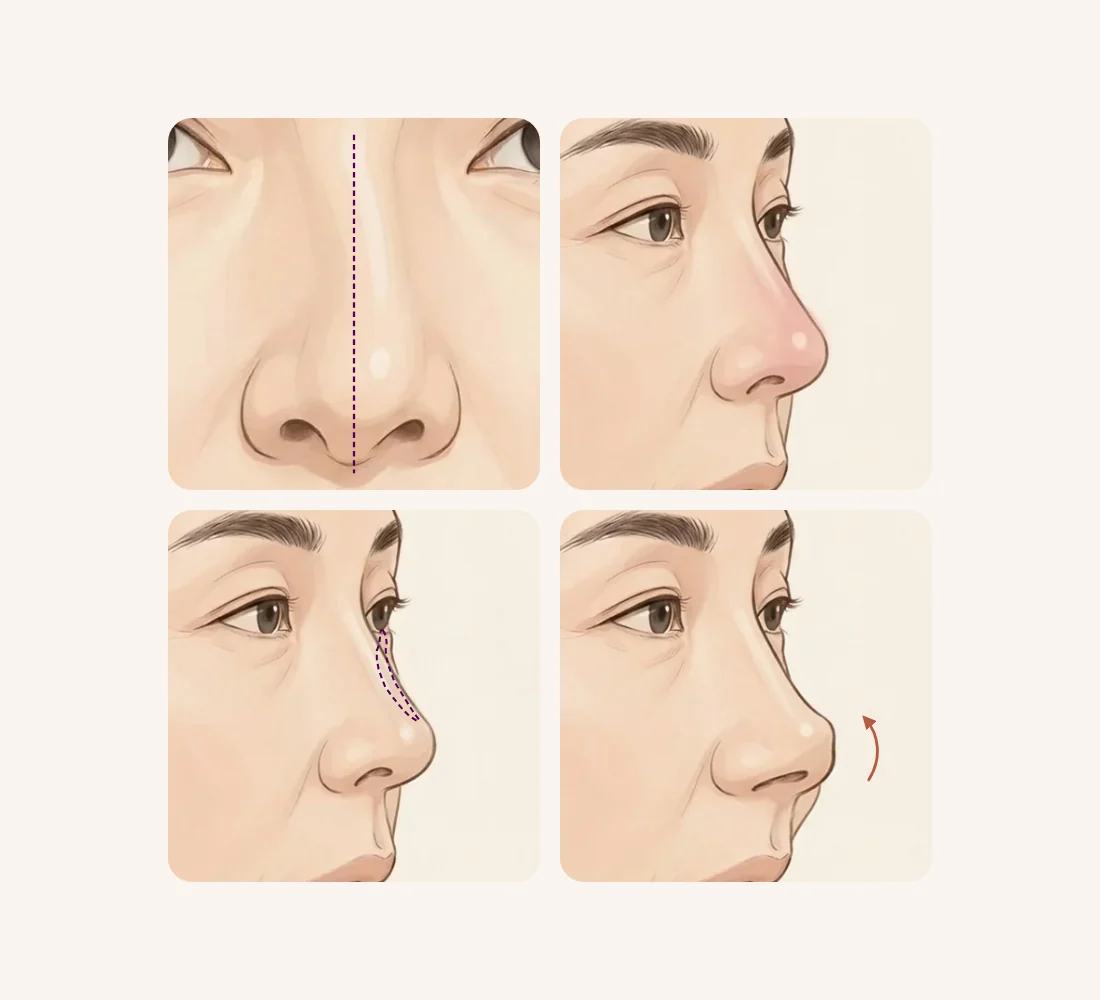
What else is looked at when an implant comes out?
Removing an implant is not just taking it out. The capsule around it, the skin and soft tissue covering it, and the support the tip will need afterwards are all looked at together. Soft tissue means the layers under the skin. The picture below shows the areas checked in nasal implant removal.
Areas checked in nasal implant removal
Why do people have nasal implants removed?
Nose augmentation often uses alloplastic implants (man-made materials). Common ones are silicone, Gore-Tex (expanded PTFE) and Medpor (porous polyethylene). A meta-analysis (a study that pools many studies and calculates them again) found that silicone implants were removed in 6.5% of cases. For Gore-Tex and Medpor, the figure was 3.1%.1 The percentage is small. But because so many people have had this surgery, a fair number eventually consider removal.
A university hospital and a private clinic in Korea looked at 581 revision cases involving alloplastic implants over ten years. The problems with the 376 silicone implants were, in order:3
- capsular contracture (the capsule tightening and pulling): 131
- displacement (the implant moving out of place): 113
- skin problems: 75
- infection: 38
- protrusion (the implant pushing out toward the skin): 19
376 silicone cases: what went wrong
Gore-Tex cases were mostly about tip and bridge contour and infection. Medpor cases combined skin problems, tip deformity and contracture.3
What is checked when you notice these changes?
The wish to remove an implant usually starts with a visible change. The cards below pair common changes with what is checked at the clinic.
Common reasons for removal and what is checked
1If the implant outline shows or looks crooked
Capsule contraction or thin cover are possible; implant position, shape and skin thickness are checked
2If redness and inflammation keep coming back
Inflammation or infection around the implant is possible; heat, pus and when it began recurring are checked
3If the skin over the implant looks thin or stretched
Long pressure is possible; skin color and thickness and the risk of the implant breaking through are checked
4If the nose looks shorter and upturned, with nostrils showing
Capsular contracture (a contracted nose) is possible; nose length, tip position and nostril show are checked
Contracted nose revision
Some people want a more natural nose again, or want the implant cleared away before a revision. In that case, what they want has changed. Then the question is whether support will be needed after removal.
How do long-standing implants change?
The body wraps any implant in a fibrous layer called the capsule. One study examined 221 silicone implants removed at revision surgery. They had been in place from 1 month to 25 years, 6 years 7 months on average. Calcification developed on the implants over time, and inflammatory cells were seen in the capsule around it. The authors concluded that this calcification causes the shape changes seen years after surgery.2
When calcification appeared on silicone nasal implants
- 4 yearsCalcified debris seen under the microscope
- 5 yrs 8 mosFirst calcification visible to the eye
- 9+ yearsFocal calcification in 50% of implants
- 15+ yearsLarge, degenerated calcification
The authors of the 581-case series also saw fibrous and calcified capsules as the main causes of contracture, protrusion and shifting that appear later on. They noted, though, that the degree of calcification varies between individuals.3
How tightly the capsule pulls
How tightly the capsule contracts also changes the shape. A study that graded 695 people who had silicone rhinoplasty reported:4
- grade I (natural, as if no implant): 71.7%
- grade II (implant edge detectable but acceptable): 14.5%
- grade III (implant deviated, skin firm and irregular): 10.8%
- grade IV (short, upturned nose with nostrils showing): 3.0%
Revision was indicated for grades III and IV.4
Four grades of capsule tightening
What is inside the bridge of the nose?
The bridge is built in layers. From the surface down, there is skin and then a fibrofatty soft-tissue layer (soft tissue mixed with fibers and fat). Below these are a thin membrane covering bone and cartilage (periosteum and perichondrium), and then the nasal bone and cartilage. Removing an implant means dealing not only with the implant but also with the capsule around it and the skin and soft tissue above it.
Nasal bridge cross-section: implant and surrounding tissue
- 1Implant wrapped in its capsule
- 2Calcification that can form over years
- 3Thinned or stretched skin and soft tissue
By area, the bridge holds the implant and its capsule, while the tip is where skin and soft tissue may thin or droop. When cartilage is needed to support the tip, it is taken from the septum, the ear or a rib.4 With surgery at Bonita Clinic, scars are mostly inside the nostrils and on the columella.
Why is taking the implant out often not enough?
The capsule
If the capsule has thickened and contracted, it can keep affecting the shape after the implant is gone. In the grading study above, noses were treated differently by grade:4
- Grade III (deviated implant): the capsule over the bridge was released with cuts (capsulotomy), the implant was replaced, and scar tissue at the tip was cleared.
- Grade IV (shortened nose): the bridge capsule was removed (capsulectomy), and the framework was rebuilt with cartilage.
Where skin was thin after capsulectomy, the cover was reinforced. Acellular dermis (skin tissue with its cells removed, prepared for grafting) or temporal fascia (the membrane over the temple muscle) was used.4
Stretched or thinned soft tissue
In many cases, a long-standing implant has stretched the skin and soft tissue over it. So removing it alone can make the tip sink or droop.
When the structure has collapsed, as in a shortened nose, cartilage support is needed. One example is a septal extension graft (cartilage attached to the end of the septum to hold up the tip). Cartilage is taken from the ear or septum, or from a rib when those have already been used.4 Your own cartilage is well tolerated and easy to carve. But the amount is limited, and warping that is hard to predict can occur. Rib cartilage provides enough material but leaves a scar where it is taken.4
What else is done when an implant comes out
Inflammation and infection
Infection around the implant changes the timing and method of removal and when reconstruction can follow. One study followed 21 patients whose infected implants (10 silicone, 9 Gore-Tex, 2 Medpor) were removed and replaced in the same operation with their own cartilage:5
- Over an average of 35 months, one patient developed an infection that settled with antibiotics.
- One needed revision because rib cartilage warped.
- No major absorption (shrinking of the cartilage) was seen.
This shows immediate reconstruction can be possible. But the study was small. Depending on how severe the infection is and the state of the tissue, the infection may be cleared first and reconstruction done at a later stage.
Material makes a difference
Tissue grows into the tiny pores of Gore-Tex. In one case, an implant could not be removed cleanly at revision three years later. Medpor bonds firmly to the lining of the nose and to perichondrium, making removal very difficult.3 That is why it matters to know which implant is where before surgery.
How do the approaches differ?
Implant removal can be thought of in about four ways, depending on the situation.
| Approach | Used when | Good to know |
|---|---|---|
| Implant removal only | No inflammation; little capsule or tissue change | A remaining capsule can contract again |
| Removal + capsule treatment | A thick, contracted capsule has shortened or twisted the nose | Thin skin may need extra cover4 |
| Removal + support with your own tissue | The tip may sink or droop once the implant is out | Ear, septal or rib cartilage; donor-site scar4 |
| Removal + immediate rebuild for infection | Infection can be cleared and rebuilt in one stage | Small-study evidence; staging is also used5 |
Whatever the approach, swelling, bleeding, inflammation, infection and nerve injury are possible after surgery. Recovery and results vary between people. Recreating the nose exactly as it was before any implant is not a realistic aim. It is more realistic to clear the implant and capsule that cause trouble and build a natural shape from what remains.
How we approach it at Bonita Clinic
At Bonita Clinic, we perform nasal implant removal as surgery under local anesthesia or sedation. You can leave the same day, and stitches are used. Recovery time and follow-up visits depend on the extent of surgery and your individual condition, and the actual surgical plan is decided after an in-person consultation.
Options you can discuss in Seoul
Dr. Kwang-Seop Chung, a plastic surgeon board-certified in Brazil, has seen patients himself at the same address since the clinic opened in 1995. For nasal implant problems, the options discussed in consultation are:
- Removal of the implant and contracted capsule
- Support reinforced with your own tissue, such as ear cartilage, where needed
- Clearing of inflamed or infected tissue, with removal and revision timing planned around the infection
- Implant replacement or full revision when that suits better (see the links at the end)
Which of these you need, and in what order, is decided only after an examination.
Why do the plan and cost differ from person to person?
Two people asking for "nose implant removal" can need very different operations. The extent of the work, not the procedure name, shapes the plan and the cost.
- Implant type and how long it has been in
- How much capsule needs treatment
- Support with ear, septal or rib cartilage
- Infection: one stage or staged
- Number of previous operations
- Anesthesia: local or sedation
Final plan and quote after an in-person exam
A final estimate is given only after the in-person examination. By then the extent of capsule work, any cartilage support and the staging are clear. Photos can suggest a direction but cannot settle these questions.
What can photos show, and what needs an in-person exam?
Photos and records are a good start. But several deciding factors can only be judged by examination.
Photos can show
- Implant outline, deviation or show-through
- Redness, skin color change
- Nose length, tip position, nostril show
- How the nose changed over time
Needs an in-person exam
- Skin and soft tissue thickness over the implant
- Implant mobility and capsule firmness
- Active infection or a draining tract
- Tip support and septal cartilage
- Implant material from records and findings
Helpful photos: front, both sides at 45 degrees, full profile and a view from below, in good light. A photo of your nose before your first rhinoplasty, and one from before the problem started, are very useful. Add whatever you know about previous surgeries: dates, materials and whether cartilage was used. You are welcome to message us with your photos and any questions.
Planning your visit and recovery
What is confirmed in advance is limited to the treatment information above: surgery under local anesthesia or sedation, same-day discharge and stitches. How long you should stay in Seoul, when stitches come out and when you can return to normal activities all vary. They depend on the scope of surgery, whether cartilage is taken and whether an infection calls for a staged plan. That is why they are planned together at consultation. If an infection means reconstruction is staged, the timing of a second visit is also discussed then.
After you return home, contact a doctor promptly if redness, swelling, pain or discharge increases instead of settling. Keeping your operative details and dated photos of the recovery is useful for any doctor who sees you later.
Frequently asked questions
Is it enough just to take the implant out?
If only the implant is removed and the capsule is left, the tissue can contract again or the nose can look unnatural. So Bonita Clinic decides on capsule removal and post-removal support together. When the capsule is thin and the tissue has changed little, removal alone can be enough.
My implant shows through. What can be done?
An implant that shows or can be felt often means its size or material does not suit, or the soft tissue over it has thinned. The options are choosing a new implant and reinforcing the supporting tissue, or removing it and rebuilding with your own tissue. Replacement is covered in our guide to nose implant revision.
If there is inflammation, can the nose be built up again right away?
It depends on the infection and the tissue. In a small study where infected implants were removed and rebuilt at once with the patient's own cartilage, most did well.5 But when infection is severe, it may be cleared first and reconstruction staged. This is decided after examining how far the inflammation extends.
Should an old implant come out even if there is no problem?
There is no rule that an implant without problems must be removed after a certain number of years. However, silicone implants do calcify more with time.2 So if the shape changes, or the nose becomes firm or red, it is worth having it examined.
Where will the scars be?
Mostly inside the nostrils and on the columella (the strip of skin between the nostrils). They are cared for so they fade over time.
What to prepare before your consultation
- When and where you had nose surgery, how many times, which implant (silicone, Gore-Tex or other) and whether cartilage was used
- When inflammation or infection first appeared, and whether you had antibiotics or drainage
- Photos of your nose before your first surgery, before the problem began and now (front and profile)
- What you want and do not want: to rebuild height, or to live without an implant
Bonita Clinic is on the 3rd floor of 565 Gangnam-daero, Seocho-gu, Seoul, about 100 m on foot from Exit 8 of Nonhyeon Station (Line 7). You can read more on our Nasal Implant Removal page. For replacing an implant, see Implant Revision and the guide to nose implant revision; for a shortened, upturned nose, see Contracted Nose Revision and the guide to contracted nose revision. When several problems overlap, see Full Revision Rhinoplasty and the guide to full revision rhinoplasty. Nasal filler problems are covered in Eye, Glabella & Nose Revision and the guide to eye, glabella and nose filler removal.
References (5)
Sources that support the explanations in this article. Study findings describe general trends and do not guarantee individual results.
- Peled ZM, Warren AG, Johnston P, Yaremchuk MJ. The use of alloplastic materials in rhinoplasty surgery: a meta-analysis. Plast Reconstr Surg. 2008;121(3):85e-92e.doi:10.1097/01.prs.0000299386.73127.a7Meta-analysis (abstract) of alloplastic materials in rhinoplasty: silicone, Gore-Tex (ePTFE) and Medpor are the most used; removal rate 6.5% for silicone vs 3.1% for Gore-Tex and Medpor
- Jung DH, Kim BR, Choi JY, et al. Gross and pathologic analysis of long-term silicone implants inserted into the human body for augmentation rhinoplasty: 221 revision cases. Plast Reconstr Surg. 2007;120(7):1997-2003.doi:10.1097/01.prs.0000287323.71630.e6Analysis (abstract) of 221 silicone nasal implants removed at revision (in place 1 month to 25 years, mean 6 years 7 months): calcification seen microscopically after 4 years, visibly after 5 years 8 months, focal calcification in 50% after 9 years, large calcification after 15 years, inflammatory cells in the capsule; calcification drives late shape change
- Kim HS, Park SS, Kim MH, et al. Problems associated with alloplastic materials in rhinoplasty. Yonsei Med J. 2014;55(6):1617-1623.doi:10.3349/ymj.2014.55.6.1617581 revision cases involving alloplastic nasal implants: silicone 376 (contracture 131, displacement 113, skin problems 75, infection 38, protrusion 19), Gore-Tex 183, Medpor 22; fibrous and calcified capsules seen as main drivers of late complications; Gore-Tex tissue ingrowth and Medpor adhesion make removal difficult
- Kim YK, Shin S, Kang NH, Kim JH. Contracted Nose after Silicone Implantation: A New Classification System and Treatment Algorithm. Arch Plast Surg. 2017;44(1):59-64.doi:10.5999/aps.2017.44.1.59Classification of 695 silicone rhinoplasty patients into four contracture grades (grade III 10.8%, grade IV 3.0%; revision indicated in 13.8%): capsulotomy and implant replacement for grade III, capsulectomy with septal extension graft from ear, septal or rib cartilage for grade IV, acellular dermis or temporal fascia for thin skin; limits of autologous cartilage (quantity, warping) and rib donor scars
- Won TB, Jin HR. Immediate reconstruction with autologous cartilage after removal of infected alloplast in revision rhinoplasty. Otolaryngol Head Neck Surg. 2012;147(6):1054-1059.doi:10.1177/0194599812459026Case series (abstract) of 21 patients whose infected implants (silicone 10, Gore-Tex 9, Medpor 2) were removed with immediate reconstruction using their own cartilage; mean follow-up 35 months: one infection settled with antibiotics, one revision for rib cartilage warping, no major absorption
About this article
This article separates general medical information from Bonita Clinic's own approach. Because the right decision depends on each person's condition, it is not a substitute for a consultation.
