 KOKorean
 ENEnglish
 JP日本語
JP日本語 CN中文(简体)
 TW中文(繁體)

Under-Eye, Glabella and Nose Filler Removal in Seoul: How Far Can Removal Safely Go?
Filler and foreign material under the eyes, between the eyebrows (the glabella) and on the nose can be removed. But the skin there is thin and blood vessels run close underneath, so the first question is not "how completely" but "how far is safe". Hyaluronic acid, the filler that can be dissolved, is usually treated with a dissolving injection first. Material that does not dissolve, or lumps that have hardened, are located by ultrasound together with the nearby vessels and then removed surgically. Some changes, such as mild under-eye puffiness or a faint bluish tint, may not need removal at all. Deciding what to remove and what to leave is part of the plan. If you are considering treatment in Seoul, you can send photos and your injection history first to see which approach may suit you.
Why do the under-eye area, glabella and nose need extra care?
These three areas have a lot in common. The skin is thin, muscle and bone or cartilage lie right underneath, and small blood vessels run through them in a dense network. So the same amount of filler shows more here than elsewhere, and taking it out also calls for more care.
Why these three areas are tricky
Under the eyes: thin skin, with bone just below
The tear trough is the groove that runs down at an angle from the inner corner of the eye toward the cheek. It is a thin stack of layers: skin, then the ring-shaped muscle that closes the eye (orbicularis oculi), then the thin covering of the bone (periosteum). In its inner part the skin is very thin, with almost no layer of fat beneath it.3 That is why even a small lump shows through, and why any small dent left after removal is easy to see.
Glabella and nose: where vessel problems are reported most
Filler that blocks a blood vessel can, rarely, damage vision. The glabella (the area between the eyebrows) and the nose are where this most serious complication has been reported most often. A review gathered reports from around the world of 98 cases of vision change after filler. Of these, 38.8% followed injections in the glabella and 25.5% in the nasal region.2 Among 48 new cases reported between 2015 and 2018, the nose accounted for 56.3% and the glabella for 27.1%.1 More than half of the reported cases came from these two areas.
Two areas where vision complications are reported most
The glabella gets most of its blood supply from a single arterial branch. If that vessel is blocked, the skin there is described as especially vulnerable to necrosis, which means tissue dying because blood can no longer reach it.6 Nasal vessels also vary a great deal from person to person in where and how deep they run. Anatomical studies place them mainly in the fibromuscular layer (a layer where muscle and fibrous tissue mix), while ultrasound studies have found some lying directly above the bone.3
So in these areas the first question is not how thoroughly material can be taken out, but how far removal can safely go. Chasing every last trace can thin the skin or injure a vessel, leaving a bigger problem than the one you started with.
What problems can under-eye filler cause?
Under-eye filler problems tend to linger, and they often show up late.
A systematic review (a study that collects and analyses all the relevant reports in a set way) looked at 52 cases of delayed complications after tear trough filler. Swelling was the most common (42.3%). Next came nodules, small lumps you can feel under the skin (25%). Then came a yellowish reaction that looks like xanthelasma, the flat yellow patches that can form around the eyelids (17.3%). Last was migration, where the material moved elsewhere (7.7%). Problems appeared on average 16.8 months after injection, and discoloration appeared latest, at an average of 52 months. Most swelling was linked to hyaluronic acid (HA, the filler that can be dissolved with an enzyme), while lumps were more common with other materials such as PMMA and PLLA.4 So an under-eye change that starts a year or two after treatment may still be related to that filler.
On the other hand, not every under-eye change has to be removed. A study followed 147 people for at least 5 years after HA injections around the eyes. It found swelling over the cheekbone in 11%, a blue-gray tint in 31.3% and uneven contour in 30.5%. Yet 90% of these were mild and needed no treatment.5
HA placed too close to the surface can scatter light under the skin and look bluish. Dissolving it with an enzyme injection is the first step, and tightly cross-linked products may need more than one session. If that fails, the material can be pressed out through a tiny nick in the skin as a last resort.6 Pressure on a vein near the inner corner of the eye has also been linked to swelling around the eyes.3 So long-lasting puffiness calls for a look at where the material sits, not only at how much there is.
When superficial HA looks bluish
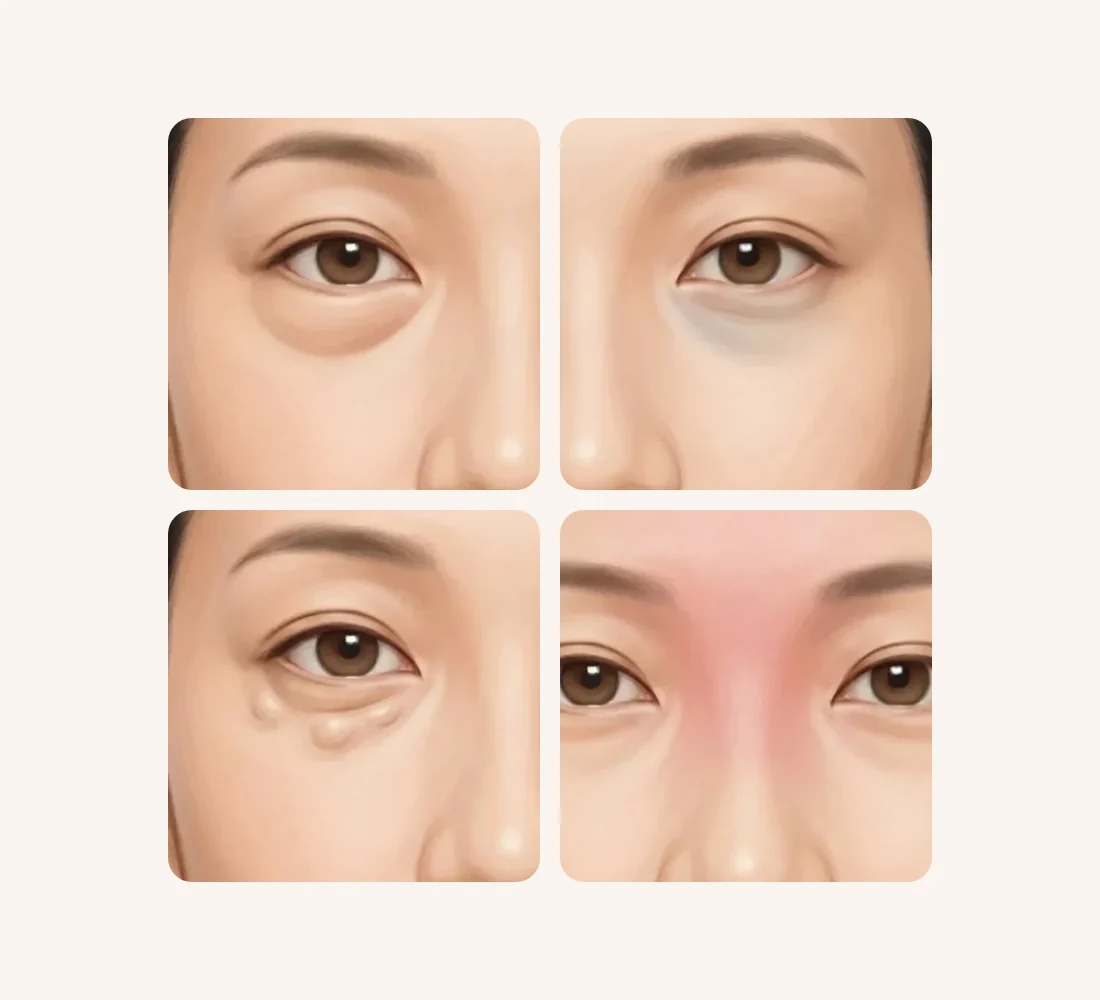
If you notice these changes, what is the likely cause?
What you see in the mirror cannot confirm the cause on its own. It can, however, suggest where to look first.
If you notice these changes
1Under-eye puffiness for months
If it is HA, dissolving comes first, and where the material sits is checked too
First suspect: water-attracting filler, a compressed vein
2A bluish tint
Dissolving comes first; if it does not work, the gel may be pressed out through a tiny nick
First suspect: HA placed too superficially
3Bumpy lumps you can feel
First tell whether it dissolves; if not, ultrasound finds it before removal
First suspect: clumped filler, foreign body granuloma
4A red, firm glabella or nose bridge
Inflammation is checked first, then the vessels, before choosing the approach
First suspect: foreign body reaction, inflammation, infection
A foreign body granuloma is a firm, inflamed lump that forms when the body walls off material it sees as foreign. A flat yellowish patch may be the xanthelasma-like reaction described above.4 In every case, the actual cause is confirmed by examination and ultrasound before anything is decided.
Why are vessels checked first in the glabella and nose?
Problems in the glabella and nose are usually one of three things. They are lumps that have hardened or become red and raised over time, material that has spread along the nose bridge, or substances of unknown composition from past unlicensed injections.
Because the depth at which vessels run here differs from person to person, mapping them with ultrasound beforehand is recommended.3 Ultrasound lets the doctor look under the skin without opening it. The same principle applies to removal: the direction and depth of approach are chosen by seeing how the material lies in relation to the vessels.
Signs that need emergency care right away
Severe pain unlike the injection itself, or whitening of the skin, may appear right after a filler injection. This may be the first sign of a blocked vessel and needs immediate treatment.6 In reported cases of vision loss after filler, the common symptoms were loss of vision, pain, difficulty moving the eye and a drooping eyelid, and 43.8% also had skin changes.1 Symptoms like these are a matter for emergency care, not for the later removal this guide describes.
If you also have a nasal implant such as silicone or Gore-Tex, the order in which the filler, foreign material and implant are dealt with needs to be planned together. Implant removal is covered on our Nasal Implant Removal page.
How do the methods differ?
The method is chosen by whether the material dissolves, how deep it lies, and how firmly it is stuck to the tissue around it. Here is what the terms in the table mean:
- Dissolving injection: an enzyme that breaks down HA is injected to melt the filler. It does not work on materials other than HA.
- Manual or microcannula removal: the material is taken out by hand, or through a fine tube with a blunt tip (a microcannula).
- Excision: a small opening is made in the skin and the lump is cut out directly.
- Fat restoration: fat taken from another part of your body is moved into the hollow left behind.
| Method | Suited to | Good to know | Tissue burden (relative) |
|---|---|---|---|
| Dissolving injection | HA lumps, tint, swelling | Cannot dissolve non-HA material | |
| Small-nick expression | Superficial HA | A last resort when dissolving fails | |
| Manual or microcannula removal | Non-dissolving material, clumps | Staged if adhesions are heavy | |
| Excision | Firm granulomas, lumps stuck to skin | Scar position planned in advance | |
| Fat restoration | Hollows after removal | Partly absorbed; extra care near vessels |
One method alone is rarely enough. A typical plan combines methods area by area. It might dissolve HA under the eyes, surgically remove a hardened lump in the glabella, and fill a remaining hollow once the tissue has settled.
Fat used to fill hollows is handled cautiously in these areas too. In the 2015 review mentioned above, autologous fat (your own fat) was the material most often involved in vision damage (47.9%).2 So when fat is moved to the glabella or around the nose, the amount, depth and timing are set conservatively, with the position of the vessels in mind.
What is recovery like, and what are the limits?
At Bonita Clinic, we perform eye, glabella and nose foreign material removal as surgery. Sedation is combined with local anesthesia, you go home the same day, and stitches are used. How long recovery takes and how many follow-up visits you need depend on how much is removed and on your own condition.
How recovery usually unfolds
- Day of surgerySedation and local anesthesia, home the same day
- Right afterSwelling and bruising; compression and cold packs explained
- RecoveringSwelling settles and the new contour shows
- SettlingTreated and restored areas stabilize; need for touch-up judged
It also helps to know the limits in advance:
- Under the eyes and on the glabella and nose, the skin is thin enough that even a small dent can show.3
- If material had spread right under the skin, the skin may be thinner or less even after removal.
- Bleeding, infection and inflammation are possible after surgery, and an incision can leave a scar.
- When material is tangled in tissue and cannot all be taken out at once, what remains is reassessed as healing progresses.
How we approach it at Bonita Clinic
Treatment options you can discuss in Seoul
Bonita Clinic has been in the same location since 1995, and Dr. Kwang-Seop Chung, a board-certified plastic surgeon trained in Brazil, sees patients himself. For filler and foreign material problems around the eyes, glabella and nose, the consultation covers:
- Ultrasound to locate the material, judge its size and check the surrounding tissue
- Removal by hand or fine cannula, freeing adhesions while limiting tissue damage
- Restoration of hollows with your own fat, with amount and timing set conservatively near vessels
- Combined laser treatment for marks and texture, and Scar Clinic follow-up for any scar that remains
- Planning alongside nasal implant removal when an implant is also present
Why do the plan and cost vary?
The same complaint, such as "my nose filler went wrong", can lead to very different procedures. What drives the plan and the cost is the scope of the work.
- Which areas: under-eye, glabella, nose, or several
- Whether the material dissolves or not
- Depth and closeness to vessels
- Whether fat restoration is needed
- A nasal implant to deal with as well
- Anesthesia: sedation with local
Quote given after examining you in person
A final estimate is given once the in-person examination and ultrasound have shown what needs to be removed and whether restoration is needed. Before that, any figure would only be a guess.
What can photos show, and what needs an in-person exam?
Photos help us understand your concern before you travel. They cannot show what the material is, or how close it lies to the vessels.
Photos can show
- Puffiness and when it is worse (morning photos)
- A bluish tint under the eyes
- Bulges on the glabella or nose bridge
- Shape and asymmetry from front and side
Needs an in-person exam
- Whether the material is HA or something else
- Depth relative to vessels (ultrasound)
- Skin thickness over the material
- Hardness, adhesion and inflammation
- Implant position, if one is present
Useful photos are taken in even light without makeup: from the front, from both sides at 45 degrees, in full profile, and with the eyes closed. If puffiness changes during the day, a morning photo and an evening photo help, as do photos from before the problem began. You can send us a message with these photos and what you remember about your injections.
Planning your visit and recovery
What is settled in advance is limited to the treatment information above: surgery under sedation with local anesthesia, going home the same day, and stitches. How long to stay in Seoul, when and how often to come back, and whether removal should be done in stages are decided with you at consultation. These depend on how many areas are involved and whether restoration is needed.
At Bonita Clinic, recovery usually goes like this: swelling and bruising are common at first, and we explain how to use compression and cold packs. As the swelling goes down, the new contour becomes visible. Once the treated and restored areas have stabilized, the need for any touch-up is judged. If treatment is staged, the first session usually deals with removal and later sessions with restoration or refinement, but the order is set case by case.
After you return home, see a doctor promptly if redness, heat, pain or discharge increases instead of settling, and seek emergency care for any change in vision. Dated photos of your recovery are useful for any doctor who sees you later.
Real treatment cases
These cases appear on Bonita Clinic's eye, glabella and nose revision page. Results vary from person to person.
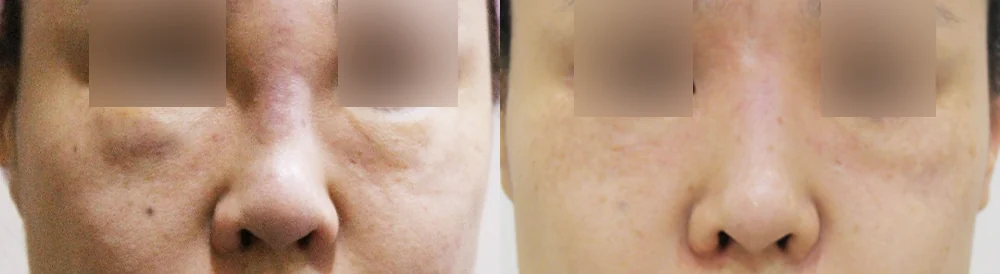
Bumpy swelling under the eyes and across the upper cheeks
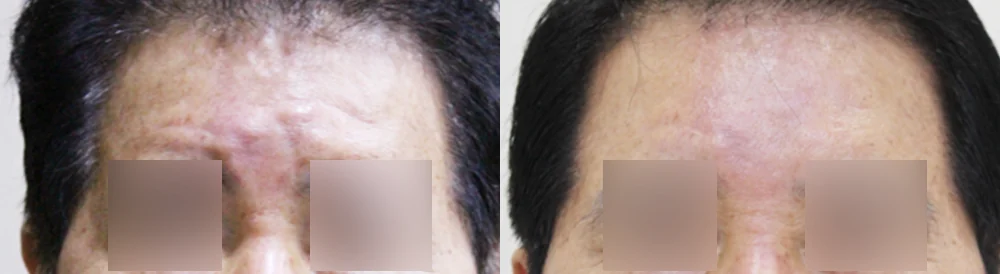
Uneven raised areas between the eyebrows and on the lower forehead
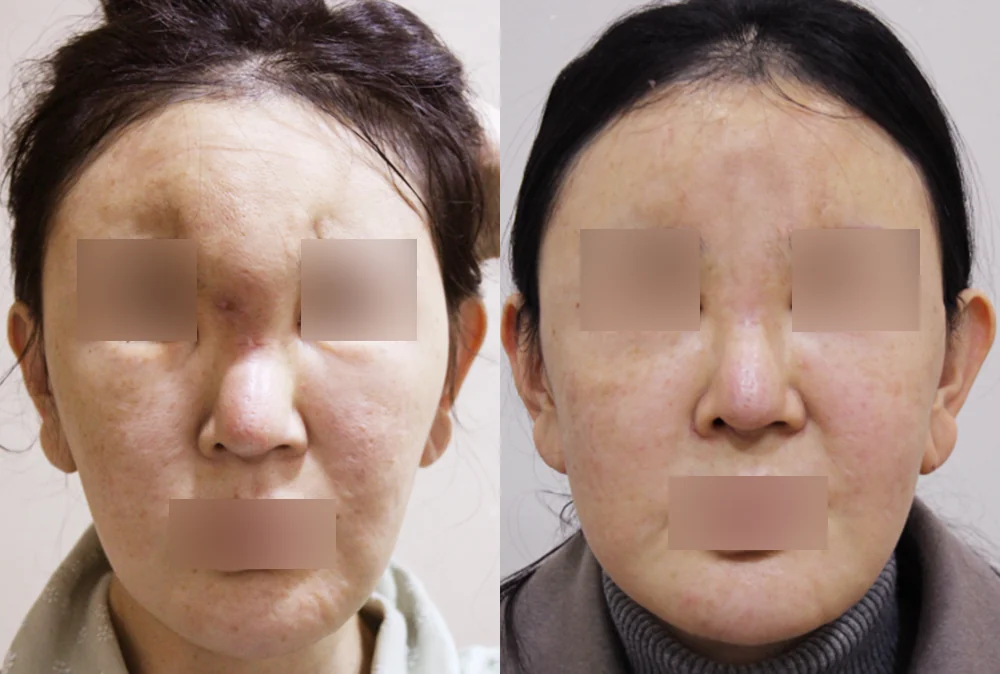
A thick raised area from the glabella to the upper nose bridge
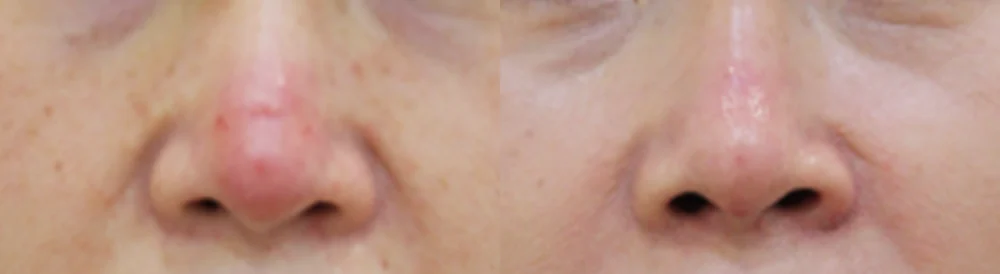
A red, rounded, swollen nasal tip
* Results vary from person to person. Side effects are possible, so please decide after a thorough consultation with a doctor.
Frequently asked questions
My under-eye filler was dissolved but the bulge is still there. Could it be something else?
The dissolving enzyme only works on HA. If a bulge remains after dissolving, there are a few possibilities. Another material may be mixed in, or the area around the filler may have turned into firm fibrous tissue. Or the cause may not be filler at all, such as swelling or fat. Ultrasound is used first to see what the remaining bulge looks like.
Can filler injected many years ago still be removed?
Yes. Older filler can be removed, though it is more often attached to the surrounding tissue, which changes the approach. How far removal can go is confirmed at consultation.
Will the under-eye area or glabella look hollow afterwards?
It can lose volume in proportion to what is removed. That is why restoration is included in the plan, using your own fat if needed. In these areas the amount and timing of fat are set conservatively because of the vessels.
I don't know what was injected. Is that a problem?
You can still have a consultation. An unknown material is hard to predict, so if it is causing symptoms, removal is considered seriously. Telling us when you were injected, what symptoms you have, and whether you have had dissolving injections helps us choose the approach.
Will there be a scar?
A scar can remain. Incisions are kept small and placed where they show least, and any remaining scar is followed up at our Scar Clinic.
What to prepare before your consultation
- For each area (under-eye, glabella, nose), when, where and what was injected
- Whether you have had dissolving injections, and what changed afterwards
- Any nose surgery or implant, and any surgery around the eyes
- Whether swelling is worse in the morning or changes during the day
- Medicines you take regularly
Bonita Clinic is on the 3rd floor of 565 Gangnam-daero, Seocho-gu, Seoul, about 100 m on foot from Exit 8 of Nonhyeon Station (Line 7). More about the process is on our Eye, Glabella & Nose Revision page. For the forehead, chin and cheeks, see Forehead, Chin & Cheek Revision and the guide to forehead, chin and cheek filler removal. For the lips, see the guide to lip filler and foreign material removal. If sagging after removal is also a concern, Multi Lifting after Foreign Body Removal may be relevant.
References (6)
Sources that support the explanations in this article. Study findings describe general trends and do not guarantee individual results.
- Beleznay K, Carruthers JDA, Humphrey S, et al. Update on Avoiding and Treating Blindness From Fillers: A Recent Review of the World Literature. Aesthet Surg J. 2019;39(6):662-674.doi:10.1093/asj/sjz053Review (abstract): 48 cases of vision loss after filler reported 2015–2018; nose 56.3%, glabella 27.1%, forehead 18.8%; hyaluronic acid in 81.3%; skin changes in 43.8%; full recovery of vision in 20.8%
- Beleznay K, Carruthers JDA, Humphrey S, Jones D. Avoiding and Treating Blindness From Fillers: A Review of the World Literature. Dermatol Surg. 2015;41(10):1097-1117.doi:10.1097/DSS.0000000000000486Review (abstract): 98 cases of vision change after filler; glabella 38.8%, nasal region 25.5%; autologous fat was the most common material (47.9%), followed by hyaluronic acid (23.5%), which is why fat restoration near the glabella and nose calls for caution
- Vasconcelos-Berg R, Desyatnikova S, Bonavia P, et al. Best Practices for the Use of High-Frequency Ultrasound to Guide Aesthetic Filler Injections—Part 2: Middle Third of the Face, Nose, and Tear Troughs. Diagnostics (Basel). 2024;14(22):2544.doi:10.3390/diagnostics14222544Expert best-practice paper (full text): ultrasound anatomy of the nose and tear trough; very thin skin and no subcutaneous fat in the medial tear trough, vein compression and swelling around the eye, variable depth of nasal arteries; basis for checking vessels by ultrasound first
- Trinh LN, McGuigan KC, Gupta A. Delayed Complications following Dermal Filler for Tear Trough Augmentation: A Systematic Review. Facial Plast Surg. 2022;38(3):250-259.doi:10.1055/s-0041-1736390Systematic review (abstract): 52 cases of delayed complications after tear trough filler; swelling 42.3%, lumps 25%, xanthelasma-like reaction 17.3%, migration 7.7%; average onset 16.8 months, discoloration on average 52 months
- Mustak H, Fiaschetti D, Goldberg RA. Filling the periorbital hollows with hyaluronic acid gel: Long-term review of outcomes and complications. J Cosmet Dermatol. 2018;17(4):611-616.doi:10.1111/jocd.12452Retrospective study (abstract) of 147 patients followed for at least 5 years after periorbital hyaluronic acid: malar edema 11%, blue-gray discoloration 31.3%, contour irregularity 30.5%; 90% mild and needing no intervention
- Funt D, Pavicic T. Dermal fillers in aesthetics: an overview of adverse events and treatment approaches. Clin Cosmet Investig Dermatol. 2013;6:295-316.doi:10.2147/CCID.S50546Review (full text): bluish tint from superficially placed hyaluronic acid (Tyndall effect), dissolving and small-nick expression, the vulnerability of the glabella with its single-artery supply, and the first signs of a blocked vessel
About this article
This article separates general medical information from Bonita Clinic's own approach. Because the right decision depends on each person's condition, it is not a substitute for a consultation.
