 KOKorean
 ENEnglish
 JP日本語
JP日本語 CN中文(简体)
 TW中文(繁體)

Lip Filler Lumps and Foreign Material Removal in Seoul: What Can Be Removed, and What Comes After
In many cases removal can be attempted. But the method, and how much can be taken out, depend on what was injected, which layer of the lip it sits in and how far it has spread. Hyaluronic acid, the filler that can be dissolved, is usually treated with a dissolving injection first. Material that does not dissolve, forms lumps or keeps causing inflammation is located by ultrasound and then removed surgically. Because the lip is thin and constantly moving, the shape left after removal, including any hollowing, should be planned from the start. If you are considering treatment in Seoul, you can send photos and your injection history first to see which approach may fit your case.
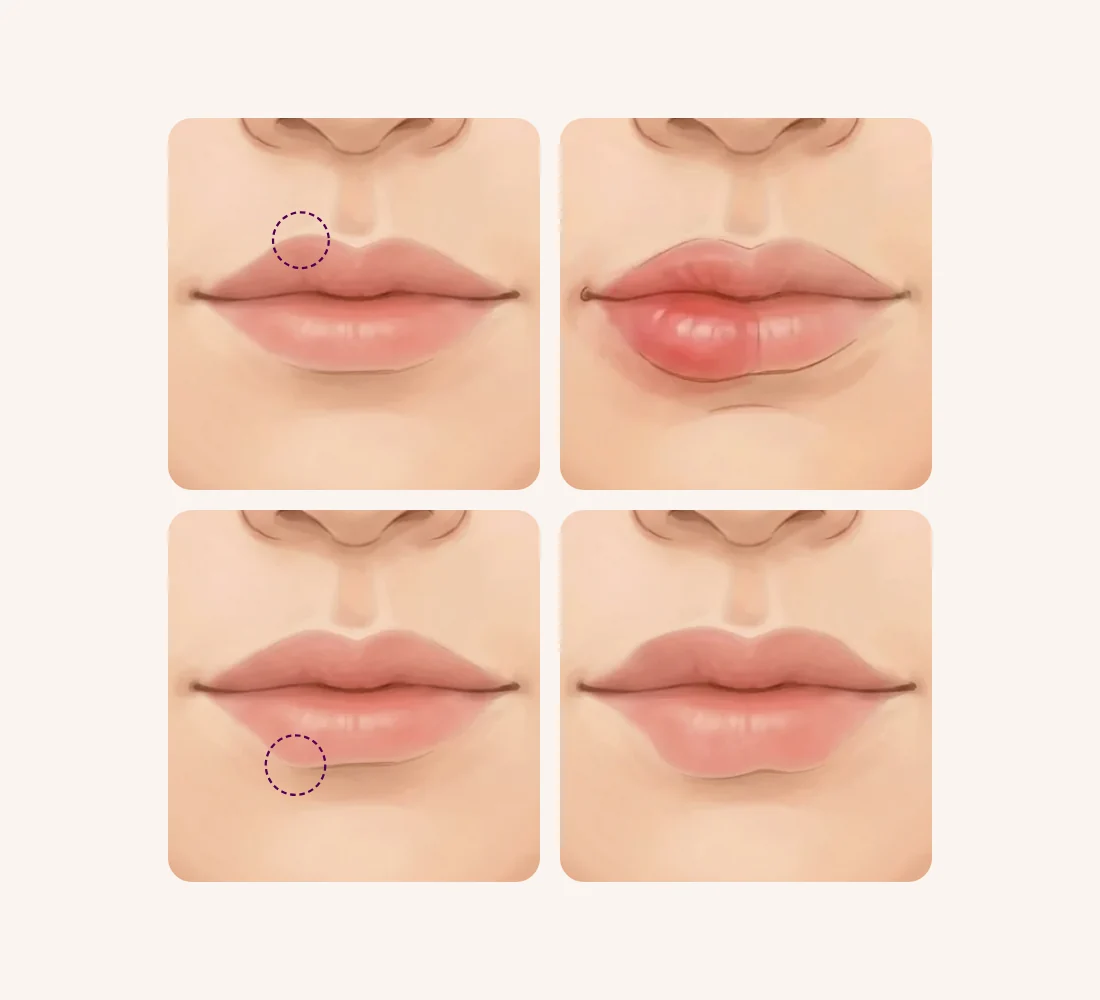
Why does injected material in the lips cause problems?
The lips move every time you speak or eat. Their skin and their inner lining (mucosa, the moist layer inside the mouth) are also thin. So the same amount of material is easier to feel here than elsewhere, and if it gathers on one side or shifts, the change in shape shows straight away. Reviews also note that fillers containing particles, placed in areas that move a lot such as the lips, can form nodules (small lumps you can feel) later on.1
Lip injectables fall into two broad groups:
- Fillers the body gradually breaks down, such as hyaluronic acid (HA).
- Materials that are not broken down and stay in the tissue, such as silicone, PMMA and polyacrylamide hydrogel (an injectable gel).1
When a non-degradable material causes trouble, the problem tends to last longer and be harder to treat.1 Many people with lip filler problems had their injections years ago, in another clinic or another country, or from an unlicensed provider, and do not know what was used. The same review notes that patients may present with reactions to fillers injected abroad, including products not available locally.1 In that situation the material has to be worked out backwards from the symptoms and imaging.
Changes that deserve a check
| What you notice | Common causes | What is checked at the clinic |
|---|---|---|
| A lump you can feel inside the lip | Material collected in one spot, foreign body granuloma | Size, firmness, whether it is growing |
| Unevenness or a difference between sides | Material spread unevenly or migrated | How far it has spread, whether it has moved toward the gum fold |
| Redness, swelling and pain | Inflammation or infection | Heat, pus, when it started and whether it recurs |
| Hardening | Long-standing inflammation and fibrosis | How firmly it is attached to the surrounding tissue |
| Color change or an open sore | Circulation problem, skin damage | Extent and how fast it is changing |
Two terms in the table, explained simply. A foreign body granuloma is a firm lump of inflammation the body builds to wall off material it cannot break down. Fibrosis means tissue turning into tough, fibrous scar-like tissue and hardening.
When 12 lip filler reactions were examined under the microscope, most showed up as firm, often movable nodules beneath the lip lining or skin. The material could also migrate under the lining of the upper or lower gum fold (the groove between the inside of the lip and the gum). These nodules were sometimes mistaken for a gum abscess, a mucous cyst (a small fluid-filled bump) or a small salivary gland tumor.5 The authors also note that people may not connect a lump with an injection received months or years earlier.5
Why does it matter when the problem started?
Complications of lip and perioral fillers are grouped into three periods: within 24 hours of injection (immediate), between 24 hours and 4 weeks (early), and after 4 weeks (delayed).2 Each period points to different causes, which is why your consultation starts with detailed questions about timing.
When complications tend to appear
- First daySevere pain or blanching: suspect a vessel problem, seek care now
- Day 1 to week 4Swelling, bruising, infection, early lumps
- Week 4 and laterLate-onset nodules, recurring inflammation
- Months to yearsForeign body granuloma, late reactions to non-degradable material
Severe pain that feels different from the injection itself, or part of the lip turning white, can mean a blood vessel has been blocked. That needs treatment on the spot.1 This guide focuses on what happens after that window: problems that surface months or years later.
Foreign body granulomas are uncommon, but they can follow any type of filler. They usually appear after a latent period (a time with no symptoms) of several months to years.1 In one survey, reactions to degradable fillers appeared on average about 4.9 months after injection, and reactions to non-degradable fillers about 18.3 months after, with wide variation between individuals.1 Granulomas are often triggered by a bacterial infection elsewhere in the body.4
Over time these lumps tend to become firmer because of fibrosis.1 On the other hand, granulomas diagnosed early and treated appropriately can shrink within a few weeks.4 The longer you wait, the fewer options tend to remain.
Time until a late reaction appears (average)
Why does it matter where in the lip the material sits?
From the outside in, the lip has five layers. They are skin, a thin layer of fat, the ring-shaped muscle around the mouth (orbicularis oris), a submucosal layer containing small salivary glands, and the inner lining (mucosa).
An anatomical study of 193 specimens looked at which layer the arteries supplying the lips (the labial arteries) run in. The upper and lower labial arteries ran between the lining and the muscle (submucosal) in 78.1% of cases. They ran within the muscle in 17.5%, and between the skin and the muscle in 2.1%. Their position varied most at the center of the lip.3 The labial arteries usually run just under the inner lining, so any material taken out from beneath the lining has to be removed with these vessels in mind.
Lip cross-section: where material sits
The shape the material has taken also changes how easily it comes out:
- When it has gathered into a nodule with clear edges, it can usually be taken out fairly cleanly.
- Material that has seeped between muscle fibers is mixed with the tissue. Trying to remove every trace would damage healthy muscle and lining as well.
Granulomas grow finger-like into the surrounding tissue. A review of granuloma treatment therefore says surgery should be the last option, and that surgery or drainage (letting collected fluid out) suits lumps and fluid-filled forms with little ingrowth.4
So the first step is mapping. In lip filler complications, ultrasound (a scan that looks under the skin without opening it) is used to help identify the type of material. It also shows where the material is and how far it extends, and locates nearby vessels.2 Seeing the depth and spread in advance, which cannot be judged by touch alone, helps avoid unnecessary incisions and tissue damage.
Which treatment comes first, and when?
Two lumps that feel alike may need very different first steps, depending on what the material is and what state it is in now.
What remains, and in what state?
1Confirmed HA filler
Dissolving is considered first; it may take several sessions
Dissolving injection
2Red, hot, swollen inflammation
Inflammation or infection is treated first; pus is drained if it collects
Treat inflammation first
3A lump of non-dissolving material
Located by ultrasound, then removed surgically; lumps and pocket-like forms suit surgery
Surgical removal
4Spread through tissue and stuck to it
Removed in stages that spare tissue; what remains is reassessed over time
Staged removal
Here is each approach in a little more detail.
| Approach | Typically suited to | Good to know |
|---|---|---|
| Dissolving injection (hyaluronidase) | Lumps caused by HA filler | Cannot dissolve other materials; heavily cross-linked products may need several sessions1 |
| Treating inflammation or infection | Red, hot, swollen phases; pus collections | Abscesses are opened and drained with antibiotics; if the material stays, it may flare again1 |
| Injections into the nodule | Granulomas found early | Commonly the first treatment for granulomas; surgery is considered if repeated injections fail14 |
| Surgical removal | Non-dissolving material, lumps, recurring inflammation | Removing volume can leave a hollow and a scar, so restoration needs planning |
| Fat grafting (your own fat) | Hollowing after removal | Part of the graft can be absorbed, so another session may be needed6 |
A dissolving injection uses an enzyme that breaks down HA. Injections into the nodule put medicine directly into the lump. The review explains that nodules which persist for months and become steadily more fibrotic are most likely foreign body granulomas and in the end require excision (cutting them out).1 It is equally clear that surgery is not always the first choice. Working out which stage you are in comes first.
What remains after removal, and what are the limits?
Taking material out reduces volume, so the lip can look hollow or change shape. That is why the plan covers both how much to remove and what shape will be left.
Fat grafting (moving your own fat to fill a hollow) does not give uniform results. Several studies report that 30–70% of the grafted volume is absorbed within a year.6 This means a good part of the moved fat may be absorbed by the body. So injecting smaller amounts over several sessions is recommended rather than one large session, and bruising, swelling, infection, necrosis and calcification can occur.6
As with any surgery, bleeding, infection and inflammation are possible, and the incision can leave a scar. If the material is tangled in tissue, it may not all come out at once, and what remains is reassessed as healing progresses. Returning the lips to exactly how they were before any injection is not a realistic goal. Reducing the material that causes trouble and restoring a natural shape and movement is.
How we approach it at Bonita Clinic
At Bonita Clinic, we perform lip and mouth foreign material removal as surgery. Sedation and local anesthesia are used together, you can go home the same day, and there are stitches. Recovery time and follow-up visits vary with the extent of removal and your individual condition.
Treatment options you can discuss in Seoul
Bonita Clinic has treated patients at the same location since opening in 1995, with Dr. Kwang-Seop Chung, a plastic surgeon board-certified in Brazil, treating each patient himself. For lip and mouth complications, the options discussed in consultation are the ones described above:
- Ultrasound assessment of the material's location, size and the condition of the tissue
- Surgical removal by hand or fine cannula, freeing adhesions while limiting tissue damage
- Restoration with your own fat when removal leaves a hollow
- Combined laser treatment to refine marks and skin texture, and follow-up of any remaining scar at the Scar Clinic
Which of these you need, and in what order, is decided only after an examination.
Why do the method and cost differ from case to case?
Two people with "lip filler problems" can need very different procedures. The extent of the work, rather than the name of the problem, shapes the plan and the cost.
- How far and how deep the material has spread
- Upper lip, lower lip, or the area around the mouth
- Whether fat grafting is needed for hollows
- Anesthesia: sedation with local
- Whether removal is split into stages
- Previous surgery, scarring or active inflammation
Final plan and quote after seeing you in person
A final estimate is given only after the in-person examination and ultrasound, once the extent of removal and any restoration are clear. Photos alone can suggest a direction, but they cannot fix the scope.
What can photos show, and what needs an in-person exam?
Photos are a useful start. They are not enough to decide how much material can be removed or whether restoration will be needed.
Photos can show
- Visible lumps, bulges and asymmetry
- Lip shape at rest and when smiling
- Redness, color change or sores
- How the shape changed over time (older photos)
Needs an in-person exam
- Which layer the material is in (ultrasound)
- How far it has spread into muscle
- Firmness and adhesion to tissue
- Active inflammation or infection
- Position of nearby blood vessels
Helpful photos: the lips closed and from the front, a gentle smile, and both sides at 45 degrees, in good light without makeup or lip color. If the swelling comes and goes, a photo from a bad day helps. Older photos from before the problem show how the shape has changed. You can send us a message with your photos and what you remember about the injections.
Planning your visit and recovery
What is confirmed in advance is limited to the treatment information above: surgery under sedation with local anesthesia, going home the same day, and stitches. How long you should stay in Seoul, when and how often you need to come back, and when the stitches come out all vary. They depend on the extent of removal and whether fat grafting is done at the same time. We plan these with you at consultation.
At Bonita Clinic, recovery usually goes like this:
| Period | Common changes | What the clinic does |
|---|---|---|
| Right after surgery | Swelling and bruising | Explains compression and cold packs |
| During recovery | Swelling settles and the treated contour shows | Checks progress |
| Settling | Removal and restoration sites stabilize | Judges whether a touch-up is needed |
If fat grafting is done, the area the fat was taken from may also bruise and swell.6 After you return home, contact a doctor promptly if redness, heat, pain or discharge increases instead of settling. Keeping dated photos of your recovery is useful for any doctor who sees you later, including at follow-up visits.
Real treatment cases
These cases appear on Bonita Clinic's lip and mouth revision page. Results vary from person to person.
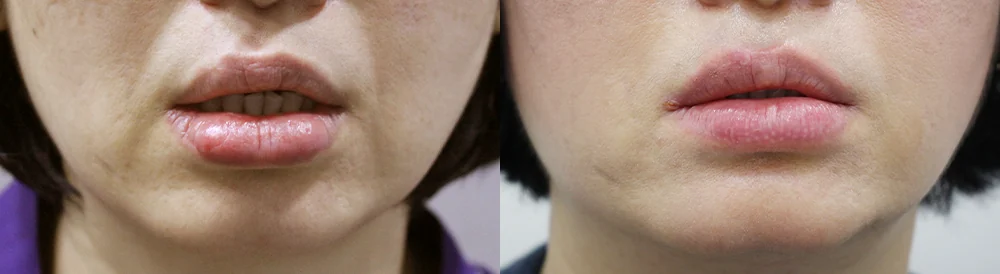
Lower lip bulging and pushed forward
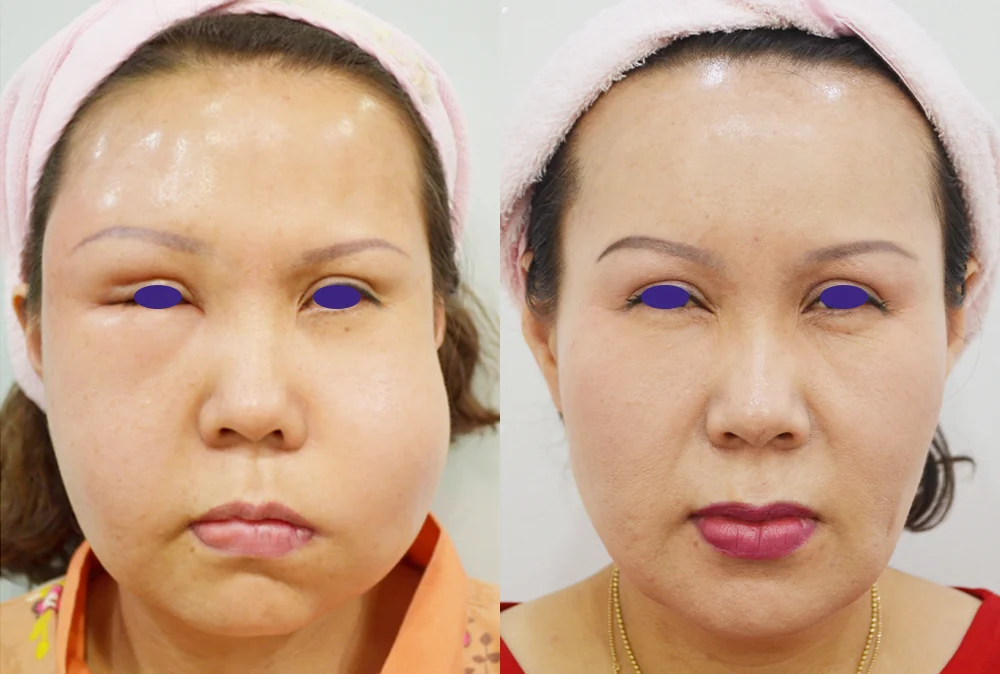
Lips swollen together with the cheeks and jaw area
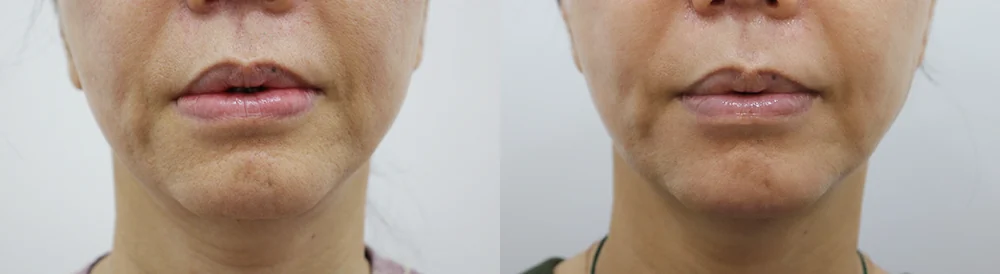
Lower lip looking thick and everted (front view)
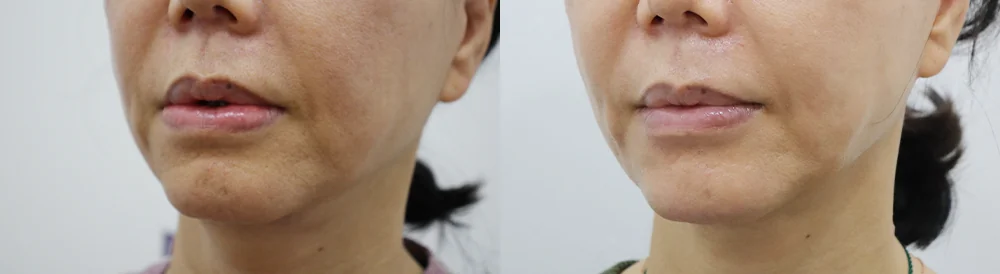
The same case seen from an angle
* Results vary from person to person. Side effects are possible, so please decide after a thorough consultation with a doctor.
Frequently asked questions
The filler was injected years ago. Can it still be removed?
Yes, older filler can be removed too. After many years it may be attached to the surrounding tissue or hardened by fibrosis, which changes the process. The remaining extent and tissue condition are checked by ultrasound before the method is chosen.
Will my lips look hollow or smaller after removal?
They can lose volume in proportion to what is removed. That is why the removal plan includes whether restoration is needed. If it is, your own fat is used. Part of grafted fat may be absorbed, so filling is sometimes done in stages while watching how it settles.
Can everything be removed in one operation?
It depends on how far the material has spread and how firmly it is attached. A single lump is easier to remove in one go. Material spread through muscle is removed within limits that protect the tissue, and anything left is reassessed later.
I don't know what was injected. Can I still have a consultation?
Yes. When the substance is unknown, it is hard to predict how it will behave. So if you have lumps, inflammation or hardening, removal is considered seriously. Tell us as much as you remember about when, where and how many times you were injected, and when the symptoms began.
Will there be a scar?
A scar can remain. Incisions are kept to a minimum and placed where they show least, and any remaining scar is followed up at our Scar Clinic.
What to prepare before your consultation
- When, where and how many times you were injected, and the product name or ingredient if known
- When the lumps, swelling, redness or pain first appeared, whether they recur, and whether they flared after an illness or dental treatment
- Treatments so far: dissolving injections, injections into the lump, antibiotics, earlier removal surgery
- Whether you get cold sores on the lips, since lip filler injections have been reported to reactivate them1
- Medicines you take regularly
Bonita Clinic is on the 3rd floor of 565 Gangnam-daero, Seocho-gu, Seoul, about 100 m on foot from Exit 8 of Nonhyeon Station (Line 7). You can read more about the process on our Mouth & Lip Revision page. For under-eye, glabella and nose filler problems, see Eye, Glabella & Nose Revision and the guide to eye, glabella and nose filler removal. For the forehead, chin and cheeks, see Forehead, Chin & Cheek Revision and the guide to forehead, chin and cheek filler removal.
References (6)
Sources that support the explanations in this article. Study findings describe general trends and do not guarantee individual results.
- Funt D, Pavicic T. Dermal fillers in aesthetics: an overview of adverse events and treatment approaches. Clin Cosmet Investig Dermatol. 2013;6:295-316.doi:10.2147/CCID.S50546Review: differences between degradable and non-degradable fillers, delayed nodules in the lips, the latency of foreign body granulomas, the usual order of treatment (dissolving, injections, excision as a last resort), first warning signs of vascular problems, and cold sore reactivation after lip injections
- Kroumpouzos G, Harris S, Bhargava S, Wortsman X. Complications of fillers in the lips and perioral area: Prevention, assessment, and management focusing on ultrasound guidance. J Plast Reconstr Aesthet Surg. 2023;84:656-669.doi:10.1016/j.bjps.2023.01.048Review (abstract): timing categories of lip and perioral filler complications (immediate, early, delayed) and the use of ultrasound to identify the material, its location and extent, and nearby vessels
- Cotofana S, Pretterklieber B, Lucius R, et al. Distribution Pattern of the Superior and Inferior Labial Arteries: Impact for Safe Upper and Lower Lip Augmentation Procedures. Plast Reconstr Surg. 2017;139(5):1075-1082.doi:10.1097/PRS.0000000000003244Anatomical study of 193 cadaver specimens: the layer in which the labial arteries run (submucosal 78.1%, intramuscular 17.5%, subcutaneous 2.1%) and their variability at the midline; basis for the lip cross-section
- Lemperle G, Gauthier-Hazan N. Foreign body granulomas after all injectable dermal fillers: part 2. Treatment options. Plast Reconstr Surg. 2009;123(6):1864-1873.doi:10.1097/PRS.0b013e3181858f4fReview (abstract): foreign body granulomas appear after a latent period, grow finger-like into tissue so surgery is the last option, and lumps or cystic forms suit surgery or drainage
- Eversole R, Tran K, Hansen D, Campbell J. Lip augmentation dermal filler reactions, histopathologic features. Head Neck Pathol. 2013;7(3):241-249.doi:10.1007/s12105-013-0436-1Case series of 12 lip filler reactions: firm submucosal nodules that may migrate toward the gum fold and mimic other conditions; filler types can be told apart under the microscope
- Simonacci F, Bertozzi N, Grieco MP, et al. Procedure, applications, and outcomes of autologous fat grafting. Ann Med Surg (Lond). 2017;20:49-60.doi:10.1016/j.amsu.2017.06.059Review: absorption of grafted fat (30–70% within a year reported in several studies), variable results, staged injections, and possible complications such as bruising, swelling, infection, necrosis and calcification
About this article
This article separates general medical information from Bonita Clinic's own approach. Because the right decision depends on each person's condition, it is not a substitute for a consultation.
