 KOKorean
 ENEnglish
 JP日本語
JP日本語 CN中文(简体)
 TW中文(繁體)

Forehead, Chin and Cheek Filler Removal in Seoul: Will It Look Hollow Afterwards?
It can. The forehead, chin and cheeks are often filled widely and generously to build contour, so taking the material out reduces volume and can change the shape. That is why the plan looks, from the start, at what will be left after removal, not only at what and how much to remove. If a hollow remains, it is filled with your own fat once the tissue has settled. Part of grafted fat is absorbed, so filling is often done in stages rather than matched exactly in one session. If you are considering treatment in Seoul, you can send photos of your face now and from before your injections to see how removal and restoration might be planned.
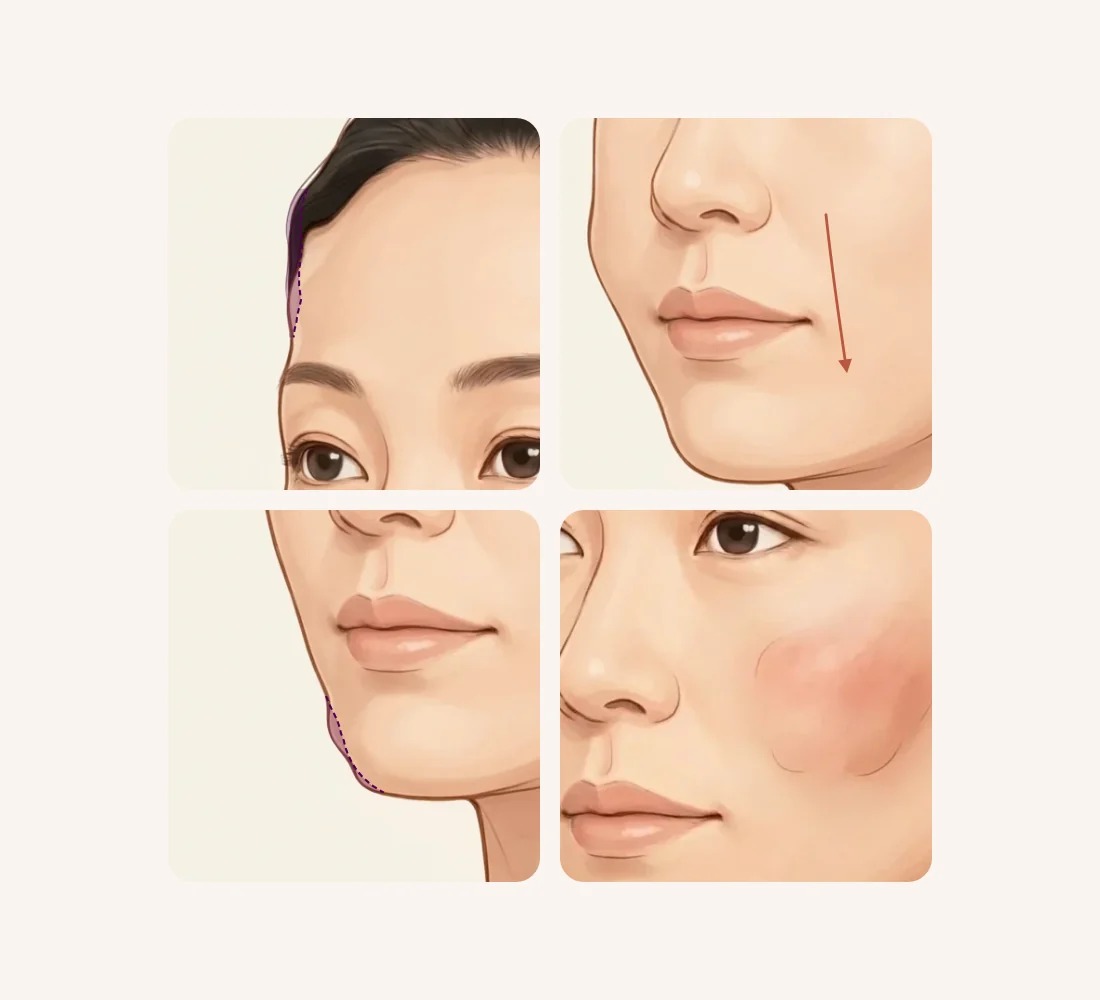
Why plan for what comes after removal in the forehead, chin and cheeks?
The under-eye area and lips are usually refined with small amounts. The forehead, chin and cheeks are different: they are filled to create the contour itself, such as a rounded forehead, a projecting chin or fuller front cheeks. Because larger amounts are spread over wider surfaces, problems cover a larger area, and the volume lost on removal is larger too. That is why, at Bonita Clinic, we talk about the hollow left after removal as part of the same treatment.
Typical changes here include an uneven, lumpy surface, lumps you can hold between your fingers, hardening, and repeated bouts of red, swollen inflammation. Some people feel that cheek material has slid down and made the jawline look heavy, or that forehead material has drifted toward the brows.
A foreign body granuloma is a firm, inflamed lump that forms when the body walls off material it sees as foreign. Late reactions like this are rare, reported in anywhere from 1 in 100 to 1 in 5,000 patients. But they tend to appear months to years after injection, at all the injected sites at the same time. With materials the body cannot break down (non-degradable materials), they are more pronounced and last longer.4 They are uncommon, but when they happen they can show up in several areas together. So if the same material went into your forehead, cheeks and chin, all of these areas need to be checked, not just the one that bothers you most.
Three areas filled widely and heavily
Why does the layer matter in the forehead?
On ultrasound (a scan that looks under the skin without opening it), the forehead is made of several layers. From the surface down, they are the skin, a layer of fat, the frontalis muscle that raises the eyebrows, and the periosteum, a thin covering over the bone.
The main forehead arteries come out deep near the eyebrows and get closer to the surface as they run upward. Vessels in the upper third of the face also connect widely with one another. So this area is considered high-risk for vision loss or stroke if material blocks a vessel (embolism).1 For the same reason, filler is usually placed deep, right on the bone, while more superficial placement is described as riskier because vessels also run in that plane.1 The higher you go on the forehead, the closer the vessels run to the skin, so the more superficial the work, the more care it needs.
Forehead cross-section: where material sits
Which layer the material is in, and what shape it has taken, changes how easily it comes out:
- A single lump collected on the bone usually has fairly clear edges and is easier to remove.
- Material spread through the fat is mixed with the tissue. Trying to remove every trace can thin the skin and leave the surface uneven.
A study of inflammatory reactions to non-degradable fillers also used ultrasound first to separate pocket-like collections from material soaked into the tissue, and treated them differently.2 That study, however, used a different, laser-based treatment. Of 219 patients, the lesions cleared completely in 62% and partly in 30%. Sterile abscesses, collections that look like pus pockets but contain no bacteria (9.5%), and minimal scarring (10%) were also reported.2 The method differs from ours, but the numbers show that with non-degradable material, no method makes everything disappear for everyone.
Why does material in the cheeks and chin move?
The muscles around the cheeks and chin move every time you talk or smile. A report on 15 patients treated for migrated polyacrylamide gel (a non-absorbable injectable gel) found that gel lying inside muscle had not formed a surrounding shell (capsule). It therefore moved easily with muscle activity or gravity. The report also explains that as the capsule thins over the years, migration may become more frequent.3 This may be why cheek material injected long ago can feel as if it has dropped.
Material that has moved is no longer where it was injected. In these areas, finding out where it is now, with ultrasound, matters more than where it was put. Removing it can make the cheeks and jawline feel lighter. But skin that has been stretched for years may remain, and sagging may need to be dealt with separately.
What changes after removal?
When material comes out, the volume it was filling goes too. The change to plan for differs a little from area to area.
What changes after removal
1Forehead material spread wide
The forehead may flatten or show dips, so restoration is planned at the same time
Removal and restoration planned together
2Cheek material that slid down
Front cheeks may hollow and stretched skin may show, so sagging is checked too
Lifting considered if needed
3A lump in the chin
Chin length and shape may change, so the contour to keep is planned first
Plan the contour that will remain
4Repeated inflammation
Filling waits until swelling and inflammation settle and the tissue is stable
Restoration timing judged separately
So restoration is part of the removal plan from the start. Your own fat is used to fill hollows, but not all of the moved fat stays. A meta-analysis (a study that pools the results of many studies) of 27 studies and 1,011 patients looked at facial fat grafting. The share of grafted fat that remained ranged from 26% to 83% between studies, with a pooled average of 47%. Retention tended to be better with a second grafting session, and complications were reported in 2.8%.5 For you as a patient, this means that about half of the fat often stays, and that it varies a lot from person to person. This is why fat is often added in stages while watching how it settles, rather than matched exactly in one go.
As described above, the forehead is an area where a blocked vessel carries a high risk.1 So the depth and amount of any fat moved there are decided carefully.
How we approach it at Bonita Clinic
From removal to restoration
- 1Map the extentUltrasound locates the material; the shape after removal is planned
- 2RemovalBy hand or fine cannula, releasing adhesions
- 3Check the tissueWatch swelling and inflammation settle
- 4Fat graftingYour own fat in hollows, timed to tissue condition
- 5Refine textureMarks and texture with combined laser
If material or a hollow remains, the next step is decided after watching your progress
At Bonita Clinic, we perform forehead, chin and cheek foreign material removal as surgery. It uses sedation together with local anesthesia, you go home the same day, and stitches are placed. Recovery usually goes like this:
- Right after treatment: there may be swelling and bruising, and you will be shown how to use compression and cold packs.
- While the swelling goes down: the contour of the treated area gradually appears.
- Settling: once the removal and restoration sites have stabilized, the need for a touch-up is judged.
How long recovery takes, and how often you need to come back, depends on the extent of treatment and on you.
What are the limits and side effects?
- Bleeding, infection and inflammation are possible after surgery, and the incision can leave a scar.
- Widely spread material may not all come out at once, and what remains is reassessed as healing progresses.
- Part of the grafted fat is absorbed, so another session may be needed,5 and some difference between sides can remain.
- Skin that has been stretched for a long time may still look loose after removal. In that case a treatment for sagging, such as Multi Lifting after Foreign Body Removal, may be considered as well.
Treatment options you can discuss in Seoul
Since opening in 1995, Bonita Clinic has stayed at one location, where Dr. Kwang-Seop Chung, a Brazilian board-certified plastic surgeon, treats patients in person. For forehead, chin and cheek complications, the consultation covers:
- Ultrasound to find where the material is now, and planning of the shape left after removal
- Removal by hand or fine cannula, releasing adhesions while limiting tissue damage
- Restoration of hollows with your own fat, timed to the condition of the tissue and often staged
- Combined laser treatment for marks and texture, and Scar Clinic follow-up for any remaining scar
- Lifting for sagging that remains after removal, when it is needed
Why do the plan and cost vary?
Two people with "forehead filler problems" can need very different procedures. The amount of work, more than the name of the problem, decides the plan and cost.
- How many areas: forehead, cheeks, chin, jawline
- How widely the material has spread
- Whether it has moved from where it was injected
- How much fat restoration is needed, and in how many stages
- Whether lifting is needed for loose skin
- Anesthesia: sedation with local
Plan and quote after an in-person exam
A final estimate is given only after the in-person examination and ultrasound have shown how much will be removed and how much restoration is likely to be needed. Because fat restoration may be staged, the plan explains which steps are expected and which depend on how you heal.
What can photos show, and what needs an in-person exam?
Photos help us understand your contour and concerns before you travel. They cannot show how deep the material is or how far it has spread.
Photos can show
- Uneven surfaces and visible lumps
- Contour from the front, side and below
- Redness or swelling that comes and goes
- Your contour before any injections
Needs an in-person exam
- Where the material is now (ultrasound)
- Whether it is collected or spread
- Depth and closeness to forehead vessels
- Firmness, adhesion and inflammation
- Skin looseness and fat donor sites
Useful photos are taken in even light without makeup: from the front, from both sides at 45 degrees, in full profile, and of the chin seen from below. Photos from before your first injection are especially helpful, because they show the contour restoration should aim for. Feel free to message us these photos along with any details you recall about the injections.
Planning your visit and recovery
What is confirmed in advance is limited to the treatment information above: surgery under sedation with local anesthesia, going home the same day, and stitches. How long to stay in Seoul, when and how often to return, and whether restoration should be done later in a separate stage are decided together at consultation. They depend on the extent of removal and the condition of the tissue.
If fat is grafted, the area it was taken from may also bruise and feel sore for a while. Grafted fat partly settles and is absorbed over the following months,5 so the final contour is judged later rather than in the first weeks.
After you return home, see a doctor promptly if redness, heat, pain or discharge increases instead of settling. Keeping dated recovery photos also helps any doctor you see afterwards.
Real treatment cases
These cases appear on Bonita Clinic's forehead, chin and cheek revision page. Results vary from person to person.
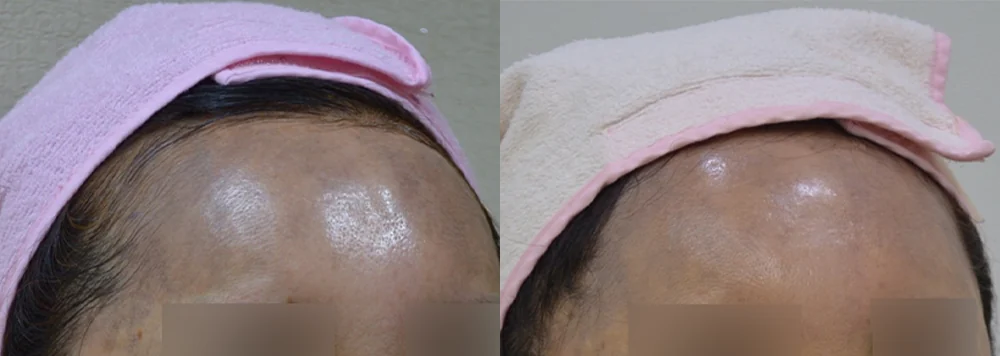
Two raised bulges on the upper forehead
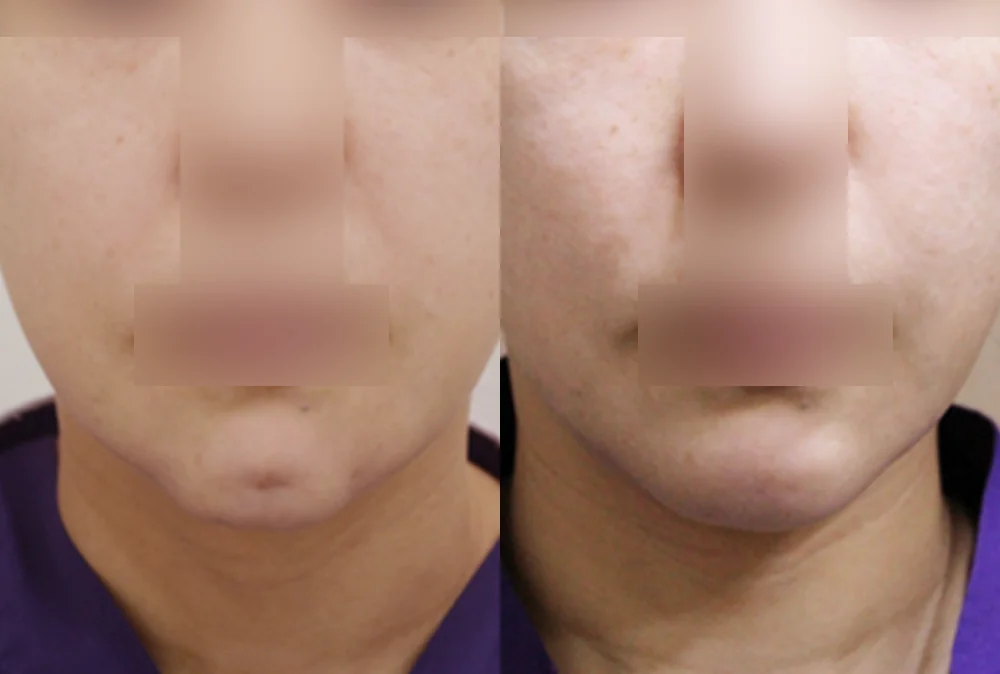
An uneven chin with a dent in the middle
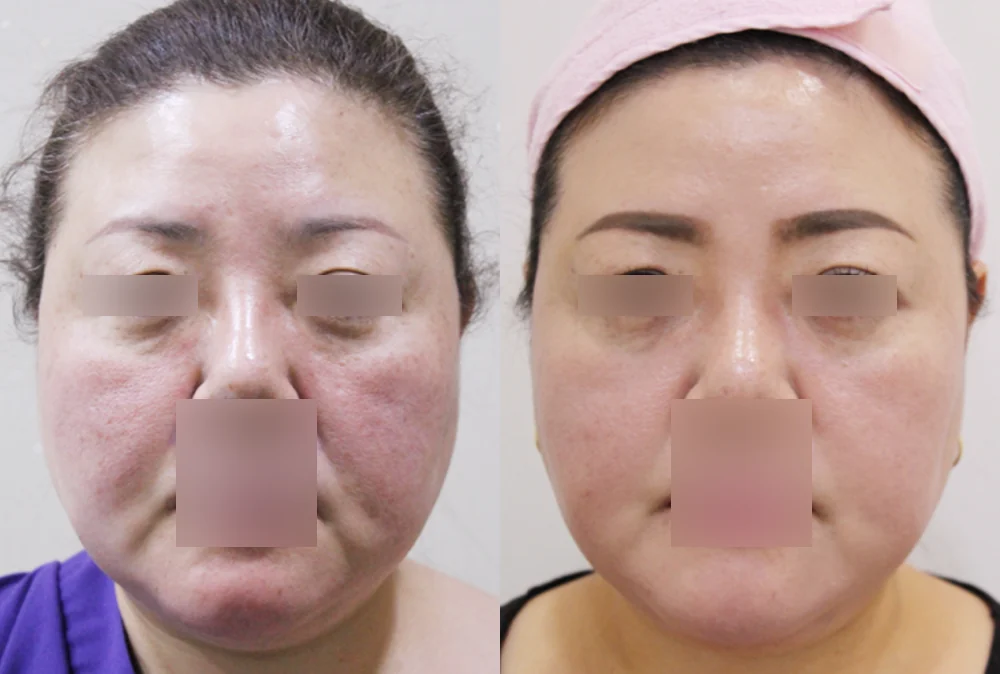
Both cheeks red, lumpy and swollen
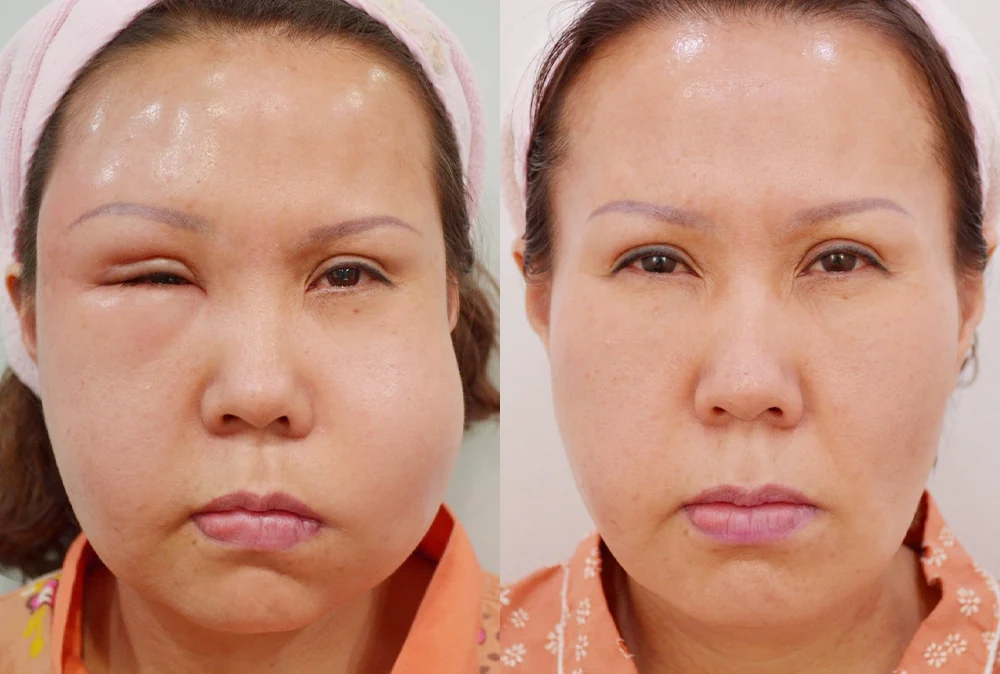
Marked swelling of the cheeks and an eyelid
* Results vary from person to person. Side effects are possible, so please decide after a thorough consultation with a doctor.
Frequently asked questions
Will my forehead look flat after the filler is removed?
It may flatten or show dips in proportion to what is removed. That is why the removal plan also considers restoration. If needed, your own fat is used once the tissue has settled. On the forehead, the depth and amount of fat are decided carefully because of the vessels.
My cheek filler seems to have dropped. Will removing it fix the sagging?
Removing the weight can make the cheeks and jawline lighter, but skin that has been stretched for years may remain. Ultrasound is used to find where the material is now before removal, and if sagging remains, lifting can be considered separately.
Is one fat grafting session enough?
Part of the grafted fat is absorbed, and the amount that stays differs between people. So one session may not be enough, and fat is often added in stages where it is needed.
The injections were long ago, or I don't know what was used. Can I still be treated?
Old filler can be removed, and you can have a consultation even if the substance is unknown. The process depends on how firmly it has attached to the tissue. Tell us as much as you remember about when and where you were injected and when symptoms began.
Will there be a scar?
A scar can remain. We keep incisions short and choose less visible spots; if a scar remains, our Scar Clinic continues its care.
What to prepare before your consultation
- For each area (forehead, chin, cheeks), when, where, what and how many times you were injected
- Whether red swelling keeps coming back, and when the last episode was
- Photos from before your first injection and recent photos
- Any previous surgery at possible fat donor sites, such as the abdomen or thighs
- Medicines you take regularly
Bonita Clinic is on the 3rd floor of 565 Gangnam-daero, Seocho-gu, Seoul, about 100 m on foot from Exit 8 of Nonhyeon Station (Line 7). More about the process is on our Forehead, Chin & Cheek Revision page. For the under-eye area, glabella and nose, see Eye, Glabella & Nose Revision and the guide to eye, glabella and nose filler removal. For the lips, see the guide to lip filler and foreign material removal.
References (5)
Sources that support the explanations in this article. Study findings describe general trends and do not guarantee individual results.
- Sigrist R, Desyatnikova S, Chammas MC, Vasconcelos-Berg R. Best Practices for the Use of High-Frequency Ultrasound to Guide Aesthetic Filler Injections—Part 1: Upper Third of the Face. Diagnostics (Basel). 2024;14(16):1718.doi:10.3390/diagnostics14161718Expert best-practice paper (full text): ultrasound layers of the forehead (skin, fat, frontalis muscle, periosteum); forehead arteries emerge deep and become more superficial higher up; the upper third of the face is a high-risk area for vascular embolism; basis for the forehead cross-section
- Cassuto D, Pignatti M, Pacchioni L, et al. Management of Complications Caused by Permanent Fillers in the Face: A Treatment Algorithm. Plast Reconstr Surg. 2016;138(2):215e-227e.doi:10.1097/PRS.0000000000002350Series of 219 patients with inflammatory reactions to non-degradable fillers (abstract): ultrasound used to separate cystic from infiltrating lesions and tailor treatment; complete clearance 62%, partial improvement 30%; sterile abscess 9.5%, minimal scarring 10%. This study used laser treatment, which differs from Bonita Clinic's method
- Cheng NX, Xu SL, Deng H, et al. Migration of implants: a problem with injectable polyacrylamide gel in aesthetic plastic surgery. Aesthetic Plast Surg. 2006;30(2):215-225.doi:10.1007/s00266-005-0081-5Series of 15 patients with migrated polyacrylamide gel (abstract): gel in muscle is not encapsulated and moves with muscle activity and gravity; thinning of the capsule over years may increase migration
- Lemperle G, Gauthier-Hazan N, Wolters M, et al. Foreign body granulomas after all injectable dermal fillers: part 1. Possible causes. Plast Reconstr Surg. 2009;123(6):1842-1863.doi:10.1097/PRS.0b013e31818236d7Review (abstract): foreign body granulomas are rare (1% to 0.02%), appear months to years after injection at all injected sites at the same time, and are more pronounced and longer-lasting with non-degradable materials
- Lv Q, Li X, Qi Y, et al. Volume Retention After Facial Fat Grafting and Relevant Factors: A Systematic Review and Meta-analysis. Aesthetic Plast Surg. 2021;45(2):506-520.doi:10.1007/s00266-020-01612-6Systematic review and meta-analysis of 27 studies and 1,011 patients (abstract): facial fat graft retention ranged from 26% to 83%, pooled average 47%; complications 2.8%; a trend toward better retention with secondary grafting
About this article
This article separates general medical information from Bonita Clinic's own approach. Because the right decision depends on each person's condition, it is not a substitute for a consultation.
