 KOKorean
 ENEnglish
 JP日本語
JP日本語 CN中文(简体)
 TW中文(繁體)

Contracted Nose Revision in Seoul: When and How Can a Short, Upturned Nose Be Lengthened Again?
A contracted nose is held short by hardened skin and capsule (the layer of tissue that formed around an implant) pulling from the inside. So simply stretching it longer can let it shrink back. The usual order is this. First the implant and capsule that caused the problem are dealt with, and the skin is checked until it has softened enough. Then the stuck tissue is released and the nose's support is rebuilt with your own tissue, such as rib cartilage. When surgery can be done is decided by the condition of the skin and any inflammation, not by a fixed number of months, and some noses need two operations. If you are considering treatment in Seoul, you can send photos and your surgical history first to see how your case might be staged.
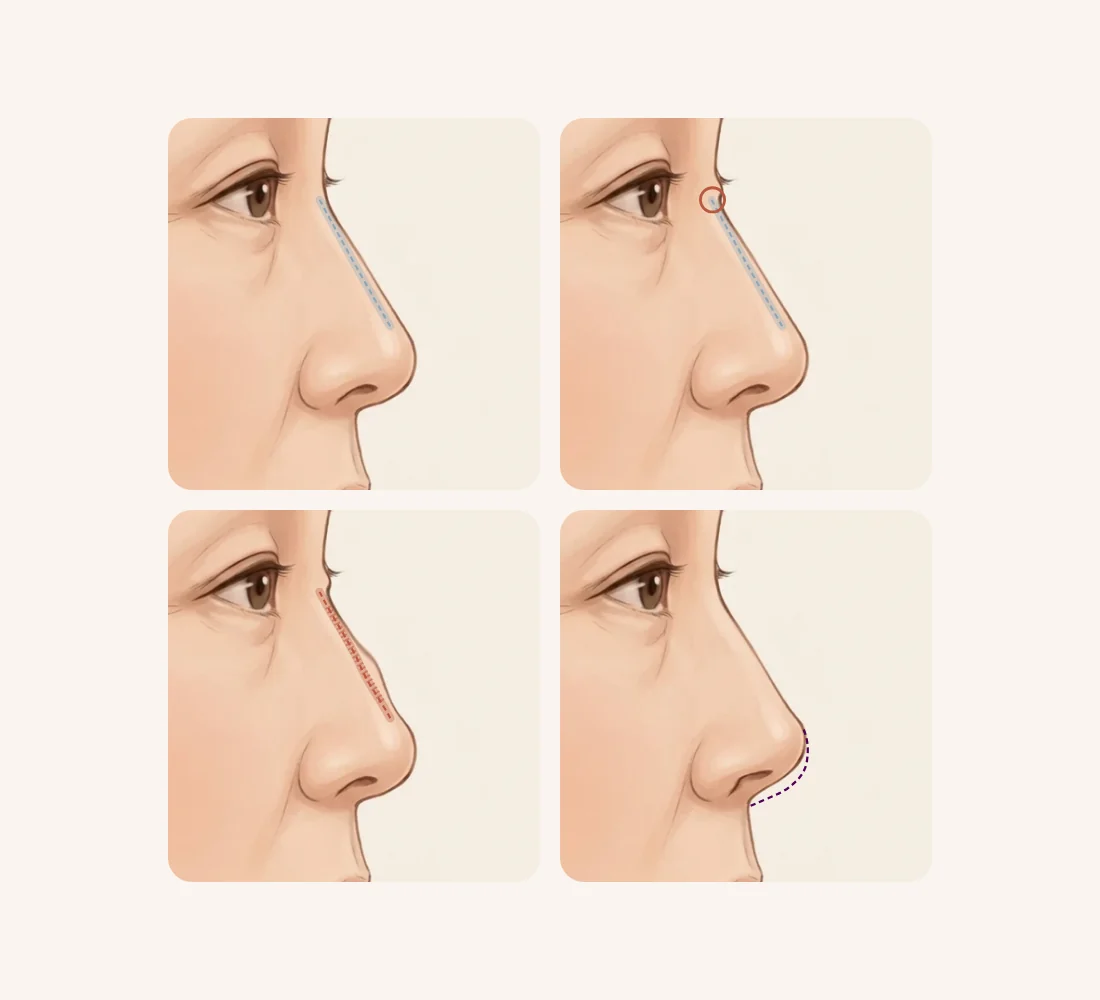
How does a contracted nose develop?
In a contracted nose, the tissue inside has hardened and shrunk, drawing the whole nose upward. "Contracture" means tissue tightening and pulling as it shrinks. It is distinctive enough to be treated as its own problem in Asian revision rhinoplasty. Three causes have been proposed:2
- the capsule around a silicone implant shrinking (contracting)
- long-term pressure from the implant damaging the tip cartilages
- infection after implant surgery
Capsular contracture after silicone rhinoplasty is described as the body building an abnormally thick fibrous capsule in response to a foreign material (something that came from outside the body). The hardened tissue showed long-lasting (chronic) inflammation and a foreign-body reaction under the microscope.1
Signs commonly seen in a contracted nose
A contracted nose shows up in several places at once. The picture below shows the signs most often seen.
How a shrinking capsule pulls the nose
Bacteria you cannot see may play a part
One study examined implants and capsules in 33 patients who had corrective surgery for shape changes after silicone rhinoplasty. A bacterial biofilm is a thin film of bacteria clumped together and attached to a surface. Biofilm was found in 1 of 10 patients with grade 1 contracture (10%), but in 4 of 5 with grade 4 (80%). It was found more often as contracture worsened.3 This helps explain why contracture can progress even in a nose that never turned red or produced pus.
How is the severity graded?
Not every capsular contracture is a contracted nose that needs surgery. A study that analysed photos of 695 people who had silicone rhinoplasty divided contracture into four grades:1
- grade 1, natural-looking: 71.7%
- grade 2, minimal, with a slightly unnatural implant edge: 14.5%
- grade 3, moderate, with the implant deviated (bent off line) and the skin hardened: 10.8%
- grade 4, severe, with a short nose and visible nostrils: 3.0%
Revision was considered necessary only for the moderate and severe groups, 13.8% in total.1 That works out to about 14 of every 100 people in this study having contracture severe enough to need revision.
Silicone rhinoplasty, scaled to 100 people
Grades of contracture and the approach suggested in research
1Grade 1: if the implant is not noticeable
Natural-looking; no treatment needed
2Grade 2: if the implant edge looks unnatural
Minimal contracture; usually no revision
3Grade 3: if the implant has deviated and the skin is hard
Moderate: capsule incision, a new implant and tip scar removal were suggested
4Grade 4: if the nose is short and the nostrils show
Severe: capsule removal and septal extension with cartilage to support the tip were suggested
Grading matters because the approach changes with each grade. When the implant has deviated, incising the capsule and replacing the implant may be enough. But once the nose has shortened and the nostrils show, the authors suggest removing the capsule. They suggest supporting the tip by extending the septum (the wall dividing the nose) with cartilage.1 An upturned tip, lifted nostril rims and hardened skin match grades 3 and 4 most closely in this scheme.
Why release the tissue before lengthening?
In a severely contracted nose, the whole skin and soft tissue envelope (the layers under the skin) is tight and hard. So expanding this covering is described as a key first step.4 The tip cartilages beneath are weak too. So tip projection is hard to create and keep without firm cartilage support.4
Why release comes before lengthening
One series treated 59 severely contracted noses. During surgery, the tip cartilages were freed from the surrounding scar and moved forward, and the inner framework was rebuilt with rib and other cartilage from the patient's own body. 51 patients were satisfied. 8 had further surgery, for infection (2), a crooked nose (1), cartilage warping (2) or appearance (3).4
What if the capsule is left in place?
Leaving the capsule also matters. A study comparing patients who had a silicone implant removed and cartilage grafted (moved into place) found that in 8 patients with contracture and a thick capsule, a nasal length index rose by 8.6% after the capsule was removed. In the group whose capsule was left, it fell instead.6 The authors concluded that removing the capsule itself can release and lengthen a contracted nose to some degree.6
Why several techniques are often combined
A study of 41 patients who had revision for a nose that had become short after earlier surgery found the following:5
- Silicone was the most common earlier bridge implant.
- Several techniques, such as septal reconstruction, tip surgery and bridge augmentation, had to be combined.
- Rib cartilage was the material most often used to rebuild the septum.
- Nasal length increased by 12.0% and tip projection (how far the tip sticks out) by 13.4% on average.
- But 27% had complications, including infection and nostril asymmetry.
Correcting a contracted nose is rarely a single technique, and complications are not unusual. This is worth knowing before surgery.
When skin is lacking
If the skin itself is badly lacking, a new cartilage framework cannot be covered. When the tip is severely pulled back, the skin covering may not be enough, and covering it with tissue from another area has been described.2 At Bonita Clinic, a skin graft from your own body (skin moved from another area) is considered when skin needs to be added.
When can surgery be done?
Bonita Clinic waits until the skin has become as soft as it will get before rebuilding a contracted nose. Hardened tissue takes time to loosen after an implant is removed, and any inflammation has to settle first. Rather than a fixed number of months, timing is set by examining:
- how soft the skin feels
- whether there is any redness
- whether there are signs of inflammation
One operation cannot always do everything. After a contracted nose has been corrected, some grafts fine-tune the relationship between the nostril rims and the columella. It has been recommended that these wait until 6 months have passed, so the final relationship can be judged.2 So a staged plan may be needed: build the main structure first, then refine details once it has settled.
Stages of contracted nose reconstruction
- 1Check inflammationSettle any inflammation or infection first
- 2Remove the causeImplant and hardened capsule
- 3WaitUntil the skin has softened enough
- 4Release and rebuildFree adhesions, support with rib cartilage
- 5Second stage if neededAdd skin, refine details
Not everyone needs every stage; some noses can be treated in one operation
What are recovery and the limits like?
At Bonita Clinic, we perform contracted nose revision under general anesthesia or sedation, and you leave the clinic on the day of surgery. Stitches are used, and recovery time and follow-up visits depend on the extent of surgery and your condition. When rib cartilage is used, there is also a chest incision. Its pain and scar heal alongside the nose.
Whether the skin starts to tighten again is judged over months, not days. As the studies above show, infection, asymmetry or warping of grafted cartilage can lead to further surgery.45
Skin that has been hard for a long time limits how much length and height can be gained. So a realistic goal is to reduce the short, upturned shape and keep it stable, rather than to recreate the nose as it was before any surgery.
How we approach it at Bonita Clinic
During the examination, three things get particular attention:
- The length of the nose from between the eyebrows to the tip
- The thickness of the skin and tissue, and how far it stretches
- The angle between the nose and the upper lip
Treatment options you can discuss in Seoul
Since opening in 1995, Bonita Clinic has stayed at one location. Dr. Kwang-Seop Chung, a plastic surgeon certified in Brazil, carries out consultations and surgery himself. For a contracted nose, the options discussed are those on our contracted nose revision page:
- Assessment of skin hardness, the degree of shortening, remaining cartilage, adhesions and infection history, and of the right timing
- Release of adherent and contracted tissue
- Rebuilding support for the bridge and tip with your own tissue, such as rib cartilage
- A skin graft from your own body when skin is lacking
- A staged plan with a first and second operation when needed
Which of these you need is decided only after an examination. If you still have an implant and are thinking first about removing it, see our nasal implant removal page.
Why do the plan and cost differ from case to case?
Two people with a "contracted nose" can be at very different stages. Severity and staging, more than the diagnosis, shape the plan and the cost.
- Grade of contracture
- Whether an implant and capsule remain
- Rib or other cartilage for support
- Whether a skin graft is needed
- One stage or two
- General anesthesia or sedation
Final plan and quote after an in-person exam
A final estimate is given only after the in-person examination. By then it is clear how much tissue must be released, which cartilage is needed and whether the work will be split into stages.
What can photos show, and what needs an in-person exam?
Photos show the shape very well. But they cannot show how hard the skin is or how far it can stretch, and that is what decides the timing.
Photos can show
- An upturned tip and visible nostrils
- Nose length in profile
- A pulled-back columella
- Lifted nostril rims seen from below
- Redness or uneven skin
Needs an in-person exam
- How hard the skin is and how far it stretches
- Remaining implant and capsule
- How much septal cartilage is left
- Signs of active inflammation
- Chest donor site for rib cartilage
Helpful photos: front, both profiles, both 45-degree views and a view from below. Add photos from before your first nose surgery if you have them, since they show how far the nose has shortened. You can send us a message with your photos and the dates of your previous operations or implant removal.
Planning your visit and recovery
What is confirmed in advance is only the treatment information above: general anesthesia or sedation, going home on the day of surgery, and stitches. A contracted nose often needs more planning than other revisions. If an implant is still in place, removal and reconstruction may be separated by a waiting period. If a second stage is needed, it usually comes months after the first. How many trips to Seoul this means, how long each stay should be and when stitches are removed are decided with you after the examination; they cannot be fixed beforehand.
If rib cartilage is used, keep in mind that the chest wound also needs to heal. After you return home, contact a doctor promptly if redness, warmth, pain or swelling of the nose or chest increases, or if there is discharge. Dated photos taken over the following months help show whether the nose stays stable.
Real treatment cases
These cases appear on Bonita Clinic's contracted nose revision page. Results vary from person to person.
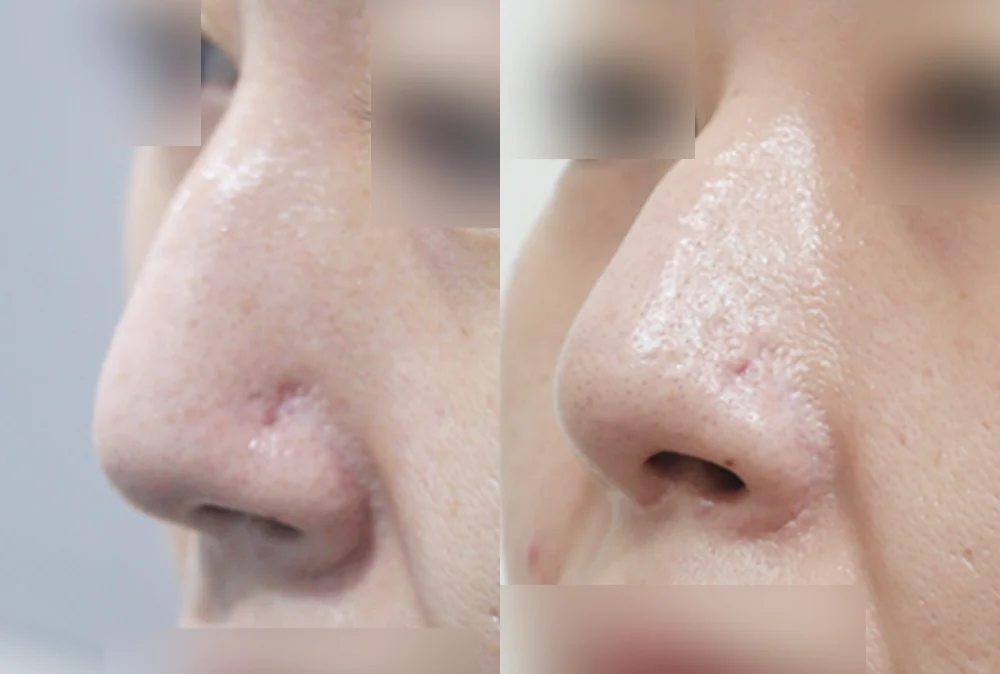
A depressed scar beside the nostril wing (close-up)
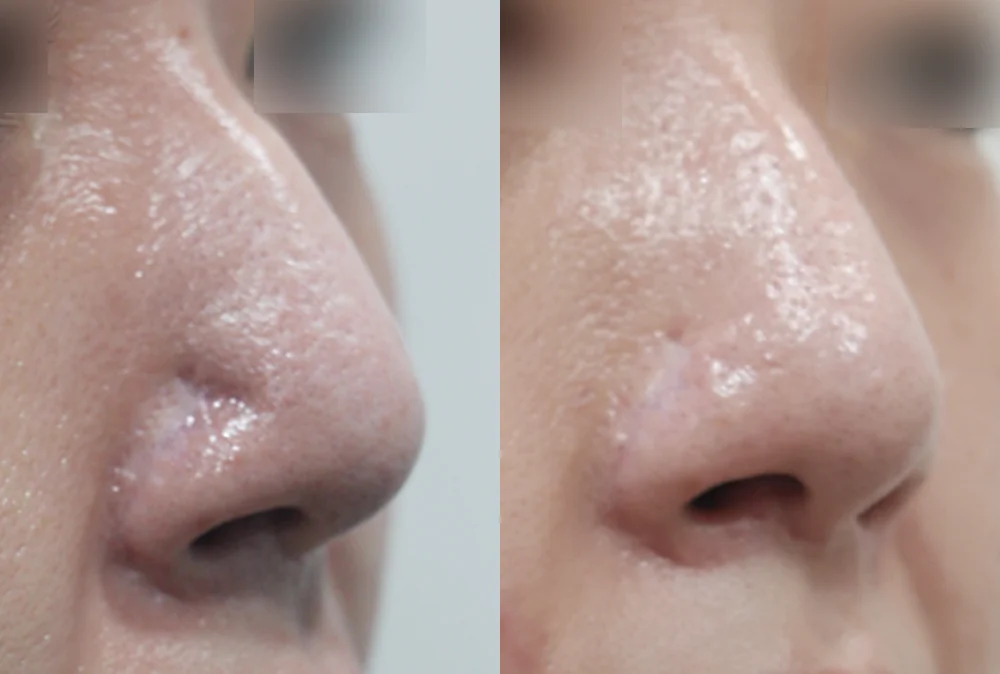
A whitish, depressed scar on the nostril wing (close-up)
* Results vary from person to person. Side effects are possible, so please decide after a thorough consultation with a doctor.
Frequently asked questions
When can contracted nose revision be done?
Reconstruction is done once the skin has softened enough. If an implant is still present, it may need to be dealt with first, followed by a waiting period. Any inflammation must settle beforehand. The exact timing is decided by examining the skin, and surgery may be divided into stages.
If the implant is removed, will my nose lengthen again?
If only the implant is removed and the capsule is left behind, the tissue can contract again or the nose can look unnatural. One comparison found that the nose actually became shorter when the capsule was left.6 So how to handle the capsule, and what will support the nose afterwards, are decided together.
Do I have to have rib cartilage?
A contracted nose needs support firm enough to resist the pull of hardened skin. So rib cartilage or other tissue from your own body is usually considered. Sometimes the remaining septum or ear cartilage is enough, which is decided after examination. The chance of rib cartilage warping is explained as well.
Can it all be done in one operation?
That depends on the degree of contracture and the skin. Sometimes one operation is enough. But if skin is lacking, or the nostril rims and columella need fine adjustment, a second operation months later is planned after the main structure has settled.
Where will the scars be?
Scars on the nose are mostly inside the nostrils and on the columella (the strip between the nostrils), and are managed so they fade. Rib cartilage leaves a scar on the chest, and a skin graft leaves one where the skin was taken.
What to prepare before your consultation
- How many nose operations you have had and when, and the implant you have (or had removed)
- If the implant was removed, when, and how the shape changed afterwards
- When you had redness, discharge or antibiotic treatment
- Front, profile and from-below photos, and photos before your first surgery
- Any blocked nose or breathing difficulty
Bonita Clinic sits on the 3rd floor of 565 Gangnam-daero, Seocho-gu, Seoul, close to Exit 8 of Nonhyeon Station on Line 7 (about 100 m on foot). The process is described on our contracted nose revision page. If your implant shows through or has shifted, see the nasal implant revision guide; for removal, see the nasal implant removal guide. If the whole nose needs rebuilding after several operations, see full revision rhinoplasty and the full revision rhinoplasty guide.
References (6)
Sources that support the explanations in this article. Study findings describe general trends and do not guarantee individual results.
- Kim YK, Shin S, Kang NH, Kim JH. Contracted Nose after Silicone Implantation: A New Classification System and Treatment Algorithm. Arch Plast Surg. 2017;44(1):59-64.doi:10.5999/aps.2017.44.1.59Photo analysis of 695 silicone rhinoplasty patients: a four-grade classification (natural, minimal, moderate, severe) with rates of 71.7, 14.5, 10.8 and 3.0%, suggested treatment by grade, and limitations such as short follow-up
- Jung DH, Moon HJ, Choi SH, Lam SM. Secondary rhinoplasty of the Asian nose: correction of the contracted nose. Aesthetic Plast Surg. 2004;28(1):1-7.doi:10.1007/s00266-003-3044-8Review (abstract): causes of the contracted Asian nose (silicone capsule contraction, pressure damage to the tip cartilages, infection), the two elements to correct (tip cartilages and skin envelope), cover when skin is insufficient, and waiting 6 months before correcting the nostril-columella relationship
- Jirawatnotai S, Mahachitsattaya B. Analysis of subclinical infections and biofilm formation in cases of capsular contracture after silicone augmentation rhinoplasty: Prevalence and microbiological study. Arch Plast Surg. 2019;46(2):160-166.doi:10.5999/aps.2018.00864Study of 33 patients with contracture after silicone rhinoplasty (abstract): bacterial biofilm was found more often as contracture grade increased (10% in grade 1 to 80% in grade 4)
- Oh YH, Seo JW, Oh SJ, et al. Correction of Severely Contracted Nose. Plast Reconstr Surg. 2016;138(3):571-582.doi:10.1097/PRS.0000000000002516Series of 59 severely contracted noses (abstract): expanding the tight skin envelope is a key first step, the tip cartilages are released from scar and advanced, and rib cartilage rebuilds the framework; 51 satisfied, 8 revised (infection 2, deviation 1, warping 2, appearance 3)
- Lan MY, Jang YJ. Revision Rhinoplasty for Short Noses in the Asian Population. JAMA Facial Plast Surg. 2015;17(5):325-332.doi:10.1001/jamafacial.2015.0645Series of 41 Asian patients with a short nose after surgery (abstract): silicone was the most common earlier implant, several techniques were combined, rib cartilage was used most, complications occurred in 27%, and nasal length rose 12.0% and tip projection 13.4%
- Kook WS, Yang CE, Lew DH. Removal of Nasal Silicone Implant and the Impact of Subsequent Capsulectomy. Plast Reconstr Surg. 2019;144(4):575e-585e.doi:10.1097/PRS.0000000000006095Retrospective comparison (abstract): in 8 patients with contracture and a thick capsule, removing the capsule lengthened the nose (length index +8.6%), while leaving it shortened the nose
About this article
This article separates general medical information from Bonita Clinic's own approach. Because the right decision depends on each person's condition, it is not a substitute for a consultation.
