 KOKorean
 ENEnglish
 JP日本語
JP日本語 CN中文(简体)
 TW中文(繁體)

Revision Tip Rhinoplasty in Seoul: If Your Nasal Tip Has Dropped or Looks Pinched, Is Lifting It Again Enough?
Lifting the tip again on its own often leads to the same problem. A tip usually drops because the cartilage or support placed during the first surgery could not hold. A tip usually looks pinched because the outer part of the tip cartilage has weakened, or because scar tissue is squeezing it. So revision of the nasal tip starts by finding out what remains and what has weakened. Then the scar is released and support strong enough to last is rebuilt. If you are considering tip revision in Seoul, you can send photos and details of your earlier surgery first to see which approach may fit.
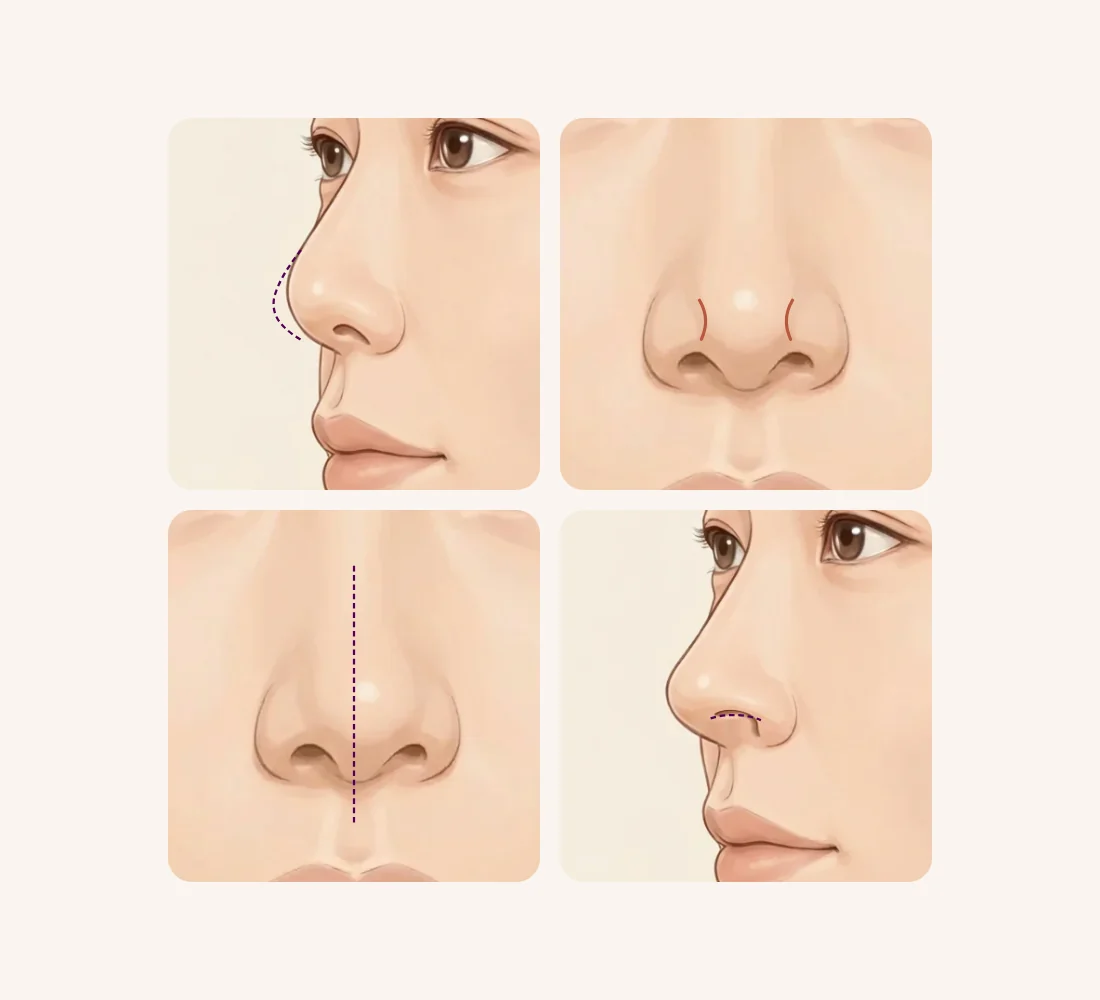
What holds the nasal tip up?
The shape of the tip comes from a pair of curved cartilages, one on each side. Each one has two parts. The inner part runs down into the columella (the strip of skin between the nostrils). The outer part spreads out toward the nostril wing. Below them, the lower end of the septum (the wall of cartilage dividing the nose) and the columella give support. Skin and soft tissue cover everything. Think of a tent: the curved cartilages are like the fabric, and the lower septum and columella act like the poles.
In a first tip operation, these cartilages are trimmed or stitched together. Or cartilage is added on top, or set like a post, to change height and shape. The picture below shows what is examined in revision tip surgery.
What holds up the tip
Revision starts from a structure that has already been changed. What was removed, what was added and where, and whether an implant reached down into the tip all change how much material is left and how much scar has formed. That is why the details of your earlier surgery matter so much.
What is checked first for each kind of change?
The changes that lead people to consider tip revision fall into a few groups. Changes can look alike but have different causes, so each one has a cause that is checked first.
The cause checked first, by what you see
1If the tip has dropped or turned bulbous
Weak support, or grafts that were absorbed or warped, are checked
2If the tip looks narrow and pinched
Weakened outer cartilage, or scar squeezing it, is checked
Pinched tip
3If the tip or nostrils differ side to side
A bent lower septum, or a graft that slipped or folded, is checked
4If the nostril rim is lifted and the nostril shows
Weak support at the nostril rim is checked
If the tip is turned up and the whole nose has become shorter, the problem may not be in the tip alone. It may be a contracted nose, where the capsule around an implant or scar tissue has tightened. That case is explained in our contracted nose revision guide.
A tip that drops again: why does support matter more than height?
Cartilage grafted (moved into place) during earlier surgery can be absorbed, warp or shift over time.4 If the tip is simply raised again without enough support, it cannot resist the pressure of the skin and scar. Then the drop may happen again.
The way the tip is supported may also affect how well its position holds over time. A meta-analysis (a study that pools many studies and calculates them again) compared two methods:3
- septal extension grafts (371 patients): cartilage fixed to the lower end of the septum to anchor the tip
- columellar struts (256 patients): a cartilage post placed inside the columella
It concluded that septal extension may hold the tip's direction (rotation) and how far it projects more reliably over the long term.3 However, it included only first-time operations. So the result cannot be transferred directly to revision surgery, where scar and a shortage of cartilage come together. Which option suits you depends on how much septum remains and how firm it is.
Why support comes before height
Why does a pinched tip happen?
When a groove forms between the tip and the nostril wing, the tip looks separate and squeezed. This is called a pinched tip. It often follows earlier nasal surgery. Techniques that focus too much on narrowing the tip can bend the outer parts of the tip cartilages and weaken the support of the nostril rim.1 One way to correct it is to place a strip of cartilage beneath the outer cartilage to straighten and support it, sometimes moving it to a new position.1
A study of Asian patients having a second tip operation describes changes that can follow implants and tip surgery. These include pinching, notching, lifted nostril rims, a tip bent to one side, a tip turned upward and outer cartilages sitting out of place. The authors linked them to unsuitable handling of the tip cartilages and to the capsule around silicone tightening.2
In that study, 37 patients had the outer cartilages supported with grafts. Their nasal appearance score rose from 30.41 before surgery to 75.90 at 12 months or later. There were minor issues such as nostril asymmetry (5.4%) and a visible graft outline (2.7%).2 A pinched tip can also narrow the nostril entrance and affect breathing, so airflow is checked along with shape.
If scar tissue is squeezing the cartilage, adding cartilage alone may simply be pulled in again. The scar has to be cleared and the stuck tissue released before the cartilage is put back in place.
Why a tip gets pinched, and how it is opened
What is looked at when the two sides differ?
A difference between the two sides of the tip or nostrils may look like a surface problem, but the cause is often deeper. If the lower septum is bent, or a graft from the earlier surgery has slipped or folded, the tip can tilt.
The remaining cartilage and the amount of skin and soft tissue have to be assessed together. Only then can the tip be rebuilt within safe limits. In noses with thin skin, the edges of a graft can show. So cartilage is sometimes crushed or finely diced to smooth the surface.4
Where does the cartilage come from?
Revision tip surgery relies mainly on your own cartilage. A systematic review (a study that gathers and sums up all the research on one question) looked at where tip grafts come from. They are taken mostly from the septum, the ear and the ribs. Rib cartilage was used to add support when septal cartilage was not available.4 In the Asian revision study above, ear cartilage was used in 24 patients, rib in 11 and septum in 2.2
| Cartilage | Strengths | Good to know |
|---|---|---|
| Septum | Straight and firm, versatile, relatively low resorption and warping4 | May already have been used in the first surgery |
| Ear | Easy to reach, low donor burden2 | Softer and weaker than rib, so limited for strong support2 · donor-site keloid (a raised, overgrown scar) or hematoma (a collection of blood) in 2.4%5 |
| Rib | Plentiful, easy to shape to length2 | Can warp or stiffen2 · needs a chest incision |
The choice depends on how much support the tip needs, how much septum remains, how thick the skin is and which donor sites were used before.
Choosing cartilage to support the tip
Which cartilage is considered first?
- Septal cartilage remainsSeptal cartilageStraight, firm, low resorption and warping
- Lower donor burden wantedEar cartilageSofter and weaker; limited for strong support
- Strong support needed, septum lackingRib cartilageCan warp; needs a chest incision
What are surgery, recovery and the limits like?
At Bonita Clinic, we perform tip revision under sedation combined with local anesthesia. It is a day procedure, and stitches are placed. The length of recovery and the number of check-ups depend on how much work is done and on how you heal.
Swelling, bleeding, inflammation and infection can occur. The cartilage donor site can also swell and bruise. Scar or skin that has already thickened cannot be fully undone by surgery. Small nostril asymmetries or a visible graft outline can remain, as in the study above.2 So it helps to agree on the expected shape and its limits before surgery.
How we approach it at Bonita Clinic
At the examination we look closely at three things:
- How far the tip projects from the face (its height)
- The thickness and stretch of the skin and soft tissue
- The angle between the nose and the upper lip (the tip angle)
Treatment options you can discuss in Seoul
Bonita Clinic has been at the same location since it opened in 1995. Dr. Kwang-Seop Chung, who is board-certified in plastic surgery in Brazil, examines patients himself. For a tip that needs revision, the options discussed in consultation are those on our tip revision page:
- Assessment of the earlier technique, remaining cartilage, scar tissue, symmetry, skin thickness and blood supply
- Clearing scar tissue and releasing adhesions
- Rebuilding tip support with your own ear, septal or rib cartilage
- Repositioning cartilage for symmetry and designing the tip in balance with the bridge
What you need is decided after an examination. If you have never had tip surgery before, our nasal tip surgery page covers first-time procedures.
Why do the plan and cost differ from case to case?
Two people with a "dropped tip" can need very different operations. The amount of work, not the label, shapes the plan and the cost.
- How much tip support must be rebuilt
- Which cartilage: septum, ear or rib
- How much scar tissue must be released
- Whether the bridge or an implant also needs work
- Sedation with local anesthesia
- Number of earlier operations
Final plan and quote after an in-person exam
A final estimate is given only after the in-person examination. By then it is clear which cartilage is needed and how much of the tip must be rebuilt. Photos can suggest a direction but cannot settle the scope.
What can photos show, and what needs an in-person exam?
Photos help us understand your concern. But they cannot show how much cartilage is left or how firm the tip is.
Photos can show
- Tip height and shape in profile
- Pinching between tip and nostril wing
- Nostril asymmetry seen from below
- An upturned or drooping tip
- Changes over time (older photos)
Needs an in-person exam
- How much septal cartilage remains
- How firm the tip support feels
- Scar tissue and skin thickness
- Nostril collapse when breathing in
- Suitability of ear or rib donor sites
Helpful photos: front, both profiles, both 45-degree views and a view from below showing the nostrils, in even light. Add a smiling profile if your tip moves noticeably when you smile, and photos from before your first surgery if you have them. You can send us a message with your photos and what you know about your earlier surgery.
Planning your visit and recovery
What is confirmed in advance is the treatment information above: sedation with local anesthesia, same-day discharge and stitches. How long to stay in Seoul, when to return for a check and when stitches are removed depend on the extent of surgery and the donor site used. So these are planned with you at consultation rather than fixed beforehand.
Swelling settles gradually, so the final shape of the tip is judged over time rather than in the first weeks. After you return home, contact a doctor promptly if redness, warmth, pain or swelling increases instead of settling, or if the nose or the donor site produces any discharge. Dated photos taken at regular intervals make later follow-up easier.
Real treatment cases
This case appears on Bonita Clinic's tip revision page. Results vary from person to person.
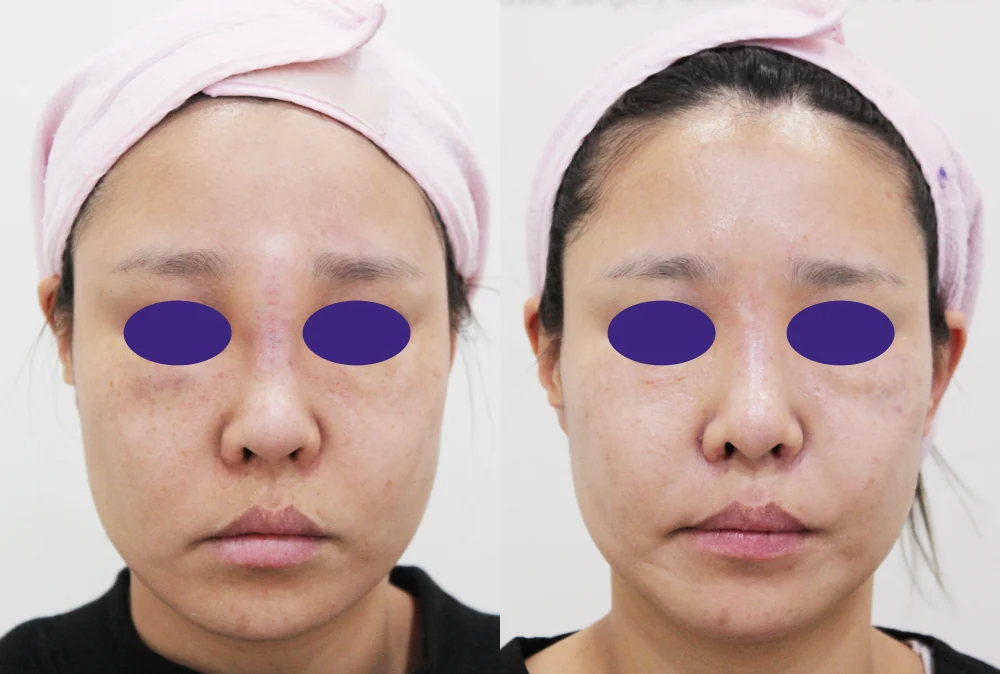
Blotchy red skin over the upper bridge (front view)
* Results vary from person to person. Side effects are possible, so please decide after a thorough consultation with a doctor.
Frequently asked questions
My tip has dropped again. Can it just be lifted higher?
Raising the height without enough support can lead to the same drop. We first check whether earlier grafts have been absorbed or weakened, and whether the lower septum can carry the load. Then the support is decided before the height.
Can a pinched-looking tip be corrected?
Correction can be considered. A pinched tip usually involves weakened outer cartilage or scar tissue squeezing it. So the scar and cartilage are assessed together before deciding how to release the scar and support the cartilage.
Is ear cartilage enough, or will I need rib cartilage?
It depends on the support needed and the cartilage left. Ear cartilage is easy to harvest but softer and weaker. So rib cartilage is considered when strong support is needed and septal cartilage is lacking. The chance that rib cartilage warps is explained as well.
Can revision change my breathing?
A pinched tip can narrow the nostril entrance and make breathing harder. Supporting the outer cartilages has been reported to help with this.2 On the other hand, weakness at the nostril entrance has also been reported after surgery.2 So any blockage you notice is checked at consultation.
Where will the scars be?
Scars are mostly inside the nostrils and on the columella, and are managed so they fade over time. The cartilage donor site, ear or chest, also leaves an incision mark.
What to prepare before your consultation
- When and how many times your tip was operated on, and which cartilage (ear, septum, rib) or implants were used
- When the tip began to drop or change shape
- Any nasal blockage or rhinitis
- Front, profile, 45-degree and from-below photos, plus photos before your first surgery
- What you want to change, and what you like about your nose now
Bonita Clinic is about 100 m on foot from Exit 8 of Nonhyeon Station (Line 7), on the 3rd floor of 565 Gangnam-daero, Seocho-gu, Seoul. The process is described on our tip revision page. For first-time tip surgery, see the nasal tip surgery guide. If your nose has also become short and upturned, see the contracted nose revision guide. If the bridge also needs work, see the full revision rhinoplasty guide.
References (5)
Sources that support the explanations in this article. Study findings describe general trends and do not guarantee individual results.
- Hyman AJ, Khayat S, Toriumi DM. Correction of Nasal Pinching. Facial Plast Surg Clin North Am. 2019;27(4):477-489.doi:10.1016/j.fsc.2019.07.004Review (abstract): a pinched tip often follows earlier surgery; techniques that over-narrow the tip deform the lateral crura and weaken alar rim support; lateral crural strut grafts are used to correct it
- Kook WS, Kim K, Suh I, et al. Versatile Usability of Lateral Crural Strut Graft for Correction of Various Nasal Tip Deformities in Secondary Rhinoplasty in Asians. Plast Reconstr Surg. 2026;157(5):677e-684e.doi:10.1097/PRS.0000000000012423Prospective series of 37 Asian secondary rhinoplasties: causes of tip deformities after implants and tip surgery, the cartilage used (ear 24, rib 11, septum 2) and its pros and cons, minor problems such as nostril asymmetry 5.4% and visible graft 2.7%, and the short follow-up as a limitation
- Ozgenc I, Alzoubi D, Vankayalapati DK, et al. Comparative Outcomes of Septal Extension versus Columellar Strut Grafts for Nasal Tip Stabilization and Positioning in Rhinoplasty: A Systematic Review and Meta-analysis. Facial Plast Surg. 2026;42(3):396-408.doi:10.1055/a-2689-1496Meta-analysis (abstract) comparing septal extension grafts (371 patients) and columellar strut grafts (256): septal extension may hold tip rotation and projection better in the long term; primary surgery patients only
- Gentile P, Cervelli V. Nasal Tip Remodeling Using Autologous Cartilage Grafts: Systematic Review. J Craniofac Surg. 2022;33(7):2035-2040.doi:10.1097/SCS.0000000000008494Systematic review of autologous cartilage in tip surgery (abstract, 39 studies): septal cartilage has low rates of resorption, extrusion and warping; ear cartilage is used for valve collapse; rib is used when septum is unavailable; crushed or diced cartilage suits thin skin
- Lan MY, Park JP, Jang YJ. Donor site morbidities resulting from conchal cartilage harvesting in rhinoplasty. J Laryngol Otol. 2017;131(6):529-533.doi:10.1017/S0022215117000639Review of 372 patients (abstract): ear (conchal) cartilage harvest had a donor-site complication rate of 2.4% (keloid 1.1%, hematoma 1.3%)
About this article
This article separates general medical information from Bonita Clinic's own approach. Because the right decision depends on each person's condition, it is not a substitute for a consultation.
