 KOKorean
 ENEnglish
 JP日本語
JP日本語 CN中文(简体)
 TW中文(繁體)

One-Day Liposuction in Seoul: Does Recovery Really Take Just One Day?
No. In one-day liposuction, "one day" means you have surgery and go home the same day; it does not mean recovery is finished in a day. It is the same surgical liposuction, performed under sedation with local anesthesia. The key feature is that the scope is kept to what can be done in one session without strain. Bruising and swelling are most noticeable in the first days, and the line settles over a few months. When wide areas are needed, splitting them into separate sessions is usually wiser than doing everything at once. If you are planning a short stay in Seoul, you can send photos of the areas first and ask what scope would be reasonable for your schedule.
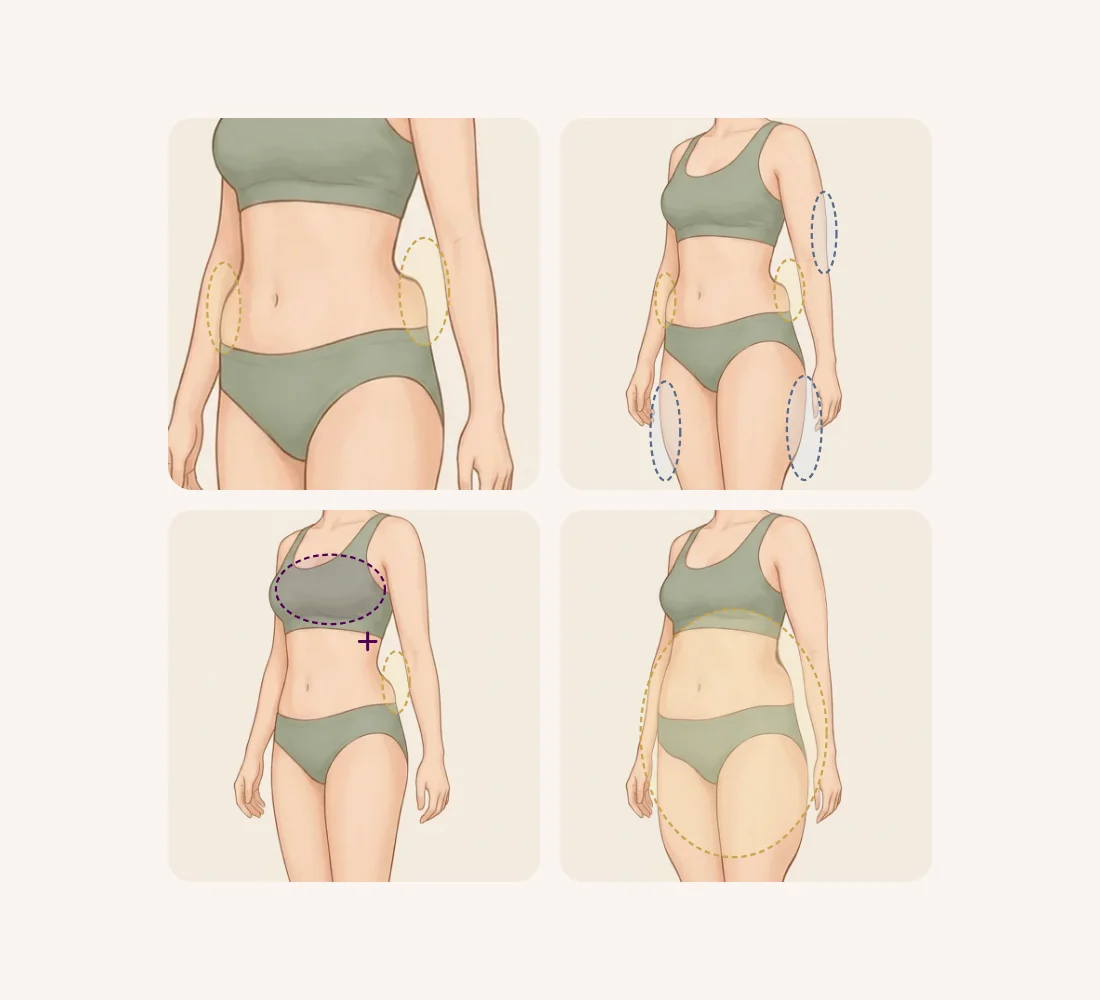
What does "one-day" actually mean?
The name "one-day liposuction" can sound like a short recovery, or like a procedure that is light on the body. At Bonita Clinic, we mean something a little different. For us, one-day liposuction means doing only as much as can be done in one day without strain, after weighing the scope of surgery and the burden of recovery. It is "one-day" to reduce the burden, not to be fast.
The operation itself is the same as standard liposuction. At Bonita Clinic, it is likewise performed as surgery under sedation combined with local anesthesia; you go home the same day, and stitches are used.
What one day covers (example)
| What "one-day" means | What "one-day" does not mean |
|---|---|
| You have surgery and go home the same day | Recovery is finished in a day |
| The scope is limited to what one day handles without strain | As many areas as possible in one day |
| The same liposuction operation (sedation plus local anesthesia) | A non-surgical procedure with injections or a machine |
| A plan to reduce the burden of surgery by reducing the scope | Safer just because of the name |
Reducing the scope can lessen some of the factors that raise risk, as shown below. But the name "one-day" does not itself mean safety. Safety depends on the scope, your health, and the monitoring and care after surgery.
Why limit the scope?
Four factors discussed below raise risk: the volume removed, the number of areas, whether other operations are combined, and how long the surgery takes.
Volume and number of areas
The American Society of Plastic Surgeons' practice advisory states that the risk of complications rises, unavoidably, as the volume and the number of areas increase. Large-volume liposuction means 5,000 cc or more of total aspirate (fat plus the fluid removed with it). It recommends that this take place in a hospital or an accredited or licensed facility with overnight monitoring. It also notes that in some cases large areas are better split into separate operations and not combined with other procedures.1
Combining with other surgery
In a study of 31,010 liposuction procedures, major complications occurred in 0.7% when liposuction was done alone, about 7 in every 1,000 people. When it was combined with other cosmetic operations, the relative risk of a major complication was 4.81. In other words, the chance of a major complication was roughly 4.8 times that of liposuction alone. Older age and a higher BMI (body mass index, a number that compares weight with height) also raised the risk on their own.2
Operating time
Operating time matters too. An analysis looked at 1,753 plastic surgery operations. Each extra hour of surgery raised the odds of a complication (a measure of how likely it is) by 21%, and risk rose clearly beyond three hours.3 Most of those operations combined several procedures, so the figure cannot be applied directly to liposuction alone. Still, it points the same way. Blood loss in liposuction varies with factors such as body weight and operating time, and surgery longer than two hours is listed as a risk factor for blood clots.4
Why the scope is kept small
| What we avoid | What we do instead |
|---|---|
| Widening the scope just to finish in one day | Judge first which areas and volume suit one day |
| Treating the whole body in one operation | Split wide areas into separate sessions |
| Rushing the result because it is "one-day" | Adjust only the spots that make the figure look heavy, and plan for the state after surgery |
These are the principles we follow for one-day liposuction at Bonita Clinic. They point the same way as the advisory and studies above on scope, combined procedures, operating time and risk.
Does one day fit me, or is splitting wiser?
At Bonita Clinic, we see a one-day scope as a good fit in cases like these:
- The volume of one particular area blurs your shape
- A long recovery is a burden, or you need to get back to daily life soon
- You want a refined change rather than a dramatic one
On the other hand, several areas may need wide reduction, or you may also want other surgery. Then splitting into sessions fits the evidence above better than widening the scope to do everything in one day.
How the scope shapes the plan
1One area blurs your shape
Only what one day handles without strain; home the same day
One-day liposuction
2Several areas need wide reduction
A smaller scope each time, with recovery in between
Split into sessions
3You also want another operation
Splitting the plan, rather than widening the scope to do it all in one day, fits the evidence
Split into sessions
4A total aspirate of 5,000 cc or more
Generally advised in a hospital or accredited facility, with overnight monitoring
Large-volume liposuction
Your health matters as well. Older age and a higher BMI raise the risk of major complications.2 Conditions that raise clot risk, such as smoking, a clotting disorder, or taking the contraceptive pill or hormones, change the surgical plan and the preventive steps.14 For these reasons, even for the same area, whether one day, split sessions or another approach fits differs from person to person.
How do the first night and first week go after same-day discharge?
Going home on the day of surgery means the first stage of recovery happens outside the clinic. The American Society of Plastic Surgeons notes that, depending on the volume, monitoring for several hours or overnight is needed. Before discharge you should be clear-headed with stable vital signs (basic signs such as blood pressure, pulse and breathing).1
A US survey from the late 1990s reported that many of the rare deaths after liposuction happened on the first night after discharge. It advised close watch during the first night after a long operation, because the effects of sedatives and anesthetics can linger.5 The data are old, and today's surgery and anesthesia differ. Even so, the spirit of that advice is to plan ahead so you do not travel home or spend the first night alone.
For the first few days, keep these points in mind:
- Bruising and swelling are clear for the first 48 to 72 hours (two to three days). Compression garments and elastic stockings are generally worn for several weeks.1
- Starting to walk early greatly reduces clot risk, so walk often without overdoing it.4
- Some signs should be reported straight away, rather than waiting. These are shortness of breath or chest pain, pain and swelling in one calf, pain that keeps getting worse, or heat or discharge around a wound.1
The first few days after going home
How long does recovery take?
Recovery after one-day liposuction follows the same course as standard liposuction. A small scope may mean less of a burden, but it still takes time for swelling to go down and the line to show.
Recovery after one-day liposuction
One review (an article that gathers and sums up many studies) describes the course like this:4
- Swelling: increases slightly over the first one to two weeks, feels firm around two to three weeks, and softens over six to eight weeks. Depending on the extent, the area feels close to normal by about three months.
- Bruising: darkest at 7 to 10 days, and usually gone within two to four weeks.
- Compression garment: usually worn for four to six weeks.
The time it takes for normal feeling to return is described as depending on the extent of surgery.4 When you can return to daily life and work depends on the areas, the scope and your job, and is planned with you at consultation.
How we approach it at Bonita Clinic
How one-day liposuction proceeds
- 1Judge areas and volumeWhether they suit a one-day scope
- 2Set the scopeOnly what one day handles without strain
- 3SurgerySedation with local; only what looks heavy
- 4Home the same dayCompression garment; swelling and bruising care
- 5As it settlesSwelling subsides and the line emerges
If the scope is wide, it is split into sessions rather than done at once
At Bonita Clinic, we perform one-day liposuction as surgery under sedation combined with local anesthesia; you go home the same day, and stitches are used. A compression garment goes on straight after surgery, and swelling and bruising are looked after. You keep the garment on through recovery and begin with light activity. The line emerges as the swelling subsides, and if fat grafting was done as well, how much of the fat has taken (survived in its new place) is checked. The length of recovery and the schedule of check-ups differ with the scope of surgery and your own condition.
One-day options you can discuss in Seoul
Since opening in 1995, Bonita Clinic has stayed at the same address, and its director, Dr. Kwang-Seop Chung (board-certified plastic surgeon, Brazil), still sees patients himself. On a short schedule, the options you can discuss are those described on our treatment pages:
- One-day liposuction of the area that most blurs your shape, with the scope set to what one day can handle
- Splitting wider body contouring into separate sessions with recovery in between (liposuction)
- Whether skin likely to loosen should be tightened with Renuvion at the same time (Renuvion line lifting)
- Correction of dents or asymmetry from an earlier operation, planned separately (liposuction revision)
Whether a one-day scope suits you is decided after an examination.
Why the plan and cost differ from person to person
Two people booking "one-day liposuction" can end up with quite different plans, because the scope that fits one day differs from person to person.
- Which areas fit a one-day scope
- Whether wider areas are split into sessions
- Expected aspirate volume
- Anesthesia: sedation with local
- Whether fat transfer or skin tightening is added
- Your health and clot risk
Final plan and quote after an in-person exam
A final estimate is given after the in-person consultation, once the areas and the scope for the day are settled.
What photos can show, and what needs an in-person exam
Photos are especially useful when your time in Seoul is short, because they let the first conversation about scope happen before you travel. They cannot settle whether one day is a sensible scope for you.
Photos can show
- Which areas bulge most
- Overall proportions from front, side and back
- How many areas you hope to treat
- Scars from earlier procedures
Needs an in-person exam
- Fat thickness in each area
- Skin elasticity
- Whether one day is a sensible scope for you
- Health, medicines and clot risk
- Adhesions from earlier surgery
Helpful photos are taken standing, from the front, both sides and the back, in even light. Tell us which area bothers you most, which comes next, and how many days you can stay. You can send us a message with your photos and your travel window.
Planning your visit and recovery
What is confirmed in advance is the treatment information above: surgery under sedation with local anesthesia, going home the same day, stitches, and a compression garment. How many days you should stay in Seoul, when to come in for checks, and when you can travel depend on the areas and scope. They are planned with you at consultation. They are not fixed by the word "one-day".
Long flights and surgery each raise the risk of blood clots, and the combination raises it further. As general guidance, the American Society of Plastic Surgeons suggests waiting five to seven days after body procedures such as liposuction before flying.6 That is a general guide, not a date we can promise; your own timing depends on the extent of surgery, your clot risk and how you recover. A same-day discharge does not shorten that window.
For the first night, plan for someone to accompany you from the clinic and stay with you, and keep the clinic's contact details at hand. After you return home, see a doctor promptly for breathlessness, chest pain, calf pain or swelling, or a wound that becomes red, hot or starts to discharge.1
Frequently asked questions
Can several areas be done in one day?
Yes, but only within a range you can recover from. If the scope is wide, we recommend splitting it into sessions. This matches the advice that risk rises with volume and the number of areas, and that large cases are better split.1
Is one-day liposuction less risky than standard liposuction?
It is the same liposuction operation, so the name alone does not change the risk. Risk depends on factors such as volume, number of areas, combined procedures, operating time, age and BMI.123 One-day liposuction is a plan that keeps the scope to what one day can handle without strain. Observation and care after surgery matter just as much.
Can I go back to work the next day?
It depends on the areas, the scope and your work. Bruising and swelling are clear for the first 48 to 72 hours, and the compression garment stays on.1 So it makes sense to plan your return to work when the scope is set at consultation. Physically demanding work needs more time.
Can I fly home the day after surgery?
Flying soon after surgery adds to clot risk, and general guidance suggests waiting several days after body procedures.6 When you can travel is decided with your surgeon based on the scope and your recovery, so please share your travel dates before booking surgery.
What to prepare before your consultation
- The one or two areas that bother you most, and what comes next
- Your available dates: arrival, how long you can stay, and when you must be back at work
- Someone who can accompany you home on the day of surgery and stay with you that night
- Medicines you take (including blood thinners, the contraceptive pill or hormones), whether you smoke, and earlier surgery
- Standing photos from the front, sides and back
Bonita Clinic is on the 3rd floor of 565 Gangnam-daero, Seocho-gu, Seoul; the walk from Exit 8 of Nonhyeon Station (Line 7) is about 100 m. See our one-day liposuction page and liposuction page, the guide to liposuction for how areas are chosen, and the guide to liposuction revision if a problem remains from earlier surgery.
References (6)
Sources that support the explanations in this article. Study findings describe general trends and do not guarantee individual results.
- Iverson RE, Lynch DJ; ASPS Committee on Patient Safety. Practice advisory on liposuction. Plast Reconstr Surg. 2004;113(5):1478-1490.doi:10.1097/01.prs.0000111591.62685.f8American Society of Plastic Surgeons practice advisory (full text): risk rises with aspirate volume and number of sites; 5,000 cc or more of total aspirate calls for a hospital or accredited facility and overnight monitoring; large cases split into separate operations and not combined; monitoring for several hours or overnight depending on volume; discharge criteria; bruising and swelling for 48–72 hours and compression for several weeks; warning signs of clots and infection
- Kaoutzanis C, Gupta V, Winocour J, et al. Cosmetic Liposuction: Preoperative Risk Factors, Major Complication Rates, and Safety of Combined Procedures. Aesthet Surg J. 2017;37(6):680-694.doi:10.1093/asj/sjw243Cohort of 31,010 liposuction procedures (abstract): major complications 0.7% for liposuction alone; relative risk 4.81 when combined with other procedures; hospital setting, age and BMI also risk factors
- Hardy KL, Davis KE, Constantine RS, et al. The Impact of Operative Time on Complications After Plastic Surgery: A Multivariate Regression Analysis of 1753 Cases. Aesthet Surg J. 2014;34(4):614-622.doi:10.1177/1090820X14528503Retrospective analysis of 1,753 plastic surgery cases (abstract): each extra hour of surgery raised the odds of complications by 21%, with risk clearly higher beyond three hours; mostly combined procedures, so not specific to liposuction alone
- Dixit VV, Wagh MS. Unfavourable outcomes of liposuction and their management. Indian J Plast Surg. 2013;46(2):377-392.doi:10.4103/0970-0358.118617Review (full text): course of swelling and bruising (about three months depending on extent), compression for 4–6 weeks, factors behind blood loss such as weight and operating time, surgery longer than two hours as a clot risk factor, keeping operating time short and not combining with lengthy procedures, early walking
- Grazer FM, de Jong RH. Fatal outcomes from liposuction: census survey of cosmetic surgeons. Plast Reconstr Surg. 2000;105(1):436-446.doi:10.1097/00006534-200001000-00072Survey of US aesthetic plastic surgeons on liposuction deaths in the late 1990s (abstract): many of the rare deaths occurred on the first night after discharge, and careful observation for lingering sedative or anesthetic effects after lengthy procedures was advised; older data
- American Society of Plastic Surgeons. Briefing Paper: Cosmetic Surgery Tourism. plasticsurgery.org (accessed Oct 2026). 2026.American Society of Plastic Surgeons briefing paper (official page): long flights and surgery each raise the risk of blood clots and pulmonary embolism, more so together, and general guidance on waiting before flying after body procedures
About this article
This article separates general medical information from Bonita Clinic's own approach. Because the right decision depends on each person's condition, it is not a substitute for a consultation.
