 KOKorean
 ENEnglish
 JP日本語
JP日本語 CN中文(简体)
 TW中文(繁體)

Liposuction Revision in Seoul: Can Dents, Lumps and Asymmetry Be Corrected?
In many cases correction can be attempted, but the method and how much can be improved depend on what the problem is. Leftover fat that still bulges is usually treated with touch-up suction. Areas where too much was removed and a dent formed are smoothed around the edges and filled with your own fat. Loose skin is tightened or removed. Because swelling has to settle fully before the contour can be judged, revision is usually planned at least six months after the first operation. Tissue with heavy scarring and adhesions may not return to an even surface. If you are thinking about liposuction revision in Seoul, you can send photos from before and after your first surgery to see which approach may fit your case.
What problems can remain after liposuction?
The most common complication of liposuction is contour deformity, which means the body's outline is left uneven. According to one review (an article that gathers and sums up many studies), up to 9% of patients report dents or bulges, loose skin, folds or wrinkles.5
A prospective study, one that followed a set group of people forward in time, tracked 1,248 patients at eight centers for an average of more than four years. Contour irregularities occurred in 5.8%, fibrosis (tissue becoming firm) in 2.3%, and 8.7% had revision surgery.2 Close to 9 in every 100 people had another operation, so this is not rare.
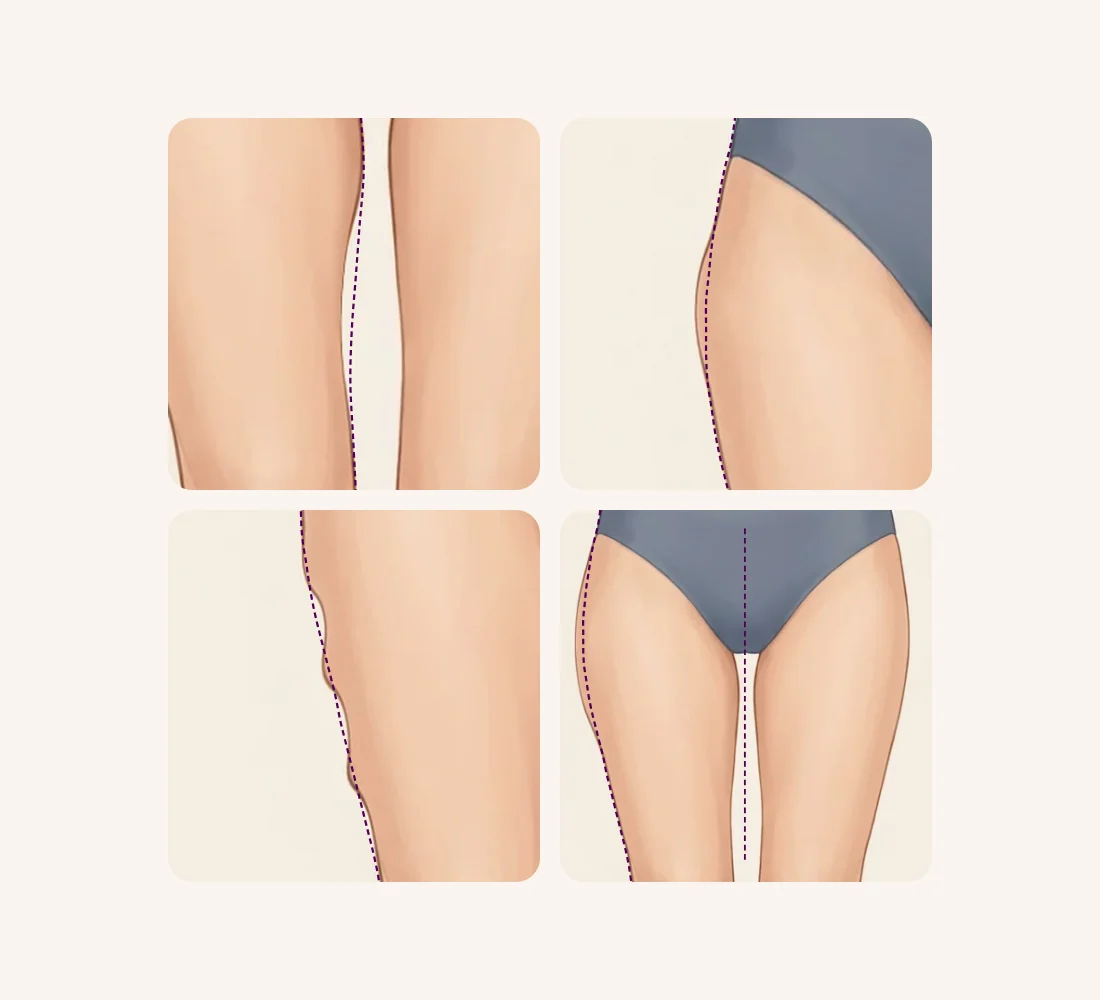
"Lumpy" can mean several different shapes with different causes. One review groups unsatisfactory results after liposuction like this:1
| Type | What it looks like | Where it often appears |
|---|---|---|
| Too much removed (overcorrection) | More fat removed than intended, leaving a dent | Middle of the inner thigh, below the saddlebag bulge, where the side of the buttock, outer thigh and back of the thigh meet, around incision sites |
| Too little removed (undercorrection) | Fat left behind as a bulge | Just above the elbow and next to incisions, flanks, around the navel, upper outer thigh, above the knee |
| Surface irregularity | Waves, dimples or grooves | Anywhere that was treated |
| Asymmetry | The two sides differ in thickness or line | Areas treated on both sides (for example, the upper outer thighs) |
| Loose skin | Volume is smaller but skin is left over | A lower abdomen that already sagged, heavy arms, lax inner thighs |
What can remain after liposuction
1Too much removed, leaving a dent
Common at the middle of the inner thigh, below the saddlebag bulge and around incision sites
Overcorrection
2Too little removed, leaving a bulge
Common on the upper outer thigh, flanks, around the navel and above the knee
Undercorrection
3A wavy or grooved surface
Can appear anywhere that was treated
Surface irregularity
4The two sides differ in thickness or line
Appears in areas treated on both sides (for example, the upper outer thighs)
Asymmetry
Over-suctioning the deep fat at the buttock crease can damage the fibrous tissue that supports the buttock, and the buttock may sag. A review describes this sagging as very difficult to correct.1 In some places the tissue under the skin is attached to the fascia (the thin sheet covering the muscle). These are the hollow at the side of the buttock, the buttock crease, the lower back of the thigh, the middle of the inner thigh and the lower outer thigh. These attachments shape the body's contours, so suctioning there easily causes contour deformity.5
Why does the cause matter so much?
A review lists these causes of an uneven surface:1
- Suction that is too shallow or too heavy
- Tissue that becomes firm (fibrosis) or sticks to the tissue below (adhesions)
- A compression garment that does not fit, or poor posture
- Skin left over once the volume is smaller
Different causes need different fixes. So a revision consultation starts by asking why the problem happened, not only where it is.
The examination looks at you in different positions
How a dent changes with your position and with muscle movement gives clues to its cause:1
- A dent that stays when you lie down, and after the skin has contracted: often from suction that was too shallow
- A dent that deepens when you tense the muscle: often from an adhesion to the muscle below
- A fold that eases when you lie down: often from excess skin
The thickness of the remaining fat, where tissue is stuck down, skin elasticity and the fat on each side are checked as well. Only then can we sort out what to reduce further, what to fill, and what to leave alone.
When can it be assessed? Why waiting matters
After liposuction, swelling stays firm for several weeks and softens over six to eight weeks. Depending on the extent of surgery, the area feels close to normal by about three months.1 Some of the unevenness seen during this time changes as the swelling goes down.
So even if a dent or leftover fat is visible after surgery, waiting until swelling has fully settled is recommended. Revision is planned only after waiting at least six months, so the contour can be judged accurately.1 Asymmetry is handled the same way after six months.1 For loose skin, further surgery is considered after allowing six months to a year for the skin to shrink back on its own.1
| After the first surgery | Why it is hard to judge then | What you can do then |
|---|---|---|
| A few weeks | Firm swelling makes the surface feel more uneven than it is | Wear compression and follow up as your surgeon advised |
| 2–3 months | Most swelling has gone, but some remains | Take photos in the same conditions to track changes |
| After 6 months | The contour can be judged fairly accurately | Plan correction based on remaining fat, adhesions and skin |
| 6 months to 1 year | The skin is still contracting | Decide whether loose skin needs further surgery |
While you wait, however, redness, heat, discharge or pain that keeps getting worse can point to another problem such as infection. In that case, see a doctor straight away.
How is it corrected?
The fix depends on the kind of problem that remains.
Leftover fat and dents
When fat has been left behind, touch-up suction to remove it and refine the contour is usually enough.1 Dents from over-suction are treated by moving your own fat into them (autologous fat grafting). Several reports describe acceptable results with fat grafting for contour problems after liposuction.1 Sometimes the bulge next to a dent also needs suction while the dent is filled.1
In one study, 57 people had irregularities after liposuction corrected with fat grafting. Graft volumes ranged from 14 to 120 ml, and 9 people needed a second graft for dents in the abdomen or below the buttock. At 12 months, 68% rated the result very good to excellent, 23% good, and 9% lower.3 This was a single-center study and the ratings were patients' own, so it cannot simply be applied to everyone.
Firm areas and loose skin
For firm, fibrotic irregularities, injections into the area are sometimes used. If that does not help, the fibrotic lump is occasionally removed and fat is grafted at the same time.1 Some areas are already firm from earlier suction. Ultrasound-assisted or power-assisted liposuction makes it easier to remove fat from such dense tissue, and is described as particularly useful in secondary (revision) surgery.4
When excess skin is the problem, skin-removal surgery is used (abdominoplasty, or arm and thigh lifts). One review notes that if liposuction has already let the skin contract somewhat, the incision may be shorter than first expected.1 A device that delivers helium plasma and radiofrequency energy under the skin through a thin probe (Renuvion) is also used with liposuction to treat loose skin.
The evidence for Renuvion is still building. A systematic review, a study that gathers all the relevant research using set rules, pooled 34 studies. Complications were 8% when it was combined with liposuction, and patient satisfaction across studies was 92%. But most of the studies were observational, and about a third had a high risk of bias (a chance that the design tilted the results). One author worked for the manufacturer.6
| Approach | Suits | Worth knowing |
|---|---|---|
| Touch-up suction | Leftover fat, or one side thicker than the other | Harder to even out the layer in tissue with adhesions1 |
| Fat grafting | Dents where too much was removed | Some fat is absorbed; a second graft may be needed3 |
| Suction plus grafting | A dent next to a bulge | The dent is filled and the bulge beside it is refined1 |
| Treating fibrosis | Firm, clumped irregularities | Injections first; surgery considered if they do not help1 |
| Skin tightening or removal | Volume reduced but skin left over | Large laxity may need excisional surgery such as abdominoplasty1 |
What are the limits and risks of revision?
Revision is harder than a first operation. Tissue that has been suctioned before develops scarring and fibrosis, which blur the boundaries between fat layers. A review notes that correcting irregularities in this situation can be very difficult or sometimes impossible.1 This is especially true when a supporting structure has been damaged, as in sagging after over-suction of the buttock crease.1
Revision is still liposuction and carries the usual risks. In the five-year study above, a higher BMI (body mass index, a number that compares weight with height), smoking, suction volumes above 5 L and combined procedures predicted complications.2 Risk also rises with the volume and the number of areas treated.4
So it helps to set realistic goals. The aim is not to return to how you looked before the first surgery or to fix everything at once. It is to reduce the most visible problems and let the lines flow naturally again. Grafted fat may be partly absorbed or some unevenness may remain, so another touch-up may be needed.3
How we approach it at Bonita Clinic
Our revision process
- 1Check the conditionRemaining fat, adhesions, sagging, both sides
- 2Re-analyse the silhouetteEarlier surgery and how the lines connect now
- 3Selective adjustmentOnly what breaks the line; changed tissue is not forced
- 4Refine the resultSurface balance and natural transitions
At Bonita Clinic, what we check first depends on the situation:
- An uneven surface: the thickness of the remaining fat and where tissue is stuck down
- Areas that dip or bulge: which parts to reduce further and which to leave
- Lines that became unnatural over time: whether there is also loose skin, and whether to tighten it with Renuvion
- Sides that differ: the fat on each side, and how far to adjust
How much can be corrected depends on the remaining fat and adhesions, so the scope is explained after both are checked.
At Bonita Clinic, we perform liposuction revision as surgery under sedation or general anesthesia. You go home the same day, and stitches are used. Right after surgery you wear a compression garment while swelling and bruising are managed. During recovery you keep wearing it and start with light activity. The line emerges as swelling subsides, and if fat grafting was done at the same time, how much of the fat has taken (survived in its new place) is checked. How long recovery takes, and how often you need to come back, depends on the scope of the revision and on you.
Revision options you can discuss in Seoul
Bonita Clinic has practised at one address since 1995, where patients are seen by its director, Dr. Kwang-Seop Chung, who is board-certified in plastic surgery in Brazil. For problems after liposuction, the options described on our treatment pages are:
- Assessment of remaining fat thickness, adhesions, skin laxity and side-to-side distribution
- Selective adjustment of the areas that break the line, without forcing tissue that has already changed
- Fat grafting where it is needed, with how much has taken checked during follow-up
- Tightening with Renuvion when loose skin is part of the problem (Renuvion line lifting)
Which of these fits your case, and whether revision is advisable at all, is decided after an examination.
Why the plan and cost differ from person to person
Revision varies far more than first-time liposuction, because every body arrives with a different history.
- Type of problem: dents, bulges, waves or loose skin
- How many areas, and how large
- Adhesions and scarring from the first surgery
- Whether fat grafting is needed
- Whether skin tightening is considered
- Anesthesia: sedation or general
Final plan and quote after an in-person exam
A final estimate is given only after an in-person exam, once remaining fat, adhesions and skin condition have been checked and the scope is clear.
What photos can show, and what needs an in-person exam
Photos help a great deal in revision, especially if you still have pictures from before your first surgery. Some of the deciding factors, however, can only be felt by hand.
Photos can show
- Where the dents, bulges or asymmetry are
- The line from the front, side and back
- How you looked before the first surgery
- Scars and incision sites
Needs an in-person exam
- How much fat remains under the skin
- Where tissue is stuck down (adhesions)
- Firm, fibrotic areas
- Skin elasticity and excess skin
- Whether swelling has fully settled
Helpful photos are taken standing, from the front, both sides and the back, in the same light, plus a close-up of the area that bothers you most. If dents change when you tense your muscles, a photo in both states is useful. You can send us a message with your photos, when and where your first liposuction was done, and what bothers you most.
Planning your visit and recovery
Timing matters more for revision than for a first operation. If your first liposuction was less than six months ago, an early consultation can still review your situation, but revision itself is usually planned once swelling has fully settled.1 What is confirmed in advance is the treatment information above: surgery under sedation or general anesthesia, going home the same day, stitches and a compression garment. How long to stay in Seoul, when to come back for checks, and whether fat grafting needs a later check all depend on the scope of surgery. They are decided with you at consultation.
Bring any records from your first operation, such as the areas treated and the volume removed, if you have them. After you return home, see a doctor promptly if an area becomes red, hot or swollen, discharges fluid, or becomes increasingly painful. Dated photos of your recovery are helpful for any doctor who sees you later.
Frequently asked questions
Can liposuction done at another clinic be corrected?
Dents, asymmetry and sagging left after earlier surgery can be considered for correction. The method depends on how much fat remains and on the condition of your skin. Knowing when, where on the body and how the first surgery was done helps us estimate the tissue condition, so share as much as you remember.
Can a lumpy surface be made smooth?
How much can be corrected depends on the remaining fat and adhesions. The surface depends on how evenly the remaining layer is left, so we explain the likely scope after checking both. Tissue with heavy scarring and fibrosis may not return to a fully even surface.1
My liposuction was three months ago. Can I have revision now?
In general, swelling has to settle fully before the contour can be judged accurately. So revision is usually planned at least six months after the first operation.1 Before then, a consultation can still check your current condition and agree when to reassess. If you have signs of infection, do not wait; see a doctor straight away.
Will fat grafted into a dent stay?
Part of the grafted fat is absorbed, and the part that takes remains. In a study correcting post-liposuction dents with fat grafting, 9 of 57 patients had one more session.3 The plan therefore allows for absorption, and whether a top-up is needed is decided after watching your progress.
What to prepare before your consultation
- Records of your first surgery: when, where, which areas, and the volume or method if known
- Photos from before your first surgery and now (front, sides and back, in the same light)
- What bothers you: dents, bulges, asymmetry or loose skin, and since when
- Any fat grafting, injections or other corrections after the first surgery
- Weight changes, medicines you take, and whether you smoke
Bonita Clinic is on the 3rd floor at 565 Gangnam-daero in Seocho-gu, Seoul, around 100 m on foot from Exit 8 of Nonhyeon Station (Line 7). Read more on our liposuction revision page and liposuction page, and in the guide to liposuction for how a first operation is planned.
References (6)
Sources that support the explanations in this article. Study findings describe general trends and do not guarantee individual results.
- Dixit VV, Wagh MS. Unfavourable outcomes of liposuction and their management. Indian J Plast Surg. 2013;46(2):377-392.doi:10.4103/0970-0358.118617Review (full text): causes and typical sites of over-correction, under-correction, surface irregularities, asymmetry and loose skin; the exam that distinguishes types of dents (lying down, tensing muscles); waiting at least six months before revision (six months to a year for loose skin); touch-up suction, fat grafting, treatment of fibrosis and skin-removal surgery; why scarring and fibrosis make correction difficult; buttock sagging after over-suction at the buttock crease
- Gentile P, Sterodimas A. Long-Term Outcomes and Complication Profile After Modern Liposuction: A Multicenter Prospective Cohort Study With 5-Year Follow-Up. Aesthet Surg J. 2026;sjag193 (online ahead of print).doi:10.1093/asj/sjag193Prospective multicenter cohort of 1,248 patients followed for five years (abstract): contour irregularities 5.8%, fibrosis 2.3%, revision surgery 8.7%; high BMI, smoking, aspirate over 5 L and combined procedures predicted complications
- Pereira LH, Nicaretta B, Sterodimas A. Correction of liposuction sequelae by autologous fat transplantation. Aesthetic Plast Surg. 2011;35(6):1000-1008.doi:10.1007/s00266-011-9720-1Case series of 57 patients whose post-liposuction irregularities were corrected with fat grafting (abstract): 14–120 ml grafted, nine needed one more session, satisfaction at 12 months; results and limits of fat-graft correction
- Iverson RE, Lynch DJ; ASPS Committee on Patient Safety. Practice advisory on liposuction. Plast Reconstr Surg. 2004;113(5):1478-1490.doi:10.1097/01.prs.0000111591.62685.f8American Society of Plastic Surgeons practice advisory (full text): why ultrasound- and power-assisted liposuction are used in fibrous areas and secondary procedures, and how risk rises with volume and number of sites
- Wu S, Coombs DM, Gurunian R. Liposuction: Concepts, safety, and techniques in body-contouring surgery. Cleve Clin J Med. 2020;87(6):367-375.doi:10.3949/ccjm.87a.19097Review (full text): five zones where the tissue under the skin is anchored to the fascia and suction raises the risk of contour deformity; contour deformity as the most common complication (up to 9%)
- Shridharani SM, Sterodimas A, Harsch MR, Larson KA. Helium Plasma Radiofrequency for Aesthetic Subdermal Treatment: A Systematic Review and Meta-Analysis. Aesthet Surg J Open Forum. 2026;8:ojag092.doi:10.1093/asjof/ojag092Systematic review and meta-analysis of helium plasma radiofrequency (Renuvion), 34 studies (full text): complications 8% when combined with liposuction, satisfaction 92%; mostly observational studies, about a third at serious risk of bias, level of evidence 4, and one author employed by the manufacturer, so the evidence is limited
About this article
This article separates general medical information from Bonita Clinic's own approach. Because the right decision depends on each person's condition, it is not a substitute for a consultation.
