 KOKorean
 ENEnglish
 JP日本語
JP日本語 CN中文(简体)
 TW中文(繁體)

Liposuction in Seoul: Does Removing More Fat Give You a Better Shape?
Removing more fat does not by itself give a better shape. Liposuction changes where fat sits under the skin, so the result depends less on how much comes out. It depends more on which areas are reduced and which are kept, and how evenly the remaining layer is left. It also depends on whether your skin can shrink back over the smaller contour. Risk also rises as the volume and the number of areas increase, so the change you want and a safe scope are planned together. If you are considering liposuction in Seoul, you can send photos of the areas first and ask which approach may fit your case.
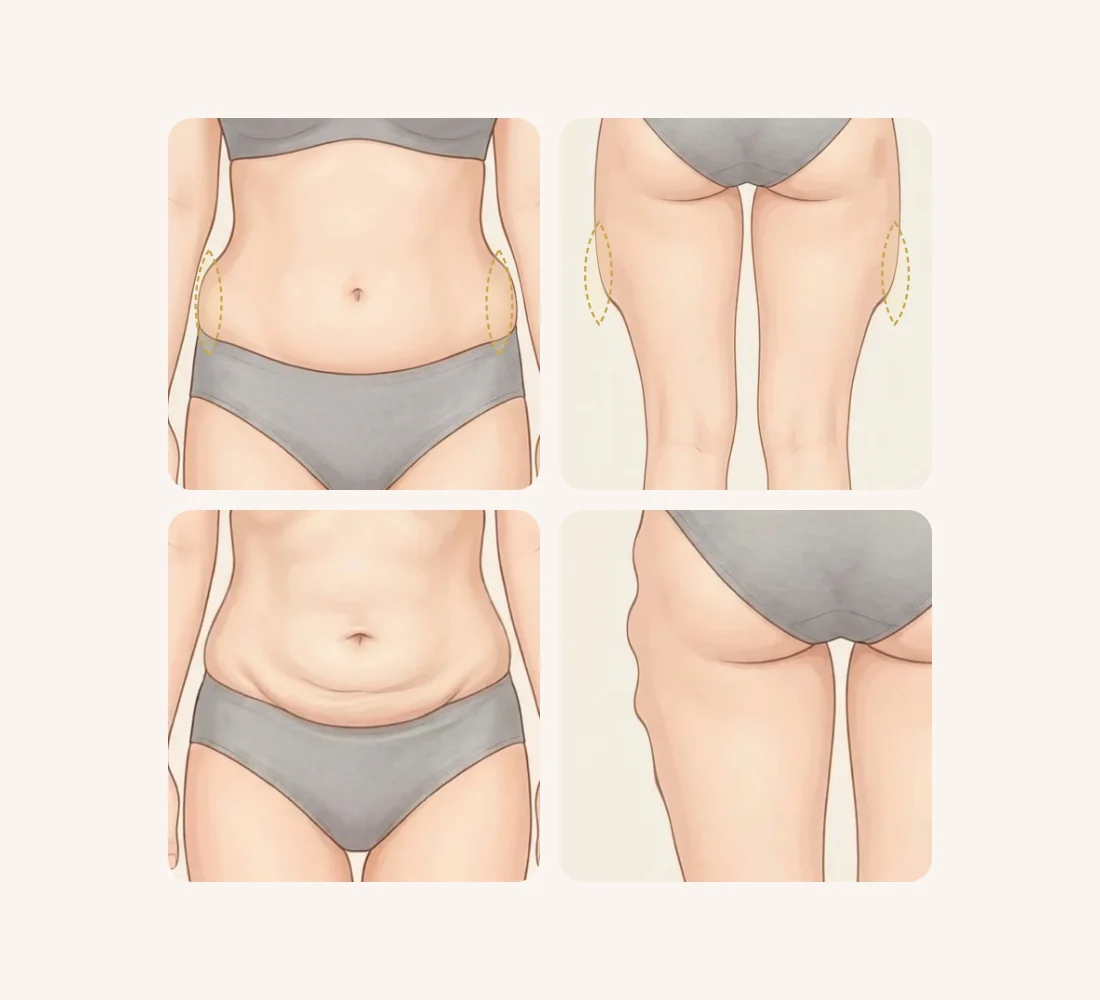
What does liposuction actually change?
Liposuction removes part of the fat that lies just under the skin (subcutaneous fat) in areas that blur your body's proportions. The fat is drawn out through thin tubes called cannulas.1 In a word, it is an operation that changes your shape, not your weight.
The American Society of Plastic Surgeons' practice advisory makes the same point: liposuction is not a standard treatment for obesity. You may have little fat gathered in one area, or hope for something far from what surgery can do. In that case, diet, exercise or other medical care may suit you better.1
Where we reduce, and what we keep
In general, the people who do well have two things. One is skin with good elasticity, and the other is a weight not far from their ideal weight (a healthy weight for their height and build). One review, an article that gathers and sums up many studies, puts that range at within 20–30% of ideal body weight.2 In other words, liposuction is not a way to solve being heavy; it refines the shape of stubborn areas once your weight is reasonably settled.
Weight gain after surgery can make the remaining fat grow again. That is why the same review advises keeping up a balanced diet and regular exercise.2
| What liposuction can do | What liposuction alone usually cannot do |
|---|---|
| Reduce stubborn fat in one area that diet and exercise have not shifted | Produce large weight loss |
| Refine the outline of the waist, flanks, arms or thighs | Tighten loose skin the way skin-removal surgery does |
| Provide your own fat to move where a curve is needed | Reduce visceral fat (the fat around the internal organs) |
What does the fat under the skin look like?
The fat under the skin is not one single block. It sits in two layers. Anatomical research on the trunk and legs, combined with CT scans (scans that show slices of the body), confirmed this structure.3
- Superficial fat layer: right under the skin. The fat sits in small pockets divided by tight fibrous walls.
- Superficial fascia: a thin sheet that separates the two fat layers.
- Deep fat layer: between that sheet and the fascia (the thin covering) of the muscle below. Its pockets have looser walls.3
The deep layer adds considerably to the overall thickness of the abdomen, the lower back and flanks, and the buttock–thigh area.3 So when these areas look thick, the deep layer is a big part of the reason.
Two layers of fat under the skin
Because of this structure, what is left behind shapes the surface more than how much comes out. A review lists these causes of a lumpy surface after liposuction:4
- Suction that is too shallow or too heavy
- Tissue that becomes firm (fibrosis) or sticks together (adhesions)
- A compression garment that does not fit, or poor posture
- Skin left over once the volume is smaller
The same review quotes the principle that what is left matters more than what is removed. It describes a recommendation to leave at least 5 mm of fat under the skin and over the fascia.4 On the other hand, some surgeons report that carefully treating the layer just under the skin helps the skin shrink back.4 So the depth worked in each area is matched to that area and to your skin.
Where do we reduce, and where do we keep?
Two people of the same weight can look very different depending on how the waist, hips and thighs relate to each other. So planning looks at the line that runs on from a bulge, not only the bulge itself. Slimming the waist alone may not create a curve. Sometimes the waist line only shows when there is volume at the hips and buttocks too.
Five spots that need extra care
In some places, the tissue under the skin is firmly attached to the fascia below. These attachments create the body's natural hollows and creases. One review names five such spots and explains that suctioning them raises the risk of contour deformity, meaning an outline that ends up dented or misshapen.2
The buttock crease (often called the banana roll) needs particular care. Over-suctioning the deep fat there can damage the fibrous tissue that supports the buttock, and the buttock may sag. A review describes this kind of sagging as very difficult to correct.4
Is the bulge on the outer thigh really fat?
A bulge on the outer thigh (saddlebags) can have two causes: fat that has built up in that spot, or a shape created by the weight of the buttock. If the bulge shrinks when you stand and tighten your buttocks, it is considered a "false" bulge. It then calls for a different plan from suctioning the outer thigh alone.4
That is why the examination before surgery is done while you stand. Looking at you relaxed and with your muscles tightened, and marking existing asymmetry and dents beforehand, is the recommended approach.4
How much can be removed at once?
There is no scientifically set limit that says "this many liters is safe". What is certain is that the risk of complications rises as the volume and the number of areas treated increase.1
The American Society of Plastic Surgeons asks surgeons to record the "total aspirate": the fat plus the fluid that comes out with it. It defines large-volume liposuction as 5,000 cc (5 liters) or more of total aspirate in one operation. It recommends that such operations take place in a hospital or an accredited or licensed facility, with vital signs (such as blood pressure and pulse) and urine output monitored overnight.1 It also notes that in some cases larger volumes are better split into separate operations and not combined with other procedures.1
How often do complications happen?
One study looked at 31,010 liposuction procedures performed in the US between 2008 and 2013, using a cosmetic surgery insurance database. When liposuction was done on its own, major complications needing an emergency visit, admission or another operation occurred in 0.7%. That is about 7 in every 1,000 people. The most common were hematoma (a pocket of pooled blood, 0.15%), lung complications (0.1%), infection (0.1%) and confirmed venous thromboembolism (a blood clot in a vein, 0.06%).5
When liposuction was combined with other cosmetic operations, the relative risk of a major complication was 4.81. Put another way, major complications were about 4.8 times as likely as with liposuction alone. Older age and a higher BMI (body mass index, a number that compares weight with height) also raised the risk on their own.5
Rare but serious complications include pulmonary embolism, where a blood clot blocks blood vessels in the lungs, and fat embolism, where droplets of fat block blood vessels. Pulmonary embolism is described as the most common cause of death after liposuction. Fat embolism can appear 12 to 72 hours after surgery, which is why careful monitoring after the operation matters.2 Walking on the day of surgery is encouraged.2 Before surgery, your clot risk is checked, including hormone use such as the contraceptive pill and any clotting disorder.1
| What is planned together | Why it matters |
|---|---|
| Total aspirate volume | Risk rises with volume1 |
| Number of areas | More areas mean more risk and longer surgery1 |
| Combining with other surgery | Raises the risk of major complications5 |
| Age and BMI | Each raises the risk of major complications on its own5 |
| Smoking and current medicines | Smoking is linked to clots and skin necrosis (skin tissue dying); blood thinners are adjusted in advance4 |
| Total local anesthetic dose | Limited by body weight because large amounts over wide areas can be toxic1 |
How is it done, and what is recovery like?
Before suction, a solution is usually infused into the fat. It contains a drug that narrows blood vessels and a dilute local anesthetic.1 In the tumescent technique, 3 to 4 cc of solution are infused for each cc of fat planned for removal. This brings blood loss down to roughly 1% of the aspirate.1 For example, when 100 cc is removed, about 1 cc of it is blood. The cannula is then passed through small incisions, and the fat is removed along the layer.
Why a solution goes in before suction
Expect clear bruising and swelling for at least the first 48 to 72 hours (two to three days). Compression garments and elastic stockings are generally worn for several weeks.1 One review describes the usual course like this:4
- First one to two weeks: swelling may increase slightly.
- Around two to three weeks: the swelling feels firm.
- Six to eight weeks: firm areas soften in patches.
- Around three months: depending on the extent of surgery, the area feels close to normal.
- Bruising: darkest at 7 to 10 days, and usually gone within two to four weeks.
Reduced feeling in the treated areas is common, but it usually returns close to normal within a year. After liposuction of the thighs, the skin can darken in places (pigmentation).4
| Stage | What is common | What the clinic does |
|---|---|---|
| Right after surgery | Bruising, swelling, stiffness in treated areas | Compression garment fitted; how to manage swelling and bruising explained |
| During recovery | Swelling firms up, then gradually softens | Compression continued; light activity resumed first |
| As it settles | Swelling goes down and the line emerges | Progress checked for any uneven areas |
Symptoms to report straight away
Contact the clinic straight away rather than waiting if you notice any of these. They can be signs of a clot or an infection.1
- Shortness of breath or chest pain
- Pain and swelling in one calf
- Pain that keeps getting worse
- Heat or discharge around a wound
Can dents, loose skin or asymmetry happen?
Contour deformity is the most common complication of liposuction. According to one review, up to 9% of patients report dents or bulges, loose skin, folds or wrinkles.2 That is up to about 9 in every 100 people.
In the following situations, some skin may be left over after liposuction, and it is worth knowing this before you decide:4
- Poor skin elasticity
- A large overhang of skin on the lower abdomen
- Heavy upper arms with loose skin
- Loose skin on the inner thighs
When a lot of excess skin is expected, a skin-removal operation may suit you better.4
Asymmetry that existed before surgery can still show afterward, so it is recorded with photos and measurements beforehand.4 If an area looks uneven while swelling remains, it is hard to judge accurately. So any corrective surgery is usually planned only after waiting at least six months. For loose skin, six months to a year is suggested so the skin has time to shrink back on its own.4 If you already had liposuction elsewhere and were left with dents or asymmetry, see our guide to liposuction revision.
How we approach it at Bonita Clinic
What we check first
1Excess fat on the belly and waist
How the waist curve will remain, not just how much to remove
Liposuction
2Thick thighs or upper arms
Inner and outer volume, and the line that connects them
Liposuction
3Skin likely to loosen after suction
Whether to tighten with Renuvion, decided before surgery
Renuvion
4Lumpiness after a previous liposuction
Remaining fat, adhesions and skin condition
Liposuction revision
At Bonita Clinic, we perform liposuction as surgery under sedation combined with local anesthesia; you go home the same day, and stitches are used. At our body contouring center, sedation or general anesthesia may be used, and an overnight stay may be needed depending on the extent. For one-day liposuction, we recommend splitting wide areas into separate sessions. Recovery time and follow-up visits vary with the extent of surgery and your condition.
Liposuction options you can discuss in Seoul
Bonita Clinic opened in 1995 and has stayed at the same address since, with Dr. Kwang-Seop Chung, a board-certified plastic surgeon who trained in Brazil, seeing patients himself. For body contouring, the options you can discuss at consultation are the ones on our treatment pages:
- Selective liposuction of the abdomen, waist and love handles, upper arms or thighs, planned around the line that remains
- Moving the removed fat to the buttocks or hips when a curve is needed (purpose of liposuction)
- Tightening with Renuvion when skin is likely to loosen (Renuvion line lifting)
- Revision when dents, asymmetry or sagging remain after an earlier liposuction (liposuction revision)
- A limited scope chosen to fit a short schedule (one-day liposuction)
Which of these you need, if any, is decided only after an examination.
Why the plan and cost differ from person to person
Two people asking for "liposuction of the waist" can need quite different operations. The plan, and therefore the cost, is shaped by the scope of the work rather than the name of the procedure.
- Which areas, and how many
- Expected total aspirate volume
- Whether fat is moved to the buttocks or hips
- Whether skin tightening is added
- Anesthesia, and whether an overnight stay is needed
- Previous liposuction or scarring in the area
Final plan and quote after an in-person exam
A final estimate is given after the in-person consultation, once the areas, the expected volume and any combined treatment are settled. Photos can suggest a direction, but they cannot fix the scope.
What photos can show, and what needs an in-person exam
Photos are a useful first step for liposuction because proportions show well in pictures. But they cannot tell how thick the fat is or how the skin will behave.
Photos can show
- Where the bulges are, and overall proportions
- Silhouette from the front, side and back
- Visible dents, folds or asymmetry
- Scars from earlier procedures
Needs an in-person exam
- How thick the fat is (pinch test)
- Skin elasticity and how much skin may remain
- True fat versus a bulge from buttock weight
- Adhesions or firm areas from earlier surgery
- Health conditions and clot risk
Helpful photos are taken standing, from the front, both sides and the back, in even light and at the same distance. Leave the areas uncovered as far as you are comfortable. If you have had liposuction before, include photos from before that operation if you have them. You can send us a message with your photos, the areas you want to change, and any earlier surgery.
Planning your visit and recovery
What is confirmed in advance is the treatment information above: surgery under sedation with local anesthesia, usually going home the same day, stitches, and a compression garment afterward. How long you should stay in Seoul, when you need to come back for checks, and how long to wear the garment depend on the areas and volume. These are planned with you at consultation.
Long flights and surgery each increase the risk of blood clots, and combining the two raises it further. As general guidance, the American Society of Plastic Surgeons suggests waiting five to seven days after body procedures such as liposuction before flying.6 This is a general guide, not a date we can set in advance. When you can travel is decided with your surgeon according to the extent of surgery, your clot risk and how you are recovering. Walking early and regularly during recovery is encouraged to lower the risk of clots.2
After you return home, contact a doctor promptly for breathlessness, chest pain, calf pain or swelling, or a wound that becomes red, hot or starts to discharge.1 Keeping dated photos of your recovery, and the record of what was done, is useful for any doctor who sees you later.
Real treatment cases
These cases appear on Bonita Clinic's liposuction page. Results vary from person to person.
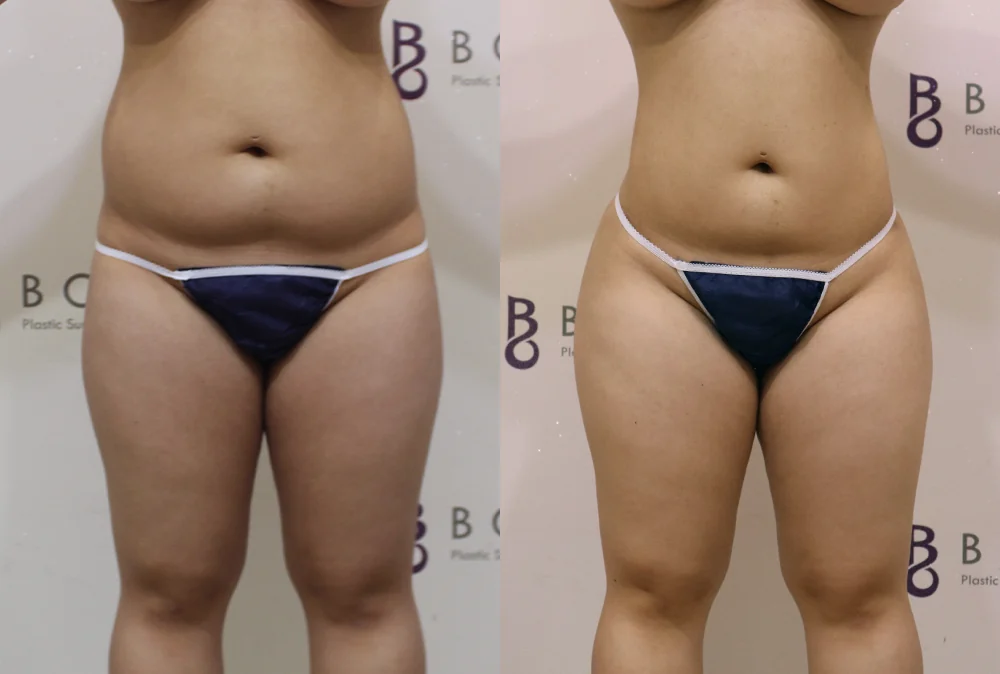
Thick abdomen and waist (front view)
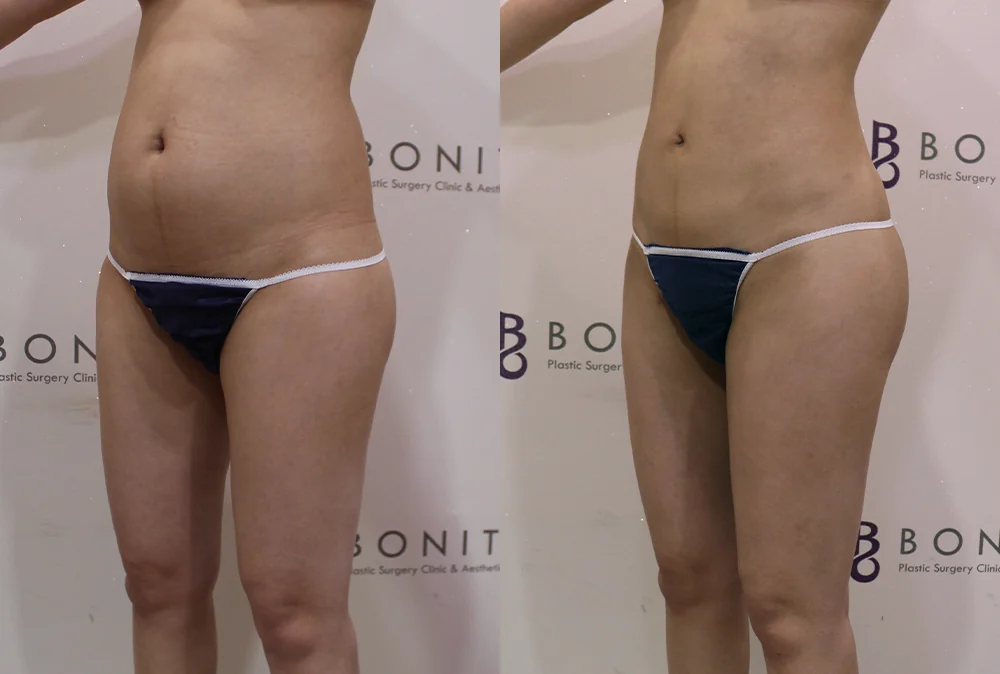
Lower abdomen that looked pushed forward (angled view)
* Results vary from person to person. Side effects are possible, so please decide after a thorough consultation with a doctor.
Frequently asked questions
Will I lose a lot of weight?
Liposuction is not a weight-loss operation. The aim is a change in the proportions and line of areas such as the waist and thighs, not in the number on the scale. Weight gain after surgery can make the remaining fat grow, so keeping up your eating and exercise habits helps protect the result.2
Will my skin sag after liposuction?
It can, depending on how much is removed and how elastic your skin is. If your elasticity is reduced, we tell you beforehand that some skin may be left over.4 If sagging is expected, we explain it before surgery and decide whether to tighten with Renuvion at the same time. When there is a lot of loose skin, skin-removal surgery may be the better option.
I'm worried the area will become lumpy.
The surface depends on how evenly the remaining fat layer is left. For several weeks after surgery, firm swelling can feel uneven. If unevenness remains once the swelling has settled, whether it can be corrected is judged after waiting at least six months.4 Irregularities left by an earlier operation are first checked to see whether revision can correct them.
How long do I wear the compression garment?
It depends on the area and the extent of surgery, and we tell you before the operation. In general, compression garments and elastic stockings are used for several weeks after surgery.1 A garment that fits poorly or leaves creases can cause surface irregularities, so we also show you how to wear it.4
Can I combine liposuction with other surgery on the same trip?
It is possible in some cases, but combining operations raises the risk of major complications compared with liposuction alone.5 Whether to combine, stage or limit the scope is decided together at consultation, taking your health and travel plans into account.
What to prepare before your consultation
- The areas you want to reduce and any areas you would like fuller
- Any previous liposuction or fat grafting: when, where on the body, and what method
- Weight changes over the last year or two, and whether you plan to lose weight
- Medicines you take (including blood thinners, the contraceptive pill or hormones) and whether you smoke
- Your travel dates, if you are coming from abroad
Bonita Clinic is on the 3rd floor of 565 Gangnam-daero, Seocho-gu, a walk of about 100 m from Exit 8 of Nonhyeon Station on Line 7. For the treatment itself, see our liposuction page and the body contouring center; for planning around a short schedule, see the one-day liposuction page and the guide to one-day liposuction.
References (6)
Sources that support the explanations in this article. Study findings describe general trends and do not guarantee individual results.
- Iverson RE, Lynch DJ; ASPS Committee on Patient Safety. Practice advisory on liposuction. Plast Reconstr Surg. 2004;113(5):1478-1490.doi:10.1097/01.prs.0000111591.62685.f8American Society of Plastic Surgeons practice advisory (full text): liposuction treats subcutaneous fat and is not a standard obesity treatment; risk rises with aspirate volume and number of sites; large-volume liposuction defined as 5,000 cc or more of total aspirate, with hospital or accredited-facility care and overnight monitoring; staging large cases; lidocaine limits; bruising and swelling for 48–72 hours and compression for several weeks; warning signs of pulmonary and fat embolism
- Wu S, Coombs DM, Gurunian R. Liposuction: Concepts, safety, and techniques in body-contouring surgery. Cleve Clin J Med. 2020;87(6):367-375.doi:10.3949/ccjm.87a.19097Review (full text): suitable candidates (good skin elasticity, within 20–30% of ideal body weight), weight regain, five zones of adherence where suction raises the risk of contour deformity, contour deformity as the most common complication (up to 9%), pulmonary and fat embolism, and same-day walking
- Markman B, Barton FE Jr. Anatomy of the subcutaneous tissue of the trunk and lower extremity. Plast Reconstr Surg. 1987;80(2):248-254.doi:10.1097/00006534-198708000-00015Anatomical study of cadavers and CT (abstract): subcutaneous fat lies in a superficial and a deep layer divided by a subcutaneous fascia, with deep fat compartments in the abdomen, lower back and buttock–thigh region; basis for the fat-layer diagram
- Dixit VV, Wagh MS. Unfavourable outcomes of liposuction and their management. Indian J Plast Surg. 2013;46(2):377-392.doi:10.4103/0970-0358.118617Review (full text): liposuction is not a weight-loss method; causes of surface irregularities; leaving a layer of fat under the skin and over the fascia; over-suction at the buttock crease and buttock sagging; examining patients standing; course of swelling, bruising, numbness and pigmentation; waiting at least 6 months before revision
- Kaoutzanis C, Gupta V, Winocour J, et al. Cosmetic Liposuction: Preoperative Risk Factors, Major Complication Rates, and Safety of Combined Procedures. Aesthet Surg J. 2017;37(6):680-694.doi:10.1093/asj/sjw243Prospective cohort of 31,010 liposuction procedures (abstract): major complications 0.7% for liposuction alone; combined procedures carried a relative risk of 4.81; age and BMI were also risk factors
- American Society of Plastic Surgeons. Briefing Paper: Cosmetic Surgery Tourism. plasticsurgery.org (accessed Oct 2026). 2026.American Society of Plastic Surgeons briefing paper (official page): long flights and surgery each raise the risk of blood clots and pulmonary embolism, the combination raises it further, and general guidance on waiting before flying after body procedures
About this article
This article separates general medical information from Bonita Clinic's own approach. Because the right decision depends on each person's condition, it is not a substitute for a consultation.
