 KOKorean
 ENEnglish
 JP日本語
JP日本語 CN中文(简体)
 TW中文(繁體)

Brazilian Butt Lift Safety in Seoul: Fat Embolism Risk, Injection Depth and What to Ask
The most serious risk of gluteal fat grafting is fat embolism: fat enters a large vein in the buttock and blocks blood vessels in the lungs. Studies link that risk mainly to injecting fat into the muscle, especially deep muscle. International societies therefore recommend placing fat only in the layer under the skin, above the thin sheet that covers the muscle (the fascia). They also recommend a wide cannula that is not angled downward, and always knowing where its tip is. When choosing a surgeon, ask where and how the fat will be placed and how complications are handled, not only what the before-and-after photos look like. If you are considering a BBL in Seoul, you can send us your photos and questions first.
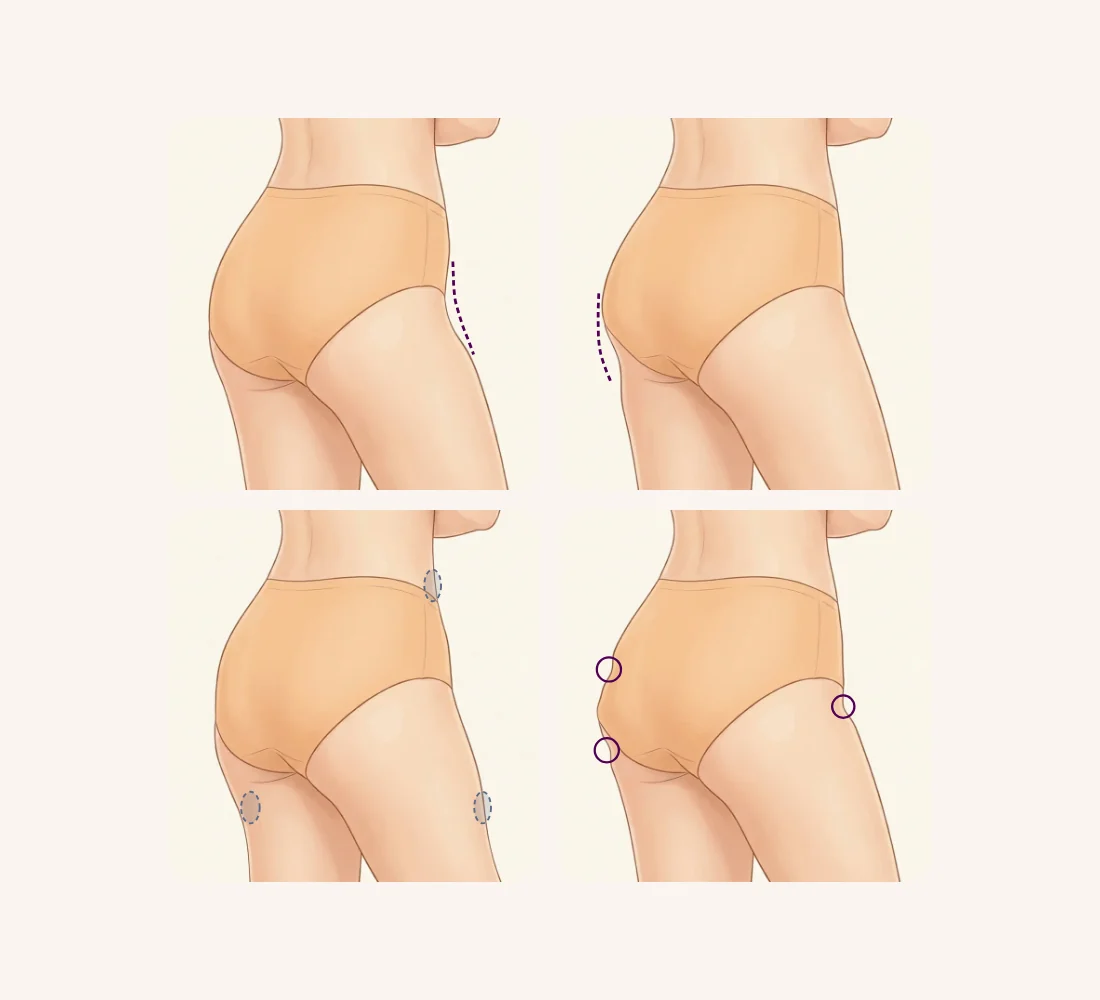
What is a Brazilian butt lift?
"Brazilian butt lift" (BBL) is the common name for gluteal fat grafting, which means moving your own fat into the buttocks. It happens in three steps. First, fat is removed by liposuction from places where there is some to spare, such as the waist, flanks and thighs. Next, the fat is filtered so that only usable fat is kept. Finally, that fat is placed into the buttocks and around the hips to shape the curve from the waist down.
The main feature is that it uses your own fat instead of an implant or other material. In return, it combines two operations in one, taking fat out and putting it in, so it is a major operation that takes considerable time from liposuction to grafting.
From where fat is taken to where it goes
Who usually asks about it?
At Bonita Clinic, we offer the Brazilian Layered Hip-up to people who:
- Have a slim build with little buttock volume
- Would rather not have implants, fillers or other materials inserted
- Have little excess fat but flat buttocks
- Have buttocks that are flat or lack firmness
- Have a flat outer hip with no visible line
- Have a flat lower buttock that makes it look dropped
Even with the same wish for a "lift", what is checked first depends on which area lacks volume and how much fat you have to spare.
Which situation sounds like yours?
1Hollow outer hip, no clear line
Fat also goes to the side (hip joint area) to join the line
2Flat lower buttock that looks dropped
The lower area is filled in layers
3Slim, with little fat to spare
Donor fat is checked first; little fat limits the increase
4Irregular after an earlier BBL
Remaining fat, skin, and the earlier layer and volume come first
Revision consultation
Why does safety deserve special attention in this operation?
The most serious risk of this operation is "fat embolism". This means that fat being injected gets inside a blood vessel, travels with the blood to the lungs and blocks the vessels there. It is rare, but it can be life-threatening.
In 2017 a task force (a group of experts formed to look into one problem) of the Aesthetic Surgery Education and Research Foundation (ASERF) looked into this risk. The 692 plastic surgeons worldwide who responded reported 198,857 gluteal fat grafting procedures, with 32 deaths from pulmonary fat embolism and 103 nonfatal pulmonary fat emboli.1 Three percent of respondents had experienced a patient death, and 7% at least one pulmonary fat embolism.1
Mortality estimates varied with the method used. The task force cautioned that none of these figures should be read as the actual rate. Even so, it concluded that the procedure appeared to carry a markedly higher mortality than other aesthetic operations.1 For you as a patient, this means the exact odds are hard to know, but this is not a risk to take lightly.
How does fat get into a vein?
Fat embolism is thought to happen when a large vein running among the buttock muscles is injured, and fat enters through the tear and travels to the lungs. The largest buttock muscle is the gluteus maximus, and the superior and inferior gluteal veins run beneath it. Where they pass beneath this muscle they can be 4 mm or wider. Near the sciatic notch, deep in the back of the pelvis, veins of 6 mm or more can gather.1
Surgeons who reported injecting into deep muscle had a markedly higher incidence of both fatal and nonfatal fat embolism. In the deaths reviewed in the report, fat was found within the gluteal muscles at autopsy (the examination that establishes the cause of death).1 That is why safety in this operation starts with one question: how deep does the fat go?
How does fat get into a vein?
How deep should the fat go?
It is easiest to picture the buttock as five layers. From the outside in, they are the skin and the fat under the skin (the subcutaneous layer). Next come a thin, tough sheet covering the main buttock muscle (the gluteal fascia), the muscle itself (the gluteus maximus), and the space beneath the muscle. The large veins lie beneath and between the deep muscles.
In an anatomical study, researchers injected a fat substitute into the buttocks. Material placed under the skin above an intact fascia stayed there even as pressure rose. When the fascia had defects, the material crossed through the muscle into the space beneath it.3
The authors concluded that the gluteus maximus fascia acts as a stout wall. Injection above it spreads under the skin, while injection beneath it creates a dangerous condition for deep migration. They therefore proposed that no injection be made below the fascia or into the muscle.3 Put simply: keep the fat on the outer side of that wall.
The fascia: a wall against deep spread
What do the international safety recommendations say?
The task force recommendations and later society advisories come down to one aim: keeping fat away from the deep layers. In the figure below, a cannula is the thin, hollow tube used to inject fat.
Recommendations and the reasons behind them
Society members were surveyed again after these recommendations. The share reporting deep muscle injection had fallen from 13.1% to 0.8%, and downward angling of the cannula from 27.2% to 4%.2 Over the same period, reported pulmonary fat embolism fell from 1 in 1,030 cases to 1 in 2,492, and mortality showed a downward trend.2 This is survey evidence, built on what surgeons reported, so it has limits. Still, it suggests that risk fell as technique changed.
When surgeons were surveyed again
An example of rules set in the US
In 2022, US plastic surgery societies issued a joint statement. It supported rules set by the Florida Board of Medicine. Fat is injected only into the layer under the skin above the gluteal fascia, and gluteal fat grafting is limited to three procedures per day. Ultrasound is used to monitor the cannula tip during injection.4
A society practice advisory also identified uncertainty or lack of documentation of the injection layer as a likely factor in deaths. It recommended using ultrasound to check and record where the cannula is before and during injection.5 These rules apply in one US state, but they show clearly what is now treated as the safety standard.
How does injection depth make a difference?
| Layer injected | Current recommendation | Evidence |
|---|---|---|
| Under the skin, above the fascia | Recommended layer | Fat placed here tends to stay here3; long-term retention comparable to studies of muscle injection6 |
| Just below the fascia, muscle surface | To be avoided | Crossing the fascia allows migration beneath the muscle3 |
| Deep in the muscle | Should not be used | Higher embolism rates; fat found in the muscle at autopsy1 |
It used to be said that fat had to go into the muscle to stay. Yet one study followed 50 patients with fat placed only under the skin. On ultrasound, subcutaneous thickness rose by a mean 56.51% right after surgery. At 12 months, it was a mean 18.16% lower than that immediate level.6 In other words, some of the gain was lost over the year, but not all of it.
The authors concluded that subcutaneous-only grafting showed long-term retention comparable to earlier reports of intramuscular injection.6 Even so, injecting under the skin does not remove every risk; the task force itself noted that some risk remains.1
What should you ask any surgeon?
Wherever you have surgery, some answers matter as much as the photos. Check that you can get a clear answer to each of these:
- Which layer will the fat go into, and is it only the layer under the skin above the fascia?
- What size and type of cannula will be used, and how is the position of its tip checked, including whether ultrasound is used?
- Who provides anesthesia, and how is an emergency during surgery handled?
- How extensive is the planned liposuction, how much fat will be grafted, and how long will surgery take?
- If a problem arises after surgery, whom do you contact, and when?
The task force recommended that informed consent include the risk of fat embolism and alternative procedures.1 You should be able to hear this explained and to ask your own questions about it.
How do surgery and recovery go?
At Bonita Clinic, we perform the Brazilian Layered Hip-up as surgery under sedation or general anesthesia; you go home the same day, and stitches are used. This is general information and can differ from person to person.
After surgery, a compression garment (snug clothing that presses on the treated areas) is worn to manage swelling and bruising. You keep wearing it while slowly increasing light activity. As the swelling goes down and the new line appears, we check how well the grafted fat has settled, that is, whether it has taken hold and survived. Recovery time and the number of follow-up visits differ with the extent of surgery and with each person.
Possible problems, and symptoms that need care right away
Bruising and swelling occur both where fat was taken and where it was placed. Infection, fluid collections, an uneven surface, and grafted fat that hardens can occur. Because part of the grafted fat is absorbed by the body, a touch-up may be considered depending on how it settles.
Sudden shortness of breath, chest pain or confusion after surgery can signal an emergency such as fat embolism. Do not wait: get emergency care immediately.
How we approach it at Bonita Clinic
Treatment options you can discuss in Seoul
Bonita Clinic opened in 1995 and has remained in one place, with its director, Dr. Kwang-Seop Chung, a Brazilian board-certified plastic surgeon, examining patients himself. For the buttocks and hips, the options described on our treatment pages are:
- The Brazilian Layered Hip-up, with liposuction and layered fat grafting to the buttocks, hip joint area and saddlebags
- Buttock fat grafting, planned around the waist curve, upper hip line, side hip volume and thigh border
- 7:10 Pelvic Contouring, focused on the line from the waist to the side of the hips
Which of these suits you, and in what combination, is decided only after an examination.
Why the plan and cost differ from person to person
The same request for "a BBL" can mean very different operations. The extent of liposuction and grafting, rather than the procedure name, shapes the plan and the cost.
- Number of liposuction areas
- Volume of fat grafted
- Areas filled: buttocks, hip joint, saddlebags
- Anesthesia: sedation or general
- Earlier grafts, fillers or implants
- Whether a touch-up may be needed
Final plan and quote after seeing you in person
A final estimate is given only after an in-person examination, once the donor areas, graft volume and anesthesia are clear. Photos help set a direction; the scope of surgery is only fixed in person.
What can photos show, and what needs an in-person exam?
Photos help us understand the shape you have and the one you hope for. They cannot show what lies beneath the skin.
Photos can show
- Buttock shape from back, side and angle
- Flat outer hip or dropped lower buttock
- Waist-to-hip curve
- Marks from earlier procedures
Needs an in-person exam
- How much donor fat you have
- Lumps or oil cysts from earlier grafts
- Skin quality and looseness
- Medical history affecting anesthesia
- Risk factors for blood clots
Helpful photos: standing from the back, both sides and a three-quarter view from behind, in plain underwear, against a plain background and in even light. If you have had fat grafting, fillers or implants in the buttocks before, tell us where, when and, if you know, which layer and how much. Send us a message with your photos and any questions about technique or safety.
Planning your visit and recovery
What is confirmed in advance is limited to the treatment information above. Surgery is under sedation or general anesthesia, with same-day discharge and stitches. A compression garment is worn, and how long is explained before surgery. How long to stay in Seoul, when to return for checks and when stitches are removed depend on the extent of liposuction and grafting. These are planned together with you at consultation.
US plastic surgery societies state that surgeons who operate on patients who have traveled should have full care plans for before and after surgery and remain available to manage complications.4 Before you book, it is reasonable to ask how follow-up will work during your stay and after you return home. After you go home, seek urgent care for sudden breathlessness, chest pain or confusion. See a doctor promptly for increasing pain, redness, heat, discharge, or swelling in one leg.
Real treatment cases
These cases are from our Brazilian Layered Hip-up page. Results vary from person to person.
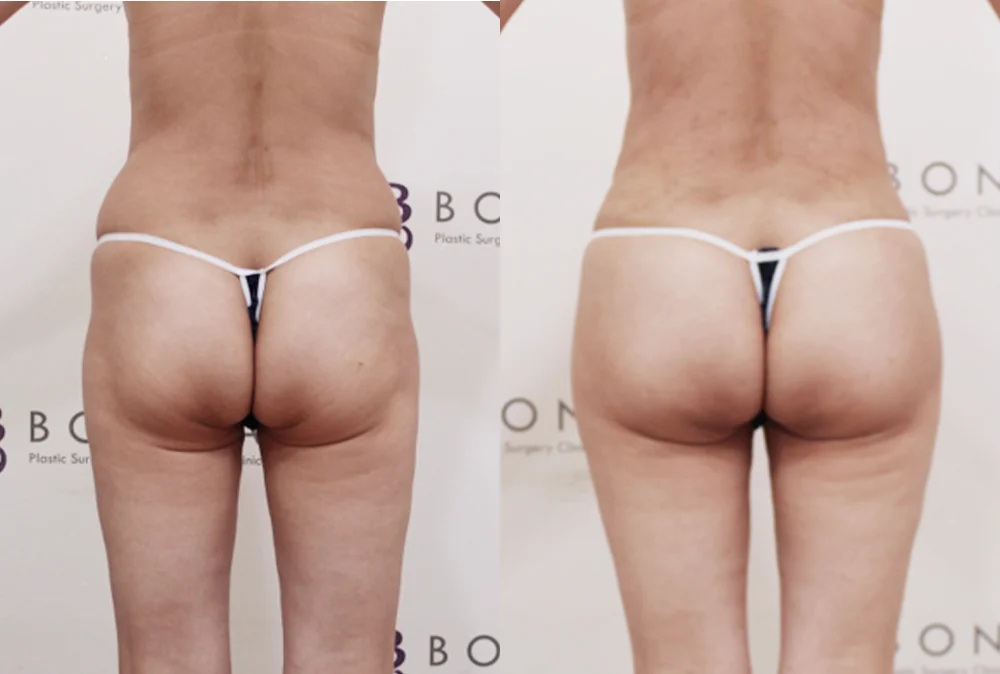
Back view: the line from the waist to the side of the buttocks
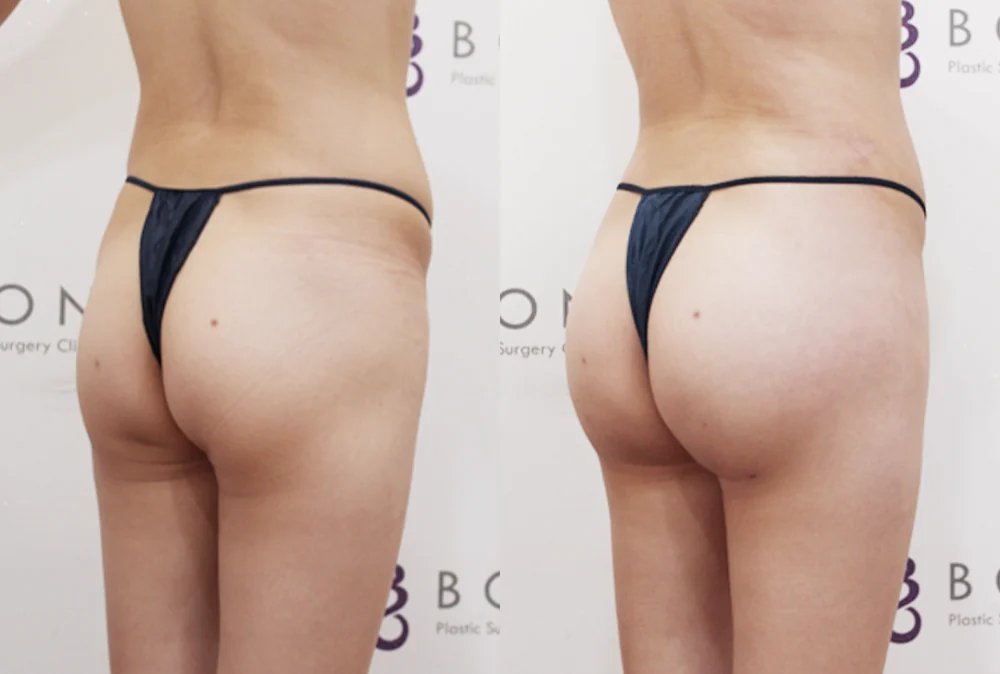
Three-quarter back view: lower buttock and side volume
* Results vary from person to person. Side effects are possible, so please decide after a thorough consultation with a doctor.
Frequently asked questions
Will fat placed only under the skin give less volume or fade quickly?
In a study of subcutaneous-only grafting, much of the volume was still present a year later, at a level comparable to earlier reports of muscle injection. How much larger the buttocks can become depends more on how much fat can be harvested and how much room the area has than on the layer. Our guide to buttock fat grafting covers this in detail.
Can a slim person have a BBL?
Bonita Clinic lists a slim build among the cases this operation is suited to, and looks for proportions in which waist, thighs and buttocks work together. If there is little fat to harvest, however, the possible increase is limited. So where and how much fat can be collected is checked first.
What difference does adding stem cells make?
Bonita Clinic separates fat stem cells from the harvested fat and grafts them together with your fat. How much such methods improve fat survival varies between studies, and most of the research comes from breast reconstruction; the evidence is summarized in our guide to pelvic fat grafting. Whether or not stem cells are used, the safety rules on injection depth matter just as much.
Can a BBL done elsewhere be revised?
Irregularities, asymmetry and sagging left after a previous operation can be corrected. The method depends on the remaining fat and the condition of the skin. It also helps to know which layer and how much was injected before, and whether there are firm lumps or oil cysts (small pockets of melted fat).
How long do I wear the compression garment?
The wearing period varies with the areas treated and is explained before surgery. Ask about sitting and lying positions as part of your surgical plan as well.
What to prepare before your consultation
- The shape you hope for and what concerns you most (dropped lower buttock, flat outer hip, hip joint area, saddlebags)
- Previous liposuction, fat grafting, buttock fillers or implants, with the clinic and date
- Any history of blood clots or lung disease, regular medicines (especially blood thinners), and whether you smoke
Bonita Clinic is on the 3rd floor of 565 Gangnam-daero, Seocho-gu, Seoul, about 100 m on foot from Exit 8 of Nonhyeon Station (Line 7). You can read more on our Brazilian Layered Hip-up page. How much grafted fat remains is covered on the Buttock Fat Grafting page and in the guide to buttock fat grafting. The waist-to-hip ratio and the side-hip line are covered on the 7:10 Pelvic Contouring page and in the guide to pelvic fat grafting.
References (6)
Sources that support the explanations in this article. Study findings describe general trends and do not guarantee individual results.
- Mofid MM, Teitelbaum S, Suissa D, et al. Report on Mortality from Gluteal Fat Grafting: Recommendations from the ASERF Task Force. Aesthet Surg J. 2017;37(7):796-806.doi:10.1093/asj/sjx004ASERF Task Force report (full text): a survey of 692 surgeons (198,857 cases) recorded 32 fatal and 103 nonfatal pulmonary fat emboli; deep muscle injection, downward-angled cannulas and cannulas under 4 mm were linked to higher risk; fat was found in the gluteal muscles in the autopsies reviewed; position of the superior and inferior gluteal veins; nine recommendations; mortality estimates should not be read as actual rates; survey limitations
- Rios L, Gupta V. Improvement in Brazilian Butt Lift (BBL) Safety With the Current Recommendations from ASERF, ASAPS, and ISAPS. Aesthet Surg J. 2020;40(8):864-870.doi:10.1093/asj/sjaa098Follow-up survey of society members two years after the recommendations (abstract): pulmonary fat embolism fell from 1 in 1,030 to 1 in 2,492 cases, mortality trended from 1 in 3,448 to 1 in 14,952, deep muscle injection fell from 13.1% to 0.8%, use of only ≥4.1 mm cannulas rose from 4.1% to 29.8%, downward angling fell from 27.2% to 4%
- Wall S Jr, Delvecchio D, Teitelbaum S, et al. Subcutaneous Migration: A Dynamic Anatomical Study of Gluteal Fat Grafting. Plast Reconstr Surg. 2019;143(5):1343-1351.doi:10.1097/PRS.0000000000005521Cadaver study of four hemibuttocks (abstract): material placed above an intact fascia stayed under the skin even as pressure rose, while material crossed into the space beneath the muscle when the fascia had defects; the gluteus maximus fascia acts as a wall, supporting subcutaneous-only injection
- American Society of Plastic Surgeons, The Plastic Surgery Foundation, The Aesthetic Society, Aesthetic Surgery Education and Research Foundation. Gluteal Fat Grafting: A joint safety statement. Statement on Patient Safety During Gluteal Fat Grafting. Joint society statement (ASPS · PSF · The Aesthetic Society · ASERF). 2022;issued 2022-08-18.Joint safety statement by ASPS, PSF, The Aesthetic Society and ASERF (August 18, 2022, full text): support for Florida's rules (subcutaneous injection above the gluteal fascia, a limit of three procedures per day, ultrasound monitoring of the cannula tip), support for real-time ultrasound, and the duty to provide pre- and postoperative care and manage complications for patients who travel
- Del Vecchio D, Kenkel JM. Practice Advisory on Gluteal Fat Grafting. Aesthet Surg J. 2022;42(9):1019-1029.doi:10.1093/asj/sjac082Practice advisory (abstract): clustering of Florida deaths at the end of the week, fatigue and distraction, and uncertainty about the injection plane; recommends ultrasound-guided documentation of cannula placement before and during injection and a maximum of three cases per day
- Cansancao AL, Condé-Green A, David JA, Vidigal RA. Subcutaneous-Only Gluteal Fat Grafting: A Prospective Study of the Long-Term Results with Ultrasound Analysis. Plast Reconstr Surg. 2019;143(2):447-451.doi:10.1097/PRS.0000000000005203Prospective study of 50 patients with subcutaneous-only grafting (abstract): subcutaneous thickness rose by a mean 56.51% immediately and fell by a mean 18.16% from that level at 12 months; long-term retention comparable to earlier reports of intramuscular injection
About this article
This article separates general medical information from Bonita Clinic's own approach. Because the right decision depends on each person's condition, it is not a substitute for a consultation.
