 KOKorean
 ENEnglish
 JP日本語
JP日本語 CN中文(简体)
 TW中文(繁體)

Hip Dip and Pelvic Contouring with Fat Grafting in Seoul: What the 7:10 Waist-to-Hip Ratio Does and Doesn't Mean
A hip dip is a hollow below the bony bump at the top of the thigh bone, where several muscles attach. Fat grafting can fill it and soften the curve, but it cannot change the shape of the bone. The waist-to-hip ratio of 7:10 is the name and design reference Bonita Clinic uses, drawn from research on preferences for a lower ratio. It is not a medical target that every body should be fitted to. How much the waist is reduced and the side of the hips filled should be planned around your frame and the fat you can spare. If you are thinking about pelvic contouring in Seoul, you can send photos of your hips first to see what may be realistic.
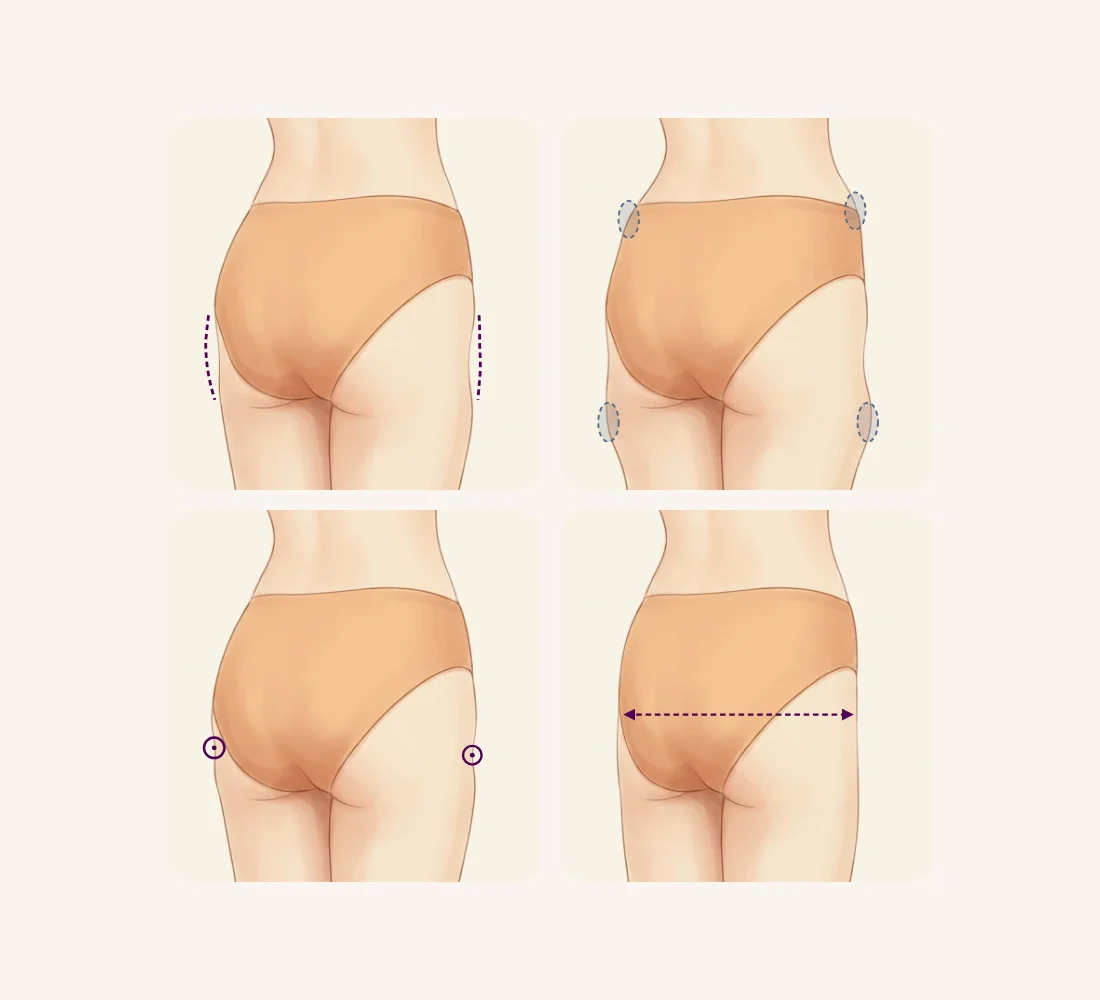
Why can the sides of the hips look hollow?
The inward curve on the side of the buttock, below the hip, is often called a "hip dip". Bone and muscle make this hollow together.
At the top of the thigh bone there is a bony bump that sticks out to the side, called the greater trochanter. The hollow sits below it. It is formed by that bone together with the places where several buttock and thigh muscles attach: the gluteus medius, vastus lateralis, quadratus femoris and gluteus maximus.3
Why can the side of the hips look hollow?
There are several reasons it appears. It can simply be your natural build. It can become more visible as exercise defines the muscles. It can also deepen with age, as the skin loosens and fat gathers in the lower buttock.3
A hip dip is not simply a lack of fat. It is a shape created by the way bone and muscle attach. So fat grafting can fill the hollow and smooth the line from the waist to the thigh. But it cannot change the width of the pelvis or the position of the trochanter. Even the authors of a filler report for this area described it as a region that can be hard to expand.3
Where does "7:10" come from?
Bonita Clinic's "7:10 Pelvic Contouring" takes its name from the ratio of waist to hip circumference (the waist-to-hip ratio, or WHR). For example, a waist of 70 cm and hips of 100 cm make 7:10.
A 1993 study is often cited as the starting point of this research. It found that men rated drawings of women with a lower WHR as more attractive and healthier.1 The drawing experiments mentioned on our treatment page belong to this line of research.
A systematic review (a study that gathers and summarizes many studies) looked at more than 25 years of such research. A preference for a relatively low WHR has been seen across many populations and methods, but the exact ideal value varies from study to study.2 Whether WHR or body weight (body mass index, weight relative to height) better explains attractiveness is still debated. Results changed with the population studied and the drawings or photos used.2
What to know about 7:10
In short, 7:10 is not a medical "right answer" but a reference for the direction of the design.
How much does the ratio actually change after surgery?
Some studies have measured this. One study looked at 35 Asian women who had buttock fat grafting placed only under the skin with ultrasound guidance. The waist got smaller, the hips got larger, and the mean WHR moved from 0.78 to 0.74.5
It is not really a matter of setting a number and fitting the body to it. It is closer to reality to say the ratio follows from slimming the waist and filling the sides and lower buttock. At Bonita Clinic, too, we use the 7:10 name but design by the balance that suits your body rather than by the number.
Where to reduce and where to fill?
The curve from the waist to the buttocks is shaped by two things together: slimming the waist and filling the side of the hips.
In one measurement study of buttock fat grafting, many patients wanted fullness at the side of the hips, over the trochanter, for an hourglass shape. So that area was filled along with the buttocks.6 In the same study, suctioning the flanks at the same time increased how much the buttocks stood out compared with the surrounding areas.6 Going by this result, the curve becomes clearer when filling the sides and slimming the waist are planned together.
Slim and fill, and the ratio moves
What options are there, and how do they differ?
There are three broad ways to change the side-hip line: fat grafting to the side of the hips with liposuction around it, liposuction around it only, and hyaluronic acid filler. The figure below shows which one is considered in which case.
The side-hip line: which case is yours?
1A hollow, and fat to move
Side-hip fat graft + liposuction; part is absorbed
7:10 Pelvic Contouring
2Thick areas around it
Liposuction around it; the hollow itself is not filled
3A small area, without surgery
Hyaluronic acid filler; few reports, hard to expand
General information
4A narrow pelvis
Bone width stays. Filling the side and slimming the waist can join the line
Even in filler research, the large vessels and nerves of the buttock are described as lying in and beneath the muscle. So the fat under the skin is described as the safest layer for injection.3 Injection depth and the safety recommendations for gluteal fat grafting are covered in detail in our Brazilian butt lift safety guide.
Stem cell-enriched fat grafting: how far does the evidence go?
In 7:10 Pelvic Contouring at Bonita Clinic, we separate fat stem cells from the suctioned fat and graft them together with your own fat. Fat-derived stem cells are expected to help new blood vessels grow, and so to help transferred fat settle.4
Studies comparing results come mainly from breast reconstruction. The most recent meta-analysis (a study that pools the results of many studies and recalculates them) reported the following.
| Method | Retention compared with standard fat grafting | Notes |
|---|---|---|
| Stem cell-enhanced grafting overall4 | Mean 26.8 percentage points higher | Moderate certainty of evidence |
| Stem cells expanded in culture | Mean 64.6 points higher | 3 studies; requires cell culture facilities |
| Stromal vascular fraction separated during surgery | Mean 17.0 points higher | Large differences between studies; low certainty |
"Percentage points" are the difference between two percentages. The share of fat that remained was higher than with standard grafting by that amount on average. "Stromal vascular fraction separated during surgery" means a group of cells is separated from the fat on the day of surgery and used right away.
The meta-analysis found complication rates similar to standard fat grafting. But the advantages in contour and satisfaction became smaller after 18 to 24 months, and results differed with how the cells were separated. The authors called for standardized methods and longer-term data.4
We did not find studies directly comparing stem cell-enriched and standard grafting in the buttocks or hips. So part of the fat may still be absorbed when stem cells are used. At Bonita Clinic, too, a touch-up may follow depending on progress.
Stem cell-enriched grafting: how far the evidence goes
What are the procedure, recovery and limits?
At Bonita Clinic, we perform 7:10 Pelvic Contouring as surgery under sedation or general anesthesia; you go home the same day, and stitches are used. This is general information and can differ from person to person.
Fat is suctioned from unwanted areas with a very thin tube (a micro-cannula), and the purified fat is grafted into the hips and buttocks together with stem cells. Afterwards you wear a compression garment (snug clothing that limits swelling) while swelling and bruising are managed. After that period, light activity resumes. As the swelling goes down and the line appears, we check whether the grafted fat has taken. How long recovery takes and how often you return depend on the extent of surgery and on your own condition.
Limits and risks to keep in mind:
- Part of the grafted fat is absorbed. A touch-up may be needed if asymmetry or a shortfall remains.
- The width of the bone and the way the muscles attach do not change. A deep hollow can only be softened so far.
- Bruising, swelling, infection, lumps and uneven areas can occur at both donor and grafted areas. Serious complications such as fat embolism (fat entering a vein and blocking vessels in the lungs) are rare but possible.
- Liposuction is not weight-loss surgery. The goal is a change in line rather than on the scale.
How we approach it at Bonita Clinic
Treatment options you can discuss in Seoul
Since 1995, Bonita Clinic has been in the same place, with Dr. Kwang-Seop Chung, board-certified in plastic surgery in Brazil, seeing patients in person. For the waist-to-hip line, the options described on our treatment pages are:
- 7:10 Pelvic Contouring: liposuction of the waist, love handles, upper arms or thighs, with stem cell-enriched fat grafting to the side hips and buttocks
- Brazilian Layered Hip-up, when the buttocks themselves also need volume
- Buttock fat grafting, planned around the waist curve, upper hip line, side hip volume and thigh border
Which of these suits you, and in what combination, is decided only after an examination.
Why do the plan and cost differ from person to person?
Two people with "hip dips" can need very different operations. What drives the plan and the cost is how much liposuction and grafting is needed, not the name of the procedure.
- Number of liposuction areas
- How deep the hollow is and how much fat it needs
- Side hips only, or buttocks too
- Anesthesia: sedation or general
- Previous grafting or fillers in the area
- Whether a touch-up may be needed
Final plan and quote after seeing you in person
A final estimate is given only after an in-person examination, once the donor areas, the graft volume and the anesthesia are clear. From photos we can discuss a likely direction, but not the final scope.
What can photos show, and what needs an in-person exam?
Photos show the outline of the hollow well. They cannot show how much of it is bone, muscle or fat.
Photos can show
- Depth and shape of the side hollow
- Waist-to-hip line from front and back
- Left-right differences
- How the line looks in clothes
Needs an in-person exam
- Bone, muscle or fat: what forms the dip
- How much donor fat you have
- Skin and fat thickness over the hollow
- Lumps from earlier grafts or fillers
- Health conditions affecting surgery
Helpful photos: standing from the front, back and both sides, in plain underwear against a plain background and in even light. Add one in fitted clothes if the line in clothes bothers you most. If you have had fat grafting or fillers in the hips before, tell us when and where. You are welcome to message us your photos and questions.
Planning your visit and recovery
What is confirmed in advance is limited to the treatment information above. Surgery is under sedation or general anesthesia, with same-day discharge and stitches. A compression garment is worn, and how long is explained before surgery. How long to stay in Seoul and when to return for checks depend on the extent of liposuction and grafting. These are planned together with you at consultation.
Swelling hides the line at first, so the result is judged after the swelling settles and the fat has taken. Keep dated photos from the same angles as your pre-operative ones; they make later comparison, at our clinic or with a doctor at home, much easier. Seek urgent care for sudden breathlessness or chest pain. See a doctor promptly if pain, redness, heat or swelling increases instead of settling.
Real treatment cases
These cases appear on Bonita Clinic's 7:10 Pelvic Contouring page. Results vary from person to person.
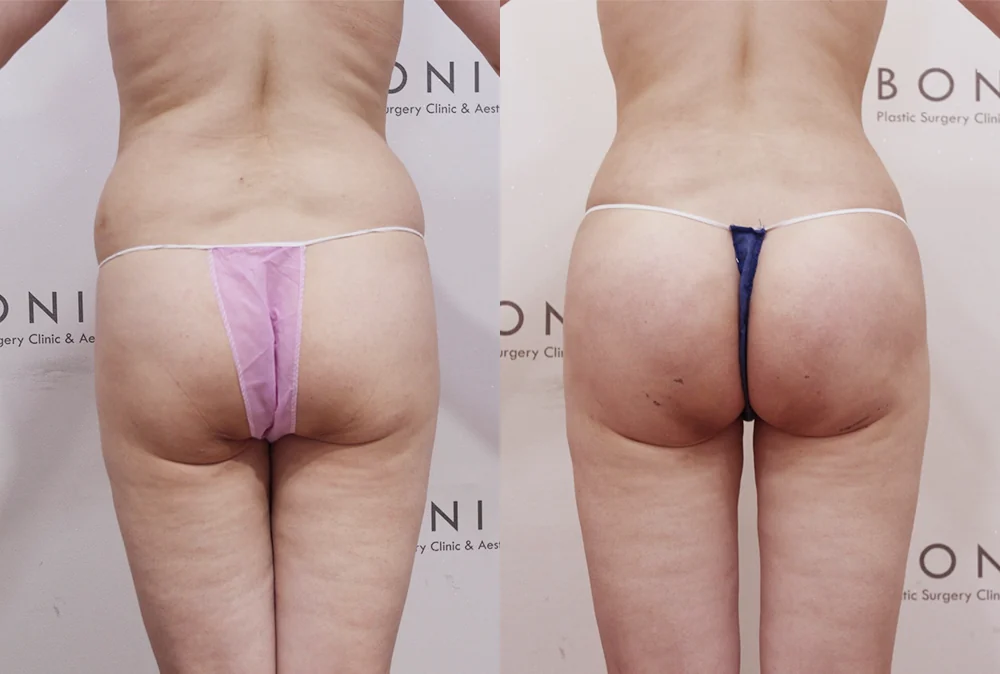
Back view: the line from the waist to the side of the hips
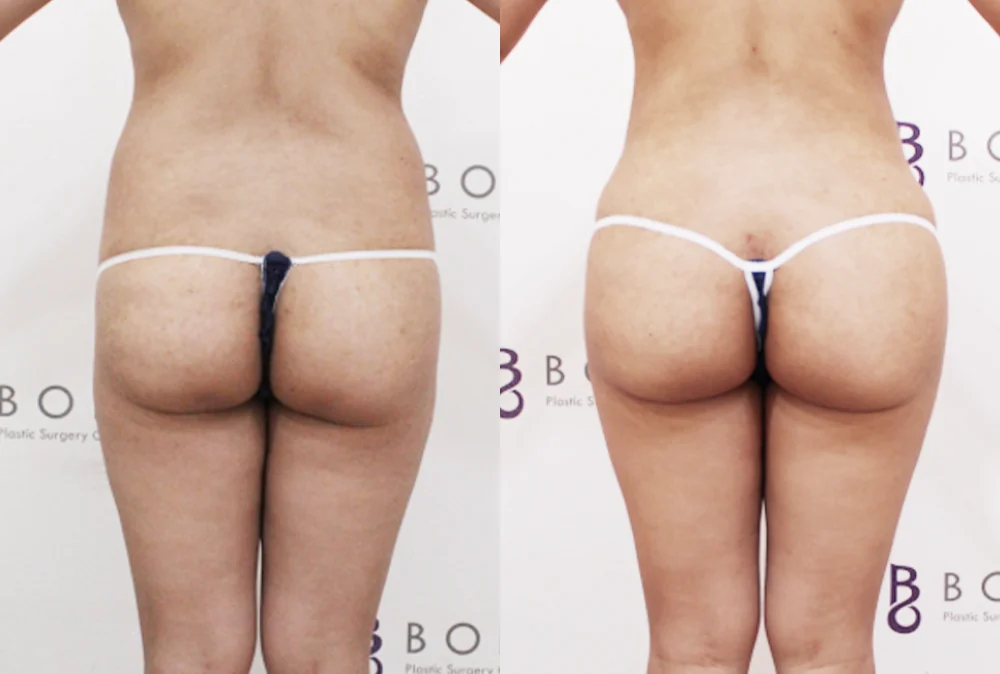
Back view: the side hips and outer buttock line
* Results vary from person to person. Side effects are possible, so please decide after a thorough consultation with a doctor.
Frequently asked questions
Will surgery set my waist-to-hip ratio to exactly 7:10?
No, it is not surgery that fits a number. Waist and hip measurements depend on your skeleton, muscles and fat distribution. How far they can change depends on the fat that can be removed and moved. 7:10 is a reference for the direction of the design; the real aim is a natural balance for your body.
My pelvis is narrow. Can it look wider?
The width of the bone does not change. But filling the hollows at the side of the hips and the hip joint area while slimming the waist can change how continuous the side line looks. How much can be filled depends on the fat available and on how much room the skin and fat layer allow, which is checked in person.
Does adding stem cells mean all the fat stays?
No. In a meta-analysis of breast reconstruction studies, stromal vascular fraction separated during surgery raised retention by about 17 percentage points over standard grafting. But results varied widely between studies, and certainty was low. The volume is planned assuming some absorption, and the need for a touch-up is judged later.
Will I lose a lot of weight?
Liposuction is not weight-loss surgery. Because fat is removed in some places and added in others, the goal is a change in line rather than in weight.
Can pelvic fat grafting done elsewhere be revised?
Irregularities, asymmetry and sagging left after a previous operation can be corrected. The method depends on the remaining fat and the condition of the skin. If you remember where and how much was injected before, telling us helps with planning.
What to prepare before your consultation
- Which areas you would like to reduce and fill, and the angle that bothers you most (front, side, in clothes)
- Previous liposuction, fat grafting or fillers, and when they were done
- Recent weight changes and your exercise habits, since muscle definition can make a dip more visible
- Medicines you take regularly and any medical conditions
Bonita Clinic is on the 3rd floor of 565 Gangnam-daero, Seocho-gu, Seoul, about 100 m on foot from Exit 8 of Nonhyeon Station (Line 7). You can read more on our 7:10 Pelvic Contouring page. Layered grafting and injection-depth safety are covered on the Brazilian Layered Hip-up page and in the Brazilian butt lift safety guide. How much grafted fat remains is covered on the Buttock Fat Grafting page and in the guide to buttock fat grafting.
References (6)
Sources that support the explanations in this article. Study findings describe general trends and do not guarantee individual results.
- Singh D. Adaptive significance of female physical attractiveness: role of waist-to-hip ratio. J Pers Soc Psychol. 1993;65(2):293-307.doi:10.1037/0022-3514.65.2.293Starting point of waist-to-hip ratio (WHR) preference research (abstract): college-age men and men aged 25 to 85 rated female figures with a lower WHR as more attractive and healthier
- Bovet J. Evolutionary Theories and Men's Preferences for Women's Waist-to-Hip Ratio: Which Hypotheses Remain? A Systematic Review. Front Psychol. 2019;10:1221.doi:10.3389/fpsyg.2019.01221Systematic review (full text): a preference for a relatively low WHR is seen across many populations and methods, but the exact ideal value varies; whether WHR or body weight (BMI) better explains attractiveness is debated, and results depend on the population and stimuli
- Lourenco L, Medeiros H, Ferreira L, et al. Hip dips technique: Filling lateral depressions with hyaluronic acid of large particles. Skin Health Dis. 2024;4(6):e461.doi:10.1002/ski2.461Hip dip technique report (full text): anatomy of the hollow below the greater trochanter where the gluteus medius, vastus lateralis, quadratus femoris and gluteus maximus attach; causes (constitutional, athletic muscle definition, ageing); subcutaneous fat as the safest injection layer in the buttock; a small filler series in an area described as hard to expand
- Shimizu Y, Inoue Y, Sowa Y, et al. Adipose-Derived Stem Cell-Enhanced versus Conventional Fat Grafting for Breast Reconstruction: A Systematic Review and Meta-Analysis. Plast Reconstr Surg. 2026;157(3):338e-349e.doi:10.1097/PRS.0000000000012421Meta-analysis of 31 breast reconstruction studies (full text): stem cell-enhanced grafting raised retention by a mean 26.8 percentage points (moderate certainty), 64.6 points with culture-expanded cells, 17.0 points with stromal vascular fraction separated during surgery (high heterogeneity, low certainty); similar complication rates; benefits in contour and satisfaction diminished after 18–24 months
- Wang B, He P, Zhao R. B-ultrasound-assisted gluteal fat grafting in Asians: A prospective study of quantitative results from three-dimensional imaging and B-ultrasound analysis. J Plast Reconstr Aesthet Surg. 2024;94:12-19.doi:10.1016/j.bjps.2024.04.035Prospective study of 35 Asian women (abstract): ultrasound-guided, subcutaneous-only buttock grafting; waist circumference fell and WHR moved from a mean 0.78 to 0.74; 3D-measured retention 64.7% at 6 months
- Swanson E. Prospective Controlled Study of Buttock Fat Transfer Using Ultrasound and Photographic Measurements. Plast Reconstr Surg Glob Open. 2016;4(5):e697.doi:10.1097/GOX.0000000000000700Prospective controlled study (full text): many patients wanted lateral (trochanteric) hip fullness for an hourglass shape, so it was filled with the buttocks; relative projection rose more when the flanks were suctioned
About this article
This article separates general medical information from Bonita Clinic's own approach. Because the right decision depends on each person's condition, it is not a substitute for a consultation.
