 KOKorean
 ENEnglish
 JP日本語
JP日本語 CN中文(简体)
 TW中文(繁體)

Buttock and Leg Filler Removal in Seoul: When Injected Material Hardens or Keeps Getting Inflamed
In many cases it can be removed. But the buttocks and legs hold far larger volumes than the face, in much thicker tissue. The realistic aim is to remove what causes trouble, down to a safe depth, rather than every trace. Well-defined lumps can usually be cut out or drawn out. Material that has seeped through the fat and into the muscle may be reduced in stages and still leave some behind. If inflammation keeps returning, or the skin is darkening or thinning, have the extent checked rather than waiting. If you are considering treatment in Seoul, you can send photos and your injection history first to see which approach may fit your case.
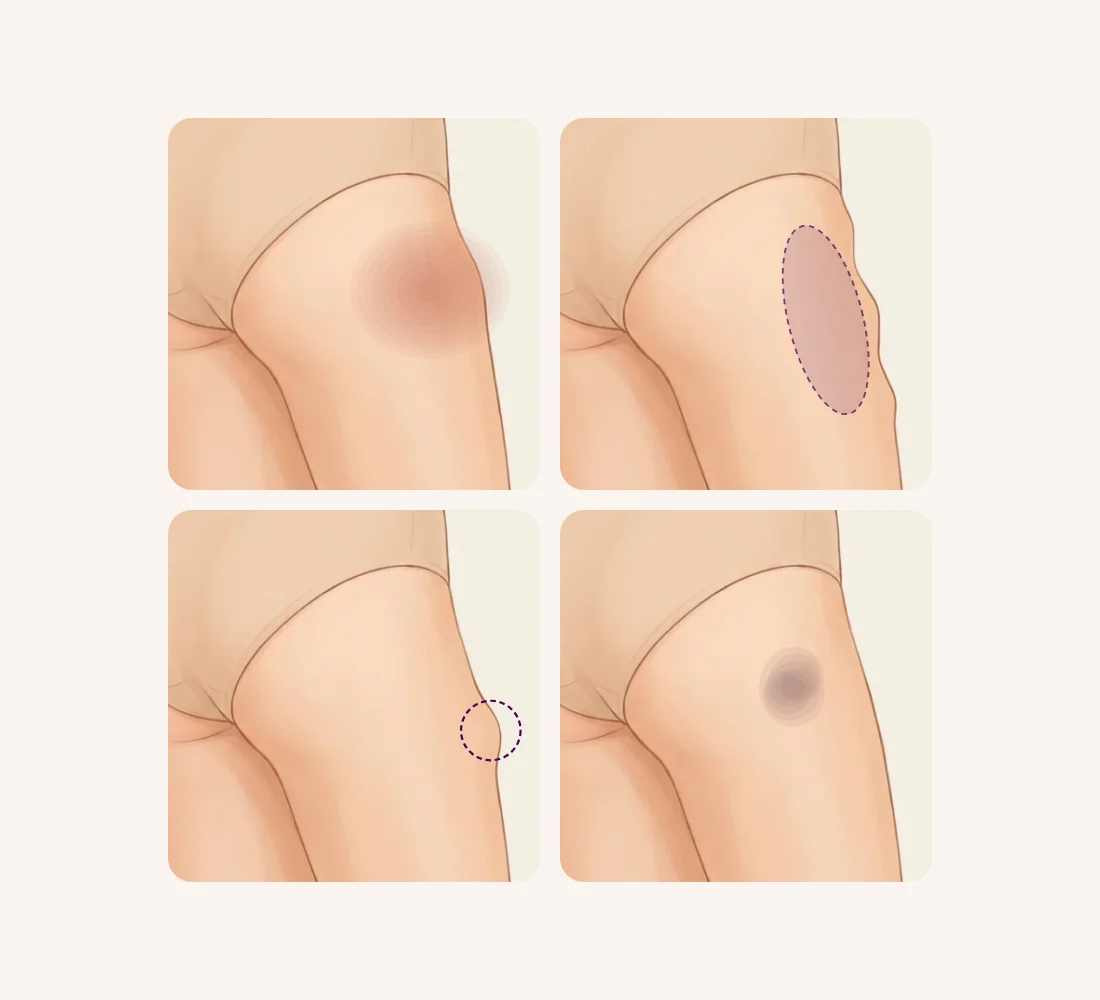
How are buttock and leg injections different from the face?
The biggest differences are volume and depth. Facial fillers are measured in a few millilitres. In the buttocks, hips and thighs, injections are used to change the whole contour, so the volumes are far larger. A Korean study looked at 146 patients who had Aquafilling hydrogel surgically removed from the breasts or buttocks. The average amount taken out of one side was 285.5 mL, and up to 750 mL.3 That is more than a full cup of material on one side. When something goes wrong with that much material, the affected area is wide. And because the fat layer under the skin is thick, the material tends to scatter at several depths.
The side of the hips is injected to create a smoother line from the waist to the thighs. Bonita Clinic's treatment page also includes a video of treating complications of pelvic filler injections in a transgender woman. The thighs and calves are sometimes injected directly. In a surgical study of silicone injected into the legs, 8 of 12 silicone masses (siliconomas) were below the knee and 4 were in the thigh.2 Injected material can also move away from where it was placed, sometimes to distant sites.2
What material is in there, and what changes can it cause?
Reported buttock injectables include liquid silicone, various oils, methyl methacrylate, paraffin, collagen and substances that were never identified.1 Hydrogel fillers (gels that hold a lot of water) have also been widely injected into the breasts and buttocks. Researchers have raised concerns about using them over areas as large as the buttocks.3 Not knowing what was injected is common. In a surgical series of 12 women with silicone deposits in the legs, 10 did not know what they had received, and only 2 had been told it was silicone.2
Changes that deserve a check
| What you notice | Common causes | What is checked |
|---|---|---|
| Firm lumps you can hold between your fingers | Collected material, foreign body granuloma (siliconoma) | Size, number and depth |
| Red, hot, painful swelling or pus | Inflammation or infection | Fever, pus, how often it comes back |
| Skin turning dusky or bluish and thinning | Poor skin circulation, a step toward necrosis | Extent and speed of change |
| A sore that will not heal | Skin ulcer | Whether material has reached the skin |
| Hard grains under the skin | Calcification | Where the calcium sits on imaging |
| Low fever and fatigue with flare-ups | A body-wide inflammatory reaction | Whether medical tests (calcium, kidney function) are needed |
Two terms from the table, explained simply. A foreign body granuloma is a firm lump of inflammation the body builds to wall off foreign material. Calcification means calcium building up in tissue so that it hardens like stone.
In the 146-patient study, symptoms began on average 38.5 months after injection. The most common problems were hardening or a palpable mass (83.6%), pain (52.1%), firmness (24.7%), asymmetry (10.3%) and migration (8.2%); these figures combine breast and buttock cases.3 On average, then, symptoms appeared after about three years, and more than eight in ten people felt a lump. All 12 patients in the leg series had repeated local infections needing antibiotics and corticosteroids, and 8 of them felt tired and unwell during flare-ups.2
Why is the whole body checked, not just the contour?
A systematic review (a study that collects and analyses all the relevant reports in a set way) looked at complications from substances injected into the buttocks. It analysed 29 publications covering 463 patients and found three groups of problems:
- Local complications at the injection site
- A body-wide inflammatory or immune response
- Kidney damage caused by high blood calcium, which the granulomas around the material can trigger1
For most patients, surgically removing the affected tissue improved both the local problem and the body-wide findings, including calcium, kidney function and inflammation. Patients who received combined care (controlling inflammation, protecting the kidneys and removing the areas holding large amounts of material) did better than those with widespread infiltration whose treatment was delayed.1
That is why buttock and leg injections are not judged by appearance alone. If you have frequent fevers, unexplained fatigue, or have been told your calcium or kidney results are abnormal, tell us at your consultation. An internal medicine assessment may be needed alongside any removal surgery.
Breathlessness or chest pain soon after an injection is a different situation: it needs emergency care, not a removal consultation. Reported complications of silicone oil injection include pneumonitis, embolism (a blood vessel blocked by material) and multi-organ failure.2
Why does depth matter?
Beneath the skin of the buttock lie a thick fat layer and the fascia (a thin, tough sheet covering the muscle). Below these are the gluteus maximus (the largest buttock muscle) and deeper muscles. Large gluteal veins, which can measure 4 mm or more, run between the gluteus maximus and the muscle beneath it. Near the sciatic notch (a hollow at the back of the pelvis), some exceed 6 mm.5 If material has reached deep into the muscle, the plan has to take these vessels into account.
Material close to the skin shows up well on ultrasound (a scan that looks under the skin without opening it). In the buttock, however, the fat and muscle are thick enough that high-frequency ultrasound cannot reach the deepest layers, and deposits inside the muscle are easily missed. In a case report on gluteal polymer complications, MRI separated deposits in the fat from those in the superficial muscle in 3D and was used to plan surgery. Ultrasound of the same area could not reliably show the deep or intramuscular spread.4
That patient had been injected in 2016 and had no symptoms for about five years. Then, after a COVID-19 infection, swelling, pain and spontaneous pus drainage began.4 Material that has been quiet for years can still flare up.
The legs are a little different. Below the knee the tissue is thin, and silicone had spread through the full thickness, from just under the skin down to the fascia. In the thigh, where the tissue is thicker, it filled only part of the layer. The surgeons therefore removed the fascia as well on the lower leg and stayed above it on the thigh.2 Before surgery they used ultrasound and Doppler (an ultrasound that shows blood flow). They checked that the material stayed above the fascia, that nearby lymph nodes were clear and that the veins were healthy despite repeated inflammation.2
Which approach fits which situation?
Two people with "buttock filler problems" may need very different first steps. What matters is whether inflammation is active, whether the material forms one lump or has seeped widely, and whether the skin can be preserved.
What state is it in now?
1Red, hot and swollen
Inflammation or infection is calmed first; it can flare again while material remains
Control infection
2Soft material spread widely
Removed through a cannula, though some is often left behind
Cannula removal
3A lump with clear edges
Cut out as one piece; the incision scar may thicken and need care
Excision of the lump
4Skin darkened or broken down
Whether the skin can be kept is judged first; wide excision and repair are staged
Wide excision and repair
Here is what the cards mean in a little more detail:
- Cannula removal (through a thin tube with a blunt tip) needs only small incisions. But it cannot promise to take everything out, and what is left can shift during or after surgery. Three of the 12 patients in the leg series had already had liposuction of their siliconomas with only partial improvement.2
- Cutting out a clearly defined mass with a margin of healthy tissue resolved symptoms reliably in that series. But the authors noted that this approach is hard to apply as-is to large areas such as the buttocks.2
- If the skin has already darkened or broken down, the first question is whether that skin can be kept at all.
In the systematic review, most patients improved after the affected tissue was removed, yet treatment varied widely between reports.1 In practice there is rarely one fixed operation. Methods are combined and divided into stages according to where the material has collected and what state the skin is in.
What remains after removal?
Hollows and leftover material
Taking material out reduces volume, so the buttocks can look hollow or uneven. Areas hardened by fibrosis (tissue turning tough and fibrous) can stay pulled inward. In the case report above, fibrosis and skin tethering persisted even after several staged operations and fat grafting. The doctors used 3D MRI to show the patient why complete removal was not possible.4 Over an area as large as the buttocks, reducing the material that causes trouble and restoring the contour is a more realistic aim than removing every trace.
Scars
Incisions leave scars. In the leg series, 3 of 12 patients (25%) needed injections for thickened scars, and 2 (16.6%) had an extra fat grafting session to refine the thigh contour.2
How deep fat is placed
When hollows are filled with your own fat, depth matters. An international task force investigated deaths from pulmonary fat embolism (fat travelling through the veins and blocking the lungs) after gluteal fat grafting. Surgeons who reported injecting into the deep muscle had about 4 times the rate of fatal emboli and about 6 times the rate of nonfatal emboli. The task force recommended avoiding deep muscle injection, while noting that injecting more superficially lowers the risk without removing it entirely.5 This is why the layer used for fat restoration in the buttocks is chosen carefully.
How we approach it at Bonita Clinic
At Bonita Clinic, we perform buttock and leg foreign material removal as surgery under sedation or general anesthesia. Most patients go home the same day, with a one-night stay when the area is large, and stitches are used.
Treatment options you can discuss in Seoul
Bonita Clinic opened in 1995 and has stayed at the same location since, with Dr. Kwang-Seop Chung, a board-certified plastic surgeon (Brazil), seeing every patient himself. For buttock, hip and leg injection problems, the options discussed at consultation are:
- Ultrasound assessment of where the remaining material is, its size and the state of the tissue
- Surgical removal by hand or fine cannula, freeing adhesions while limiting tissue damage
- Fat grafting with your own fat when removal leaves a hollow, timed to the tissue's recovery
- Combined laser treatment for marks and skin texture, with remaining scars followed up at our Scar Clinic
Imaging such as MRI and blood tests mentioned in this guide are general medical information; whether you need them is discussed after an examination.
Why do the plan and cost differ from person to person?
The diagnosis name says little about the work involved. What shapes both the plan and the cost is how much has to be done.
- How many areas: buttocks, hips, thighs, calves
- Depth: fat layer only, or into the muscle
- Cannula removal, excision, or both
- Fat grafting now, later, or not at all
- Sedation or general anesthesia, overnight stay
- Active infection or skin damage to treat first
Final plan and quote after an in-person exam and ultrasound
A final estimate is given only after the in-person examination and ultrasound, once the extent of removal and any restoration are clear. Photos can suggest a direction but cannot fix the scope of surgery.
What can photos show, and what needs an in-person exam?
Photos help us understand the shape of the problem. They cannot show how deep the material lies.
Photos can show
- Bulges, dents and asymmetry
- Skin color change, thinning or sores
- Which areas are involved
- How the contour has changed (older photos)
Needs an in-person exam
- Depth: fat or muscle (ultrasound, sometimes MRI)
- Firmness and adhesion to tissue
- Active infection or pus
- Whether thin skin can be kept
- How much fat is available for grafting
Helpful photos: standing, taken from behind, from each side and at 45 degrees, in plain underwear and good light, without your face. If the area swells from time to time, a photo taken during a flare is useful, and older photos show how the contour has changed. Send us a message with the photos and a short note on when and where each area was injected.
Planning your stay and recovery
What is confirmed in advance is the treatment information above. Surgery is under sedation or general anesthesia, with stitches. You usually go home the same day, with an overnight stay for larger areas. How long to stay in Seoul, when and how often to return, and when stitches come out all vary. They depend on how much is removed and whether fat grafting is done at the same time. These are planned with you at consultation.
Recovery after buttock and leg material removal happens in three stages:
- Right after: swelling and bruising are managed with compression and cold packs.
- As the swelling settles: the contour of the treated area becomes clearer.
- Settling: once the removal and grafted sites have stabilized, the need for any touch-up is judged.
After you return home, see a doctor promptly if redness, heat, pain, fever or discharge increases instead of settling. Tell any doctor who treats you later that material was removed, and whether some was left. If you had abnormal calcium or kidney results before, keep following them with your local doctor.
Real treatment cases
These cases appear on Bonita Clinic's buttock and leg revision page. Results vary from person to person.
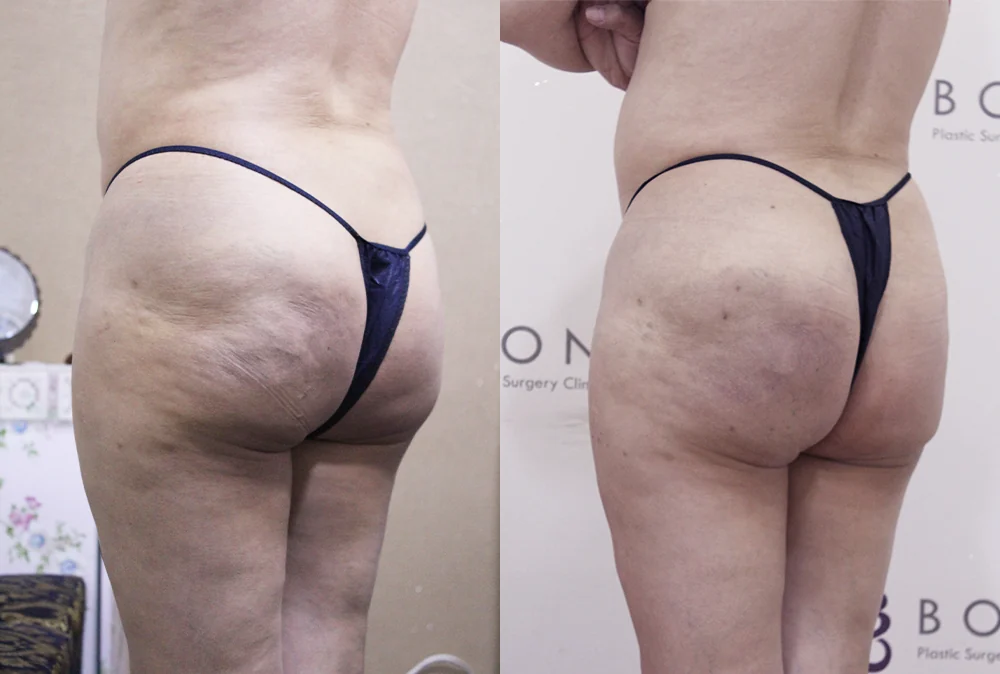
Buttock skin wrinkled, uneven and dimpled in places
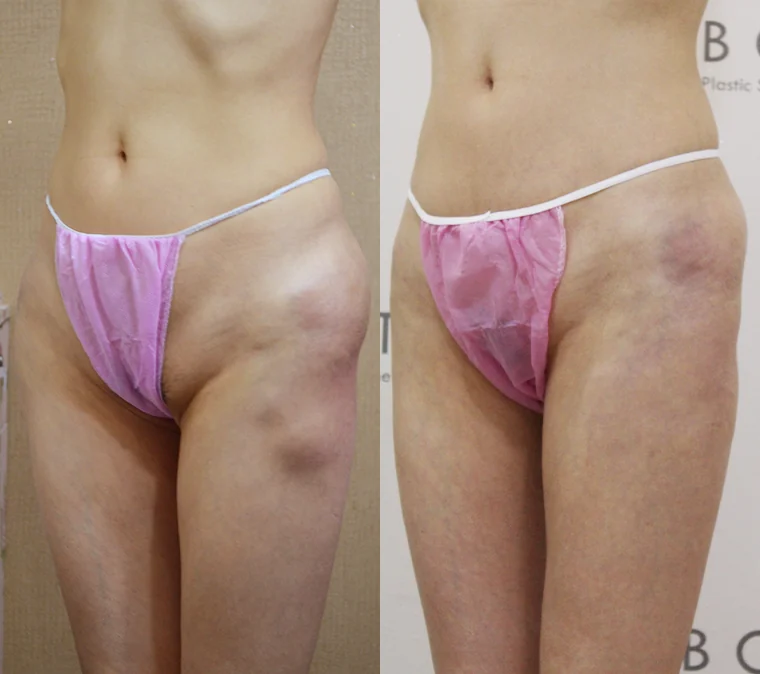
Lumps bulging at the side of the hip and the upper thigh
* Results vary from person to person. Side effects are possible, so please decide after a thorough consultation with a doctor.
Frequently asked questions
My buttock injections were more than ten years ago. Can they still be removed?
Yes, old material can be removed. Over the years it often hardens and attaches to the surrounding tissue, which changes how much can be removed safely. Ultrasound comes first. If spread deep into the muscle is suspected, imaging such as MRI can help with planning.4
Will my buttocks look flat or misshapen afterwards?
They can lose volume or become uneven in proportion to what is removed. That is why restoration is planned together with removal, using your own fat once the tissue has settled if needed. In the buttocks, fat should be kept out of the deep muscle layer where the large veins run.5
The area is swollen and I have a fever. Can I have surgery straight away?
When pus has collected or the area is red, hot and swollen, the infection is calmed first. As long as the material remains, though, inflammation can return. So the removal plan is made with ultrasound once things have settled.
What if it cannot all come out at once?
Over a wide, thick area such as the buttocks, even several stages may not remove everything.4 Lumps that drive inflammation and areas threatening the skin are reduced first, and what remains is reassessed over time.
Where will the scars be?
Scars form along the incisions and can thicken; in the leg series about one in four patients needed extra treatment for thick scars.2 Incisions are kept as short as possible and placed where they are less visible, and remaining scars are followed up at our Scar Clinic.
Before your consultation
- For each area, when, where, how many times and roughly how much was injected (list buttocks, hips, thighs and calves separately)
- Any product name or ingredient you were told, and any leaflet or receipt you kept
- How often swelling and fever come back, and whether you have taken antibiotics or steroids
- Dates of any earlier liposuction or excision, and ultrasound or MRI reports from that time
- Whether you have ongoing low fever or fatigue, or abnormal calcium or kidney results
- Medicines you take regularly
Bonita Clinic is on the 3rd floor of 565 Gangnam-daero, Seocho-gu, Seoul, about 100 m on foot from Exit 8 of Nonhyeon Station (Line 7). You can read more about the process on our Buttock & Leg Surgery Revision page. For injected breast material, see Breast Surgery Revision and the guide to breast filler and foreign material removal. For shaping the buttocks with your own fat instead of injectables, see Buttock Fat Grafting.
References (5)
Sources that support the explanations in this article. Study findings describe general trends and do not guarantee individual results.
- Ramos-Gallardo G, Cuenca-Pardo J, Cárdenas-Camarena L, et al. Morbidity induced by the infiltration of foreign substances into the buttocks: A systematic review. J Plast Reconstr Aesthet Surg. 2024;91:135-153.doi:10.1016/j.bjps.2024.01.047Systematic review (abstract), 29 reports and 463 patients: injected substances, three groups of complications (local, systemic inflammatory-immune, kidney damage from high calcium), improvement after resection, worse course with diffuse infiltration and delayed care
- Agostini T, Perello R. Siliconomas of the lower limb: Tumour-like excision and reconstruction. Indian J Plast Surg. 2016;49(3):384-389.doi:10.4103/0970-0358.197228Case series of 12 leg siliconomas: unknown substances, lower leg vs thigh depth, recurrent infection and malaise, ultrasound and Doppler staging, limits of liposuction, 25% thick scars and 16.6% extra fat grafting, limited use in large areas such as the buttocks
- Namgoong S, Kim HK, Hwang Y, et al. Clinical Experience with Treatment of Aquafilling Filler-Associated Complications: A Retrospective Study of 146 Cases. Aesthetic Plast Surg. 2020;44(6):1997-2007.doi:10.1007/s00266-020-01889-7Korean retrospective study (abstract) of 146 Aquafilling removals from the breasts or buttocks: onset at a mean 38.5 months, mean 285.5 mL removed per side, symptom frequencies (breast and buttock combined), concerns about use over large areas
- Bussed VM, Serra-Guimarães F, do Carmo CCM, Werner H. Three-dimensional Magnetic Resonance Imaging Segmentation for Preoperative Planning in Gluteal Polymer Complications. Plast Reconstr Surg Glob Open. 2026;14(7):e7941.doi:10.1097/GOX.0000000000007941Single case report: high-frequency ultrasound misses deep and intramuscular gluteal deposits that MRI shows; flare after years without symptoms; fibrosis after staged surgery and why complete removal was not possible
- Mofid MM, Teitelbaum S, Suissa D, et al. Report on Mortality from Gluteal Fat Grafting: Recommendations from the ASERF Task Force. Aesthet Surg J. 2017;37(7):796-806.doi:10.1093/asj/sjx004Task force report on deaths from gluteal fat grafting: about 4- and 6-fold higher rates of fatal and nonfatal fat embolism with deep muscle injection, position and size of the gluteal veins, recommendation to avoid deep muscle while noting residual risk
About this article
This article separates general medical information from Bonita Clinic's own approach. Because the right decision depends on each person's condition, it is not a substitute for a consultation.
