 KOKorean
 ENEnglish
 JP日本語
JP日本語 CN中文(简体)
 TW中文(繁體)

Breast Augmentation in Seoul: Implants or Fat Grafting, and What the Safety Data on Implants Show
Implants let you choose a size in advance and reach it in one operation. But they are not lifetime devices: they come with regular imaging and a real chance of another operation at some point. Fat grafting leaves nothing artificial in the body, yet part of the transferred fat is absorbed and you need enough fat to harvest. Which suits you depends on how much change you want and how much breast tissue you have to cover an implant. Your body fat and how much long-term follow-up you are prepared for also matter. If you are considering surgery in Seoul, you can send photos and your history first to see which approach may fit.
What is the basic difference between implants and fat grafting?
There are two main ways to enlarge the breasts. One places an implant: a silicone shell filled with silicone gel or saline (salt water). The other is autologous fat grafting: fat is removed by liposuction from another area, such as the abdomen or thighs, and moved into the breasts.
Implants approved in the United States come in two types, saline-filled and silicone gel-filled. The outer surface is either smooth or textured (roughened).2 A silicone gel implant contains a fixed volume, so the size is chosen before surgery.2
Two ways to enlarge the breasts
Fat grafting's main advantage is that nothing artificial stays in the body. The trade-off is that not all of the transferred fat survives. A systematic review (a study that gathers and summarizes many studies) looked at 22 studies on cosmetic breast fat grafting, with 3,565 patients. After at least a year, an average of 62.4% of the grafted volume remained, ranging from 44.7% to 82.6% between studies.6 Compared with what was injected, that is a little under half at the low end and about four-fifths at the high end. The amount injected is not the size you keep.
So which is better? There is no one-line answer. An implant makes the final size easier to predict, but it leaves a device in the body that needs lifelong attention. Fat grafting avoids a foreign body, but makes the final size harder to fix in advance.
Which approach is considered when
1You want a set size in one operation
Implant. Not a lifetime device; regular imaging is needed
Implant augmentation
2A modest change is enough and you have fat to spare
Fat grafting. About 62% stays on average; firm areas or calcification possible
General information
3An implant has contracture, rupture or a similar problem
Depending on the cause, the implant is replaced and the capsule treated at the same time
Revision surgery
4Implants come out, but you want volume back
After removal, the space is filled with your own fat and stem cells
Revision surgery
The sections below go through the known risks and limits of each.
Where does an implant sit, and what does the body form around it?
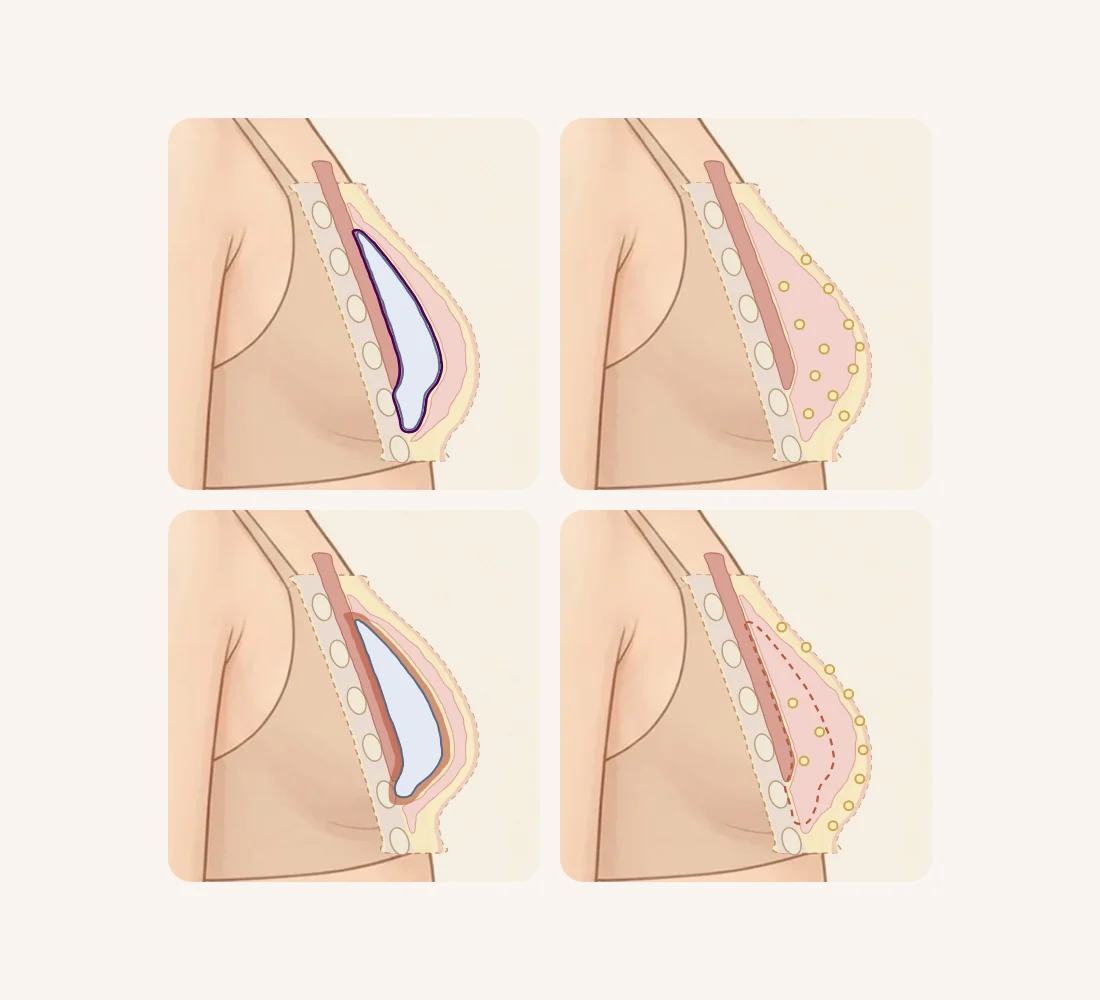
The breast is made of several layers. From the surface inward, there is skin, a layer of fat and the breast gland. Below these lie a thin sheet covering the chest muscle (the fascia), the chest muscle (pectoralis major), and the chest wall with the ribs. Implants are placed either beneath the breast gland or beneath the chest muscle.2
Wherever it is placed, the body wraps the implant in a thin fibrous layer called the capsule. This is the body's natural way of walling off something that came from outside. The figure below shows the implant first below the gland and then below the muscle.
Where an implant sits
Capsular contracture: when the capsule tightens
When the capsule thickens and tightens, the breast can become firm, change shape and hurt. This is called capsular contracture. It is the most common complication after implant surgery and a common reason for another operation. Reported rates range from 2.8% to 20.4% between studies.5 Out of 100 people, that means roughly 3 to 20, depending on the study.
Severity is usually described with the Baker grades:5
- Grade I: looks and feels natural, like a breast without surgery.
- Grade II: a surgeon can tell by touch, but there are no symptoms.
- Grade III: you can feel the firmness yourself.
- Grade IV: visibly severe, with symptoms.
Grades III and IV are the ones that need treatment.5
Capsular contracture: when the capsule tightens
The same review lists four factors linked to contracture. Two are a smooth surface (compared with textured) and placement below the gland (compared with below the muscle). The other two are silicone gel (compared with saline) and previous radiotherapy to the breast.5 Textured surfaces, however, are linked to BIA-ALCL (see below). So the surface cannot be chosen on contracture risk alone.2 The implant and its position are decided by weighing tissue thickness, the shape you want and each of these risks together.
What is established about implant safety?
Implants are not lifetime devices
The US Food and Drug Administration (FDA) is the agency that approves medicines and medical devices in the United States. After reviewing long-term data in 2011, it concluded that silicone gel implants have a reasonable assurance of safety and effectiveness when used as labeled. It also stated that local complications are frequent, and that the longer a woman has implants, the more likely complications become. It added that she will need to monitor her breasts for as long as she has them.1
In the manufacturers' long-term studies, 20-40% of augmentation patients and 40-70% of reconstruction patients had another operation in the first 8 to 10 years.1 For cosmetic augmentation, that is 2 to 4 in 10 people. "Reoperation" here includes minor procedures such as biopsies, and capsular contracture was the most common reason after augmentation.1 The FDA notes that routine replacement is not necessary, but that many women will need further surgery to modify, remove or replace their implants.1 So it is wise to plan from the start for the possibility of another operation someday.
The boxed warning and patient decision checklist
In 2020 the FDA recommended a boxed warning at the front of breast implant labeling. It says three things:2
- Breast implants are not considered lifetime devices; the chance of complications grows the longer you have them, and some will require more surgery.
- Implants are associated with BIA-ALCL, a cancer of the immune system.
- Some patients have reported a range of whole-body symptoms.
The accompanying patient decision checklist also notes that as many as 20% of women who receive implants for augmentation have them removed within 8 to 10 years.2 That is up to 1 in 5.
Since October 2021, US rules have tightened the sale of breast implants. The health care provider must review this checklist with each patient before surgery. The patient has the opportunity to initial and sign each part, and the implanting surgeon signs it too.3 It is a US regulation, but it is also a clear official list of what to understand before deciding, wherever you have surgery.
Rupture and regular imaging
A silicone gel implant can tear without any change in how the breast looks or feels. So a physical exam alone often cannot detect it. The FDA therefore recommends a first scan 5 to 6 years after surgery, even without symptoms, and then one every 2 to 3 years. The scan can be an ultrasound (which uses sound waves) or an MRI (a detailed scan that uses magnets). If you have symptoms or an unclear ultrasound result, MRI is recommended.2 Implants can also hide part of the breast on a mammogram, so always tell the screening staff that you have them.2 Here is what to check, and when, after silicone gel implants:
Living with silicone gel implants
- Before surgeryReview risks and alternatives on the checklist
- Years 5-6First ultrasound or MRI, even without symptoms
- Every 2-3 yearsImaging to look for silent rupture
- Any timeSwelling, a lump, pain or shape change: get checked
- If a problem appearsReplacement or removal, depending on the cause
BIA-ALCL: a rare lymphoma around the implant
Breast implant-associated anaplastic large cell lymphoma (BIA-ALCL) has a long name, but it simply means "a lymphoma linked to breast implants". It is not breast cancer. It is a lymphoma, a cancer of immune cells, usually found in the capsule and the fluid around the implant. An individual's risk is considered low. But it is serious and can be fatal if not treated promptly, which is why it appears in the boxed warning.2 It occurs more often with textured than with smooth implants, although patients with smooth implants have also been diagnosed.2
By June 30, 2024, the FDA had received 1,380 reports of BIA-ALCL. Where the implant surface was known, 1,010 were textured and 40 were smooth. That is, most reports with a known surface involved textured implants. The median (middle) time from the last implant to diagnosis was 8 years, ranging from 0 to 40 years. The most common first signs were fluid collecting around the implant (48%), breast swelling or pain (27%) and a lump (11%).4 These are report counts, not rates of how often it happens.4
BIA-ALCL reports to the FDA
Confirmed BIA-ALCL is treated by removing the implant together with the surrounding capsule. Chemotherapy or radiation is added for some patients, depending on the stage.2 So if one breast swells for no clear reason, or a lump appears years after surgery, have it examined rather than putting it down to an old implant.
Whole-body symptoms
Some patients with implants have reported joint pain, muscle aches, long-lasting tiredness, memory problems and other whole-body symptoms, sometimes called breast implant illness (BII). How these symptoms relate to implants is not yet clear, and individual risk has not been established.2 Some patients report improvement after their implants are removed without replacement, but not everyone improves.2
What should you know about fat grafting?
In fat grafting, harvested fat is processed and placed in small amounts throughout the breast tissue. In the systematic review above, the complication rate was 17.2%. Firm lumps of fat (induration) were the most common, followed by lasting pain and collections of blood (hematoma).6
Mammograms showed micro-calcifications in 9.0% and larger calcifications in 7.0%.6 Calcifications are tiny deposits of calcium that show up as white spots on a mammogram. The authors judged these findings comparable to implant augmentation. But the studies included were of limited quality, and the authors called for more research on cancer occurrence and detection.6
There are practical points too:
- You need enough fat to harvest, and the harvest site will bruise and swell as well.
- Because the share of fat that survives varies widely between people6, some need an additional session to reach the size they want.
- If you have had fat grafting, mention it at every future breast screening; it helps the radiologist interpret any calcifications.
At Bonita Clinic, we offer filling with your own fat and stem cells mainly as a way to restore volume after implants are removed. That route is explained in our guide to breast revision surgery.
How do you decide which approach fits?
The table below sets the two approaches side by side on five points. If more of your answers fall in the left column, implants may suit you better; if more fall on the right, fat grafting may. The final choice is made after an examination of your tissue.
| Consider | Leans toward implants | Leans toward fat grafting |
|---|---|---|
| The change you want | A defined size increase in one operation | A modest change or shape refinement |
| Fat to harvest | Too little body fat to transfer | Enough fat to transfer |
| Long-term care | You accept regular imaging and possible further surgery | You accept absorption and a possible extra session |
| What stays in the body | A device, and a capsule around it | No device, but calcification or firm areas are possible |
| Breast screening | Implants can hide part of the mammogram | Calcifications mean your history must be shared |
If you choose implants, look not only at size but at whether there is enough skin and breast tissue to cover it. Besides contracture and rupture, the local complications counted in the FDA's long-term studies include wrinkling, asymmetry, shifting of the implant, an implant that can be felt or seen, and sagging.1
Before surgery, ask about these choices and how each relates to the risks above:
- Type: silicone gel or saline
- Surface: smooth or textured
- Position: below the gland or below the muscle
- Incision: armpit, around the areola, or breast fold
What should you check before surgery?
The FDA checklist asks patients to confirm the following before deciding on implants.2
- You should not have implants if you have an active infection anywhere in the body or are pregnant or breastfeeding. The same applies to a breast cancer or pre-cancer (an early change that may become cancer) that has not been adequately treated
- The risk of a poor outcome is higher with conditions that affect healing (such as diabetes or connective tissue disease). Current or past smoking and steroids or other immune-suppressing medicines also raise it. So do past or planned chemotherapy or radiation, bleeding or clotting disorders, or reduced blood supply to the breast
- Some conditions have not been studied enough, including autoimmune disease or a family history of it. The same is true of mental health conditions such as depression, body dysmorphic disorder (being overly focused on small flaws in appearance) or eating disorders
- After surgery you receive a device card describing your implants; keep it, so any doctor years later can tell what you have
How we approach it at Bonita Clinic
At Bonita Clinic, we perform implant breast augmentation as surgery without general anesthesia; you go home the same day, and stitches are used. Recovery time and follow-up visits depend on the extent of surgery and your individual condition.
Breast augmentation options you can discuss in Seoul
Bonita Clinic opened in 1995 and has stayed at the same address since; Dr. Kwang-Seop Chung, a plastic surgeon board-certified in Brazil, sees patients himself. For breast surgery, the options discussed in consultation are:
- Implant augmentation through a small endoscopic incision in the armpit, around the areola or in the breast fold, without general anesthesia
- For existing implants: replacement with a new implant and treatment of the capsule, chosen according to the cause of the problem
- Removal of implants with restoration of volume using your own fat and stem cells
Which of these suits you, and in what order, is decided only after an examination.
Why do the plan and cost differ from person to person?
Two people asking for "breast augmentation" may need quite different operations. The scope of the work, not the name of the procedure, shapes the plan and the cost.
- Implant or your own fat
- Implant type and the size your tissue can support
- Incision site and endoscopic approach
- Anesthesia used
- Existing implants or earlier breast surgery
- Capsule work or fat transfer added
Final plan and quote after an in-person exam
A final estimate is given only after the in-person examination, once the method, the implant and the scope are clear. Photos can suggest a direction but cannot fix these choices.
What can photos show, and what needs an in-person exam?
Photos are a useful first step. But they cannot measure the tissue that will cover an implant, or show what is happening around an existing one.
Photos can show
- Overall size, shape and asymmetry
- Sagging and nipple position
- Existing scars and their location
- How the breasts changed over time
Needs an in-person exam
- Skin and breast tissue thickness
- Breast base width and tissue laxity
- Feel and position of any existing implant
- Firmness, lumps or fluid around an implant
- Imaging results and medical history
Helpful photos: front-on, both sides at 45 degrees and side views, standing with arms relaxed, in good light. If you already have implants, add your implant card or operative note, recent ultrasound or MRI reports, and a photo from before the change you are worried about. You can send us a message with your photos and questions.
Planning your visit and recovery
What is confirmed in advance is limited to the treatment information above: surgery without general anesthesia, same-day discharge and stitches. How long you should stay in Seoul, when the stitches come out and when you can return to work or exercise depend on the method and scope of surgery. These are planned with you at consultation.
Before you travel, gather your medical history, current medicines and any previous breast imaging. After surgery, keep your implant device card and the operative details with your records. The FDA screening schedule for silicone gel implants (first ultrasound or MRI at 5 to 6 years, then every 2 to 3 years) continues wherever you live.2 Any doctor who checks your implants later will need that information. If one breast swells, becomes red, hot or painful, or a lump appears at any point, see a doctor promptly.
Real treatment cases
These cases are from our safe breast augmentation page. Results vary from person to person.
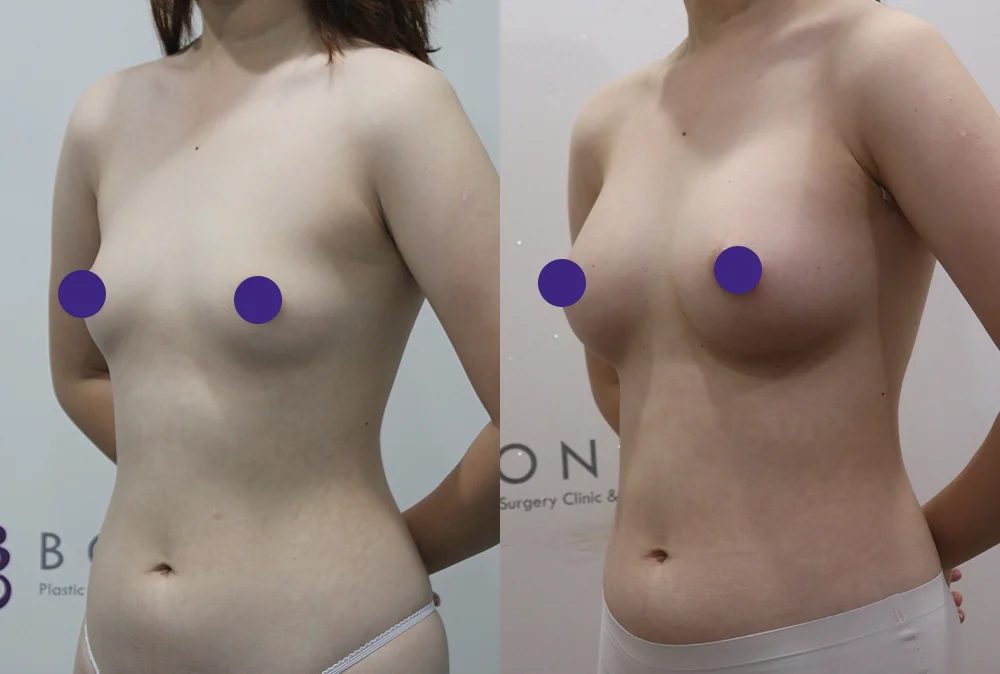
Small breast volume before surgery (angled view)
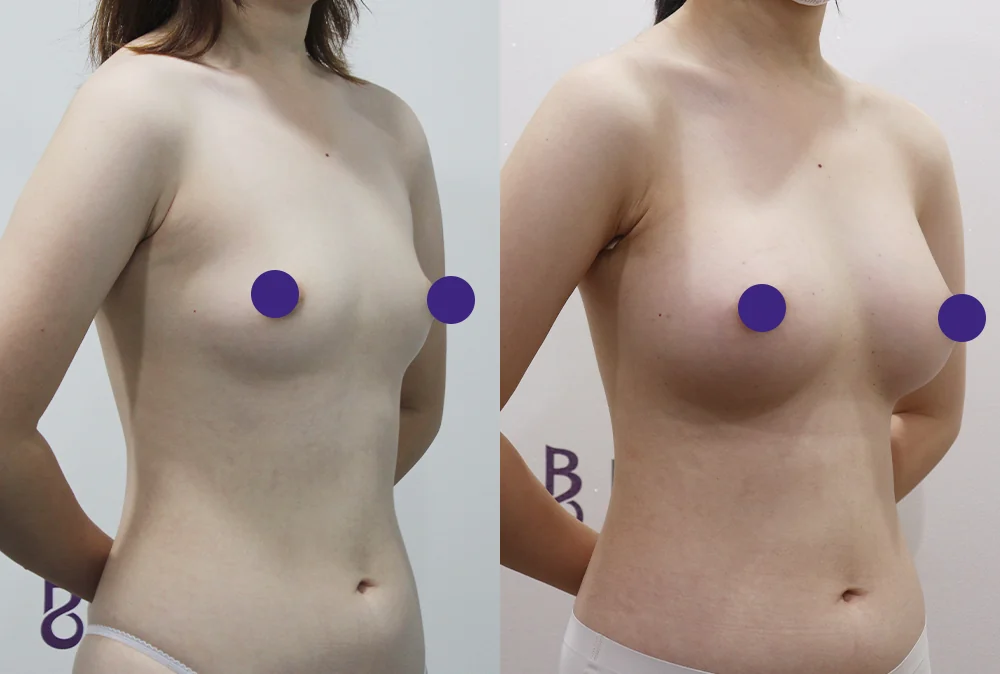
Small breast volume before surgery (near-side view)
* Results vary from person to person. Side effects are possible, so please decide after a thorough consultation with a doctor.
Frequently asked questions
Do implants have to be replaced every 10 years?
There is no fixed replacement date. The FDA says routine replacement is not necessary, while also stressing that implants are not lifetime devices and complications become more likely over time.1 So while nothing is wrong, the implants are monitored with regular imaging. If contracture, rupture or a change in shape appears, replacement or removal is considered according to the cause.
Can fat grafting alone give me the size I want?
For a modest increase it sometimes can, but part of the grafted fat is absorbed. In the research, about 62% of the volume remained on average, with wide variation.6 Depending on how much fat you have and the size you want, more than one session may be needed, so that possibility is planned from the start.
I have textured implants. What should I do about BIA-ALCL?
Start by finding out exactly which implants you have; your operative note or implant card helps. If one breast swells, a lump appears or there is pain years after surgery, get checked promptly.4 What to do when you have no symptoms is covered in our guide to breast revision surgery.
Do implants affect breastfeeding or breast cancer screening?
They can. The FDA checklist notes that implants and breast surgery may make breastfeeding harder, and that implants can interfere with mammography and delay a breast cancer diagnosis.2 Tell the staff about your implants at every screening; additional views or ultrasound may be used.
Where will the scar be?
It stays where the incision was made: the armpit, around the areola or in the breast fold. Bonita Clinic uses small endoscopic incisions and cares for the scar so that it fades over time.
What to prepare before your consultation
- The size and shape you want, and what you do not want (reference photos help)
- Any previous breast surgery or injections, with your implant card or operative notes
- Medical conditions, regular medicines and whether you smoke
- Recent breast imaging and any family history of breast cancer
- Plans for future pregnancy and breastfeeding
Bonita Clinic is on the 3rd floor of 565 Gangnam-daero, Seocho-gu, Seoul, about 100 m on foot from Exit 8 of Nonhyeon Station (Line 7). You can read more on our Safe Breast Augmentation page. If you are thinking about replacing or removing implants, see the Revision Breast Surgery page and our guide to breast revision surgery. For problems from fillers or other material injected into the breasts, see Breast Surgery Revision and the guide to breast injection and foreign material removal.
References (6)
Sources that support the explanations in this article. Study findings describe general trends and do not guarantee individual results.
- U.S. Food and Drug Administration, Center for Devices and Radiological Health. FDA Update on the Safety of Silicone Gel-Filled Breast Implants. U.S. FDA. 2011;June 2011.FDA safety review (2011): reasonable assurance of safety when used as labeled, local complications that increase with time, reoperation in 20-40% of augmentation and 40-70% of reconstruction patients in the first 8-10 years of the manufacturers' Core Studies, routine replacement not necessary but implants are not lifetime devices
- U.S. Food and Drug Administration. Breast Implants - Certain Labeling Recommendations to Improve Patient Communication: Guidance for Industry and Food and Drug Administration Staff. U.S. FDA. 2020;Final guidance, September 2020.FDA labeling guidance (2020): boxed warning content (not lifetime devices, BIA-ALCL, systemic symptoms), patient decision checklist items (who should not have implants, higher-risk conditions, up to 20% removed within 8-10 years), rupture screening for silicone gel implants (first ultrasound or MRI at 5-6 years, then every 2-3 years), effects on mammography and breastfeeding, the patient device card
- U.S. Food and Drug Administration. Breast Implant Surgery. U.S. FDA. 2023;Content current as of 03/08/2023.FDA page: the October 27, 2021 orders restricting sale and distribution so that the patient decision checklist is reviewed with each patient before surgery, with the patient able to initial and sign and the implanting physician signing
- U.S. Food and Drug Administration. Medical Device Reports of Breast Implant-Associated Anaplastic Large Cell Lymphoma. U.S. FDA. 2025;Data as of 06/30/2024; content current as of 02/06/2025.FDA medical device reports of BIA-ALCL: 1,380 reports, 1,010 textured vs 40 smooth where the surface was known, median 8 years from last implant to diagnosis (range 0-40), most common presentations (fluid collection 48%, swelling or pain 27%, lump 11%); report counts cannot give incidence
- Headon H, Kasem A, Mokbel K. Capsular Contracture after Breast Augmentation: An Update for Clinical Practice. Arch Plast Surg. 2015;42(5):532-543.doi:10.5999/aps.2015.42.5.532Review of capsular contracture: definition and Baker grades (treatment for grades III-IV), reported incidence of 2.8-20.4% across studies, associated factors (smooth surface, subglandular placement, silicone gel, radiotherapy), most common complication and reason for reoperation
- Groen JW, Negenborn VL, Twisk JW, et al. Autologous Fat Grafting in Cosmetic Breast Augmentation: A Systematic Review on Radiological Safety, Complications, Volume Retention, and Patient/Surgeon Satisfaction. Aesthet Surg J. 2016;36(9):993-1007.doi:10.1093/asj/sjw105Systematic review (abstract) of cosmetic breast fat grafting, 22 studies and 3,565 patients: mean volume retention 62.4% (44.7-82.6%), complication rate 17.2% with induration most common, micro- and macro-calcifications on mammography (9.0% and 7.0%), level of evidence 3
About this article
This article separates general medical information from Bonita Clinic's own approach. Because the right decision depends on each person's condition, it is not a substitute for a consultation.
