 KOKorean
 ENEnglish
 JP日本語
JP日本語 CN中文(简体)
 TW中文(繁體)

Eravity Laser in Seoul: What This 1064 nm Laser Can Do for Skin Firmness, and What the Evidence Shows
Eravity is a 1064 nm Nd:YAG laser that fires microsecond-length pulses in rapid succession. It is non-ablative: it leaves the skin surface intact and warms the dermis to encourage collagen remodeling. Research on the device itself is limited to one small study of under-eye wrinkles and dark circles. Studies of similar lasers describe changes in texture and firmness as subtle and gradual. It suits fine lines, rough texture and mild loss of firmness when you want little downtime; it is not a way to lift a sagging face. If you are considering treatment in Seoul, you can send photos of your skin first to see whether it fits your concern or whether another approach would suit you better.
What kind of device is Eravity?
The only peer-reviewed study (one checked by other experts before publication) describes Eravity as a 1064 nm Nd:YAG laser that delivers 650-microsecond (µs) pulses at 40 pulses per second.1 A microsecond is a millionth of a second, and a pulse is one short burst of light.
1064 nm is the standard wavelength of the Nd:YAG laser. It is absorbed relatively little by melanin, the pigment that gives skin its color, which is why it has been used across a wide range of skin types.2 The same wavelength is used in very different ways depending on pulse length and energy, so when reading research it matters which settings were used.
What is a non-ablative laser?
Eravity is a non-ablative laser, meaning it does not remove the epidermis (the outer layer of skin). Non-ablative lasers leave the surface intact and warm the dermis (the main body of the skin underneath), aiming to improve wrinkles and photoaging (skin aging caused by the sun).
It helps to think of lasers in three groups. Ablative lasers remove the surface; fractional lasers create microscopic columns of injury; non-ablative lasers leave the surface as it is. Non-ablative lasers produce smaller changes than the other two, but carry less downtime and risk.5
Lasers in three groups
How is it different from ultrasound lifting?
It works differently from ultrasound lifting such as Ulthera. Ultrasound lifting focuses sound waves at set depths beneath the skin, reaching the dermis and the SMAS. The SMAS is a thin layer that covers the facial muscles under the skin, the layer lifted in a facelift.6 Eravity uses light. We found no research showing that Eravity delivers heat as deep as the SMAS.
What happens inside the skin?
Light at 1064 nm is not strongly captured by melanin at the surface, so it passes into the dermis and turns into heat there.2 Heating the dermis is thought to start a process in which collagen (the protein fibers that support the skin) is rebuilt.
In a study of a similar microsecond 1064 nm Nd:YAG laser (300 µs), skin samples from nine people were examined under an electron microscope after three sessions. At one and three months, collagen fibers in the upper (papillary) dermis were thinner, a change that fits with new collagen being formed. Younger patients showed larger changes.3 In the same study, people who had facial redness beforehand saw it reduce.3
Where 1064 nm light becomes heat
What does research show, and what is still unknown?
Research on Eravity itself
So far there is one study of Eravity itself. Sixteen people with under-eye wrinkles and dark circles had five sessions one week apart, measured with a skin analyzer. Their wrinkle score fell from 4.15 to 3.32 by the last session, and was 3.71 one month later. It improved, then partly slipped back after a month. The dark-circle score also improved but partly returned toward baseline one month later.1
Six of the sixteen rated themselves greatly improved, while six reported no change or slight improvement.1 Apart from redness that settled within an hour, the researchers observed no other adverse effects.1
The Eravity study: under-eye, 16 people
That study had no control group (no comparison with untreated people), was small and single-center, and was funded by the device manufacturer. Its authors note that collagen changes were not confirmed in tissue and that there was no long-term follow-up.1 It also did not measure firmness or sagging directly.
Firmness and sagging: what similar lasers suggest
In 34 people who had at least seven sessions with a long-pulse 1064 nm Nd:YAG laser, physician ratings of laxity fell by 17.3% and coarse wrinkles by 11.9%. The authors described the improvements as subtle and gradual.2
A split-face study in 12 people compared one long-pulse 1064 nm laser session with one radiofrequency session on the two halves of the face. It found higher laxity improvement scores on the laser side. But the author concluded that larger controlled studies were needed.4 Because pulse length and energy in these studies differ from Eravity's, their results cannot simply be transferred to this device.
Which concerns does it suit, and when does another method fit better?
In short, a non-ablative 1064 nm laser like Eravity trades a small change for a light recovery, with results that build gradually over several sessions.25 It is worth considering for fine lines, rough texture and mild loss of firmness when you want to keep downtime low.
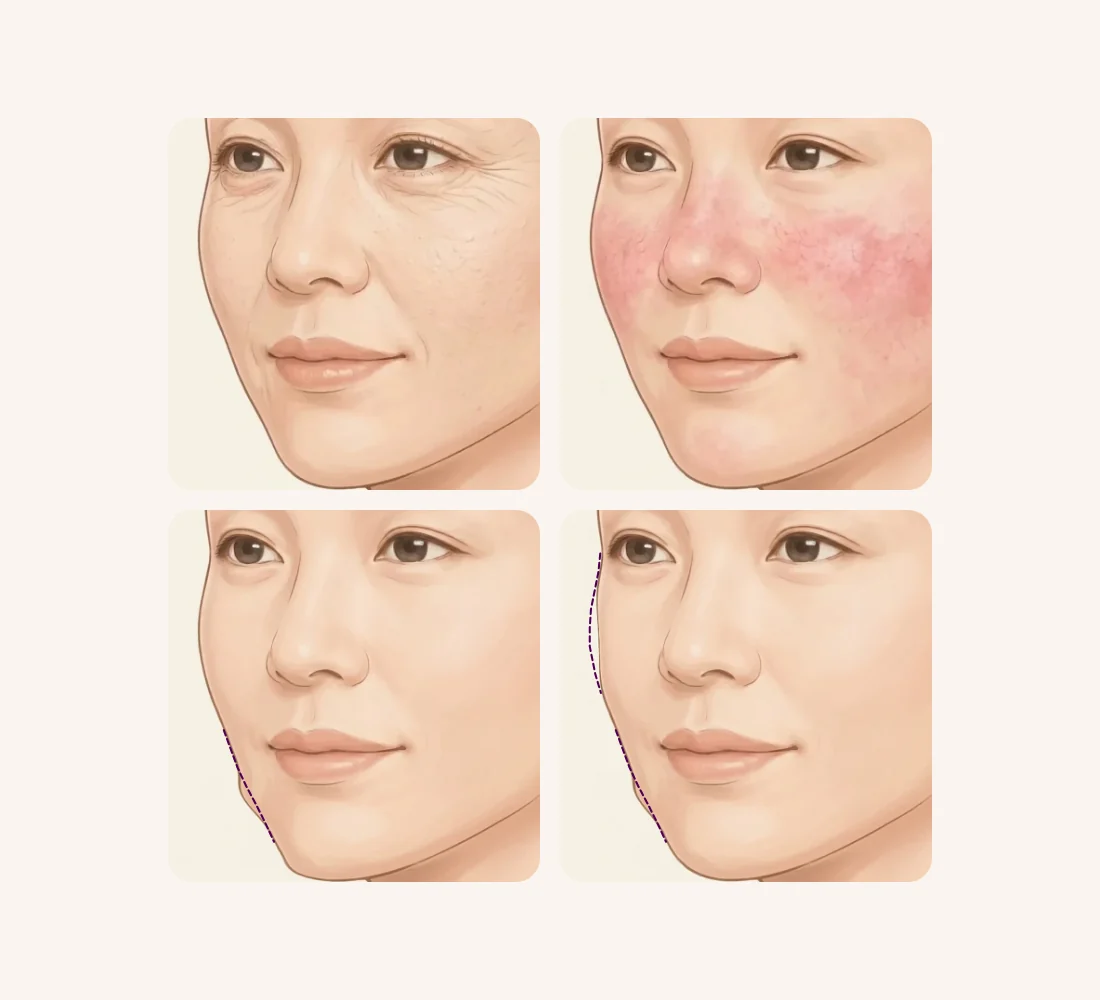
It is usually not the right tool for lifting a visibly sagging face, substantially changing deep wrinkles or depressed scars, or replacing lost volume.
What is considered first, by concern
1If it is fine lines or rough texture
Subtle change over several sessions; a fractional laser is also considered if there are scars
Eravity
2If the face is red and uneven
Less redness was reported with a similar laser; the cause of the redness is checked first
Find the cause first
3If the jawline or under-chin has sagged
Change with this laser may be small, so ultrasound lifting is considered as well
Ulthera (HIFU)
4If cheeks or forehead are hollow, or sagging is deep
A laser cannot restore volume, so fat grafting or a facelift is discussed
Fat grafting or facelift
If your skin tone is darker: 1064 nm is a wavelength with low melanin absorption, and it has been used across many skin tones.2 Pigment changes are still possible depending on the settings, so the strength is matched to your skin type.
Matching the method to the concern
| Method | Where it acts | Main concerns |
|---|---|---|
| Eravity (1064 nm laser) | Passes the epidermis, warms the dermis | Fine lines, texture, mild firmness |
| Ultrasound lifting (HIFU) | Focal points from dermis to SMAS | Mild sagging of brows and under the chin |
| Fractional laser | Microscopic columns of heat injury | Scars, texture, wrinkles |
| Fat grafting, facelift and similar | Volume and deeper layers directly | Volume loss, deep sagging |
What are the session, recovery and precautions like?
At Bonita Clinic, we perform Eravity as a non-surgical treatment after a numbing cream. You go home the same day, and there are no stitches. We advise that you can wash your face and wear makeup right after treatment, and that mild redness settles within a few hours. In the device study, redness settled within an hour.1 Depending on the device and intensity, redness, swelling or flaking can last a few days, and pigment changes occasionally occur.
The studies of similar lasers reported no serious side effects, but each involved no more than a few dozen people.123 Any heat-based treatment can react differently depending on settings and skin condition. That is why your recent treatments and any skin conditions need to be known first.
Aftercare advice:
- Use sunscreen when going outside.
- Avoid harsh cosmetics and scrubs for a week.
- Avoid saunas and other hot environments for a week.
- If there is redness or swelling, use a soothing anti-inflammatory product.
How long recovery takes, and whether follow-up visits are needed, depends on the area treated and on your skin.
How many sessions?
Bonita Clinic carries out one to three sessions as needed. The device study used five sessions a week apart, and the similar-laser study used seven or more.12 No study has compared how many sessions are enough, so it is realistic to decide while watching how your skin responds.
How we approach it at Bonita Clinic
Skin and lifting options you can discuss in Seoul
Dr. Kwang-Seop Chung, a plastic surgeon board-certified in Brazil, has seen patients himself at the same Bonita Clinic location since it opened in 1995. For skin quality and firmness, the options discussed at consultation are the devices and procedures we actually use:
- Eravity, the 1064 nm laser described here, for fine lines, texture and mild loss of firmness
- Ulthera focused ultrasound when mild sagging of the brows, jawline or under the chin is the main concern
- Other lasers and a radiofrequency device among our equipment, chosen by whether firmness, pigment, redness or texture comes first
- Multi-lifting or a facelift consultation when fat, lost volume or deep sagging is part of the cause
Which device or combination fits is decided after your skin has been examined.
Why does the plan and cost differ from person to person?
Two people asking about "Eravity for firmness" can end up with different plans. The number of sessions, the area treated and whether other devices are combined all change what is involved.
- Area treated: full face, under-eye, neck
- Number of sessions, one to three
- Settings for your skin type
- Whether other devices are combined
- Recent treatments that change timing
- Your main goal: firmness, texture, redness
Final plan and quote after seeing you in person
A final estimate is given after your skin has been examined in person, once the number of sessions and any combination with other treatments are clear.
What can photos show, and what needs an in-person exam?
Photos help to judge whether your main concern is texture and fine lines, redness, pigment or sagging, which is the first step in deciding whether Eravity is worth discussing. They cannot set the device settings.
Photos can show
- Fine lines and visible texture
- Redness and its spread
- Visible spots and uneven tone
- Sagging versus hollowing, roughly
Needs an in-person exam
- Skin type and sensitivity
- Active acne or inflammation
- How lax the skin feels
- Pigment type under proper light
- Recent treatments and skin products
Helpful photos: your face front-on and from both sides, in daylight or even indoor light, without makeup or filters, plus close-ups of the areas that bother you. You can send us a message with your photos and a list of recent laser, lifting or filler treatments.
Planning your visit around the treatment
What is confirmed in advance is the treatment information above. It is a non-surgical treatment under numbing cream, you go home the same day and there are no stitches. As we advise, face washing and makeup are possible straight after. Whether one session or a series is planned, and how far apart the sessions should be, is decided with you at consultation. This is because we watch changes over two to four weeks after a session.
When planning a trip, keep in mind that sun protection is needed afterwards, and that saunas, hot environments and harsh skin products should be avoided for a week. Changes develop gradually, so the result is usually judged after you are back home. Dated photos taken from the same angles in similar light make comparison easier. If redness, swelling or darker patches persist after you return, contact us or see a local doctor.
Frequently asked questions
How is Eravity different from Ulthera?
Ulthera focuses ultrasound at set depths beneath the skin, creating small heated points in the dermis and the SMAS.6 Eravity is a laser that warms the dermis with 1064 nm light.1 Ulthera is aimed more at mild sagging of the brows and under the chin. Non-ablative lasers like Eravity are aimed more at the quality of the skin itself, such as fine lines and texture. The two are sometimes planned together.
Will one session firm up my skin?
A clear change after a single session is unlikely. With similar lasers, improvement appeared gradually over several sessions,2 and the device study reported results after five sessions.1 Bonita Clinic watches the changes for two to four weeks after a session and splits treatment into one to three sessions if needed.
Can it lift a sagging jawline or smooth deep wrinkles?
Non-ablative lasers belong to the group with smaller changes and lower risk.5 Even in studies of similar lasers, improvement in sagging and coarse wrinkles was modest.2 For a sagging jawline, consider Ulthera; if volume has been lost or the sagging is deep, methods such as Multi Lifting or a facelift are worth discussing.
Does it hurt, and will I need time off?
Bonita Clinic applies a numbing cream before treatment and advises that you can wash your face and wear makeup right afterwards. In the device study, treatment was done without anesthesia and redness settled within an hour.1 Depending on your skin and the intensity, redness or flaking can last a few days.
Can I have it if my skin is darker?
1064 nm is a wavelength that melanin absorbs relatively little, and in a study of a similar laser it was used on skin types I to V.2 Skin type groups skin by how easily it burns or tans; higher numbers mean darker skin. Pigment changes can still occasionally occur, so settings are matched to your skin type and sun protection afterwards is essential.
What to prepare before your consultation
- Your main concern: firmness, fine lines, texture, redness or pigment, and which comes first
- Laser, lifting or filler treatments in the past six months, with dates
- Whether you use retinoids or medicines that make your skin sun-sensitive
- Whether you have had lasting redness or dark marks after earlier treatments
- Upcoming events such as a wedding or business trip, so the timing can be planned around them
Bonita Clinic is on the 3rd floor of 565 Gangnam-daero, Seocho-gu, Seoul, about 100 m on foot from Exit 8 of Nonhyeon Station (Line 7). You can read more on our Eravity page. For deeper lifting with ultrasound, see Ulthera and the guide to Ulthera lifting; for a fractional laser aimed at texture, fine lines and pores, see Ultra Clear.
References (6)
Sources that support the explanations in this article. Study findings describe general trends and do not guarantee individual results.
- Yang YS, Ha JH, Song BH, et al. Nonsurgical lower eyelid rejuvenation using a novel 1064-nm Nd:YAG laser with a 650-microsecond pulse duration. Lasers Med Sci. 2025;40(1):432.doi:10.1007/s10103-025-04682-7The only study of the device itself (full text): it describes Eravity (Innomed) as a 1064 nm Nd:YAG laser with 650 µs pulses at 40 Hz; 16 people with under-eye wrinkles and dark circles, five weekly sessions; analyzer wrinkle score fell from 4.15 to 3.32 at the last session and was 3.71 one month later; dark-circle score improved; six rated satisfaction 0 or 1; only transient redness resolving within an hour; no control group, single center, funded by the manufacturer, no tissue analysis or long-term follow-up
- Dayan SH, Vartanian AJ, Menaker G, Mobley SR, Dayan AN. Nonablative laser resurfacing using the long-pulse (1064-nm) Nd:YAG laser. Arch Facial Plast Surg. 2003;5(4):310-315.doi:10.1001/archfaci.5.4.310Study of a similar laser (long-pulse 1064 nm Nd:YAG, abstract): 34 patients with at least seven sessions; physician-rated laxity down 17.3% and coarse wrinkles down 11.9%, improvements described as subtle and gradual; melanin is targeted less, so it was used across skin types I–V; no adverse events
- Schmults CD, Phelps R, Goldberg DJ. Nonablative facial remodeling: erythema reduction and histologic evidence of new collagen formation using a 300-microsecond 1064-nm Nd:YAG laser. Arch Dermatol. 2004;140(11):1373-1376.doi:10.1001/archderm.140.11.1373Study of a similar laser (300 µs 1064 nm Nd:YAG, abstract): electron microscopy in 9 patients after three sessions showed thinner collagen fibers in the upper dermis, consistent with new collagen, with larger changes in younger patients; redness improved; no adverse events
- Key DJ. Single-treatment skin tightening by radiofrequency and long-pulsed, 1064-nm Nd: YAG laser compared. Lasers Surg Med. 2007;39(2):169-175.doi:10.1002/lsm.20414Split-face study of 12 patients (abstract): one long-pulse 1064 nm laser session versus one radiofrequency session for laxity (overall improvement score 47.5% vs 29.8%); the author calls for larger controlled studies
- Alexiades-Armenakas MR, Dover JS, Arndt KA. The spectrum of laser skin resurfacing: nonablative, fractional, and ablative laser resurfacing. J Am Acad Dermatol. 2008;58(5):719-737.doi:10.1016/j.jaad.2008.01.003Review (abstract): non-ablative lasers heat the dermis while leaving the epidermis intact, giving smaller changes than fractional or ablative resurfacing but with lower risk
- Fabi SG. Noninvasive skin tightening: focus on new ultrasound techniques. Clin Cosmet Investig Dermatol. 2015;8:47-52.doi:10.2147/CCID.S69118For comparison (review, full text): ultrasound lifting (HIFU) is a different technology that focuses energy in the dermis and the tissue beneath it, including the SMAS
About this article
This article separates general medical information from Bonita Clinic's own approach. Because the right decision depends on each person's condition, it is not a substitute for a consultation.
