 KOKorean
 ENEnglish
 JP日本語
JP日本語 CN中文(简体)
 TW中文(繁體)

UltraClear Laser in Seoul: Which Skin Concerns It Suits and How Long Recovery Takes
UltraClear is an ablative fractional laser: it makes a dense grid of very thin channels in the skin. It uses a 2,910 nm wavelength that is strongly absorbed by water in the skin. It is mainly used for sun-related changes such as fine lines, rough texture and dull pigment, and for depressed acne scars. In studies, redness after the light shallow mode lasted a day or two, while the deep mode that reaches the dermis needed about three to seven days. The device studies are still small and mostly in lighter skin, so if you have melasma or darken easily, intensity and spacing need extra care. Wondering whether it fits your skin? You can send us photos and your treatment history before planning a visit to Seoul.
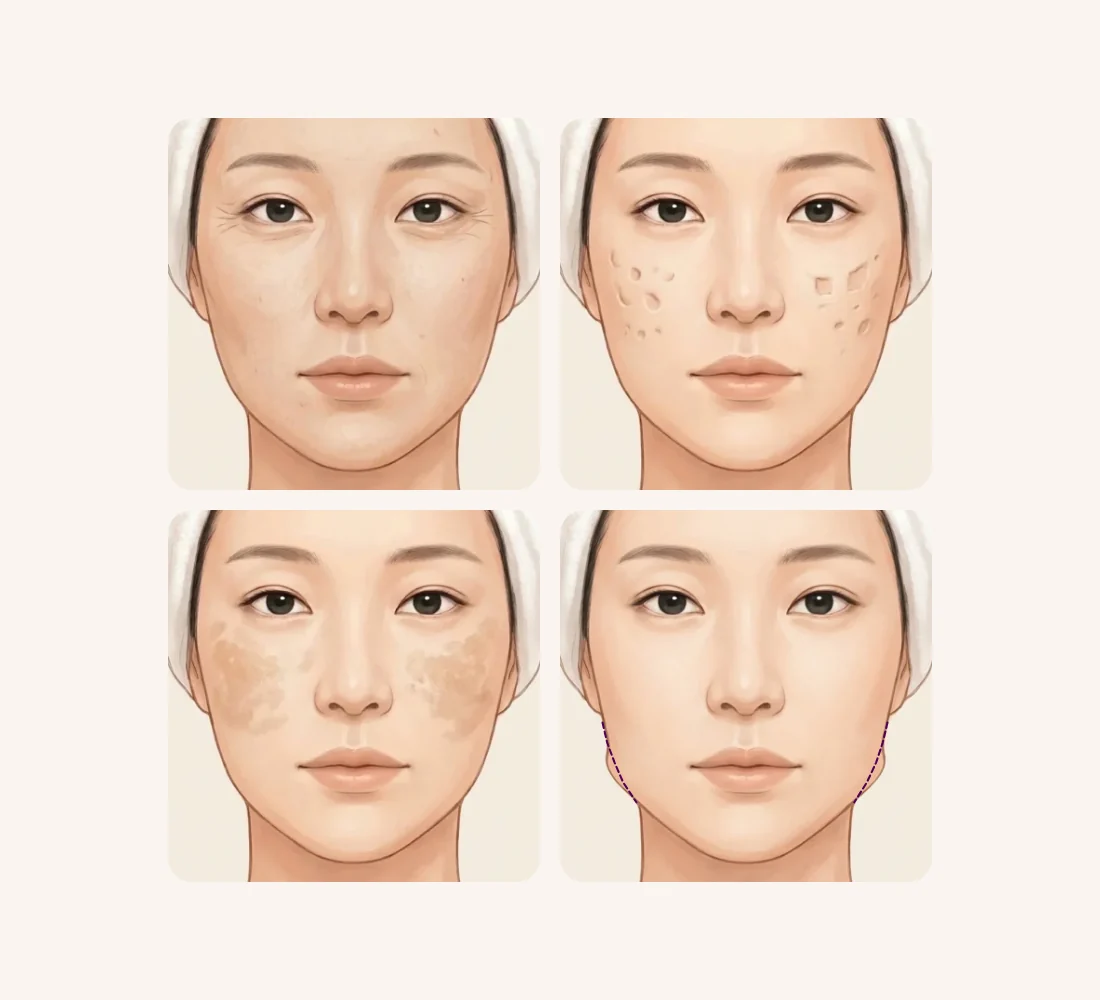
What kind of laser is UltraClear?
UltraClear is an ablative fractional laser made by Acclaro Medical in the United States. The name sounds technical, but the idea is simple:
- Ablative means the light actually removes a very thin amount of skin tissue.
- Fractional means it does not treat the whole surface at once. Instead, very thin beams make tiny channels close together, and the skin between them is left untouched.
Each UltraClear channel is roughly 170 µm wide, or 0.17 mm (1 µm is a thousandth of a millimeter).1 The untouched skin acts as a base for healing, from which collagen (the protein fibers that keep skin firm) and elastic fibers are rebuilt. This is the basic idea behind every fractional laser. Compared with older lasers that resurfaced the entire face, recovery is lighter and the risk of side effects lower, but results usually come from several sessions rather than one.1
How UltraClear is applied
What is different about 2,910 nm?
A laser's wavelength decides which part of the skin absorbs it most easily. At 2,910 nm, UltraClear sits in the range where water in the skin absorbs light most strongly (2,900-3,100 nm). So tissue can be removed while leaving less heat behind in the surrounding skin.3
In the studies, the band of heat damage around each channel was narrower than with a CO2 laser, which spreads heat widely. The authors link this to the shorter redness and recovery they observed.14 The light travels through an optical fiber and can pulse (fire in short bursts) up to 5,000 times per second. This lets one device do anything from a light polish of the outermost layer of skin to thin channels deep in the dermis.14
Fine channels, healing from the skin between
What it is cleared for, and a common misunderstanding about "lifting"
The U.S. FDA (Food and Drug Administration) has cleared UltraClear for skin resurfacing, among other uses. These include treating wrinkles and fine lines, uneven texture, scars including acne scars, and benign pigmented lesions.6 A clearance defines what a device may be used for; it does not tell you how large a result will be.
UltraClear is closer to a skin-renewal laser that changes surface quality than to a lifting device that raises sagging tissue. One study did score skin laxity, but laxity improved less than wrinkles, pigment and texture.1
How do light polishing and deep channels differ?
The settings published in studies fall into a few depth ranges:2
- Shallow mode: removes 10-30 µm of the outermost layer, a gentle peel aimed at rough texture and dullness.
- Middle setting: removes 40-70 µm of the epidermis (the outer skin layer) to reach fine lines and shallow scars.
- Deep mode: makes thin channels 100-1,500 µm into the dermis (the main body of the skin under the epidermis), where collagen in deeper lines and scars is remodeled.2
Doctors often combine the two in one session. They may polish the whole face lightly while going deeper only where damage is greatest, such as around the mouth or on the cheeks.12
Modes that differ by depth
Going deeper can bring more change, but redness, swelling, pinpoint bleeding and recovery time grow with it. Even on the same device, the choice of mode, density and number of sessions effectively makes it a different treatment.
What changes with the mode
| Approach | Depth | Typical concern | Recovery in studies | Recovery burden (relative) |
|---|---|---|---|---|
| Shallow mode | about 10-30 µm | Texture, dullness | Redness 1-2 days | |
| Deep mode | about 100-1,500 µm | Lines, acne scars | Redness 3-5 days | |
| Both combined | Epidermis and dermis | Advanced sun damage | 5-7 days incl. crusting |
Which concerns may it suit?
How well this laser fits, and what to check first, depends on the concern. The cards below group what the studies and our treatment information say by concern.
What is checked first, by concern
1If it is fine lines, rough texture or dullness
The shallow mode is considered first; studies reported improvement after just two sessions
Shallow mode
2If you have depressed acne scars
The deep mode reaches the dermis; red scars may get a vascular laser first
Deep mode
3If melasma is suspected
It can darken after fractional laser, so melasma is diagnosed first
Diagnosis first
4If sagging is the main concern
Laxity scored lowest with this laser, so a firming device is planned separately
Combine with lifting
| Concern | What studies found | What to keep in mind |
|---|---|---|
| Fine lines, rough texture, dullness | Improvement on blinded photo review after just two shallow sessions3 | Smaller change than deeper treatment |
| Advanced sun damage | Wrinkles, pigment and texture all rated as improved after three face-and-neck sessions1 | 5-7 days of recovery each time; several sessions |
| Depressed acne scars | Improvement on blinded photo review after three deep-mode sessions4 | 13 participants, lighter skin types only |
| Sagging (laxity) | Scored, but improved less than other features1 | A lifting device may need to be planned separately |
| Melasma | No study found that used this device mainly for melasma | Fractional lasers can darken melasma, so diagnosis comes first5 |
"Blinded photo review" in the table means the reviewers did not know which photo was taken before and which after treatment. This keeps their expectations from affecting the scores.
Some researchers describe treating redness in acne scars with a vascular laser first and then following with this laser.4 Scar shape and depth often call for other treatments first. If acne scars are your main concern, our guide to acne scars that have not improved with laser is worth reading as well.
How strong is the evidence?
UltraClear is one of the devices that has been studied by name in peer-reviewed journals (journals in which other experts check a study before it is published). The results need to be read together with how the studies were designed.
| Study | Participants | Treatment | Main findings |
|---|---|---|---|
| Mild sun damage3 | 20, skin types I-IV | Two shallow sessions, 2 months apart | About 25% average improvement on blinded photo review; pain 1.9 out of 10 |
| Sun damage pilot2 | 37 (35 completed), types II-III | Up to four shallow sessions, or one deep session | Both rated "improved" on average; no scarring or pigment change |
| Advanced sun damage1 | 22 (15 completed), types I-IV | Three deep-plus-shallow sessions to face and neck, 6-8 weeks apart | Blinded average score 3.2 on a 0-4 scale; temporary darkening in 2 people |
| Acne scars4 | 14 (13 completed), types II-III | Three deep-mode sessions | Improvement on blinded photo review; no scarring or pigment change |
"Skin type" in the table groups skin by how easily it burns or tans in the sun. The higher the number, the darker the skin and the more easily it tends to form pigment.
All four studies compared before-and-after photos without a control group (people who had no treatment or a different one), and none had more than a few dozen participants. In three of them, the manufacturer funded the work or lent the device, or one of the authors advised or worked for the company.123
Most participants had skin types I-III, and only a handful had type IV. Data for the skin types most common in East Asia are still limited. So these figures show what the device can do in study conditions; they are not a forecast for any one person.
What should you watch for if your skin darkens easily?
A review of fractional laser treatment in Asian patients names two main problems. One is post-inflammatory hyperpigmentation (brown darkening where inflammation has been). The other is rebound worsening of melasma (melasma becoming darker after treatment). The review concludes that more sessions at lower density, spaced further apart, lower that risk without giving up much of the benefit.5
Lower density, more sessions
In the UltraClear studies, two people developed temporary darkening. One was after sun exposure and an allergic reaction to an ointment; the other was melasma, not recognized before treatment, that flared in type IV skin. Both settled with time.1 This is why melasma is looked for before treatment, and why strict sun protection matters afterwards.
If you get cold sores, say so in advance. Resurfacing can trigger an outbreak, and preventive antiviral medicine was given in the study as well.1
What are the treatment day and recovery like?
At Bonita Clinic, we perform UltraClear as a non-surgical procedure with numbing cream; you go home the same day and there are no stitches. Recovery time and follow-up visits vary with the extent of treatment and your individual condition.
Discomfort depends on intensity. With the shallow mode and no numbing, the average pain score was 1.9 out of 10;3 when deep mode was included, scores were around 4 to 5.21
Recovery after treatment
- Treatment dayRedness and heat; pinpoint bleeding with deep mode
- Days 1-2Redness from shallow mode usually settles
- Days 3-7Redness, swelling and light crusts from deep mode clear
- Around week 2Inflammation inside the skin settles
- Month 3When studies assessed results
Our aftercare advice:
- Apply sunscreen thoroughly whenever you go outside.
- Avoid harsh cosmetics and scrubs for one week.
- Use plenty of moisturizer to keep the skin hydrated.
- Skip hot baths and saunas, and wash with lukewarm water.
Contact us promptly if redness gets worse instead of fading, if the skin oozes or forms pus, or if blisters appear around the lips.
How we approach it at Bonita Clinic
Treatment options you can discuss in Seoul
Bonita Clinic has been at the same address since 1995, and Dr. Kwang-Seop Chung, a plastic surgeon board-certified in Brazil, sees patients himself. For skin texture, fine lines, pigment and scarring, the devices described on our pages include:
- UltraClear (2,910 nm fractional laser) in shallow, deep or combined modes
- Sculpio, a dual-wavelength picosecond laser
- Mediostar, which we use for firmness and contour
- Ulthera (HIFU) for the deeper SMAS layer, Eravity (a 1064 nm Nd:YAG laser) and 10THERMA (radiofrequency)
Device descriptions reflect general use; which of them you need, and in what order, is decided after your skin is examined.
Why does the plan and cost differ from person to person?
Two people asking for "UltraClear" can need very different treatments. The cost follows the plan, and the plan follows your skin.
- Main concern: texture, lines, pigment or acne scars
- Area: face only, or face and neck
- Shallow mode, deep mode, or both
- Number of sessions and spacing
- Skin type and risk of pigmentation
- Combination with other devices
Final plan and quote after an in-person skin exam
A final quote is given after the in-person exam, once the mode, area and number of sessions are clear. Photos can point in a direction but cannot fix the plan.
What can photos show, and what needs an in-person exam?
Photos are a useful first step for understanding your concern. They cannot show everything a laser plan depends on.
Photos can show
- Overall texture and visible fine lines
- Where pigment and redness are spread
- The outline of acne scars in good light
- How your skin reacted to past lasers
Needs an in-person exam
- Whether the pigment includes melasma
- Scar depth and type under side lighting
- Skin thickness and sensitivity
- Active acne or inflammation
- How much is sagging rather than texture
Helpful photos are taken front-on and from both sides at 45 degrees, in daylight, without makeup. If you have had lasers before, photos from before and after those treatments show how your skin tends to react. You can send us a message with your photos and a short history of past treatments.
Planning your visit and recovery
What is confirmed in advance is limited to the treatment information above: a non-surgical procedure with numbing cream, going home the same day and no stitches. In the published studies, redness from the shallow mode lasted one to two days and deep treatment needed about three to seven days. Your own course depends on the settings chosen.21
Studies spaced repeat sessions four weeks to two months apart.213 A plan that needs several sessions therefore means either returning to Seoul or choosing a gentler, single-session approach. How many visits make sense for you is decided together at consultation, based on your skin and schedule.
After you return home, keep up sun protection and gentle skin care, and avoid other lasers or peels on the treated area unless a doctor advises them. If redness, oozing or blisters develop, see a local doctor and keep dated photos; they help any doctor who sees you later, including at follow-up.
Frequently asked questions
Can I go back to work or wear makeup right away?
It depends on intensity. In studies, redness after the shallow mode lasted a day or two on average, and after the deep mode three to five days. After deep multi-pass treatment of the whole face, redness and light crusting lasted about five to seven days.21 If you have photos, a presentation or other important plans, tell us at consultation.
How many sessions will I need?
That depends on the goal and the intensity. Studies used two to four shallow sessions or one to three deep sessions, spaced four weeks to two months apart.213 Treatment may be a single session or several, and we explain the recommended number and interval in advance.
Can I have it if I have melasma?
Having melasma does not rule out every treatment. But the review of Asian patients lists rebound melasma as a key complication of fractional lasers, and limits fractional treatment of melasma to selected cases with non-ablative devices used cautiously.5 We therefore check whether melasma is present first, and decide whether to use this laser, and how strongly, after the exam.
How is it different from a CO2 fractional laser?
Both are ablative fractional lasers; the difference is the wavelength and how far heat spreads. A CO2 laser spreads heat widely and leaves a thick coagulated rim (a thin layer "cooked" by heat). A 2,940 nm erbium laser is absorbed far more strongly by water and leaves little heat. UltraClear's 2,910 nm wavelength is also strongly absorbed by water, and the amount of coagulation can be adjusted.1
Researchers reported less pain and downtime than with conventional fractional ablative lasers,1 but we could not find a study comparing the two side by side in the same people. With any device, depth, density and spacing shape both recovery and the risk of pigmentation.5
Does it hurt a lot?
With the shallow mode and no numbing, the average was about 1.9 out of 10;3 when the deep mode was included, scores were around 4 to 5.12 Bonita Clinic applies numbing cream before treatment.
What to prepare before your consultation
- What you most want to change (fine lines, texture, pigment, acne scars, sagging) and in what order
- Whether you have been diagnosed with melasma, or have darkened after a laser before
- Recent lasers, fillers or other treatments and their dates, and any retinoids you use (creams or oral isotretinoin)
- Whether you get cold sores, and whether your scars tend to thicken (keloids)
- How many days of redness you can accept, and any dates you need to avoid
Bonita Clinic is on the 3rd floor of 565 Gangnam-daero, Seocho-gu, Seoul, about 100 m on foot from Exit 8 of Nonhyeon Station (Line 7). More about the treatment is on our UltraClear page. If firmness and contour are your main concern, see the Mediostar page and the Mediostar guide. For a picosecond laser that works on both texture and pigment, see the Sculpio guide, and for a laser that heats deeper skin for firmness, see the Eravity guide.
References (6)
Sources that support the explanations in this article. Study findings describe general trends and do not guarantee individual results.
- Murray TN, Hu JK, Friedman PM. Full-face and neck resurfacing with a novel ablative fractional 2910 nm erbium-doped fluoride glass fiber laser for advanced photoaging. Lasers Surg Med. 2024;56(3):249-256.doi:10.1002/lsm.23764UltraClear study (22 enrolled, 15 completed, skin types I-IV): three face-and-neck sessions, blinded review, pain 4.9/10, 5-7 days of recovery, temporary darkening in two people (one melasma flare), antiviral prophylaxis, heat-damage comparison with CO2 and erbium lasers; funded by the manufacturer with an advisory relationship
- Selim MM, Lowery JA, Maredia HS, Zelickson BD. Clinical evaluation of a new fractional ablative 2910 nm erbium laser on photodamaged skin: A pilot study. Lasers Surg Med. 2023;55(8):715-723.doi:10.1002/lsm.23714Mode depths (shallow 10-30 µm, epidermal 40-70 µm, deep 100-1,500 µm) and comparison of repeated shallow sessions with one deep session (redness 1.7 vs 4.4 days on average); pain about 4/10; skin types II-III only; unblinded rating; manufacturer support
- Bernstein EF, Sanzo JF, Wang JY, et al. Low-fluence treatment with a novel fractionated 2,910-nm fiber laser improves photodamage. Lasers Surg Med. 2023;55(1):35-45.doi:10.1002/lsm.23624Two shallow sessions (20 people, skin types I-IV): about 25% improvement on blinded photo review, pain 1.9/10, water absorption peak at 2,900-3,100 nm, dermal inflammation back to baseline by two weeks on biopsy; first author is a company officer and shareholder
- Bernstein E, Alajmi A, Wang J, et al. The 2910-nm Fiber Laser Is Safe and Effective for Improving Acne Scarring. Lasers Surg Med. 2024;56(9):755-761.doi:10.1002/lsm.23845Acne scars (14 enrolled, 13 completed, skin types II-III): three deep-mode sessions, improvement on blinded review, no scarring or pigment change, 5,000 Hz pulsing and a narrow heat-damage zone, vascular laser first for red scars; no data in darker skin
- Wat H, Wu DC, Chan HH. Fractional resurfacing in the Asian patient: Current state of the art. Lasers Surg Med. 2017;49(1):45-59.doi:10.1002/lsm.22579Review (abstract): main complications of fractional lasers in Asian skin are post-inflammatory hyperpigmentation and rebound melasma; lower density, more sessions and wider intervals lower the risk; melasma only in selected cases with non-ablative devices
- U.S. Food and Drug Administration. 510(k) Premarket Notification K233803: UltraClear. FDA 510(k) database. 2024.U.S. FDA clearance: resurfacing, wrinkles and fine lines, uneven texture, scars including acne scars and benign pigmented lesions, among others (Indications for Use)
About this article
This article separates general medical information from Bonita Clinic's own approach. Because the right decision depends on each person's condition, it is not a substitute for a consultation.
