 KOKorean
 ENEnglish
 JP日本語
JP日本語 CN中文(简体)
 TW中文(繁體)

Sculpio Picosecond Laser in Seoul: Can It Refine Texture, Pores and Tone Without Resurfacing?
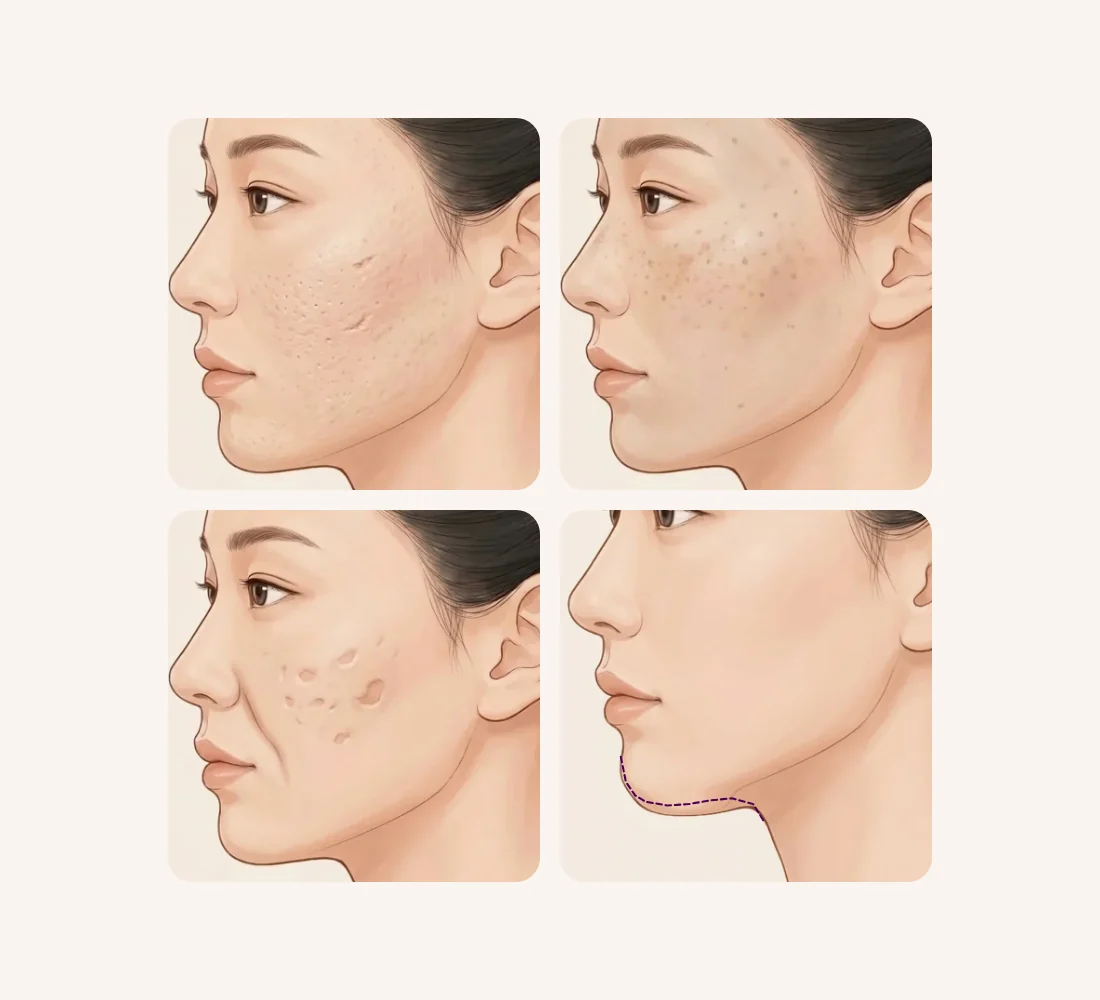
Sculpio is a picosecond laser that emits 1064 nm and 532 nm light. It uses a lens that splits the beam into fine points. These create tiny cavities inside the dermis, known as LIOB, without removing the skin surface, and the skin's repair response does the rest. In studies of similar devices, texture, pores and shallow acne scars improved gradually over several sessions. Preliminary results suggest 532 nm may do more for pigment, and redness usually settled within one to three days. We could not find studies of Sculpio itself, and changes in fine lines and sagging were small, so it is more realistic to expect gradual change built over a series. Not sure whether it fits your concern? Send us your photos before planning your visit to Seoul.
What is Sculpio?
Sculpio is a skin laser that uses two wavelengths. The unit shown on our treatment page is made by LASEROPTEK, a Korean manufacturer. According to the manufacturer's product information, it is a picosecond Nd:YAG laser emitting at 1064 nm and 532 nm. It is used with handpieces whose diffractive lens splits the beam into many fine points. At Bonita Clinic, we use it for skin renewal, tone, fine lines and pores, and texture together.
What do "picosecond" and "diffractive lens" mean?
A picosecond is a trillionth of a second. Sculpio fires pulses (short bursts of light) this short. Very short pulses leave less heat in the surrounding tissue but create a sharp pressure effect. This is why picosecond lasers were first used to break up tattoo ink and pigment.2
Once lenses that split the beam came into use, the same lasers were applied to skin renewal and scars. A systematic review (a study that gathers earlier studies by a set method and looks at them again) looked at picosecond laser studies. It rated the evidence as level II for skin renewal, II to III for scars, II for melasma and I for tattoo removal.1 A lower level number means the evidence comes from a more reliable kind of study.
One point to be clear about first
We could not find any peer-reviewed study (a study checked by other experts before publication) published under the name "Sculpio". The studies cited here used an earlier picosecond laser from the same company with a similar split-beam lens, or other devices of the same type. Because lenses and output differ between devices, their results cannot be transferred to Sculpio one-to-one.
How can it work in the dermis without removing the skin surface?
The diffractive lens divides the laser beam into dozens of fine beamlets. Like a magnifying glass focusing sunlight on one spot, each beamlet concentrates its energy, and a microscopic cavity forms for an instant inside the skin. This is called laser-induced optical breakdown, or LIOB.
Under the microscope, LIOB appears as tiny cavities within the dermis, without damage to the outermost layer of skin or to the junction between the epidermis and dermis.2 That is the key difference from resurfacing lasers, which open channels through the skin surface.
This small, controlled injury is thought to trigger repair, increasing collagen (the protein fibers that support the skin) and elastic fibers. In an animal skin experiment, new collagen and elastic fibers built up from one to four weeks after treatment.3 In human acne scar tissue, more collagen and elastic fibers were found four weeks after treatment.4 When our treatment page says the collagen response continues beyond four weeks, it refers to this repair process.
Working in the dermis without removing the surface
How do the two wavelengths differ?
- 1064 nm goes deeper into the skin.
- 532 nm goes less deep but is absorbed more strongly by pigment (melanin, which gives skin its color).3
The depth at which LIOB forms depends on energy, the lens and how much pigment the skin has. With more pigment and higher energy, more cavities form closer to the surface.3 This is why darker skin calls for lower energy, and why we at Bonita Clinic adjust depth to skin thickness and condition.
Two wavelengths and the depth of LIOB
Which concerns may it help, and by how much?
Several studies of similar devices have been done in Korean patients.
| Study | Participants | Treatment | Main findings |
|---|---|---|---|
| Split-beam 1064 nm, wrinkles and acne scars2 | 22 Korean adults | Three sessions, 3 weeks apart | About 35% improvement on blinded photo review; 3D measures of wrinkle depth, texture and pores improved; elasticity readings rose about 9-11% |
| 532 nm versus 1064 nm, split face3 | 8 Korean women, skin types III-IV | One session | Similar gains in texture and pores; pigment improved more with 532 nm; fine lines and laxity improved less than "mild" |
| Acne scars, low versus high energy4 | 25 people | Three sessions, 4 weeks apart | Fewer scars on both sides with similar effect; more pain and side effects with high energy |
| Wide-beam 1064 nm picosecond ("toning"), sun-related pigment5 | 47 Korean adults | Six sessions, every 2 weeks | Pigment severity and melanin index decreased; no serious side effects |
Some terms in the table: in a "blinded photo review", the reviewers do not know which photo was taken before and which after treatment. A "split-face" study gives the left and right sides of the same face different treatments and compares them. "Skin type" groups skin by how easily it burns or tans; higher numbers mean darker skin.
What studies saw, concern by concern
To sum up, changes in texture, pores and shallow acne scars were measured gradually over several sessions, and preliminary results suggest 532 nm may do more for pigment.23 Visible change in fine lines or sagging after a single session is unlikely.3
Our treatment page mentions people who want several concerns addressed at once. According to the studies, it is more accurate to say that several concerns can be treated together, with change building up session by session.
Stronger is not automatically better
In the acne scar study, lower energy worked about as well as higher energy, with less pain and fewer side effects.4 All of these studies were small, though, and they either had no control group or a short follow-up (the split-face study followed patients for two weeks after one session).23
When are other treatments considered as well?
Depending on what you most want to change, Sculpio may be the main treatment or play a supporting role.
By what you most want to change
1If it is texture, pores or shallow scars
Repeated dermal sessions with the split-beam lens; studies used three, 3-4 weeks apart
Sculpio as the main step
2If it is dullness and spots
Wavelength and strength are set for pigment, after checking whether it is melasma
Pigment check first
3If it is deep scars or marked lines
A resurfacing fractional laser may be considered as well; recovery is longer
With a resurfacing laser
4If it is sagging and contour
Sculpio alone does little here, so lifting devices are planned with it
With HIFU or radiofrequency
Deep scars and marked wrinkles sometimes call for a fractional resurfacing laser that opens microscopic channels in the skin surface. Recovery is longer, and the differences are explained in our UltraClear guide. If a sagging jawline is your main concern, Sculpio on its own is unlikely to change much. A combination with HIFU, radiofrequency or a firmness and contour laser is then discussed at consultation.
What are the treatment day and recovery like?
At Bonita Clinic, we perform Sculpio as a non-surgical procedure with numbing cream. You go home the same day, there are no stitches, and you can wash your face on the day of treatment. How long recovery takes, and whether you need follow-up visits, depends on how much is treated and on your own skin.
Reactions reported in studies:
| Reaction | How common | When and how long |
|---|---|---|
| Redness, warmth | Almost everyone23 | Usually settles within 1-3 days |
| Itching | Around 70-80%2 | Starts on day 2-3 and lasts about two days |
| Pinpoint bleeding marks | About 60%2 | Fade within a few days |
| Small pimples | Some people2 | Settle within a few days |
| Darkening | None in the 22-person study;2 one of 8 in the split-face study3 | Improved after two months with sun protection alone |
Reactions over the first days
Itching and pinpoint bleeding are reported more often with this type of laser than with other non-ablative lasers.2
Afterwards:
- Use sunscreen whenever you go out.
- Avoid harsh cosmetics and scrubs for a week.
- Moisturize well.
- Skip hot baths and saunas, and wash with lukewarm water.
Let us know if redness has not settled after a week, or if the skin starts to ooze.
What should you watch for if your skin darkens easily?
In the split-face study, the one person who developed darkening had type IV skin. It appeared as patchy pigment along the jawline on the side treated with 532 nm. The authors thought the handpiece tip had not fully touched the skin at the edge of the face, which made the focus shallower. They advised lower energy for darker skin.3 Angled areas such as under the chin and along the jawline need particular care.
Picosecond lasers have also been studied for melasma, with level II evidence.1 But melasma is planned differently from other spots, so the type of pigment is identified at the exam first.
How we approach it at Bonita Clinic
Treatment options you can discuss in Seoul
Since 1995 Bonita Clinic has worked from one location, and Dr. Kwang-Seop Chung, a plastic surgeon board-certified in Brazil, sees patients in person. For texture, pores, tone and shallow scars, the devices on our pages include:
- Sculpio, a dual-wavelength picosecond laser used with a split-beam lens
- UltraClear, a 2,910 nm fractional laser that resurfaces the skin when deeper change is needed
- Mediostar, which we use for firmness and contour
- Ulthera (HIFU), Eravity (a 1064 nm Nd:YAG laser) and 10THERMA (radiofrequency) for laxity
Which of these suit you, and in what order, is decided after your skin is examined.
Why does the plan and cost differ from person to person?
"Pico laser" can mean very different plans: a few sessions focused on texture, a longer series for pigment, or a combination with other devices. The cost follows that plan.
- Main concern: texture, pores, tone or acne scars
- Which wavelength and handpiece are used
- Area treated
- Number of sessions and spacing
- Skin tone and how easily it darkens
- Combination with other devices
Final plan and quote after an in-person skin exam
A final quote is given after the in-person exam, once the wavelength, number of sessions and any combination are settled. Photos help narrow down the options, but the plan is only set in person.
What can photos show, and what needs an in-person exam?
Photos help us understand what bothers you. Some of what decides a picosecond laser plan, especially the type of pigment and how your skin reacts, needs to be seen in person.
Photos can show
- Visible pores and roughness
- Spots and uneven tone
- Where acne scars are
- Results of past pico or toning sessions
Needs an in-person exam
- What kind of pigment it is (melasma or not)
- How easily your skin darkens
- Thin skin over the jawline and bone edges
- Active acne, rash or irritation
- Scar depth under side lighting
Take photos front-on and from both sides at 45 degrees in daylight, without makeup or filters. If you have had pico, toning or other laser treatments, photos from before and after them are useful. You can send us a message with your photos and treatment history.
Planning your visit and recovery
What is confirmed in advance is limited to the treatment information above. It is a non-surgical procedure with numbing cream, you go home the same day, there are no stitches, and face washing is allowed on the day. In studies, redness usually settled within one to three days, while itching or pinpoint marks could last a few days more.23
Most of the change in the studies came after repeated sessions three to four weeks apart.24 If you can visit only once, discuss at consultation what a single session can realistically offer, or whether a series spread over several visits suits your plans better. The number of visits is decided together, based on your skin and your schedule.
Back home, keep up daily sun protection and gentle skin care, and avoid other lasers or peels on the treated area unless a doctor advises them. If dark patches appear, see a dermatologist and keep dated photos; they help anyone who assesses your skin later.
Frequently asked questions
Is this the same as pico toning?
The same picosecond laser can do both, but the approach and purpose differ. Toning uses a wide, gentle beam without a lens and mainly targets pigment; in the study cited here it was repeated every two weeks for six sessions.5 The split-beam lens creates LIOB in the dermis to work on texture and scars.2 The LIOB described on our Sculpio page is the second approach; how the two are combined depends on your skin.
How many sessions, and how far apart?
Studies assessed results after three sessions three or four weeks apart, and scores improved with each session.24 A single session produced smaller changes.3 We explain the recommended number and interval for your goal in advance.
Can I go back to normal life right away?
Mostly, yes. You can wash your face the same day, and in studies redness and warmth usually settled within one to three days.23 Itching may start on day two or three, and pinpoint marks can last a few days,2 so tell us at consultation if you have important plans.
Will it lift sagging skin?
Expectations should stay modest. In the split-face study, laxity improved less than "mild" after one session.3 In another study, elasticity readings rose about 9-11% after three sessions, but that does not mean a visible lift.2 If sagging is your main concern, a combination with other devices is planned.
What to prepare before your consultation
- What you most want to change (texture, pores, spots, acne scars, fine lines) and in what order
- Whether you have been diagnosed with melasma, or have darkened after a laser before
- Recent lasers, fillers, thread lifts or other treatments and their dates
- Retinoids (creams or oral isotretinoin) and steroids you use
- Any plans in the days after treatment that you need to keep
Bonita Clinic is on the 3rd floor of 565 Gangnam-daero, Seocho-gu, Seoul, around 100 m from Exit 8 of Nonhyeon Station on Line 7. Details of the treatment are on our Sculpio page. For a laser that resurfaces the skin, see the UltraClear page and the UltraClear guide. For firmness and contour, see the Mediostar guide, and for a laser that heats deeper skin for firmness, see the Eravity guide.
References (5)
Sources that support the explanations in this article. Study findings describe general trends and do not guarantee individual results.
- Wu DC, Goldman MP, Wat H, Chan HHL. A Systematic Review of Picosecond Laser in Dermatology: Evidence and Recommendations. Lasers Surg Med. 2021;53(1):9-49.doi:10.1002/lsm.23244Systematic review (abstract) of 77 picosecond laser studies graded by level of evidence: rejuvenation II, melasma II, scars II-III, benign pigmented lesions I-IV, tattoos I
- Lee CH, Jin EM, Seo HS, et al. Efficacy and Safety of Treatment with Fractional 1,064-nm Picosecond Laser with Diffractive Optic Element for Wrinkles and Acne Scars: A Clinical Study. Ann Dermatol. 2021;33(3):254-262.doi:10.5021/ad.2021.33.3.254Earlier device from the same maker (PicoLO, split-beam 1064 nm) in 22 Korean adults, three sessions: about 35% improvement on blinded review, gains in 3D and elasticity measures, LIOB on histology, redness for 1-3 days, itching and pinpoint bleeding; no control group
- Han HS, Hong JK, Park SJ, et al. A Randomized, Prospective, Split-Face Pilot Study to Evaluate the Safety and Efficacy of 532-nm and 1,064-nm Picosecond-Domain Neodymium:Yttrium-Aluminum-Garnet Lasers Using a Diffractive Optical Element for Non-Ablative Skin Rejuvenation: Clinical and Histological Evaluation. Ann Dermatol. 2023;35(1):23-31.doi:10.5021/ad.22.070Split-face pilot of 532 nm and 1064 nm split-beam picosecond lasers (8 Korean women, one session, two-week follow-up): similar texture and pore gains, more pigment improvement with 532 nm, little change in lines and laxity, darkening in one type IV patient, shallower LIOB with more pigment and higher energy; dermal LIOB and collagen formation over 1-4 weeks in animal skin
- Lee SH, Kim DH, Jo SJ, et al. The efficacy and safety of low- versus high-fluence fractional picosecond Nd:YAG 1064-nm laser in the treatment of acne scars: A randomized split-face comparison study. Photodermatol Photoimmunol Photomed. 2024;40(1):e12922.doi:10.1111/phpp.12922Split-face trial (abstract) in 25 people with acne scars, three sessions 4 weeks apart: low energy as effective as high energy with less pain and fewer side effects; more collagen and elastic fibers four weeks after treatment
- Kim YJ, Suh HY, Choi ME, et al. Clinical improvement of photoaging-associated facial hyperpigmentation in Korean skin with a picosecond 1064-nm neodymium-doped yttrium aluminum garnet laser. Lasers Med Sci. 2020;35(7):1599-1606.doi:10.1007/s10103-020-03008-zWide-beam 1064 nm picosecond laser (toning approach) in 47 Korean adults, six sessions every two weeks (abstract): pigment indices decreased, no serious side effects
About this article
This article separates general medical information from Bonita Clinic's own approach. Because the right decision depends on each person's condition, it is not a substitute for a consultation.
