 KOKorean
 ENEnglish
 JP日本語
JP日本語 CN中文(简体)
 TW中文(繁體)

Mediostar Laser Lifting in Seoul: How Much Can It Help a Sagging Jawline?
Mediostar is a diode laser originally cleared for hair removal and for treating vascular and pigmented lesions. It is also used for firmness, by delivering heat deep into the skin while cooling the surface. In a study of an earlier model from the same family, firmness readings and physician ratings improved after four sessions three weeks apart. But the evidence amounts to roughly one 30-person study, and repeated treatment was needed to keep the effect. It is more realistic to think of it as non-surgical upkeep for mild sagging; when sagging is marked, deeper-acting devices or other approaches should be discussed as well. If you are unsure which approach fits your face, you can send us photos before planning your visit to Seoul.
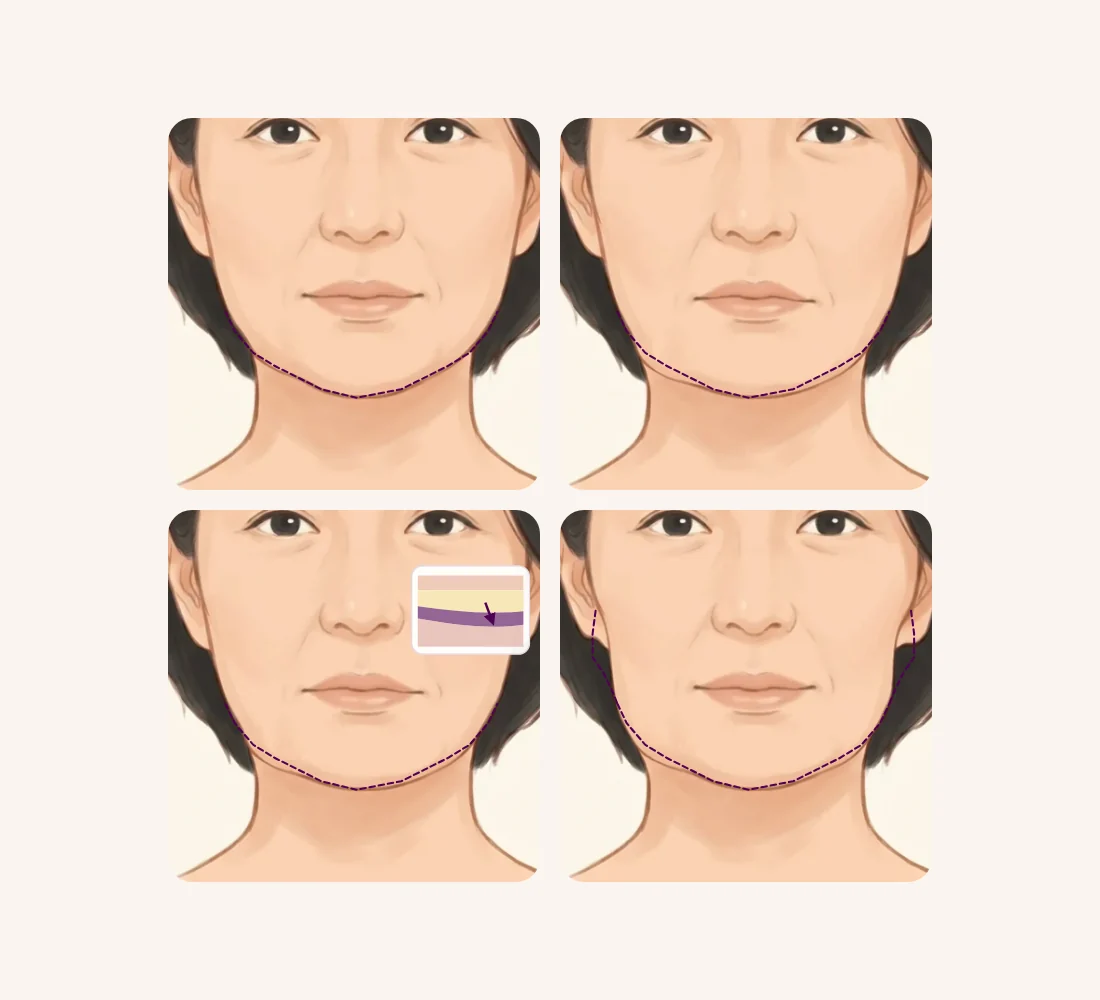
What kind of device is Mediostar?
Mediostar (MeDioStar) is a diode laser made by Asclepion, a German company. The model we use at Bonita Clinic is the "sixth-generation MeDioStar Monolith". It has two handpieces (the parts held against the skin) and cools the skin surface on contact. We use it for firmness and facial contour, the purpose usually called "laser lifting".
How MeDioStar is used
What was it originally cleared for?
It is worth knowing what the device was designed for. According to its U.S. FDA (Food and Drug Administration) clearance, MeDioStar is a pulsed diode laser emitting 755-1,060 nm light. It is cleared for hair removal and hair reduction, and for treating benign vascular and benign pigmented lesions.1
Skin tightening or lifting is not among those cleared uses. Using a device outside its cleared indications is not wrong in itself, but the evidence for that use has to be looked at separately.
Multi-wavelength diode lasers were first designed to target hair follicles precisely. Because they can deliver heat deep into the skin while cooling the surface, they have also become popular in Korea for facial contouring. A commentary on this practice points out that there is still no standard treatment protocol, and no agreed endpoint that says when to stop.5
How is a laser meant to change the line of the face?
The basic idea is simple: deliver heat deep into the skin, and protect the surface with cooling.5 Whether that heat turns into firmer skin has been measured with a skin elasticity meter in one study.2
Cool the surface, heat the depth
It works differently from surgery, though. Surgery removes loose skin or moves tissue into a new position. Mediostar aims to improve the skin's own firmness a little at a time. So the change is modest, and upkeep is needed over time.2
At Bonita Clinic, we treat the whole face with broad, even passes and use focused passes on sagging areas such as the jawline and cheeks.
Why do results differ from person to person?
Skin-tightening devices are known for inconsistent results. Age, degree of laxity, smoking, ethnicity, body mass index (weight relative to height) and pain tolerance may all affect the response. But which of these matters most has not been established.4 That is why the same device and settings can give different results in different people.
What do studies show, and what is still unknown?
| Study | Participants | Treatment | Findings |
|---|---|---|---|
| 810 and 940 nm diode laser (earlier model, MeDioStar NeXT), facial laxity2 | 30 people with laxity grade II-IV | Four sessions, 3 weeks apart | Firmness readings improved at 1 and 3 months after treatment; physician laxity scores improved at 1 and 6 months; about 10% had mild pain or minor side effects; upkeep needed to maintain the effect |
| 810 nm diode laser, wrinkles around the eyes3 | 10 people | Three sessions, 1 month apart | Slight improvement in texture and wrinkles at 3 months, maintained to a lesser degree at 8 months |
The 30-person study above is the only peer-reviewed study (a study checked by other experts before publication) we found of this device family for facial sagging. And it used an earlier model, not the Monolith now in use. According to its abstract, the authors concluded cautiously that the diode laser "may be effective" for facial skin tightening, and added that maintenance treatment is needed.2
We found no study confirming, with this device, the smaller pores mentioned on our treatment page. A separate study of an 810 nm diode laser for wrinkles around the eyes reported small changes in texture, but it involved only ten people.3
What you can expect
- Measurable firmness change in mild sagging
- Slightly smoother skin texture
- A non-surgical treatment with no time off
- Upkeep through repeated sessions
What is unlikely
- Results like surgery that removes loose skin
- A single session with lasting results
- Repositioning of marked jowls or cheek sag
- Studies showing smaller pores
When does Mediostar fit, and when does something else come first?
If mild sagging has started and you prefer a non-surgical option that lets you carry on with your day, Mediostar is an option to consider. It suits people who are comfortable with repeated sessions to maintain the result.
If the jowls or cheeks have clearly dropped, or the skin is very loose, a laser alone can only do so much. Bonita Clinic combines devices according to skin thickness and the cause of sagging, and sets the order to match.
What is considered first, by type of sagging
1If mild sagging has just started
Considered as non-surgical upkeep that lets you carry on with your day; repeat sessions are needed
Mediostar
2If the cheeks and jowls have clearly dropped
A laser alone does little, so a combination of devices and their order is planned
Device combination
3If sagging starts deeper than the skin
An ultrasound (HIFU) device that targets deeper layers is considered
Ulthera (HIFU)
4If fat, sagging and hollows occur together
Multi-lifting, which combines several methods, is discussed
Multi-lifting
When sagging starts in deeper layers, a device such as Ulthera (HIFU) that targets deeper tissue is considered. When fat, sagging and hollowing occur together, approaches such as multi-lifting are discussed.
What should be checked for safety?
Please tell us before treatment if any of the following applies to you.
Tell us before treatment
- Around the eyes: these wavelengths penetrate deeply, and the light can be seen even with the eyes closed. Eye injuries have been reported during cosmetic laser treatment, so eye protection is essential near the eyes.5
- Bruised areas after injections: burns have been reported when energy was absorbed by blood pooled under the skin. Tell us if bruising from recent fillers or injections remains.5
- Areas with fillers or thread lifts: how laser heat affects fillers or threads has not been studied enough.5
- Thin areas over the cheekbones and jaw: when energy reaches deep, pain may be felt from the thin lining around the bone (periosteum).5
- Facial hair: the wavelengths were developed for hair removal, so hair in the treated area may thin. Conversely, a pooled analysis of hair-removal studies found that about 3% of people developed more or coarser hair (paradoxical hair growth), mostly on the face and neck.6 Whether this applies to lifting settings is not known.
What are the treatment day and recovery like?
At Bonita Clinic, we perform Mediostar as a non-surgical procedure with numbing cream; you go home the same day and there are no stitches. We advise that temporary redness and warmth usually settle within one to two days. The length of recovery and the number of follow-up visits differ with the treated area and your condition. In the study, about 10% of participants reported mild pain or minor side effects.2
Treatment schedule and when change was measured
- Treatment dayRedness and warmth
- Days 1-2Redness and warmth usually settle (clinic guidance)
- 4 sessions, 3 weeks apartSchedule used in the study
- 1-3 months afterSkin firmness readings improved
- Month 6Physician ratings improved; upkeep needed
Afterwards, use sunscreen when going out and moisturize well. Blisters, or redness and pain lasting more than a few days, can signal a burn. If that happens, contact us promptly.
How we approach it at Bonita Clinic
Treatment options you can discuss in Seoul
Bonita Clinic opened in 1995 and has stayed at the same location, where Dr. Kwang-Seop Chung, a plastic surgeon board-certified in Brazil, examines patients himself. For sagging and loss of firmness, the options described on our pages include:
- Mediostar, a diode laser used for firmness and contour
- Ulthera (HIFU) reaching the SMAS layer, 10THERMA (radiofrequency) and Eravity (a 1064 nm Nd:YAG laser)
- UltraClear or Sculpio when skin texture and fine lines are part of the concern
- Surgical options such as multi-lifting and facelift when sagging is marked
Which of these suits you depends on how loose the skin is and where the sagging starts, which is judged at the examination.
Why does the plan and cost differ from person to person?
Two people asking for "laser lifting" may need very different plans: a few Mediostar sessions, a combination with HIFU or radiofrequency, or a different approach altogether. The cost follows the plan.
- How much sagging, and in which layer
- Areas: whole face, jawline, cheeks
- Number of sessions and upkeep
- Combination with HIFU, RF or other lasers
- Skin type, facial hair, recent injections
- Numbing cream
Final plan and quote after an in-person exam
A final quote is given after the in-person exam, once the areas, number of sessions and any combination are settled. Photos can suggest a direction but cannot fix the plan.
What can photos show, and what needs an in-person exam?
Photos help us see your contour and how it has changed. How loose the skin is, and in which layer the sagging starts, needs to be judged in person.
Photos can show
- Jawline and cheek contour from the front and side
- How sagging changed over the years (older photos)
- Visible texture and fine lines
- Facial hair you would want to keep
Needs an in-person exam
- Skin thickness and how loose it is
- Whether sagging starts in deeper layers
- Fillers, threads or bruising in the area
- Skin type and response to heat
- Thin areas over the cheekbones and jaw
Useful photos show your face from the front, from both sides at 45 degrees and in profile, with a relaxed expression and hair pulled back. Older photos from a few years ago show how your contour has changed. You can send us a message with your photos and a list of recent treatments.
Planning your visit and recovery
What is confirmed in advance is limited to the treatment information above. It is a non-surgical procedure with numbing cream, you go home the same day and there are no stitches. As we advise, redness and warmth usually settle within a day or two.
In the study, results came from four sessions three weeks apart, and upkeep was needed to maintain them.2 A single session during a short stay is therefore unlikely to match those results. At consultation we discuss what one session can realistically offer, whether a series over repeated visits fits your plans, or whether another approach suits your goal better.
After you return home, protect your skin from the sun and avoid other heat-based treatments on the same area unless a doctor advises them. If you notice blisters, lasting pain or changes in facial hair, see a local doctor and keep dated photos to share at follow-up.
Frequently asked questions
How is it different from ultrasound lifting such as Ulthera?
They use different energy and aim at different depths. Among the devices we use, Ulthera is ultrasound (HIFU) lifting that reaches the SMAS layer (a thin sheet that covers the facial muscles under the skin). Mediostar is a diode laser that heats the skin while cooling its surface. We found no study comparing the two side by side in the same people. Depending on which layer the sagging starts in, one is chosen or both are planned together. Ultrasound lifting is covered in our Ulthera guide.
How often do I need it?
The study used four sessions three weeks apart and reported that repeated treatment is needed to maintain the effect.2 Bonita Clinic also advises that firmness lasts longer with regular care, and the recommended number and interval are explained in advance based on your skin.
Is it painful, and will I swell?
Numbing cream is applied, and redness and warmth may last a day or two afterwards. Over thin areas such as the cheekbones and jaw, deep heat can feel more uncomfortable.5
I have had fillers or a thread lift. Can I still have it?
How laser heat affects fillers or threads has not been studied enough.5 Tell us what you had, where and when, and the treatment area and timing will be judged accordingly.
Is it the same device as a hair-removal laser?
It belongs to the same family: hair removal and hair reduction are among MeDioStar's cleared uses in the U.S.1 Hair in the treated area may therefore thin, and in rare cases hair-removal treatment on the face and neck has been followed by more hair growth.6 If changes to beard or facial hair would bother you, mention it at consultation.
What to prepare before your consultation
- Which area bothers you most (jawline, cheeks, neck) and when it started to change
- Dates and areas of recent fillers, botulinum toxin, thread lifts or fat grafting
- Any bruising left from recent injections
- Whether changes to facial hair would be acceptable, and any past laser hair removal
- How much change you hope for, and how much time you can give to upkeep
Bonita Clinic is on the 3rd floor of 565 Gangnam-daero, Seocho-gu, Seoul, a walk of about 100 m from Exit 8 of Nonhyeon Station (Line 7). More about the treatment is on our Mediostar page. For a fractional laser that treats texture and fine lines, see the UltraClear guide; for a picosecond laser that leaves the surface intact, see the Sculpio guide.
References (6)
Sources that support the explanations in this article. Study findings describe general trends and do not guarantee individual results.
- U.S. Food and Drug Administration. 510(k) Premarket Notification K240816: MeDioStar. FDA 510(k) database. 2024.U.S. FDA clearance: pulsed diode laser, 755-1,060 nm, contact handpiece; cleared for hair removal and hair reduction, benign vascular lesions and benign pigmented lesions (skin tightening or lifting is not among them)
- Voravutinon N, Seawthaweesin K, Bureethan A, et al. Efficacy of diode laser (810 and 940 nm) for facial skin tightening. J Cosmet Dermatol. 2015;14(4):e7-e14.doi:10.1111/jocd.12165Earlier model MeDioStar NeXT (810 and 940 nm) in 30 people with facial laxity, four sessions three weeks apart (abstract): firmness readings improved at 1 and 3 months, physician ratings at 1 and 6 months, about 10% minor pain or side effects, maintenance needed; the only peer-reviewed study of this device family for sagging that we found
- Levy JL, Trelles M, Servant JJ, Agopian L. Non-ablative skin remodeling: an 8-month clinical and 3D in vivo profilometric study with an 810 nm diode laser. J Cosmet Laser Ther. 2004;6(1):11-15.doi:10.1080/14764170410030750810 nm diode laser for wrinkles around the eyes in 10 people, three monthly sessions (abstract): slight improvement in texture and wrinkles at 3 months, less at 8 months; shows how small the evidence for texture change is
- Northington M. Patient selection for skin-tightening procedures. J Cosmet Dermatol. 2014;13(3):208-211.doi:10.1111/jocd.12106Review (abstract): non-surgical skin-tightening devices, including infrared devices, give inconsistent results; age, laxity, smoking, ethnicity, BMI and pain tolerance may affect response, but the most important factors are not established
- Yi KH, Oh W, Kim HM, Park HJ. Is multiple wavelength diode laser for facial contouring safe?. J Cosmet Dermatol. 2024;23(5):1588-1591.doi:10.1111/jocd.16198Commentary on multi-wavelength diode lasers used for facial contouring in Korea: originally designed for hair removal, deep heating with surface cooling, no standard protocol or endpoint, eye injury risk, burns over bruises, periosteal pain, unknown interaction with fillers and threads
- Snast I, Kaftory R, Lapidoth M, Levi A. Paradoxical Hypertrichosis Associated with Laser and Light Therapy for Hair Removal: A Systematic Review and Meta-analysis. Am J Clin Dermatol. 2021;22(5):615-624.doi:10.1007/s40257-021-00611-wSystematic review and meta-analysis (abstract): paradoxical hair growth after laser or light hair removal in about 3% pooled, associated with the face and neck; not known whether it applies to lifting settings
About this article
This article separates general medical information from Bonita Clinic's own approach. Because the right decision depends on each person's condition, it is not a substitute for a consultation.
