 KOKorean
 ENEnglish
 JP日本語
JP日本語 CN中文(简体)
 TW中文(繁體)

Ulthera (HIFU) Lifting in Seoul: Which Kind of Sagging It Suits and What to Realistically Expect
Ulthera focuses ultrasound at set depths beneath the skin, creating tiny heated points in the dermis and the SMAS (the fibrous layer surgeons lift in a facelift), all without incisions. The tissue there contracts and new collagen forms, which is how it tightens. It suits mild to moderate laxity, and the change measured in studies is modest: brows lifted by a millimeter or two and a slightly tidier line under the chin. If your face looks saggy because of lost volume, fat below the jaw or deep laxity, ultrasound alone is often not enough, so the cause is sorted out first. If you are planning treatment in Seoul, you can send photos of the areas that bother you before your visit to see which approach may fit.
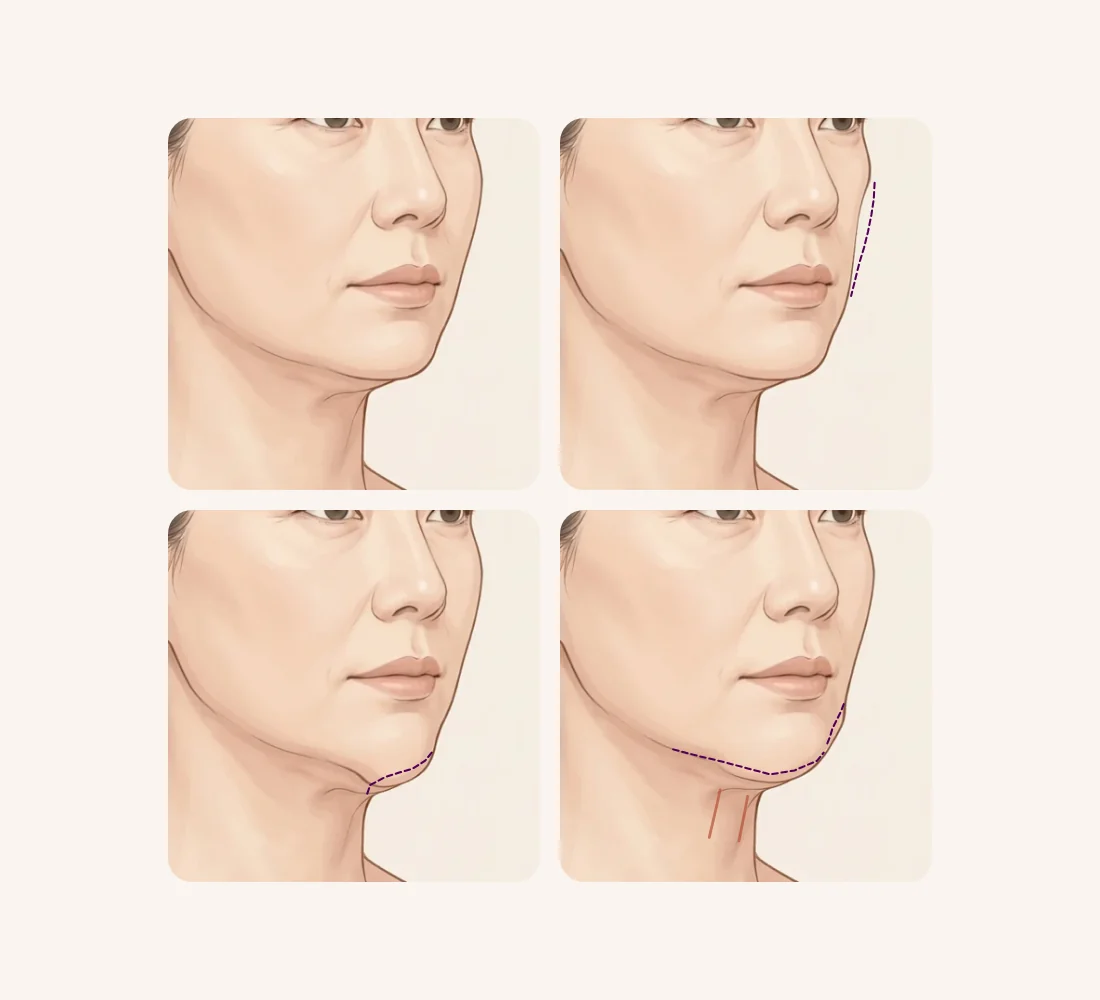
What is Ulthera, and where is it used?
Ulthera is a lifting device that uses ultrasound to heat and tighten deeper layers beneath the skin, without incisions. It is also called high-intensity focused ultrasound (HIFU). Bonita Clinic uses it where the skin and the layers beneath it have lost firmness and sagged, such as around the eyes, along the jawline and under the chin. It does not suit every kind of sagging, so the first step is to sort out why the face looks saggy.
Where Ulthera is usually considered
What does Ulthera actually do beneath the skin?
Ulthera is an ultrasound device, not a laser. Much as a magnifying glass gathers sunlight into a single spot, it gathers ultrasound into points at a chosen depth beneath the skin. At each point the temperature briefly rises above 60 °C, creating a coagulation point (a tiny spot where heat has set the protein) smaller than 1 mm³.2
Only the focal depth is heated; the epidermis and upper dermis above it are left unaffected.2 The heated collagen (the protein fiber that supports the skin) contracts straight away, and new collagen then forms over the following months. This is how the tightening effect is explained.23
When ultrasound gathers at a point
What made this technology stand out is the SMAS. The SMAS is the thin fibrous layer beneath the skin and fat that wraps the muscles of facial expression; it is also the layer a surgeon lifts in a facelift. An early anatomical study of six facial specimens showed that focused ultrasound could create heated zones of consistent size and position in the SMAS while sparing the epidermis and surrounding tissue.5 Reaching that depth without surgery is what separates it from most skin treatments.
What do 1.5 mm, 3.0 mm and 4.5 mm mean?
Ulthera uses interchangeable transducers (the tips placed on the skin that send out the ultrasound), each with a different focal depth. The numbers are distances from the skin surface to the focal point.
A review describes the 1.5 mm transducer as targeting the dermis and the 4.5 mm transducer as targeting the tissue beneath the skin, including the SMAS. For the 3.0 mm depth, one review names the deep dermis and another the area just below the dermis.23 Skin and fat thickness, however, vary between people and between areas of the face. So the tissue sitting at 4.5 mm is not identical in every case.
That is why the layers are checked on screen first. The U.S. FDA clearance describes the imaging function as a way to see up to 8 mm beneath the skin. The function is also described as a way to confirm that the transducer is properly touching the skin, and to confirm a treatment depth that avoids bone.1 A review adds that imaging helps avoid tissue that should not be treated, such as bone and larger blood vessels.2
Each transducer, a different focal depth
How much change have studies measured?
The U.S. FDA has cleared the Ulthera System as a non-invasive device (one that does not cut or pierce the skin) for "temporary changes in the physical appearance of the skin". The cleared indications, meaning the uses the regulator has accepted, are lifting the eyebrow and lifting lax tissue under the chin and on the neck. They also include improving lines and wrinkles of the décolleté and improving skin laxity on the abdomen and arms.1 The evidence is tied to specific areas, and the word "temporary" is a reminder that aging continues after treatment.
A prospective study (one planned in advance that follows people over time) included 35 people who had one session covering the full face and neck. Three blinded specialists compared photos at 90 days and judged that 30 of them (86%) had a clinically significant brow lift. The brow height measured on photos rose by 1.7 mm on average.4
A systematic review (a study that gathers all relevant research by a set method) of 16 studies found similar figures after a single session. Brows rose by 0.47–1.7 mm, and the lax area under the chin, measured on side-view photos, shrank by 26–45 mm².3
| What was measured | Result in studies | How to read it |
|---|---|---|
| Brow height | 0.47–1.7 mm higher after one session3 | A change measured in millimeters |
| Under-chin contour | 26–45 mm² less lax area on side-view photos3 | A tidier line, visible when measured |
| Doctor-rated result (day 90) | 92% improved: mild 47%, moderate 36%, significant 8%3 | Mostly mild to moderate |
| Patient-rated result (day 90) | 25% saw no change3 | What you notice may be smaller |
These numbers mean neither that Ulthera does nothing nor that it pulls the face up dramatically. From a patient's point of view, people with mild to moderate laxity tend to get a small but measurable change, and the size of that change varies from person to person. Most of the studies in the review enrolled women, results were usually assessed at 90 and 180 days, and no study followed patients beyond one year.3
Which kind of sagging does it suit, and when should I look elsewhere?
According to one review, this treatment is most suitable for mild to moderate laxity of the skin and soft tissue, and younger patients who heal normally are ideal candidates.2
The same review regards some people as poor candidates who should be offered surgery instead. They have extensive sun damage and severe laxity, marked vertical neck bands (platysmal bands, where a thin neck muscle stands out like cords) or a very heavy neck.2 Results have also been weaker in people with a BMI (a number comparing weight with height) above 30 and in those with more severe laxity.23
Very often the face looks saggy for reasons other than loose skin and fascia. If the cheeks and forehead have hollowed, tightening tissue with heat cannot replace lost volume. If a lot of fat has gathered below the jawline, reducing that fat usually comes first.
What is chosen depends on why the face looks saggy
1Skin and fascia are mildly lax
Ultrasound lifting is considered for mild sagging of the brows, jawline and under the chin
Ulthera
2The cheeks look hollow
Ultrasound does not add volume, so a volume treatment is considered alongside
Fat grafting, etc.
3Fat has gathered under the jaw
Reducing the fat usually comes first
Jaw liposuction, etc.
4Deep sagging with clear neck bands
Non-surgical change may be small, so surgery is discussed
Facelift
| If this is your concern | What ultrasound lifting can do | What to consider alongside or instead |
|---|---|---|
| Brows and upper lids slightly lowered | Brow lift is a cleared indication1 | Around the eyes, treatment stays on bone2 |
| Blurred jawline, loose skin under the chin | Lifts lax submental and neck tissue1 | If fat is the main issue, reduce fat |
| Hollow cheeks or forehead | Tightens tissue but does not add volume | Fat grafting or other volume treatment |
| Thin skin with fine lines and rough texture | The shallow 1.5 mm depth targets the dermis2 | Lasers for texture |
| Severe sagging and prominent neck bands | Change may be small2 | Facelift consultation |
How does a session go, and when do changes appear?
At Bonita Clinic, we perform Ulthera as a non-surgical procedure. Anesthesia is either a numbing cream or sedation, you go home the same day, and there are no stitches. The actual anesthesia, session length and recovery depend on the areas treated and your individual condition.
Pain varies a lot between people and areas. In the systematic review, the average pain score was 3.8 out of 10 (ranging from 2.5 to 6.1 between studies). Treatment around the eyes and below the jaw hurt more.3 Most of these scores were recorded with painkillers or numbing cream already in use.3
Right after treatment, almost everyone has some temporary redness, sometimes with swelling.3 Collagen rebuilds over months after the heating.23 So changes appear gradually rather than the next day, and studies mostly assessed results at three and six months.34
After the session
- Same dayRedness, swelling, slight stiffness
- First weekAvoid saunas and other hot environments (clinic advice)
- 1–2 monthsCollagen forms gradually (clinic advice)
- 3–6 monthsWhen studies usually assessed change
- 6–12 monthsDecide on maintenance by degree of sagging
What are the side effects and limits?
The common reactions are temporary redness and swelling, and bruising can occur.23 Less often, people have reported temporary numbness or oversensitivity, stinging, striped marks or raised welts on the skin, and burns along the jawline. In the systematic review these uncommon effects affected 2% of patients (14 of 573).3 Temporary muscle weakness or nerve paresis, and darker patches of skin about a month later, are also listed among rare reactions.26
Rarer but more serious problems exist too. A case series of five patients described problems after a single session. These were blistering, erosion or ulceration, swelling of the tissue under the skin followed by shrinking (atrophy), and skin necrosis (part of the skin being damaged). Its authors suggest such complications may be underreported.6 Around the eyes, ultrasound can pass through a protective eye shield and injure the cornea (the clear front of the eye), so treatment there must stay on bone.2
Treatment is not done over an infection or open wound, active severe or cystic acne, or an implanted metal electronic device such as a pacemaker in the treatment area. Treating directly over keloids (scars that grow thick and raised), implants or non-degradable fillers calls for caution.2 This is why your previous treatments and skin condition need to be known first.
The limits are clear as well. Ulthera does not add volume or remove excess skin. So the change may be small where sagging is deep or volume loss is marked. The effect is cleared as a temporary change,1 and there is not yet enough research to say how often, or at what interval, it is ideal to repeat it.3
How we approach it at Bonita Clinic
The order we follow
- 1Find the causeSkin and fascia, or volume and fat?
- 2Plan areas and depthsDeeper for the jawline, shallower around eyes and mouth
- 3Treat on screenSkin layers checked, energy to the needed depth
- 4Follow-upMaintenance every 6–12 months as needed
If ultrasound alone is not enough, other treatments such as fat grafting are considered
After treatment you may have temporary redness and slight stiffness, and we advise avoiding saunas and other hot environments for a week. If numbness or pain persists, please let us know. How long recovery takes and how often you come back depend on the areas treated and on your condition.
Lifting options you can discuss in Seoul
Dr. Kwang-Seop Chung, a board-certified plastic surgeon trained in Brazil, has treated patients at the same Bonita Clinic location since 1995 and sees each patient himself. When sagging is the concern, the options discussed at consultation are those we actually offer:
- Ulthera focused ultrasound for mild to moderate laxity of the brows, jawline and under the chin
- Other energy devices listed for this treatment, such as the Eravity laser and a radiofrequency device, when skin texture and firmness are part of the goal
- Multi-lifting, which picks only what is needed from jawline liposuction, dissolvable threads, fat grafting and combined lasers when fat or lost volume is part of the cause
- A facelift consultation when laxity reaches deep into the SMAS and non-surgical change is likely to be small
Which of these fits, alone or combined, is decided after an examination rather than in advance.
Why do the plan and cost differ from person to person?
"An Ulthera session" can mean very different things. A brow-only treatment and a full face and neck treatment differ in the number of lines delivered, the depths used and the time needed. The plan is also often combined with other treatments.
- Which areas: brows, jawline, under chin, neck
- Lines needed, set by the degree of laxity
- Which depths are combined
- Numbing cream or sedation
- Whether other treatments are added
- Whether maintenance sessions are planned
Final plan and quote after seeing you in person
How many lines are delivered depends on how lax the tissue is.2 That, together with the depths used, can only be judged once the skin is felt and seen on the ultrasound screen. A final estimate is therefore given after the in-person examination.
What can photos show, and what needs an in-person exam?
Photos are a useful starting point for deciding whether ultrasound lifting is worth discussing. They are not enough to set the depths, the number of lines or whether another treatment is needed.
Photos can show
- Which areas sag: brows, jawline, under chin
- Hollowing of the cheeks or temples
- Differences between left and right
- How things changed (older photos)
Needs an in-person exam
- Skin and fat thickness on ultrasound
- How lax the tissue feels
- Loose skin versus fat under the jaw
- Where previous fillers or threads sit
- Acne, wounds or other skin issues
Helpful photos: your face from the front, from both sides at 45 degrees and in profile, in even light without makeup, with your head level. A photo from a few years ago shows how the sagging has developed. You can send us a message with your photos and a list of any lifting treatments, threads or fillers you have had.
Planning your visit around the treatment
What is confirmed in advance is the treatment information above: a non-surgical procedure under numbing cream or sedation, going home the same day and no stitches. Which areas are treated, whether other treatments are added on the same visit, and whether a follow-up visit is useful are planned together with you at consultation.
Two points from the aftercare guidance are worth building into a trip. Temporary redness and slight stiffness are common on the day, and hot environments such as saunas should be avoided for a week. Because collagen forms gradually over the following months, the change is usually judged after you are back home. Taking dated photos from the same angles helps you, and any doctor you see later, compare the result. If numbness or pain continues after you return home, contact us or see a local doctor.
Frequently asked questions
Is Ulthera a laser?
No. Ulthera focuses sound (ultrasound) rather than light at a point beneath the skin. Unlike a laser, whose energy is absorbed near the surface, its focal point is set at a chosen depth, which lets it heat the dermis and the SMAS.2 Lasers that address texture or pigment work differently, so the two are sometimes planned together.
When will I see a change, and how long does it last?
Collagen takes time to rebuild after the heating, so changes appear gradually over months. Studies mostly assessed them at three and six months.3 The FDA clearance refers to temporary changes,1 and data beyond one year are lacking.3 Bonita Clinic usually recommends maintenance every six months to a year, depending on the degree of sagging.
Does it hurt?
The average across studies was 3.8 out of 10, but areas close to bone, such as around the eyes and below the jaw, felt more painful.3 At consultation we decide between numbing cream and sedation.
I have had fillers or a thread lift. Can I still have Ulthera?
Often yes. But treating directly over implants or non-degradable fillers calls for caution.2 Tell us what you had and when, so those areas can be avoided or the depth adjusted. If an unknown injected material has formed lumps, that problem should be checked before any lifting.
Can Ulthera replace a facelift?
For mild to moderate sagging, a non-surgical option can be considered first. But the changes measured in studies are a matter of millimeters,34 and surgery is recommended for severe sagging or prominent neck bands.2 If laxity reaches deep into the SMAS, a facelift is discussed at consultation as well.
What to prepare before your consultation
- The areas that bother you most: brows and eyes, jawline, under the chin, neck, cheeks
- Previous lifting treatments: ultrasound or radiofrequency devices, thread lifts, fillers (with product names if known) and when you had them
- Whether you form keloids, and any current acne or open wounds
- Any implanted electronic device, such as a pacemaker, or metal implant2
- Medicines you take regularly
Bonita Clinic is on the 3rd floor of 565 Gangnam-daero, Seocho-gu, Seoul, about 100 m on foot from Exit 8 of Nonhyeon Station (Line 7). You can read more on our Ulthera page. If fat or lost volume is part of the cause, see Multi Lifting and the guide to multi-lifting. For a device that addresses texture and firmness together, see Eravity and the guide to Eravity.
References (6)
Sources that support the explanations in this article. Study findings describe general trends and do not guarantee individual results.
- U.S. Food and Drug Administration. 510(k) Premarket Notification K243035: Ulthera System — Indications for Use and 510(k) Summary. FDA CDRH 510(k) database. 2025.U.S. FDA clearance (510(k) K243035): cleared for temporary changes in the appearance of the skin; indications are brow lift, lifting lax submental and neck tissue, décolleté lines and wrinkles, and skin laxity on the abdomen and arms; imaging up to 8 mm to confirm skin contact and a depth that avoids bone
- Fabi SG. Noninvasive skin tightening: focus on new ultrasound techniques. Clin Cosmet Investig Dermatol. 2015;8:47-52.doi:10.2147/CCID.S69118Review (full text): mechanism (above 60 °C, coagulation points under 1 mm³, epidermis and upper dermis spared), transducer depths (1.5 mm dermis, 3.0 mm deep dermis, 4.5 mm subdermal tissue including the SMAS), imaging to avoid bone and larger vessels, suitable candidates and when surgery is preferable, contraindications and precautions, staying on bone around the eyes because of corneal risk
- Contini M, Hollander MHJ, Vissink A, et al. A Systematic Review of the Efficacy of Microfocused Ultrasound for Facial Skin Tightening. Int J Environ Res Public Health. 2023;20(2):1522.doi:10.3390/ijerph20021522Systematic review of 16 studies (full text): brow lift of 0.47–1.7 mm and submental area reduction of 26–45 mm² after one session; investigator-rated improvement in 92% at day 90, mostly mild to moderate, with 25% of patients rating no change; mean pain 3.8/10; uncommon side effects in 2% (14/573); no data beyond one year; weaker results with severe laxity or BMI over 30
- Alam M, White LE, Martin N, et al. Ultrasound tightening of facial and neck skin: a rater-blinded prospective cohort study. J Am Acad Dermatol. 2010;62(2):262-269.doi:10.1016/j.jaad.2009.06.039Prospective rater-blinded cohort of 35 patients (abstract): after one full-face and neck session, 86% showed a clinically significant brow lift at 90 days, with a mean brow elevation of 1.7 mm and transient mild redness and swelling
- White WM, Makin IR, Barthe PG, et al. Selective creation of thermal injury zones in the superficial musculoaponeurotic system using intense ultrasound therapy: a new target for noninvasive facial rejuvenation. Arch Facial Plast Surg. 2007;9(1):22-29.doi:10.1001/archfaci.9.1.22Cadaver study of 6 specimens (abstract): focused ultrasound produced consistent thermal injury zones in the SMAS while sparing the epidermis, the starting point for the idea of targeting the SMAS without surgery
- Friedmann DP, Bourgeois GP, Chan HHL, et al. Complications from microfocused transcutaneous ultrasound: Case series and review of the literature. Lasers Surg Med. 2018;50(1):13-19.doi:10.1002/lsm.22768Case series of 5 patients with literature review (abstract): rare but serious complications after a single session, including blistering, erosion or ulceration, subcutaneous swelling followed by atrophy, and skin necrosis; common reactions include transient redness, swelling, bruising and nerve paresis; complications may be underreported
About this article
This article separates general medical information from Bonita Clinic's own approach. Because the right decision depends on each person's condition, it is not a substitute for a consultation.
