 KOKorean
 ENEnglish
 JP日本語
JP日本語 CN中文(简体)
 TW中文(繁體)

Facelift Surgery in Seoul: Which Kind of Sagging Needs It, and What Recovery Involves
A facelift is worth considering when the jawline has lost its shape and the neck skin has loosened. Early to moderate sagging, or a face that looks tired mainly because it has lost volume, may be better served by other approaches first. Instead of pulling the skin alone, a facelift lifts and fixes the layer beneath it (the SMAS). It leaves scars in front of and behind the ear and along the hairline, and needs time for swelling to settle. The starting point is working out which layer the sagging comes from and whether hollows also need filling. If you are thinking about surgery in Seoul, you can send photos first to see which approach may fit your case.
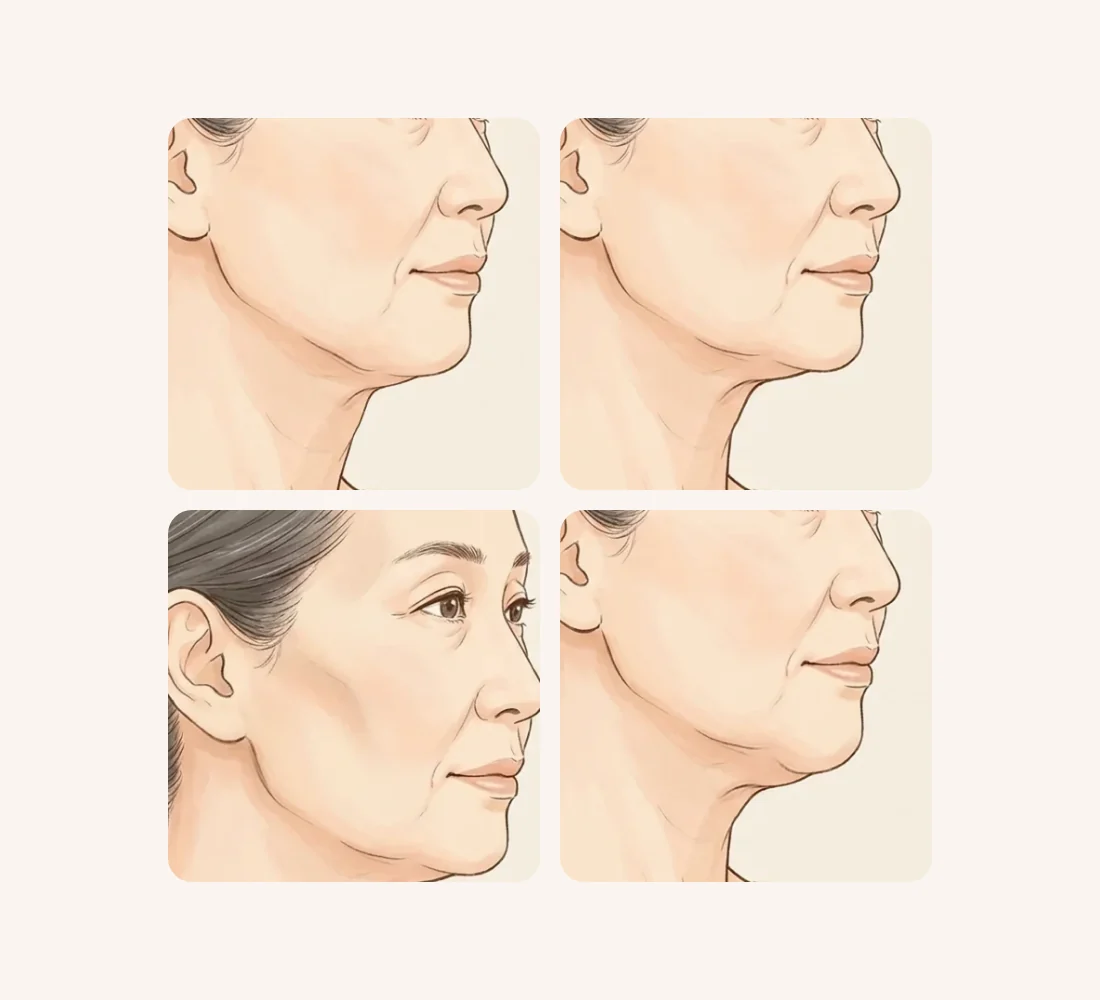
What kind of surgery is a facelift?
A facelift lifts sagging tissue below the cheeks, along the jawline and in the neck up and back through surgery. Bonita Clinic's core operation is an endoscopic facelift. Incisions are made in the crease in front of the ear and inside the hairline behind the ear, and the SMAS, a layer beneath the skin, is lifted and fixed. An endoscope is a thin tube with a small camera at its tip; using it keeps the incisions short. When neck lines are treated too, the incision behind the ear is extended.
How a facelift proceeds
This guide explains which kinds of sagging need a facelift, when something else should come first, what recovery and scarring involve, and which complications you should know about.
Which layers of the face sag?
Sagging with age is not only a matter of stretched skin. The face is built in layers of bone, ligaments (cord-like tissue that anchors soft tissue toward the bone), muscle, fat and skin, and aging happens in all of them. When the changes start and how fast they progress differ between structures, between individuals and between ethnic groups.1
That is why two people who both say "my face is sagging" can look quite different. In one, fat gathers below the jawline. In another, the cheeks hollow and cast shadows. In a third, the skin and the layer beneath it have both loosened, so the line between jaw and neck blurs.
In the cheek and in front of the ear, beneath the skin and fat, lies a thin fibrous sheet called the SMAS (superficial musculo-aponeurotic system). Put simply, it is a thin but tough sheet connected to the facial muscles. The 1976 anatomical study that described this layer reported that going beneath the SMAS can help during a facelift. It also reported that this approach, safe over the parotid gland (the saliva gland in front of and below the ear), can become dangerous in front of it.2 The area in front of the parotid is where the nerve branches that move your facial expressions run. That is why techniques that dissect (separate tissue layers) widely beneath the SMAS have traditionally been considered to carry more risk of nerve injury.4
A simplified cross-section of the cheek
How is pulling the skin different from lifting the SMAS?
If a sagging face is lifted by pulling the skin alone, all of the tension lands on the skin. In Bonita Clinic's view, this tends to give a strained expression. It also stretches the skin in front of the ear so that the earlobe is dragged down, the so-called pixie ear.
The literature also describes the pixie ear as one of the most recognizable telltale signs of a facelift. The direction in which the skin is pulled drags the ear forward and downward and rotates the earlobe forward. It has been reported in about 5% of cases in which the earlobe is re-attached, and many techniques have been described to prevent and correct it.6
Lifting and fixing the SMAS aims to support the sagging tissue from the layer beneath the skin rather than from the skin itself. This is why Bonita Clinic lifts from the SMAS and closes the area around the ear to suit the shape of each face.
What the evidence cannot yet tell you is which facelift technique lasts longest or is safest. A systematic review (a study that gathers all relevant research by a set method) compared techniques. Of the 57 articles it gathered, only 10 directly compared results and only 5 directly compared complications. The authors concluded that good-quality comparative data are lacking.3
In other words, you cannot assume that any SMAS lift automatically lasts longer. It is more accurate to say that the result, and how long it holds, depend on several things. These are the degree of sagging, your skin, the extent of surgery and how you continue to age.
When does a facelift fit, and when should something else come first?
The right approach depends on which layer the sagging comes from. At Bonita Clinic, early to moderate sagging is often handled with multi-lifting, while deep sagging and neck lines are often treated with a facelift. Multi-lifting is a non-incisional combination of jaw liposuction, dissolvable threads, stem cell fat grafting and combined laser, choosing only what is needed.
Filling hollows and lifting sagging tissue serve different purposes. So whether fat grafting is needed is judged separately.
If your sagging looks like this, what is considered first
1Deep sagging, loose neck skin
A facelift that lifts and fixes the SMAS is considered
Facelift
2Early to moderate sagging
Multi-lifting, combining only what is needed without large incisions, is considered first
Multi-lifting
3Hollow cheeks or forehead
Filled with fat grafting, which has a different goal from lifting
Fat grafting
4Excess fat below the jawline
Jaw liposuction is added, sometimes together with a facelift
Jaw liposuction
Here is the same idea, organized by what you see in the mirror.
| What you notice | Likely contributors | What is checked at consultation |
|---|---|---|
| A blurred jawline, loose tissue below the cheeks | Sagging of skin and SMAS, fat under the jaw | Whether sagging or fat is the bigger factor |
| Neck lines and loose neck skin | Laxity of the neck skin and the layer beneath | How much can be lifted through the incision behind the ear |
| Deeper smile lines and mouth lines | Sagging combined with volume loss | Which parts to lift and which to fill |
| Hollow forehead or cheeks | Volume loss | Whether fat grafting is needed |
| Rough texture and fine lines | Changes in the skin itself | Whether skin treatments such as laser should be added |
What may be added to a facelift when needed?
Not everyone goes through the same steps. On top of the core operation, only the treatments you need are added, according to how much sagging there is and where the face has hollowed.
- Jaw liposuction: if there is a lot of fat under the jawline, it is suctioned with a special cannula (a thin tube that draws out fat) to define the jawline.
- Stem cell fat grafting: hollow areas such as the forehead or cheeks are grafted with fat together with adipose-derived stem cells. Evidence that adding stem cells improves the result beyond fat grafting alone is still limited; we explain this in our guide to fat stem cell wrinkle treatment.
- Dissolvable threads: sometimes added to areas with fine lines, such as smile lines, hollow cheeks or under the eyes.
A facelift repositions sagging tissue. It does not restore lost volume or change skin texture and color. If those are part of your concern, whether to combine another treatment is discussed at consultation.
What are recovery and scarring like?
At Bonita Clinic, we perform the facelift as surgery under general anesthesia or sedation. It involves a one-night stay (same-day discharge depending on your condition), and stitches are used. How long recovery takes, and how often you come back, depends on the extent of surgery and your condition.
How recovery usually unfolds
- Right after surgeryCompression dressing; swelling and bruising managed
- During recoveryStitch removal scheduled; swelling and bruising fade
- As things settleThe pull feels natural; fat graft take checked if done
- AfterwardsIncision marks followed up at the Scar Clinic
Scars sit along the incisions in front of and behind the ear and along the hairline. They are managed so that they become less noticeable over time, and the Scar Clinic can continue care if needed. Swelling takes time to go down, so if you have an important date coming up, let us know at consultation.
Which complications and limits should I know about?
One study analyzed 11,300 facelift patients in a large cosmetic surgery database in the United States. Major complications, meaning an emergency visit, admission or reoperation within 30 days, occurred in 1.8%. Hematoma (blood collecting under the skin, 1.1%) and infection (0.3%) were the most common.5 That is fewer than 2 in 100 people.
In the same study, the rate was 1.5% for facelifts alone and up to 3.7% when other procedures were combined. Men had 3.9 times the risk of hematoma. A BMI (a number comparing weight with height) of 25 or more and combined procedures increased the risk of infection.5
Major complications within 30 days
A meta-analysis (a study that pools the results of many studies) looked at 183 studies. Temporary facial nerve injury, hematoma and skin necrosis occurred at somewhat different rates depending on how the SMAS was handled. Skin necrosis means part of the skin is damaged because too little blood reaches it. Temporary nerve injury was highest with the high lateral SMAS (1.85%) and composite (1.52%) techniques, while the risk of lasting nerve injury did not differ between techniques.4 The authors concluded that technique should be chosen for the quality of its results rather than for small differences in complications.4
These figures come from many clinics in other countries and are not Bonita Clinic's own data. Your individual risk depends on your health and the extent of surgery.
- One side of the face becoming steadily more swollen and painful after surgery can mean a hematoma; contact the clinic straight away.
- Scars remain in front of and behind the ear and along the hairline, and a pixie ear deformity can occur.6
- Aging continues after surgery. A facelift addresses the sagging you have now; it does not stop the clock.
- Lost volume, skin texture and fine lines may not be solved by lifting alone.
How we approach it at Bonita Clinic
Treatment options you can discuss in Seoul
Bonita Clinic has been at the same location since opening in 1995, and Dr. Kwang-Seop Chung, a board-certified plastic surgeon trained in Brazil and a former president of the Korean Academy of Aesthetic Surgery, sees patients himself. For facial sagging, the options you can discuss in consultation are:
- An endoscopic facelift that lifts and fixes the SMAS, with the neck included through the incision behind the ear when needed
- Jaw liposuction for fat below the jawline
- Stem cell fat grafting for hollow areas such as the forehead or cheeks
- Dissolvable threads for areas with fine lines
- Multi-lifting, a non-incisional combination, when the sagging is early to moderate
- Follow-up of incision marks at the Scar Clinic
Which of these suits you, and in what combination, is decided only after an examination.
Why do the plan and cost differ from person to person?
Two people asking about a "facelift" may need quite different operations. The extent of the work, rather than the name of the procedure, shapes both the plan and the cost.
- How deep the sagging is, and whether the neck is included
- Incision length in front of and behind the ear
- Added jaw liposuction, fat grafting or threads
- Anesthesia: general or sedation
- Overnight stay or same-day discharge
- Earlier facelift, threads or fillers
Final plan and quote after an in-person exam
A final estimate is given after an in-person examination, once the extent of the lift and any additional treatments are clear. Photos can point to a likely direction, but the scope is set only in person.
What can photos show, and what needs an in-person exam?
Photos are a useful starting point for a facelift consultation. But how loose the deeper tissue is, and how it responds when lifted, can only be judged in person.
Photos can show
- Where the jawline and neck sag
- Hollows in the cheeks or forehead
- How deep smile and mouth lines are
- Change over the years (older photos)
Needs an in-person exam
- How loose the skin and SMAS are
- Fat under the jaw versus loose skin
- Skin thickness and quality
- Effects of earlier lifts or threads
- Ear and earlobe position
- Health and medicines
Helpful photos: your face straight on, both sides at 45 degrees and both full profiles, in even light and without makeup. Tie your hair back so the ears and jawline are visible. A photo from five or ten years ago helps show how your face has changed. You can send us a message with your photos, the areas that bother you and any earlier lifting, threads or fillers.
Planning your visit and recovery
What is confirmed in advance is limited to the treatment information above: surgery under general anesthesia or sedation, a one-night stay or same-day discharge depending on your condition, and stitches. How long you should stay in Seoul, when the stitches come out and how often you need to come back depend on the extent of surgery and any added treatments. They are planned together with you at consultation.
At Bonita Clinic, we apply a compression dressing right after surgery and manage swelling and bruising. The stitch removal schedule is explained during recovery. As things settle, the pull begins to feel natural, and fat graft take is checked if grafting was done. If you have an important date, such as an event or a return to work, tell us at consultation so the schedule can take it into account.
After you return home, contact a doctor promptly if swelling, pain or redness increases instead of settling, especially if it is on one side. Keeping dated photos of your recovery is useful for any doctor who sees you later.
Real treatment cases
These cases appear on Bonita Clinic's facelift page. Results vary from person to person.
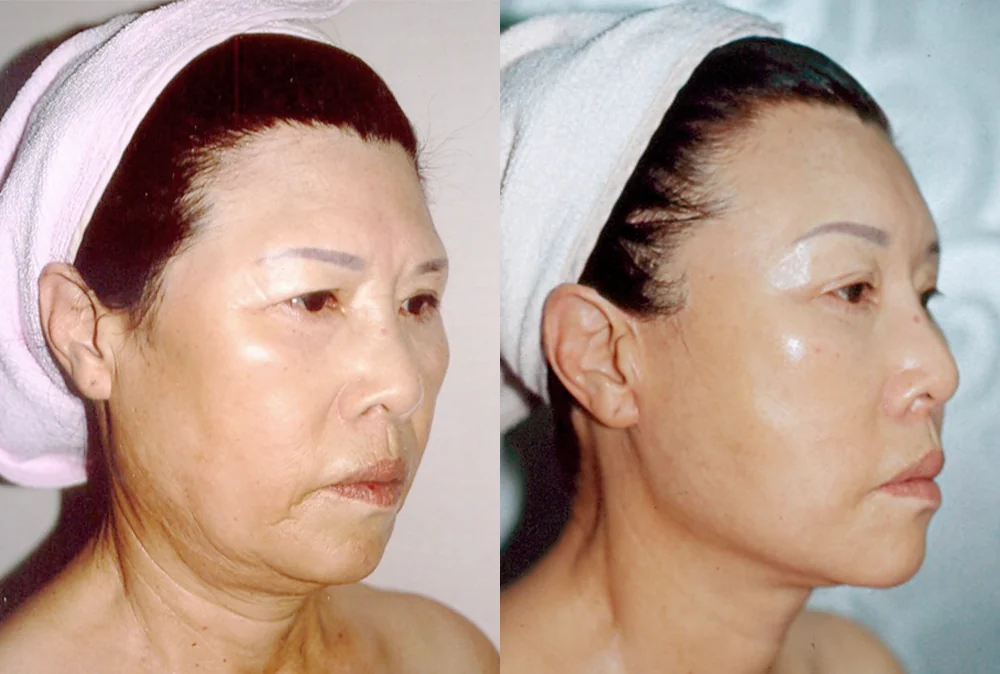
Loose skin below the jawline and on the neck (side view)
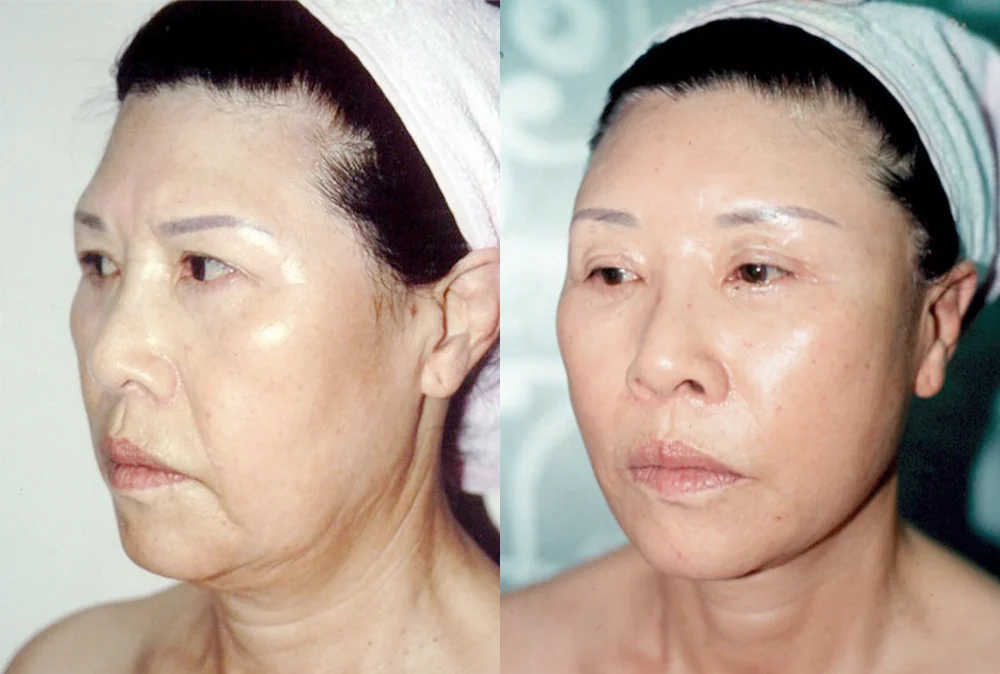
Sagging jawline below the cheeks and neck lines (angled view)
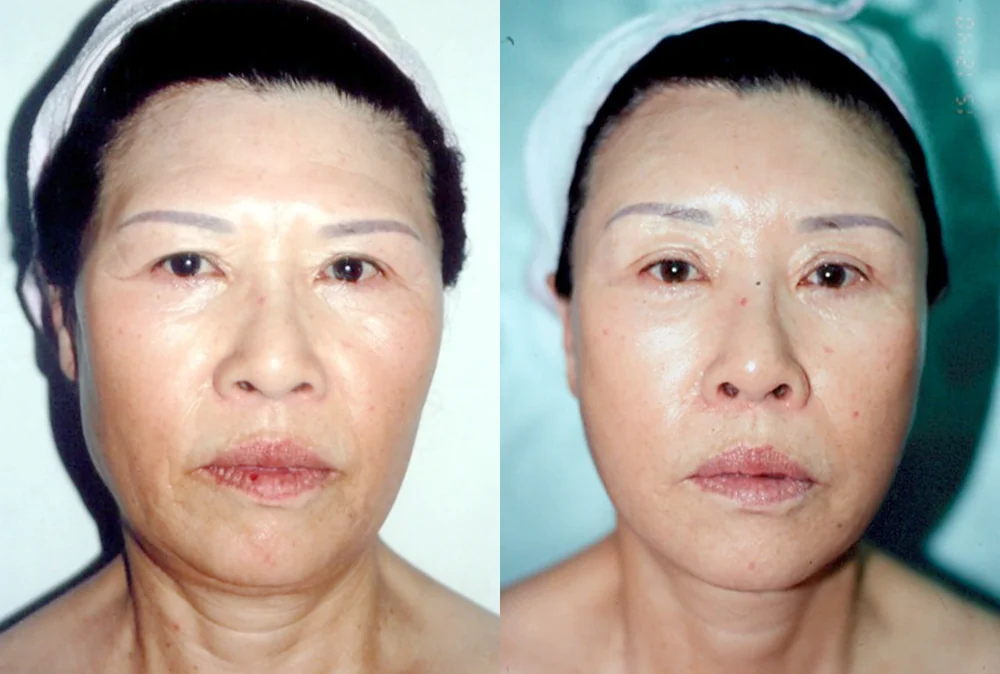
Sagging around the mouth and jawline (front view)
* Results vary from person to person. Side effects are possible, so please decide after a thorough consultation with a doctor.
Frequently asked questions
Do I need fat grafting with a facelift?
Not necessarily. Surgery that lifts sagging tissue and treatment that fills hollow areas have different purposes. Whether fat grafting is needed is explained after checking where volume is lacking and what change you want.
I'm worried about a pixie ear.
A pixie ear forms when the pull on the skin in front of the ear drags the earlobe down. That is why Bonita Clinic lifts the SMAS and closes the area around the ear to suit the face, to reduce the deformity. The risk cannot be removed entirely, so the incision site and extent are explained at consultation.
Where will the scars be?
Along the incisions in front of and behind the ear and along the hairline. When the neck is included, the incision continues inside the hairline behind the ear. The scars are managed so that they become less noticeable over time, with Scar Clinic follow-up if needed.
Thread lift or facelift: which suits me?
It depends on how much sagging there is and which layer it comes from. In Bonita Clinic's experience, early to moderate sagging often suits multi-lifting, while deep sagging and neck lines often suit a facelift. You can compare the two in our multi-lifting guide.
How long is recovery?
It depends on the extent of surgery and any added treatments, and time is needed for the swelling to go down. The stitch removal schedule is given after surgery. If you have an important date, let us know at consultation.
What to prepare before your consultation
- The areas that bother you most (jawline, cheeks, neck, smile lines, mouth) and the change you hope for
- Earlier lifting, threads, fat grafting, fillers or facelift surgery, and when they were done
- Medicines you take, especially blood thinners, conditions such as high blood pressure or diabetes, and whether you smoke
- Photos from the front, both 45-degree angles and both profiles, plus an older photo if you have one
- How much time you can set aside for recovery, and dates you need to avoid
Bonita Clinic is on the 3rd floor of 565 Gangnam-daero, Seocho-gu, Seoul, about 100 m on foot from Exit 8 of Nonhyeon Station (Line 7). More about the procedure is on our Face Lift page. Non-incisional options are on the Multi-Lifting page, and sagging above the eyes is covered on the Brow Lift page and in our direct brow lift guide.
References (6)
Sources that support the explanations in this article. Study findings describe general trends and do not guarantee individual results.
- Cotofana S, Fratila AA, Schenck TL, et al. The Anatomy of the Aging Face: A Review. Facial Plast Surg. 2016;32(3):253-260.doi:10.1055/s-0036-1582234Review (abstract): the face is a layered structure of bone, ligaments, muscle, fat and skin; aging affects every layer, with onset and speed differing by structure, individual and ethnicity
- Mitz V, Peyronie M. The superficial musculo-aponeurotic system (SMAS) in the parotid and cheek area. Plast Reconstr Surg. 1976;58(1):80-88.doi:10.1097/00006534-197607000-00013Anatomical and histological study (abstract): the SMAS in the parotid and cheek area; going beneath it is safe over the parotid but can become dangerous in front of it; basis for the cross-section
- Chang S, Pusic A, Rohrich RJ. A systematic review of comparison of efficacy and complication rates among face-lift techniques. Plast Reconstr Surg. 2011;127(1):423-433.doi:10.1097/PRS.0b013e3181f95c08Systematic review (abstract): few studies directly compare facelift techniques (10 on efficacy and 5 on complications out of 57 articles), and the quality of comparative data is low
- Jacono AA, Alemi AS, Russell JL. A Meta-Analysis of Complication Rates Among Different SMAS Facelift Techniques. Aesthet Surg J. 2019;39(9):927-942.doi:10.1093/asj/sjz045Meta-analysis of 183 studies (abstract): complication rates by SMAS technique, with temporary nerve injury highest for high lateral SMAS (1.85%) and composite (1.52%) and no difference in lasting nerve injury
- Gupta V, Winocour J, Shi H, et al. Preoperative Risk Factors and Complication Rates in Facelift: Analysis of 11,300 Patients. Aesthet Surg J. 2016;36(1):1-13.doi:10.1093/asj/sjv162Prospective multicenter database of 11,300 facelifts (abstract): 1.8% major complications within 30 days, hematoma 1.1% and infection 0.3%, 1.5% alone versus up to 3.7% combined; male sex, BMI of 25 or more and combined procedures as risk factors
- Vaccari S, Fondrini R, Ragaini E, et al. The pixie ear: How to prevent and correct it-a review of the literature. Surgery. 2024;176(4):1247-1255.doi:10.1016/j.surg.2024.06.017Review (abstract): the pixie ear forms when flap tension pulls the ear forward and down and rotates the lobe; reported in about 5% of earlobe inset cases; methods to prevent and correct it
About this article
This article separates general medical information from Bonita Clinic's own approach. Because the right decision depends on each person's condition, it is not a substitute for a consultation.
