 KOKorean
 ENEnglish
 JP日本語
JP日本語 CN中文(简体)
 TW中文(繁體)

Fat Stem Cell Wrinkle Treatment in Seoul: What the Evidence Can and Cannot Tell You
Treatments that inject cells obtained from your own fat into the skin aim to improve fine lines and texture across the face. But the research behind them is still limited and the methods vary, so it is hard to say how large or lasting any effect will be. Systematic reviews generally conclude that these treatments appear safe but that improvement in skin quality is unclear or needs further confirmation. Expression lines, deep folds and sagging have different causes and may be better served by other approaches. So the first step is to identify which kind of lines you have and set realistic expectations. If you are considering treatment in Seoul, you can send photos first to discuss whether it fits your concern.
What is fat stem cell wrinkle treatment?
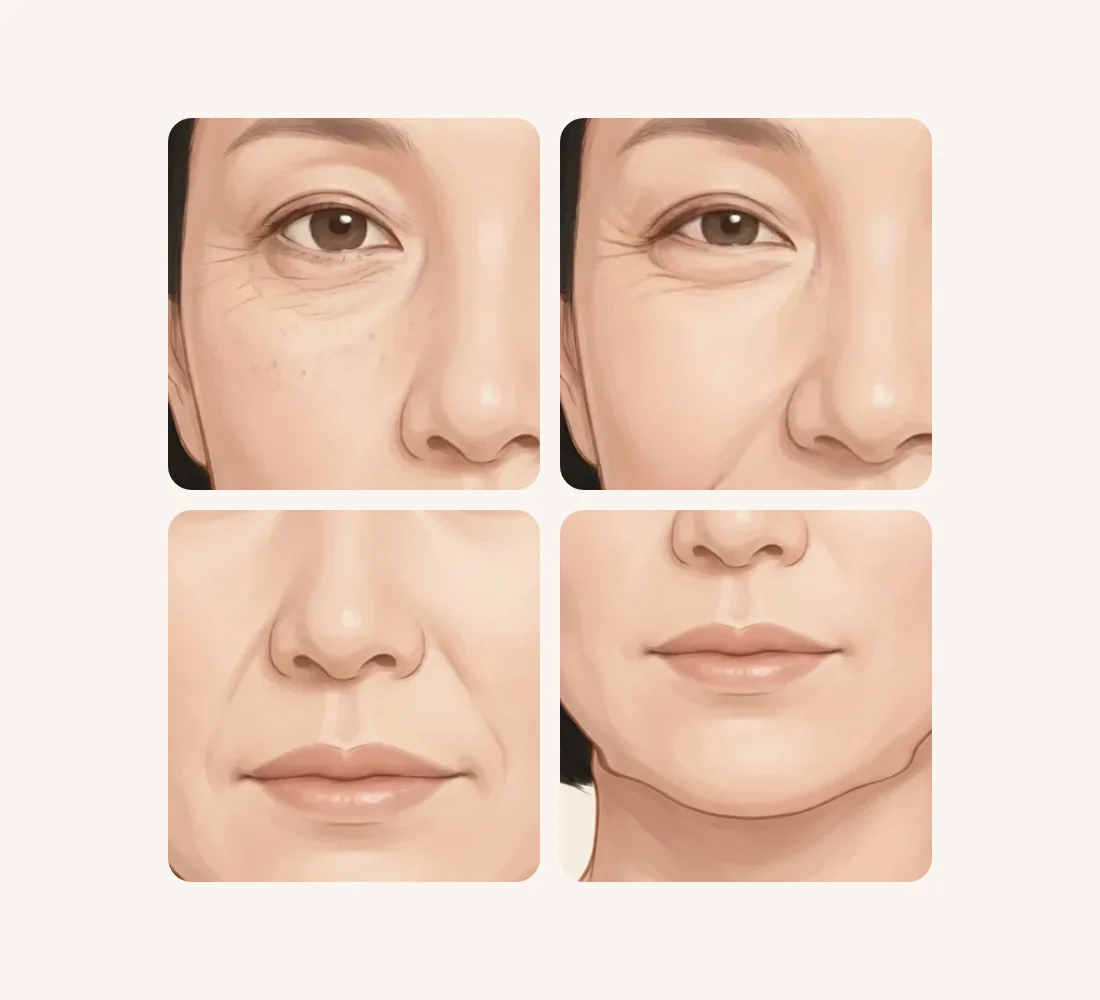
It is a treatment in which cells obtained from your own body fat are placed in small amounts in the skin of the face. It aims to improve fine lines and texture across the face. Bonita Clinic offers a wrinkle program of this kind. At consultation we look at areas with fine lines, such as around the eyes, the mouth and the forehead, together with skin texture and tone.
The research behind this treatment, however, is still limited, and the methods differ between studies. So this guide first helps you sort out what kind of lines you have, then explains what the research shows and how the treatment differs from other options.
Why do wrinkles form, and what kinds are there?
Wrinkles have more than one cause. When sunlight and other factors change the collagen fibers (the protein fibers that support the skin) and elastic fibers, moisture falls, firmness declines and wrinkles form. Everyday facial expressions also create lines, and the skin's ability to maintain itself declines with age. Genetics, smoking and skin color play a part too; fairer skin is more easily affected by sunlight, so lines tend to show more clearly.
Different causes call for different approaches. Sorting your lines into the groups below changes which treatment makes sense to consider first.
What is usually considered first, by type of line
1Fine lines and rough texture across the face
Sun protection and skin treatments come first; this treatment also aims here
Sun protection · skin treatment
2Lines that appear when you smile or frown
Caused by repeated muscle movement, so an injection that relaxes the muscle may be more direct
Botox
3Deep folds, hollow cheeks or forehead
Caused by volume loss, so filling treatments are considered first
Fat grafting, etc.
4Lines that come with a sagging jaw and neck
Caused by loose skin and the layer beneath, so lifting is considered
Lifting
The fat stem cell wrinkle treatment discussed here targets the first card: fine lines and texture across the whole face. It is not a substitute for treating expression lines or sagging, and it is worth being clear about that from the start.
What can "fat stem cells" mean?
Besides fat cells, the fat under the skin contains many other cells around its blood vessels. The cell fraction without the fat cells is called the stromal vascular fraction (SVF), and it includes adipose-derived stem (stromal) cells.5 SVF is obtained by processing fat and collecting the cells that are not fat cells.
How fat-derived material is prepared for the skin differs between studies:
- Nanofat: fat that has been washed, mechanically broken down into a smooth liquid (emulsified) and filtered. An expert consensus has, for the first time, defined it as washing followed by 20 to 30 passes of emulsification and a final filtration step.4
- Cellular SVF: the cell fraction collected after dissolving fat tissue with an enzyme.5
- Some studies use culture-expanded adipose stem cells, or the medium in which such cells were grown. Culturing means growing cells in a laboratory to increase their number.2
All of these tend to be called "stem cells", but the material and the processing are different. That makes the research hard to pool and compare.12
What does the research show?
The evidence is still thin, the methods vary, and the conclusions do not all point the same way. That is the most important thing to know before deciding.
A systematic review (a study that gathers all relevant research by a set method) of fat grafting, SVF and nanofat for facial skin quality gathered 9 studies with 301 patients. Eight reported increased elasticity, better texture or more even color, and one found no increase in elasticity. Some showed improvement on skin biopsy (a small piece of skin examined under a microscope).
But the measures differed so much that no meta-analysis (pooling the numbers from several studies) was possible, and the overall level of evidence was low. The authors concluded that these treatments hardly seem to improve facial skin quality, although they can be considered safe.1
A 2025 systematic review analyzed 17 studies of SVF, adipose stem cells and their conditioned medium. Some reported fewer wrinkles around the eyes and smile lines, but a meta-analysis of two conditioned-medium studies found no statistically significant reduction in wrinkles (P = .12). The difference was not large enough to be confident that wrinkles really decreased. Results on pigmentation were also inconsistent.
In the same review, combining treatments, such as SVF with laser or platelet-rich plasma (PRP, platelets concentrated from your own blood), gave better results than SVF alone. Follow-up ranged from 3 weeks to 12 months, and many studies had no control group or relied on subjective ratings. The authors called for larger randomized trials, in which people are assigned to groups by chance, using standardized methods.2
A systematic review of facial fat grafting for volume likewise found no demonstrable benefit from adding SVF or PRP to the graft.3 For nanofat, experts summarize that the regenerative potential looks promising but most applications lack robust clinical evidence.4
Reported in studies
- Better elasticity, texture or tone in some studies
- Some improvement on skin biopsy
- Better results when combined with laser and similar
- No serious complications in the included studies
Not yet established
- Which cells or processing are effective
- Size of the effect (a 2-study meta-analysis was not significant)
- How many sessions, at what interval
- How long any effect lasts
- Whether it beats plain fat grafting
The summary above brings together the systematic reviews.123 In short, there are reports that skin texture may improve after fat-derived cell injections. But the size of the effect, how long it lasts and the most effective method have not been established. Results can differ a great deal between people, and there may be no visible change.
How are the cells obtained, and how is this regulated?
There are two broad ways of obtaining cells from fat.
Separating cells by dissolving the tissue with an enzyme (collagenase) is regarded in many countries as "more than minimal" manipulation. So it is most often limited to controlled clinical trials subject to regulatory review. Non-enzymatic, mechanical ways of breaking fat down were developed partly to reduce that burden and to allow processing within a single procedure.5
Regulation differs from country to country. When you are offered any treatment called "stem cell", it is reasonable to ask how the cells are obtained and processed (same day or cultured, with or without enzymes). It is also reasonable to ask what evidence supports that particular method.
How does it compare with other options?
Different wrinkles, different approaches
| Approach | Main concern | How it works | Good to know |
|---|---|---|---|
| Fat stem cell treatment | Fine lines and texture across the face | Cells from your own fat, small amounts in several skin layers | Limited evidence; methods vary between studies |
| Botox | Lines that appear with expression | Small injections into specific muscles | Works by reducing muscle movement |
| Daily sunscreen | Sun-related skin aging | Broad-spectrum sunscreen every day | Slowed skin aging in a randomized trial |
Botox is injected into muscle to reduce movement, which suits lines that appear with expression. Fat stem cell treatment injects small amounts into several layers of the skin to address fine lines and texture. The two aim at different targets.
Whatever you choose, there is a foundation underneath. In a randomized trial in Australia, 903 adults were assigned to daily or discretionary use of broad-spectrum sunscreen. Over 4.5 years, skin aging progressed 24% less in the daily-use group.6 It is a simple measure, but one backed by a randomized trial, and worth having in place before choosing any procedure.
What are the procedure and recovery like?
At Bonita Clinic, we provide stem cell wrinkle treatment as a non-surgical treatment using local anesthesia or sedation, with same-day discharge. There are stitches at the site where fat is taken. Recovery time and follow-up visits vary with the extent of treatment and your individual condition.
- Bruising and swelling at the injection sites usually fade on their own.
- Saunas and vigorous exercise should be avoided afterwards.
- Smoking and alcohol should be avoided for about a week afterwards.
With treatments that use fat, bruising or hematoma (blood collecting under the skin), fat necrosis (lumps or oil cysts) and uneven results have been reported. In studies of facial fat grafting for volume, the overall complication rate was 6% (bruising or hematoma 5%, fat necrosis or oil cysts 2%, irregularity 2%).3
The skin-quality studies reported no serious complications,1 but they were small. The site where fat is taken can also bruise and swell. Rare vascular complications of injecting fat into the face are covered in our guide to fat grafting for a protruding mouth.
How we approach it at Bonita Clinic
Treatment options you can discuss in Seoul
Bonita Clinic has been at the same location since opening in 1995, and Dr. Kwang-Seop Chung, a board-certified plastic surgeon trained in Brazil, sees patients himself. For fine lines and texture, what you can discuss at consultation includes:
- The stem cell wrinkle program described above, with the number of sessions decided as you progress
- Whether your main concern is better suited to another approach, such as lifting for sagging
- Laser treatments offered at the clinic, such as Eravity, if firmness and texture are the main concern
Which of these fits, and in what order, is decided only after an examination.
Why do the plan and cost differ from person to person?
Two people asking about the same wrinkle treatment may need quite different plans. The areas treated and the number of sessions shape both the plan and the cost.
- Areas: around the eyes, mouth, forehead or whole face
- Number of sessions, given at 1 to 3 month intervals
- Anesthesia: local or sedation
- Fat harvest from your own body
- Combination with other treatments such as laser
- Recent fillers, Botox or laser
Final plan and quote after an in-person exam
A final estimate is given after an in-person examination, once the areas and the likely number of sessions are clear.
What can photos show, and what needs an in-person exam?
Photos can help sort out which kind of lines you have. But skin thickness and laxity, and whether this treatment is the right fit, need an in-person examination.
Photos can show
- Where fine lines show at rest
- Lines that appear when smiling or frowning
- Overall texture and tone, in even light
- Hollows or sagging that may need other care
Needs an in-person exam
- Skin thickness and laxity
- Static versus dynamic lines, up close
- Earlier filler or treatment in the area
- Fat available to harvest
- Health and medicines
Helpful photos: your face at rest and while smiling, straight on and from both sides, in even daylight without makeup. Close-ups of the areas that bother you help too. You can send us a message with your photos, the areas you are concerned about and any recent treatments.
Planning your visit and recovery
What is confirmed in advance is limited to the treatment information above: a non-surgical treatment under local anesthesia or sedation, same-day discharge, and stitches at the fat harvest site. Because we give this program at intervals of 1 to 3 months, several sessions cannot be completed within one short stay. How many sessions, and therefore how many visits, make sense for you is discussed at consultation.
Allow for bruising and swelling in your schedule, avoid saunas and vigorous exercise afterwards, and avoid smoking and alcohol for about a week. After you return home, contact a doctor promptly if redness, pain, swelling or lumps increase instead of settling. Dated photos of the treated areas are useful for judging any change over time.
Frequently asked questions
When will I see an effect, and how much?
It differs from person to person. In research, the size and timing of any effect are not consistent, and some studies found no clear improvement. Bonita Clinic adjusts the program and interval as you progress. It helps to discuss at consultation exactly what change you are hoping for.
How is it different from Botox?
Botox is injected into muscle to reduce movement. Fat stem cell treatment injects small amounts into several layers of the skin to address texture and fine lines. If your main concern is lines that appear when you smile or frown, an approach such as Botox may be more direct.
How many sessions will I need?
Bonita Clinic gives sessions at 1 to 3 month intervals and decides the number as you progress. Research has not yet established the optimal number of sessions or interval.
Are there side effects?
Bruising, swelling and temporary discomfort can occur at the injection sites and where fat is taken. Fat forming lumps or settling unevenly has also been reported. Tell us about any conditions and medicines, especially blood thinners, at consultation.
Should I mention previous treatments?
Yes. Telling us about recent fillers, Botox, laser or other treatments and when you had them helps decide the areas and timing.
What to prepare before your consultation
- The areas that bother you (around the eyes, mouth, forehead) and whether texture, fine lines or tone comes first
- Recent fillers, Botox or laser and when they were done
- Photos at rest and smiling, which help tell expression lines from lines that show at rest
- A schedule that allows for bruising and swelling, and a list of medicines and health conditions
Bonita Clinic is on the 3rd floor of 565 Gangnam-daero, Seocho-gu, Seoul, about 100 m on foot from Exit 8 of Nonhyeon Station (Line 7). More about the program is on our Stem Cells for Wrinkles page. Combined approaches to sagging and volume are on the Multi-Lifting page, and laser for skin firmness is on the Eravity page and in our Eravity guide.
References (6)
Sources that support the explanations in this article. Study findings describe general trends and do not guarantee individual results.
- van Dongen JA, Langeveld M, van de Lande LS, et al. The Effects of Facial Lipografting on Skin Quality: A Systematic Review. Plast Reconstr Surg. 2019;144(5):784e-797e.doi:10.1097/PRS.0000000000006147Systematic review of 9 studies and 301 patients (abstract): most reported better elasticity, texture or color after fat grafting, SVF or nanofat, but evidence was low-level and too varied to pool; conclusion that these hardly seem to improve facial skin quality but appear safe
- Chon J, Randall SE, Schumann TA, et al. A Systematic Review of Adipose-Derived Cell Therapies on Skin Quality. Aesthet Surg J Open Forum. 2025;7:ojaf098.doi:10.1093/asjof/ojaf098Systematic review of 17 studies on adipose-derived cell therapies: some reported fewer wrinkles, a 2-study meta-analysis was not significant, pigmentation results inconsistent, combinations did better than SVF alone, and follow-up, methods and measures varied widely
- Groen JW, Krastev TK, Hommes J, et al. Autologous Fat Transfer for Facial Rejuvenation: A Systematic Review on Technique, Efficacy, and Satisfaction. Plast Reconstr Surg Glob Open. 2017;5(12):e1606.doi:10.1097/GOX.0000000000001606Systematic review of 18 studies and 3,073 patients on facial fat grafting: 6% complications (bruising or hematoma 5%, fat necrosis or oil cysts 2%, irregularity 2%), no demonstrable benefit from adding SVF or PRP, low-level evidence
- Arcani R, Velier M, Sabatier F, et al. Nanofat Use in Regenerative Medicine: A Systematic Literature Review and Consensus Recommendations from Expert Opinions. Facial Plast Surg Aesthet Med. 2025;27(6):469-480.doi:10.1089/fpsam.2024.0385Systematic review with expert consensus on nanofat (abstract): most applications lack robust clinical evidence; first consensus definition (washing, emulsification, filtration)
- Trivisonno A, Alexander RW, Baldari S, et al. Intraoperative Strategies for Minimal Manipulation of Autologous Adipose Tissue for Cell- and Tissue-Based Therapies: Concise Review. Stem Cells Transl Med. 2019;8(12):1265-1271.doi:10.1002/sctm.19-0166Review (abstract): enzymatic isolation of SVF is regarded in many countries as more than minimal manipulation and is usually limited to controlled trials under regulatory review; options for non-enzymatic mechanical processing
- Hughes MC, Williams GM, Baker P, Green AC. Sunscreen and prevention of skin aging: a randomized trial. Ann Intern Med. 2013;158(11):781-790.doi:10.7326/0003-4819-158-11-201306040-00002Randomized trial of 903 adults (abstract): daily sunscreen use slowed skin aging by 24% over 4.5 years compared with discretionary use, an example of a well-supported basic measure
About this article
This article separates general medical information from Bonita Clinic's own approach. Because the right decision depends on each person's condition, it is not a substitute for a consultation.
