 KOKorean
 ENEnglish
 JP日本語
JP日本語 CN中文(简体)
 TW中文(繁體)

Fat Grafting for a Protruding Mouth in Seoul: What It Can and Cannot Change
Your mouth may look protruding mainly because the areas around it, such as the smile lines, chin and front cheeks, are hollow or small. Then filling them with your own fat can change the balance of your profile so the mouth looks less prominent. Fat grafting cannot move teeth or jaws, though. If the front teeth are tilted forward and the lips are hard to close, orthodontics or jaw surgery may be what changes the mouth itself. The first step is to work out whether the cause lies in the teeth and bone or in the volume around them. If you are considering treatment in Seoul, you can send profile photos first to see which approach may fit your case.
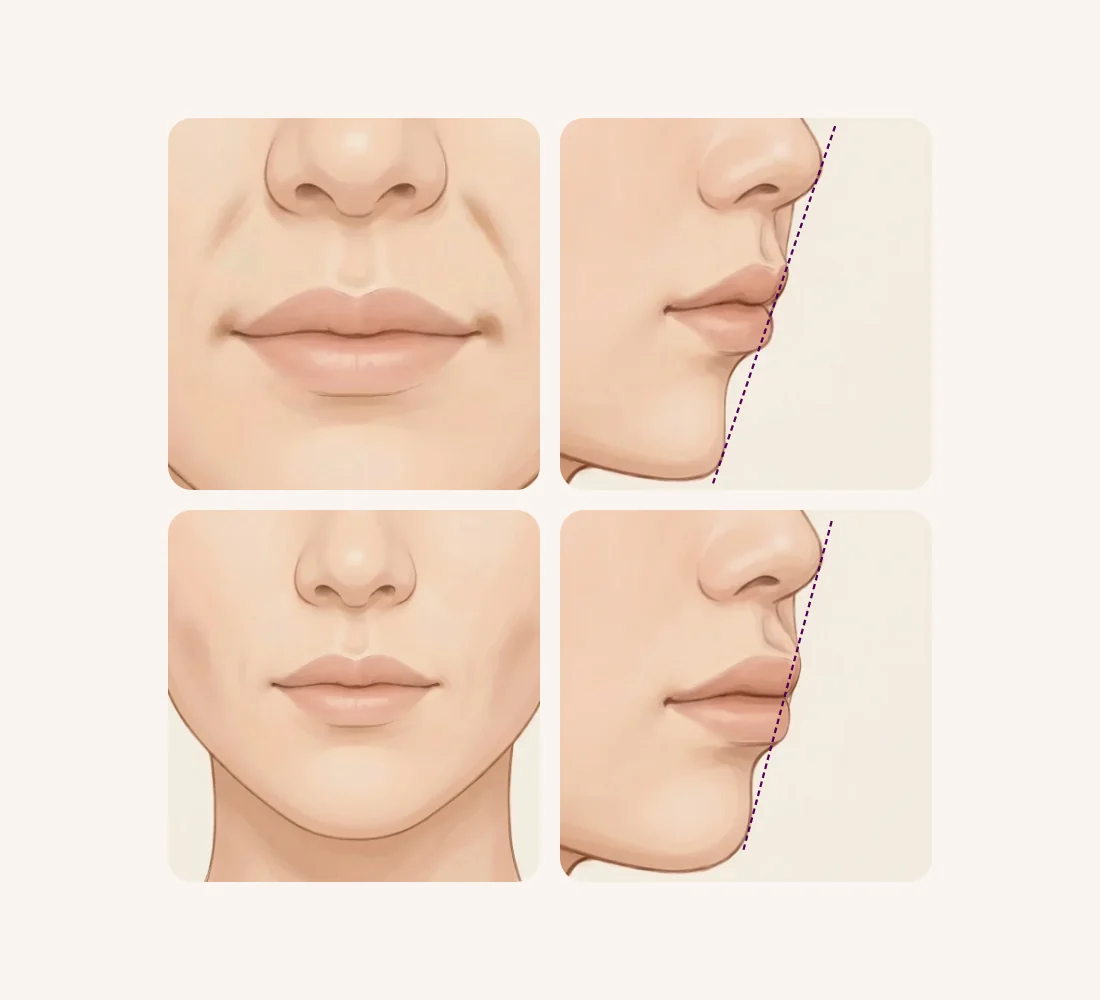
Does a protruding mouth always have the same cause?
A mouth that looks pushed forward is often called a protruding mouth. But the reasons behind that look differ from person to person. They fall into two broad groups.
In the first, the teeth and the bone that holds them (the alveolar bone, which surrounds and supports the tooth roots) sit forward. Upper and lower front teeth that are pushed forward and tilted, carrying the lips with them, are known as bimaxillary protrusion, which is common in Asian populations. It often comes with difficulty closing the lips comfortably, a gummy smile, and strain in the chin muscle when the lips are closed.1
Same lips, a moving reference line
In the second, the teeth and jaws are not especially forward, but the areas around the mouth are hollow or small, so the mouth looks prominent by comparison. Hollows around the smile lines that cast shadows, a short or set-back chin, or flat front cheeks all have the same effect. They can leave the mouth looking like the most forward part of the face.
One reference line often used for the profile is the E-line, drawn from the tip of the nose to the tip of the chin. When the chin sits further back, the line moves back too, and the same lips look more protruding.
In practice the two often overlap. Front teeth that look prominent and lips that do not close easily can also arise from other causes, such as a short upper lip or a vertically long upper jaw. That is why this is assessed properly rather than judged from appearance alone.1
How can I tell teeth and jaw from hollows around the mouth?
Before choosing a treatment, it helps to separate what is actually forward. The signs below are only clues you can check yourself. The tilt of the front teeth and the position of the jaws are confirmed by examination and imaging.
| What to check | Signs pointing to teeth and bone | Signs pointing to hollows around the mouth |
|---|---|---|
| Can you close your lips comfortably? | Only with effort, with dimpling of the chin1 | Yes, without strain |
| Do your gums show when you smile? | Often a lot of gum shows1 | Not much gum shows |
| What stands out in profile? | Front teeth and lips both come forward | The chin looks short or set back |
| How does the area around the mouth look from the front? | Lips look thick and pushed out | Hollows and shadows around the smile lines |
| What did an orthodontist tell you? | That the front teeth are tilted forward | That the tooth alignment is broadly fine |
What can fat grafting change, and what can it not?
Fat grafting does not move bone or teeth. It fills the hollow areas around the mouth with your own fat, changing the balance in which the mouth stood out on its own. Put simply, it does not push the mouth back; it brings the surroundings forward. So being clear from the start about what changes and what stays the same is the most important part of the decision.
What can change
- Hollows and shadows around the smile lines soften, so the mouth area stands out less
- Filling the chin changes the balance between nose tip and chin in profile
- Filling the front cheeks and the area under the cheekbones reduces a flat midface
What does not change
- The position and tilt of the front teeth, and the position of the upper and lower jaws
- Difficulty closing the lips, a gummy smile, or a bite (the way upper and lower teeth meet) in which the front teeth do not touch
- The thickness and projection of the lips themselves: filling the surroundings does not push the lips back
What changes, and what does not
| Approach | Changes | Cannot change | Good to know |
|---|---|---|---|
| Fat grafting around the mouth | Volume of hollow smile lines, cheeks, chin; profile balance | Tooth and jaw position, lip closure, gum show | Part is absorbed; a top-up may be needed |
| Orthodontics with extractions | Position and tilt of the front teeth, lip protrusion | Size and position of the jaw bones | Dental specialty; lip change of a few mm |
| Jaw surgery | Moves front tooth-bearing bone and teeth back | Hollow areas | Oral and maxillofacial surgery; major recovery |
So if the teeth and alveolar bone protrude a lot and closing the lips is uncomfortable, fat grafting alone is unlikely to give the change you are hoping for. In that case the realistic range of change with fat grafting should be explained first, with a referral for orthodontic or jaw surgery consultation where appropriate.
On the other hand, filling too much can make the lower face look bulky. So the amount is decided with the balance of the whole face in mind.
What do orthodontics and jaw surgery change?
The following is general medical information. Orthodontics and jaw surgery are diagnosed and treated by orthodontists and oral and maxillofacial surgeons (specialists in surgery of the mouth, jaws and facial bones).
The typical orthodontic treatment for bimaxillary protrusion removes the four first premolars and uses that space to pull the front teeth back and upright. Clear skeletal problems need jaw surgery. Procedures such as anterior segmental osteotomy, which cuts the front tooth-bearing bone and moves it back, are considered when orthodontics alone cannot correct the flaring of the front teeth.1
A systematic review (a study that gathers all relevant research by a set method) looked at extraction orthodontics in adults with bimaxillary protrusion. The upper lip moved back by 2 to 3.2 mm and the lower lip by 2 to 4.5 mm. The change was fairly predictable but small, did not dramatically alter the profile, and varied widely between individuals.2
After anterior segmental osteotomy, lip prominence decreased and the angle between the nose and upper lip increased. But how much the soft tissue, such as the lips, followed the bone varied between studies.3 In the end, with either braces or surgery, how far the lips will move back differs a great deal from person to person.
How is protruding-mouth fat grafting done, and what is recovery like?
At Bonita Clinic, we assess the face anatomically. Your own fat is grafted into the areas that make the mouth look protruding, such as the smile lines, cheekbones, cheeks and chin. The areas and amount depend on the shape of your face and how far the mouth protrudes.
At Bonita Clinic, fat grafting for a protruding mouth is classed as a non-surgical treatment. We perform it under sedation combined with local anesthesia, with same-day discharge. Stitches are placed where the fat is harvested. How long recovery takes and how many follow-up visits you need depend on the areas treated and your condition.
| Stage | Common changes | What the clinic does |
|---|---|---|
| Right after treatment | Swelling and bruising at the harvest and graft sites | Explains aftercare |
| During recovery | As swelling subsides, the contour of the filled areas appears | Checks progress |
| As it settles | Part of the graft is absorbed and the rest settles | Checks how the fat has taken and whether a top-up is needed |
What are the limits and side effects of fat grafting?
A systematic review of 18 studies (3,073 patients) looked at facial fat grafting. The proportion of grafted volume that remained ranged from 13% to 68% and differed by area. So it is hard to know in advance exactly how much of the fat will stay.
In the same review, the overall complication rate was 6%. The most common problems were bruising or hematoma (blood collecting under the skin, 5%), fat necrosis or oil cysts (2%) and uneven results (2%). In fat necrosis or oil cysts, fat that did not survive hardens or leaves an oily lump. No major complications were reported. The authors noted that most studies looked back at past records without a comparison group, so the evidence is weak and results vary widely between studies.4 This is why the final shape may not be reached in one session and a top-up graft can be needed.
There is also a rare but serious risk. If injected material enters a blood vessel and blocks the artery supplying the eye, sight can be lost. In a review of 32 people who lost vision after cosmetic facial injections, 15 cases followed fat injection.6 Korean retina specialists ran a national survey. Artery blockages after fat injection were more extensive than after hyaluronic acid filler, had a worse visual outcome and were more often accompanied by stroke.5
Precautions proposed in the literature include small, blunt cannulas (thin tubes with a rounded tip used instead of a sharp needle). They also include low-pressure injection of small amounts and limiting the total volume in one session.6 Eye pain or blurred vision during or after treatment must be reported immediately.
How we approach it at Bonita Clinic
In these cases, what we check first
1Hollow smile lines make the mouth look forward
We decide where and how much to fill around the smile lines and mouth
Protruding-mouth fat grafting
2The chin looks set back
The chin is filled as well, and the profile balance (E-line) is checked
Chin fat grafting
3Front cheeks and cheekbone area are hollow
We decide whether to fill the cheeks and cheekbone area too
Cheek fat grafting
4Teeth and gums protrude a lot
We first explain whether fat grafting can make the change, and suggest orthodontic or jaw surgery advice if needed
Checked at consultation
Treatment options you can discuss in Seoul
Bonita Clinic has treated patients at the same location since opening in 1995, with Dr. Kwang-Seop Chung, a board-certified plastic surgeon trained in Brazil, seeing patients himself. For a mouth that looks protruding because of the surrounding areas, the options you can discuss are:
- Fat grafting to the area around the smile lines and mouth
- Fat grafting to the chin to rebalance the profile
- Fat grafting to the front cheeks and cheekbone area when they are hollow
- A follow-up check of how the fat has taken, and a top-up graft if needed
Orthodontics and jaw surgery are not part of this treatment. If your teeth or jaws are the main cause, the limits of fat grafting are explained first at consultation. Advice on braces or jaw surgery comes from orthodontists and oral and maxillofacial surgeons.
Why do the plan and cost differ from person to person?
Two people who both describe a protruding mouth may need very different plans. Which areas are filled and how much fat is needed shape both the plan and the cost.
- Which areas need filling: smile lines, cheeks, chin
- How much fat is needed, and where it is harvested
- Anesthesia: sedation with local
- Whether a top-up session may be needed
- Earlier fillers or fat grafting in the area
- Dental or jaw protrusion needing other care
Final plan and quote after an in-person exam
A final estimate is given after an in-person examination, once the areas and amount are clear. Photos give a first impression, but they cannot set the scope.
What can photos show, and what needs an in-person exam?
Profile photos are especially useful for this question. But whether the teeth or the surroundings are the main cause cannot be settled from photos alone.
Photos can show
- Chin position and the nose-to-chin line
- Hollows and shadows around the smile lines
- Lips at rest and when smiling
- Gum show when smiling
Needs an in-person exam
- Tooth tilt and jaw position (dental X-rays)
- Whether the lips close without strain
- Tissue thickness, earlier filler
- Fat available to harvest
- Health and medicines
Helpful photos: straight on, both sides at 45 degrees and both full profiles, with your lips gently closed and then with a slight smile. Tie your hair back and use even light, without makeup. If you have had orthodontic consultations, a summary of what you were told helps too. Feel free to message us your photos and questions.
Planning your visit and recovery
What is confirmed in advance is limited to the treatment information above: sedation with local anesthesia, same-day discharge and stitches at the harvest site. How long to stay in Seoul, when to have a follow-up check and whether a later top-up is likely depend on the areas treated and the amount grafted. They are planned together with you at consultation.
Swelling and bruising at both the harvest and graft sites are expected at first, and the filled contour becomes clearer as the swelling goes down. How much fat has taken is judged later, when the graft has settled. So a top-up, if needed, is planned for a later visit rather than the same trip.
After you return home, contact a doctor promptly if pain, redness or swelling increases instead of settling, and seek emergency care at once for any change in vision. Keeping dated photos of your recovery also helps any doctor who sees you later.
Real treatment cases
These cases appear on Bonita Clinic's protruding-mouth fat grafting page. Results vary from person to person.
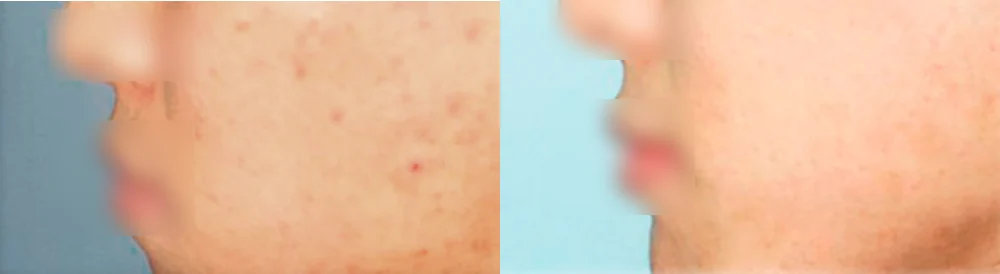
A short, set-back chin making the mouth look protruding (side view)
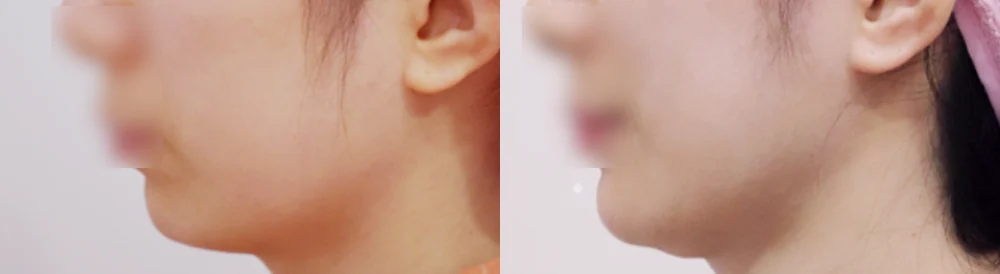
A chin that looked set back (side view)
* Results vary from person to person. Side effects are possible, so please decide after a thorough consultation with a doctor.
Frequently asked questions
Can my mouth look less protruding without bone surgery?
If the mouth looks more prominent because the area around it and the chin are hollow, filling these with your own fat can change the balance of your profile. If the front teeth and alveolar bone themselves protrude a lot, the change from fat grafting is small. That range is explained at consultation first.
I'm already considering orthodontics. Should fat grafting come first?
The two change different things. If braces bring the front teeth and lips back, the volume needed around the mouth may also change. So tell us about any orthodontic plans and the expected change. The order and timing are worth deciding together.
Won't all the grafted fat disappear?
Part of it is absorbed and the fat that takes remains. How much remains varies between people and areas. So the amount is planned with this in mind, and a top-up is decided after watching your progress.
Will there be a scar?
The face itself is not incised. The site where fat is taken has stitches and may leave a small mark; where fat is taken from is explained at consultation.
Will my smile lines improve too?
Hollows around the smile lines are often filled as part of this treatment. How deep the lines are also depends on sagging and skin quality. If sagging is significant, other methods may be considered alongside.
What to prepare before your consultation
- Photos from the front, both 45-degree angles and both profiles, with lips relaxed and with a slight smile
- If you have seen an orthodontist, what you were told and when
- Earlier fillers, fat grafting or thread lifts around the mouth and chin, and when they were done
- Whether closing your lips takes effort, and whether a lot of gum shows when you smile
- Medicines you take and any health conditions
Bonita Clinic is on the 3rd floor of 565 Gangnam-daero, Seocho-gu, Seoul, about 100 m on foot from Exit 8 of Nonhyeon Station (Line 7). More about the procedure is on our Fat Grafting for Protruding Mouth page. Combined approaches to sagging and volume are on the Multi-Lifting page and in our multi-lifting guide. If the area around your mouth bulges because of earlier filler or foreign material, see Mouth & Lip Revision and our guide to lip filler and foreign material removal.
References (6)
Sources that support the explanations in this article. Study findings describe general trends and do not guarantee individual results.
- Chu YM, Bergeron L, Chen YR. Bimaxillary protrusion: an overview of the surgical-orthodontic treatment. Semin Plast Surg. 2009;23(1):32-39.doi:10.1055/s-0028-1110099Review: bimaxillary protrusion (forward teeth and alveolar bone) is common in Asian populations and comes with flared incisors, lip procumbency, lip incompetence, gummy smile and chin muscle strain; similar features can have other causes; indications for extraction orthodontics and jaw surgery such as anterior segmental osteotomy
- Leonardi R, Annunziata A, Licciardello V, Barbato E. Soft tissue changes following the extraction of premolars in nongrowing patients with bimaxillary protrusion. A systematic review. Angle Orthod. 2010;80(1):211-216.doi:10.2319/010709-16.1Systematic review (abstract): after premolar extraction in adults with bimaxillary protrusion, the upper lip retracted 2 to 3.2 mm and the lower lip 2 to 4.5 mm; predictable but small, with large individual variation
- Jayaratne YS, Zwahlen RA, Lo J, Cheung LK. Facial soft tissue response to anterior segmental osteotomies: a systematic review. Int J Oral Maxillofac Surg. 2010;39(11):1050-1058.doi:10.1016/j.ijom.2010.07.002Systematic review (abstract): after anterior segmental osteotomy for bimaxillary protrusion, common in Asians, lip prominence decreased and the nasolabial angle increased, with the size of soft tissue change varying between studies
- Groen JW, Krastev TK, Hommes J, et al. Autologous Fat Transfer for Facial Rejuvenation: A Systematic Review on Technique, Efficacy, and Satisfaction. Plast Reconstr Surg Glob Open. 2017;5(12):e1606.doi:10.1097/GOX.0000000000001606Systematic review of 18 studies and 3,073 patients: graft retention 13 to 68% depending on area, 6% complications (bruising or hematoma 5%, fat necrosis or oil cysts 2%, irregularity 2%), low-level and heterogeneous evidence
- Park KH, Kim YK, Woo SJ, et al. Iatrogenic occlusion of the ophthalmic artery after cosmetic facial filler injections: a national survey by the Korean Retina Society. JAMA Ophthalmol. 2014;132(6):714-723.doi:10.1001/jamaophthalmol.2013.8204National survey of 44 patients by the Korean Retina Society (abstract): ophthalmic artery occlusion after cosmetic facial injections; fat injections (22) caused more extensive occlusion, worse vision and more stroke than hyaluronic acid (13)
- Lazzeri D, Agostini T, Figus M, et al. Blindness following cosmetic injections of the face. Plast Reconstr Surg. 2012;129(4):995-1012.doi:10.1097/PRS.0b013e3182442363Systematic review (abstract): of 32 cases of blindness after cosmetic facial injections, 15 followed fat injection; proposed precautions such as small blunt cannulas, low pressure, small amounts and limited total volume
About this article
This article separates general medical information from Bonita Clinic's own approach. Because the right decision depends on each person's condition, it is not a substitute for a consultation.
