 KOKorean
 ENEnglish
 JP日本語
JP日本語 CN中文(简体)
 TW中文(繁體)

Direct Brow Lift in Seoul: When Heavy Upper Eyelids Come from a Drooping Brow
If your upper eyelids look heavy because the eyebrows have dropped, correcting the brow position is usually considered first. Removing eyelid skin alone may leave the hooding in place, or even let the brows sink further. A direct brow lift removes a strip of skin just above the brow to raise it. In middle-aged and older patients it lifts the outer brow fairly predictably, but it leaves a scar along the upper edge of the brow and can change forehead sensation. How far the brow has really dropped can only be judged with the eyes closed and the forehead fully relaxed, so diagnosis comes before choosing an operation. If you are considering treatment in Seoul, you can send photos first to see which approach may suit your case.
Has the eyelid stretched, or has the brow come down?
When your eyes start to look smaller and your eyelids heavier with age, the upper eyelid skin is usually the first suspect. But the skin covering the eye can come from two things. The eyelid itself may have stretched, or the brow may have moved down and dragged the skin below it down too. One review (a paper that gathers and summarises many studies) notes that many people seeking eyelid surgery also have some brow descent, so the two often overlap.1
Clinically, the brow is considered to have dropped (brow ptosis) when part or all of it sits below the bony upper rim of the eye socket. This rim is the supraorbital rim, the bony ridge above the eye.2 The brow usually drops first at its outer tail, which is described as the earliest visible sign of forehead ageing.3 When the outer brow sags, the outer part of the upper eyelid becomes thickly hooded, giving a tired, heavy look.3
What changes when the brow comes down
If your forehead is always working
When the brows and eyelids block your view, you tend to lift the brows with the forehead muscle without noticing. This deepens the horizontal forehead lines. When you close your eyes and relax the forehead, the brows often sit much lower than you would expect.
A Korean study describes forehead muscle tension, brow position and upper eyelid sagging as closely linked. It stresses that the true amount of drop should be measured with the eyes closed and the forehead completely relaxed.3
In front of a mirror, keep your eyes open and gently lift your brows with a finger. If the heaviness above the eyes eases a lot, the brow may be part of the cause. However, ptosis (weak eye-opening muscles) or sagging of the eyelid skin itself is often present too. How much each one contributes is sorted out at the examination.
If the brow is the cause, why isn't eyelid surgery enough?
If some or all of the excess upper eyelid skin comes from brow descent, upper blepharoplasty, which removes only eyelid skin, may not deal with the hooding well. The bigger problem is that the brow can drop further after surgery and give an awkward result. So some surgeons advise that clear brow descent should be corrected before excess eyelid skin is addressed.2
Why would the brow drop further?
The reason lies in the forehead muscle. While eyelid skin blocks your view, the forehead muscle keeps pulling the brows up. When upper blepharoplasty clears the view, that tension relaxes, and the brow settles back to its original low position. The forehead muscle that was holding the brow up gets to "rest".
The Korean study found that the outer brow often drops further after a crease is made with upper blepharoplasty. The authors corrected the brow first and did the blepharoplasty only after the swelling had fully settled.3 Two early patients needed a second brow lift after their later blepharoplasty, as the forehead relaxed further. The authors cited this as an example of why accurate measurement with the forehead relaxed matters.3
What ways are there to raise the brow?
Approaches to brow descent fall into four groups:1
- Non-surgical treatment such as botulinum toxin or filler
- Fixing the brow through a double-eyelid (crease) incision
- A direct lift through an incision just above the brow
- A forehead lift through the forehead or scalp, raising the whole forehead
The review concludes that no single method is better than the others. Each has its own limits in how much it lifts, how long it lasts and its side effects.1
Ways to treat a low brow
| Method | Incision | Suits | Good to know |
|---|---|---|---|
| Direct brow lift | Just above the brow | Outer brow ptosis, middle age and beyond | Scar above the brow, forehead numbness |
| Infrabrow (sub-brow) excision | Just below the brow | Thick upper eyelid skin | A form of eyelid surgery, not a brow lift |
| Browpexy via eyelid incision | Eyelid crease | Stabilizing the brow during eyelid surgery | Lifts only a little |
| Endoscopic forehead lift | Several small scalp incisions | Whole forehead and brow descent | Needs equipment and training; durability limits reported |
| Hairline or scalp forehead lift | Hairline or scalp | Forehead lines treated at the same time | Long incision; numbness or hair loss possible |
| Botulinum toxin | Injection | Mild drooping of the brow tail | Temporary effect |
How is it different from a "sub-brow lift"?
The similarly named sub-brow lift is a different kind of operation. In East Asian eyes, upper eyelid skin gets thicker toward the brow. So in older patients, a standard blepharoplasty that removes a lot of skin can leave a crease that folds awkwardly through thick skin. For this reason, removing thick skin just below the brow, without changing the crease, is widely used in Asia, and it is classed academically as a type of eyelid surgery.5 A direct brow lift, by contrast, changes the height of the brow itself.
How is a direct brow lift done?
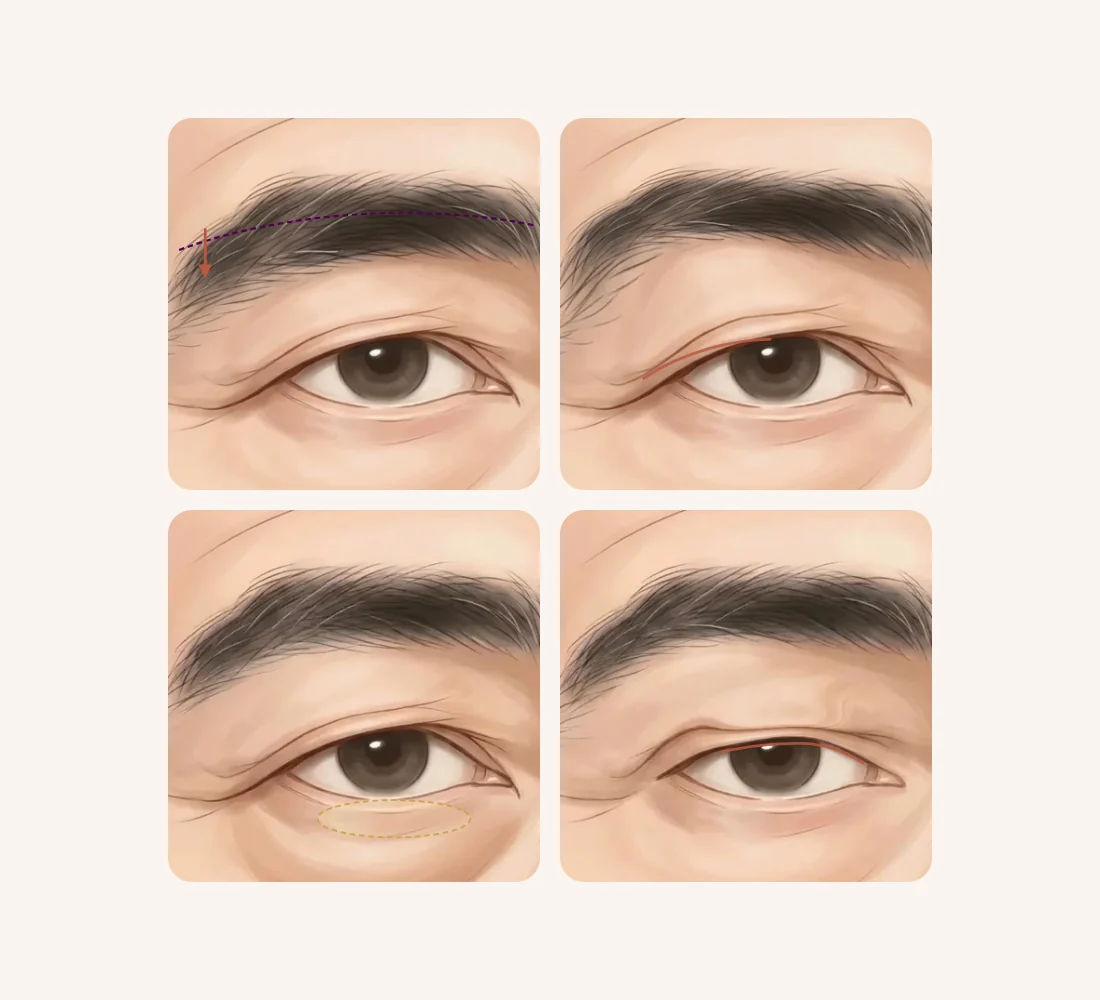
A direct brow lift removes a long crescent of skin and fat from just above the brow, along the upper border of the brow hairs. The wound is then closed, which moves the brow to the chosen height.23
- Before surgery, the brow is lifted by hand to the desired height.
- That amount is marked to set the width of skin to remove.2
- The marked skin and fat are removed and the wound is closed.
In a study of 60 Korean patients, the width of skin removed at the peak of the brow averaged 8 mm (range 5–15 mm).3
Removing a crescent above the brow, step by step
Above the brow: what is removed
The advantages are a simple procedure, a large lift for the amount of skin removed, and easy direct control of brow height and shape.12 Sensory nerves and blood vessels run through the inner forehead, so that area is handled only within the fat layer under the skin. Further out, the surgeon goes down to just above the muscle.2
What are the limits?
- It is effective for lifting the outer brow, but limited for lifting the inner end.3
- It does not smooth horizontal forehead lines directly.1
- The brow can settle slightly after surgery, mostly within the first year.1
How visible are the scar and the change in sensation?
The scar is what people ask about most. Because the incision follows the edge of the brow hairs, it often becomes less noticeable over time, but people differ a lot.
A study looked back at 54 direct brow lifts (36 patients, average age 69) over 13 years at one UK hospital. Of the 43 lifts with survey answers, 81% were rated satisfactory for scar appearance, while two patients whose scars were prominent early on remained dissatisfied.2 About 8 in 10 were happy with the scar. In the Korean study most scars were barely visible, but they showed more in thick, oily or darker skin and in younger patients.3 So one author uses the method mainly for restoring function around the eyes in middle-aged and older patients. It is used less for cosmetic purposes in younger people, whose scars may show more.2
Other points to know:
- Forehead numbness: a dull or tingling forehead is fairly common. In the UK study, 74% of 43 lifts had some change in sensation, but only 7% were unhappy about it.2 A review notes that reduced sensation usually recovers over several months.1
- Brow tattoos: part of a tattoo lying in the incision line was sometimes removed with the skin and needed touching up later.3
- Other problems: wound infection, inflammation around stitches and wound separation have been reported occasionally.23 If the scar becomes sunken or thick, scar treatment or revision may be needed.1
What if the drooping blocks your vision?
Brow descent, and the eyelid hooding it causes, can block your view. In a study of 14 patients over 50 who had a direct lift extended toward the outer side, all reported better vision and less heaviness of the brow. Scars were reported to be barely visible after 6 to 9 months.4 It is a small study, so the findings are hard to generalise. The same study added that long, thick brows and low forehead lines help hide the scar.4
Should it be done with upper blepharoplasty?
Some people have only brow descent, but many also have sagging upper eyelid skin. In the UK study, 36 of 54 lifts also had excess eyelid skin, and 15 of these later had upper blepharoplasty.2 In the Korean study, nearly half of the 60 patients, especially those over 60, had only the brow lift and no blepharoplasty. They were still very satisfied because their eyes felt lighter to open.3
When both are done, the order matters. Only once the brow height is settled can the remaining eyelid skin be measured accurately. The studies corrected the brow first and did blepharoplasty after the swelling settled.23 Whether to do both on the same day or in stages is decided at consultation, based on how much has dropped and your recovery plans. The crease and eye-opening strength are covered in the guide to upper blepharoplasty.
How we approach it at Bonita Clinic
By what is making the eyes heavy
1The brow has dropped over the eye
Correcting the brow position is considered first
Direct brow lift
2Upper eyelid skin is sagging
Removing the stretched eyelid skin is considered
Upper blepharoplasty
3Under-eye fat bulges and sags
Treating under-eye fat and skin is considered
Lower blepharoplasty
4The lid margin covers the iris
Eye-opening strength is checked; correction considered
Ptosis correction
At Bonita Clinic, we perform the brow lift as surgery under sedation combined with local anesthesia. You go home the same day, and stitches are used. How long recovery takes, and how many follow-up visits you need, depends on how much the brow is lifted and on how you heal.
Treatment options you can discuss in Seoul
Since opening in 1995, Bonita Clinic has stayed at one location, and Dr. Kwang-Seop Chung, a plastic surgeon board-certified in Brazil, still examines and operates on patients himself. For heavy upper eyes, the options discussed in consultation are:
- An assessment of brow position, eyelid skin, eye-opening strength and under-eye fat
- Brow lift through an incision along the upper border of the brow
- Upper blepharoplasty when excess eyelid skin remains, with ptosis correction considered if the eye-opening muscle is weak
- Lower blepharoplasty when under-eye fat and sagging are part of the tired look
Which of these you need, and in what order, is decided only after an examination.
Why the plan and cost differ from case to case
Two people with "heavy eyelids" can need very different operations. The cause and how much surgery is needed, rather than the name of the procedure, shape the plan and the cost.
- Brow alone, or eyelid skin as well
- One side or both, and the incision length
- Upper blepharoplasty or ptosis repair added
- Same day or staged surgery
- Anesthesia: sedation with local
- Brow tattoo or previous eye surgery
Final plan and quote after seeing you in person
A final estimate is given only after the in-person examination, once the true brow position, the amount of eyelid skin and your eye-opening strength have been checked. Photos help point in a direction, but the true brow drop has to be measured in person.
What photos can show, and what needs an in-person exam
Photos are a good starting point. But the key measurement for a brow lift is taken with the forehead relaxed, which is hard to judge from a picture.
Photos can show
- Brow height and symmetry
- How much skin hangs over the lashes
- Forehead lines and frown lines
- Brow tattoo shape and position
- Change over time (older photos)
Needs an in-person exam
- True brow drop with the forehead relaxed
- Eye-opening strength (ptosis)
- Eyelid skin left once the brow is lifted
- Skin thickness and oiliness
- Eye closure and dryness
Helpful photos: face straight on with the eyes open, the same view with the eyes gently closed and the forehead relaxed, and both sides at 45 degrees. Use even light and keep the brows uncovered. A photo from 10 to 20 years ago helps show where your brows used to sit. You can send us a message with your photos and any previous eye surgery or brow tattoo.
Planning your visit and recovery
What is confirmed in advance is limited to the treatment information above: surgery under sedation with local anesthesia, same-day discharge, and stitches. How long you should stay in Seoul, when the stitches come out and how many visits you need all vary. They depend on the extent of surgery and on whether eyelid surgery is added. These are planned with you at consultation and may vary.
At Bonita Clinic, the usual course of recovery is this: swelling and bruising are common right after surgery, and we show you how to use cold compresses. The stitches are then removed as the swelling goes down and the brow and eye area look more natural. Finally, the settled line is checked. If eyelid surgery is planned as a second stage, the timing is set after the swelling from the brow lift has settled.3
After you return home, some forehead numbness is common and usually improves over months,1 and the brow can settle slightly during the first year.1 Contact a doctor promptly if redness, pain, swelling or discharge increases instead of settling. Keeping dated photos of the healing brow helps any doctor you see later compare progress.
Real treatment cases
These cases appear on Bonita Clinic's brow lift page. Results vary from person to person.
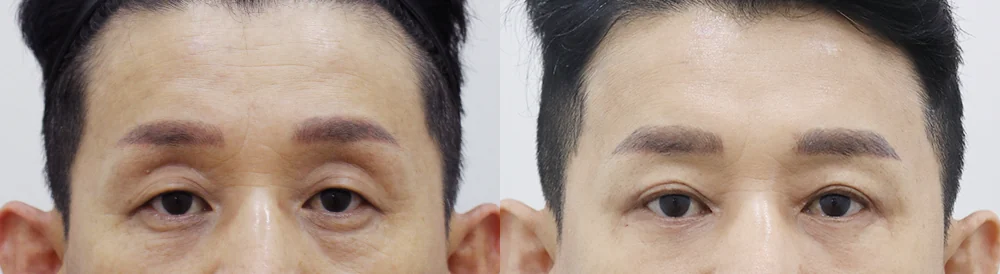
Brows and upper eyelid skin hanging low, making the eyes look small (front view)
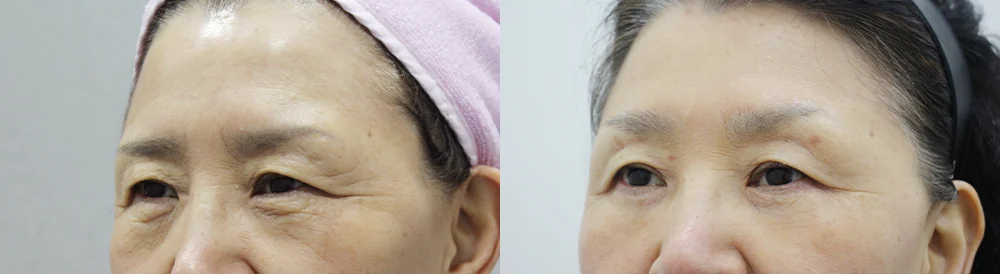
Thick hooding over the outer upper eyelids (angled view)
* Results vary from person to person. Side effects are possible, so please decide after a thorough consultation with a doctor.
Frequently asked questions
How is this different from double-eyelid surgery or upper blepharoplasty?
Upper blepharoplasty removes excess skin from the eyelid itself; a brow lift removes skin above the brow to raise the brow. If the hooding comes from a low brow, a new crease alone may leave the heaviness. Once the view clears, the forehead can also relax and let the brow drop further. When both problems are present, correcting the brow first is usually considered.
Will the scar be visible?
Because the incision follows the upper edge of the brow, the scar often becomes less visible as it is hidden by the brow hairs over time. It is still a procedure that leaves a scar. It may show more in thick, oily or darker skin and in younger patients, so skin type and brow density are checked at the examination.
Can I have it if my brows are tattooed?
Yes. Part of the tattoo that falls within the incision may be removed, so the tattoo may need touching up later.3 Whether the incision follows the hair border or runs inside the tattoo is decided at consultation based on the tattoo's position and shape.
Will it smooth my forehead or frown lines?
A direct brow lift changes the height of the brow; it does not smooth horizontal forehead lines or frown lines directly.1 People who have been constantly lifting a low brow may use the forehead less afterward,3 but how much this changes varies.
How long is recovery?
When the stitches come out and how long swelling lasts depend on the extent of surgery and on the individual. Swelling and bruising are expected at first, and cold compresses are explained. After the stitches are removed, the swelling eases and the brow and eye area look more natural. If you have important plans, tell us at consultation and we will plan around them.
What to prepare before your consultation
- Photos with the eyes open, and with the eyes closed and forehead relaxed
- A photo from 10 to 20 years ago, if you have one
- Whether you have brow tattoos or microblading, and when it was done
- Previous eye surgery: double-eyelid, blepharoplasty or ptosis repair
- Whether your vision feels blocked or your forehead often feels tense
- Medicines you take regularly, especially blood thinners
Bonita Clinic is on the 3rd floor of 565 Gangnam-daero, Seocho-gu, Seoul, about 100 m on foot from Exit 8 of Nonhyeon Station (Line 7). You can read more on our Brow Lift page and the overview of Eye Surgery for Middle Age. For eyelid skin and eye-opening strength, see the Upper Blepharoplasty page and our guide to upper blepharoplasty. For under-eye sagging, see the guide to lower blepharoplasty, and for ptosis from weak eye-opening muscles, the eye surgery guide.
References (5)
Sources that support the explanations in this article. Study findings describe general trends and do not guarantee individual results.
- Karimi N, Kashkouli MB, Sianati H, et al. Techniques of Eyebrow Lifting: A Narrative Review. J Ophthalmic Vis Res. 2020;15(2):218-235.doi:10.18502/jovr.v15i2.6740Narrative review: pros and cons of brow-lift techniques (botulinum toxin and fillers, browpexy through the eyelid incision, direct lift, endoscopic and scalp-incision forehead lifts); most blepharoplasty candidates have some brow ptosis; brow descent after a direct lift (mainly in the first year), scars and numbness; no technique is superior to the others
- Booth AJ, Murray A, Tyers AG. The direct brow lift: efficacy, complications, and patient satisfaction. Br J Ophthalmol. 2004;88(5):688-691.doi:10.1136/bjo.2003.019232Case series of 54 direct brow lifts (36 patients, mean age 69): 81% satisfied with the scar, altered sensation in 74% (7% bothered); definition of brow ptosis; why significant brow ptosis should be corrected before eyelid surgery; dissection depth to protect nerves; the authors reserve it for rehabilitative lifts in middle age and beyond
- Lee JW, Cho BC, Lee KY. Direct brow lift combined with suspension of the orbicularis oculi muscle. Arch Plast Surg. 2013;40(5):603-609.doi:10.5999/aps.2013.40.5.603Korean case series of 60 direct brow lifts: the outer brow drops first; links between forehead muscle tone, brow position and eyelid hooding; measuring with the forehead relaxed; mean excision width 8 mm; brow first and eyelid surgery later; scars more visible in thick, oily or young skin; partial loss of brow tattoos; limited lift of the inner brow
- Har-Shai Y, Gil T, Metanes I, et al. Brow lift for the correction of visual field impairment. Aesthet Surg J. 2008;28(5):512-517.doi:10.1016/j.asj.2008.07.009Small case series (abstract): an extended direct brow lift in 14 patients over 50 with visual field impairment; all reported relief of the visual field and brow heaviness; scars hardly noticeable after 6 to 9 months; long, dense brows help conceal the scar
- Kiranantawat K, Suhk JH, Nguyen AH. The Asian Eyelid: Relevant Anatomy. Semin Plast Surg. 2015;29(3):158-164.doi:10.1055/s-0035-1556852Review of Asian upper eyelid anatomy: eyelid skin thickens toward the brow, so removing a lot of skin in standard blepharoplasty can look unnatural in older Asian patients, which is why infrabrow (sub-brow) excision is popular in Asia
About this article
This article separates general medical information from Bonita Clinic's own approach. Because the right decision depends on each person's condition, it is not a substitute for a consultation.
