 KOKorean
 ENEnglish
 JP日本語
JP日本語 CN中文(简体)
 TW中文(繁體)

Upper Blepharoplasty in Seoul: What It Changes for Vision and Appearance After 40
When stretched upper eyelid skin hangs over the lash line, removing the excess with upper blepharoplasty can widen the upper field of vision and make the eyes look less heavy. Studies commonly report improvements in visual field and daily comfort. The hooding may come from weak eye-opening muscles (ptosis) or a drooping brow, however. Then removing skin alone can leave the eyes looking heavy and may even let the brows drop further. Removing more skin does not mean a better result, so the key is to judge skin, fat, eye-opening strength and brow position together before deciding how much to take. If you are considering surgery in Seoul, you can send photos first to see which approach may fit your eyes.
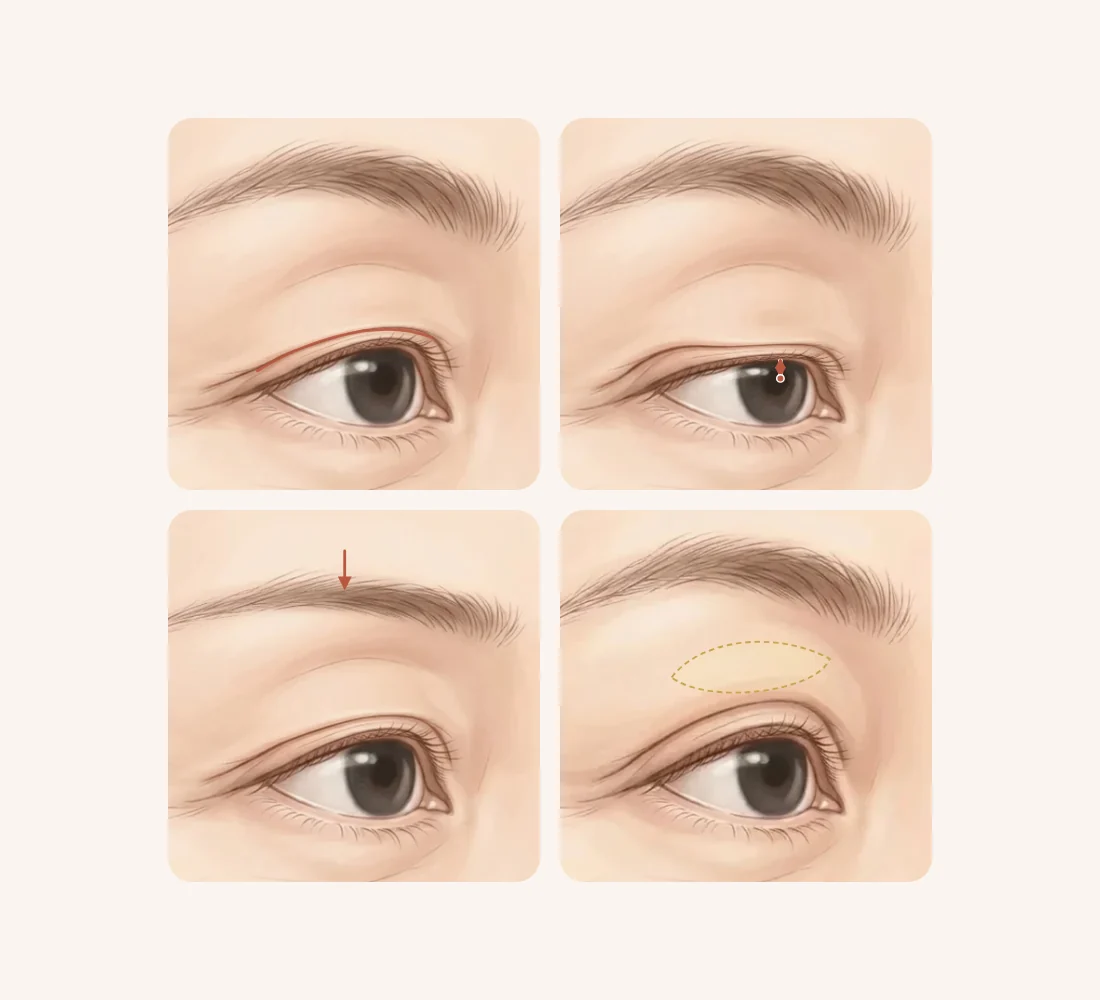
Why do upper eyelids become heavy?
With age, upper eyelid skin stretches and begins to hang over the lash line. This is called dermatochalasis (skin laxity), and upper blepharoplasty is the operation that removes this excess skin.
But skin is not always the only reason the eyes look small and heavy. These causes can also play a part:
- Ptosis: the muscle that lifts the lid and its tendon (the levator aponeurosis) have weakened, so the lid margin itself sits lower.
- Brow descent: the brow has dropped and pushes skin down from above.
- Fat: the amount and position of fat inside the lid can make it look full.
That is why one review (a paper that gathers and summarises many studies) lists checks to make before upper blepharoplasty. Brow descent and asymmetry, ptosis, crease height, whether the lids close fully and dry eye should all be checked.5
Which situation is closest to yours?
The first choice depends on the cause. These are the four most common situations.
The first choice depends on the cause
1Skin hangs over the lash line
Upper blepharoplasty removes the excess skin
Upper blepharoplasty
2The lid margin covers the iris
Eye-opening strength is checked; ptosis correction considered
Ptosis correction
3A lowered brow pushes skin down
A direct brow lift is considered first
Direct brow lift
4The upper lids look full
Whether to trim fat is decided together; too much can look hollow
Fat trimming
What to look at in the mirror first
- Skin: with your eyes open, gently lift the lid skin with a finger. If the lash line shows clearly and the lid margin does not cover much of the top of the iris, loose skin is the more likely main cause.
- Eye-opening strength: if the lid margin still covers much of the iris with the skin lifted, ptosis is considered. A distance of 2 mm or less from the pupil centre to the upper lid margin (MRD1) is given as one sign that functional surgery may be appropriate.1
- Brow: if lifting your brows with a finger greatly eases the heaviness, brow descent may be part of it. This is covered separately in the direct brow lift guide.
What you see yourself is only a guide. Two or more causes often overlap, so the examination checks each one in turn.
What does upper blepharoplasty remove?
The upper lid is made of several thin layers stacked together. From the outside in:4
- Skin
- Orbicularis muscle: the muscle that closes the eye
- Orbital septum: a thin membrane that holds the fat in place
- Orbital fat: the fat that cushions the eye
- Levator aponeurosis: the tendon of the muscle that lifts the lid
- Muller's muscle: a small muscle that helps lift the lid
- Conjunctiva: the moist lining on the inside of the lid
East Asian eyelid skin is among the thinnest skin in the body, but it gets thicker toward the brow. It is about 0.3 mm near the lashes and about 0.8 mm over the tarsal plate (the firm plate that gives the lid its shape). Just below the brow it is 1–1.3 mm.4 The orbital fat also often sits lower than in Western eyelids, reaching close to the top edge of the tarsal plate. This is why the upper lid tends to look full.4
Upper-lid cross-section: what is removed, what is kept
What upper blepharoplasty mainly removes is the stretched skin. Depending on the lid, part of the orbicularis muscle and bulging fat may be trimmed as well. To reach the fat, the septum has to be opened, but the levator aponeurosis behind it must be kept intact. The two layers join near the bottom, so telling them apart matters.5 The levator aponeurosis is what passes the eye-opening force to the lid. Put simply, the layer that is removed and the layer that must be protected lie very close together.
Does it widen your vision, or change how you look?
It can do both. Upper blepharoplasty is easy to think of as purely cosmetic, but when sagging skin blocks the upper field of vision, it is also surgery that restores function.
An evidence assessment by the American Academy of Ophthalmology concluded that correcting ptosis and upper-lid skin laxity meaningfully improves vision, peripheral vision and quality of life related to daily activities.1 A systematic review (a study that collects all relevant research in a set way and analyses it) looked at 28 studies on the functional results of upper blepharoplasty alone. It also reported a wider visual field and better quality of life related to headaches and vision.2
Signs that vision may be a reason for surgery
The same assessment listed these as signs that surgery can be expected to improve function:1
- 2 mm or less from the pupil centre to the upper lid margin (MRD1)
- 12 degrees or more, or 24% or more, of the upper visual field blocked
- The lid drooping when you look down, getting in the way of reading or close work
- Raising your chin and tilting your head back to see
- Eye discomfort or tiredness from the drooping lid, and everyday difficulties you notice yourself
| Functional side | Cosmetic side | |
|---|---|---|
| Main concern | Blocked upper vision, opening the eyes with the forehead, tired eyes | Looking tired and heavy, a crease that shrinks or disappears, asymmetry |
| What is used to judge | Extent of upper visual field, lid margin position (MRD1), head-tilt posture | Front and side photos, crease height, balance with brows and face |
| Nature of the evidence | Improved visual field and quality of life reported in several studies12 | Satisfaction varies widely with expectations and preferences |
In practice, the two sides are often mixed in one person, and the same operation can change both. In the same review, however, lid sensation became dull after surgery and recovered to a different degree in different people. Results on brow height and dry eye differed between studies, so no firm conclusion could yet be drawn.2
Why should the brow and eye-opening strength be checked too?
The brows tend to come down a little after upper blepharoplasty. A meta-analysis (a study that pools many studies and recalculates the results) looked at the height from the pupil to the brow. It fell by 1.45 mm on average after upper eyelid surgery. It fell about 0.67 mm after simple blepharoplasty, 2.52 mm after double eyelid surgery and 2.10 mm after ptosis correction.3 The fall was larger in study groups from East Asian researchers, and whether skin was removed was not linked to the change in brow height.3
How far the brow came down after upper-lid surgery
If your brows were already low before surgery, the space between your eyes and brows can look narrower afterwards. So brow position is checked at the same time, and treating the brow first is considered when needed.
The same goes for eye-opening strength. If the skin has stretched and the eye-opening muscle has also weakened, removing skin alone can still leave a sleepy look. In that case ptosis correction is considered as well; this is covered in the eye surgery guide.
Is it better to remove more skin?
No. It may seem that removing more skin will open the eyes more, but in East Asian eyelids, "only as much as needed" is what matters.
It has been noted that traditional upper blepharoplasty removing a lot of skin in older East Asian patients can leave a crease that folds awkwardly through thick skin.4 The East Asian crease sits on average about 2 mm lower than in Western eyes, and lower in men (4–6 mm) than in women (6–8 mm). So finding a height that looks natural for the person is recommended, rather than copying a high Western crease.4
Only as much as needed: a crescent of skin
What goes wrong if too much is removed?
Over-removal is hard to undo.
- If too much skin is removed, the eyes may not close fully, and the clear front surface of the eye (the cornea) can dry out and be damaged. Leaving a set amount of skin below the brow is therefore given as a principle.5
- Removing too much fat or making the crease too high can leave the upper lid looking hollow, and refilling a hollow is not easy.5
- Some surgeons advise that in East Asian upper blepharoplasty the incision should stay low and the crease should not be raised too much, even in older patients. This is to avoid an unnatural "westernized" look, asymmetry and ptosis.5
Old photos are a useful guide to your original eye shape. The review adds, however, that trying to change the look of someone whose upper lids were naturally full is usually a mistake.5
How does recovery go, and what side effects can occur?
Bruising is an expected change for almost everyone after upper blepharoplasty. Cold compresses and resting with the head raised in the first few days are known to help recovery.5 A lid that looks droopy the day after surgery is commonly due to swelling and is usually temporary. Without clear muscle injury, it is usually watched for about three months before any judgement is made.5
Side effects to know about:
- Eye discomfort: swelling can make blinking less smooth, causing watering or a gritty feeling, so keeping the eyes moist is important.5
- Crease asymmetry: this is the result patients notice most. Even if a small adjustment is needed, waiting at least three months after the first operation is recommended.5
- Eyes not closing fully: this can happen when too much skin is removed, which is why the amount is set with the greatest care.5
- Rare but urgent: bleeding behind the eye with vision loss is a rare complication, estimated at between 1 in 2,000 and 1 in 25,000. Severe pain in one eye, reduced vision or a feeling that the eye is pushed forward needs an immediate call to the clinic.5
How we approach it at Bonita Clinic
Upper blepharoplasty at Bonita Clinic
- 1Analysis and design consultationLid sagging, eye-opening strength and balance assessed together
- 2Tailored upper blepharoplastyExcess skin removed to suit your eye structure
- 3Recovery and stabilizationProgress followed while the eyes settle naturally
At Bonita Clinic, we perform upper blepharoplasty as surgery under sedation combined with local anesthesia. You go home the same day, and stitches are used. The length of recovery and the number of follow-up visits depend on the extent of surgery and on how your eyelids heal.
Treatment options you can discuss in Seoul
Bonita Clinic opened in 1995 and has remained at the same address; Dr. Kwang-Seop Chung, who trained and was board-certified in plastic surgery in Brazil, sees each patient himself. For sagging upper eyelids, the options discussed in consultation are:
- An analysis of lid sagging, eye-opening strength, brow position and eye balance
- Upper blepharoplasty that removes excess skin, with fat and muscle trimmed only as your eyelid requires
- Ptosis correction considered together when the eye-opening muscle is weak
- A brow lift first when a drooping brow is the main cause
Which of these you need, and in what order, is decided only after an examination.
Why the plan and cost differ from case to case
Two people with "droopy eyelids" can need quite different surgery. What drives the plan and the cost is the cause and the amount of work, not the name of the operation.
- How much skin, and whether fat is trimmed
- Ptosis correction needed or not
- Brow lift before or alongside
- Previous eyelid surgery (revision)
- Anesthesia: sedation with local
- Crease design and asymmetry between eyes
Final plan and quote after seeing you in person
A final estimate is given only after the in-person examination, once skin, fat, eye-opening strength and brow position have been checked. Photos give a first impression; the scope is settled only once your eyelids have been examined.
What photos can show, and what needs an in-person exam
Photos show a lot about how your eyelids look, but much less about how they work.
Photos can show
- How much skin hangs over the lashes
- Crease shape and asymmetry
- Fullness of the upper lids
- Brow height at rest
- Change over time (older photos)
Needs an in-person exam
- Eye-opening strength and lid margin position
- Brow position with the forehead relaxed
- Thickness of skin and amount of fat
- How fully the eyes close
- Dry eye and other eye conditions
Helpful photos: face straight on with the eyes open, looking down, and both sides at 45 degrees, in even light without eye makeup. A photo from your younger years helps show your natural crease. You can send us a message with your photos and any previous eye surgery.
Planning your visit and recovery
What is confirmed in advance is limited to the treatment information above: surgery under sedation with local anesthesia, same-day discharge, and stitches. How long you should stay in Seoul, when the stitches come out and how many follow-up visits you need all vary. They depend on the extent of surgery and on whether ptosis correction or a brow lift is added. These are agreed with you at consultation and may change.
In our usual recovery guidance, swelling and bruising are expected right after surgery, and we show you how to use cold compresses. The stitches are then removed as the swelling settles and the crease looks more natural. Once the eyes have settled, the final line is checked. If an adjustment of crease asymmetry is ever needed, waiting at least three months is generally advised,5 which is worth keeping in mind when planning a return visit.
After you return home, keep your eyes moist if they feel dry or gritty, and contact a doctor promptly if pain, redness or discharge increases. Severe pain on one side, reduced vision or a bulging eye needs urgent care.5 A short series of dated photos of your eyelids during healing also helps a local doctor follow your progress.
Real treatment cases
This case appears on Bonita Clinic's upper blepharoplasty page. Results vary from person to person.

Upper eyelid skin hanging down and hiding the crease (front view)
* Results vary from person to person. Side effects are possible, so please decide after a thorough consultation with a doctor.
Frequently asked questions
If my eye-opening strength is weak, is upper blepharoplasty alone enough?
Sometimes the problem is not only stretched skin but weak eye-opening muscles, so both the skin and the muscle are checked. If the lid margin covers much of the iris, removing skin alone can leave a sleepy look. Ptosis correction is then considered together where needed.
Is it better to remove more skin?
No. Removing too much can stop the eyes from closing fully or make the upper lids look hollow, and these results are hard to reverse.5 The amount is set by looking at the sagging skin, eye-opening strength and brow position together.
Will my vision actually improve?
If sagging skin was blocking your upper field of vision, it often widens. Studies report a larger visual field and better vision-related quality of life after upper blepharoplasty.12 If the hooding comes from ptosis or a low brow, that cause also has to be treated to expect the same change.
I have no double eyelid crease. Can I still have upper blepharoplasty?
Yes. The incision used to remove skin usually becomes the crease, so its height is planned with you. For people whose eyes had no crease or a low crease, finding a height that looks natural for them matters more than creating a high one.4
How long is recovery?
When the stitches come out and how long swelling lasts vary from person to person. At first, swelling and bruising are normal, and we explain how to use cold compresses. After the stitches are removed, the swelling eases and the line looks more natural. Let us know about any important dates at consultation so the schedule can take them into account.
What to prepare before your consultation
- Photos with the eyes open, looking down, and from both sides at 45 degrees
- Photos from your younger years, if you have them
- When your vision feels blocked (driving, stairs, looking up) and whether your eyes or forehead feel tired
- Previous eye surgery: double eyelid, ptosis or brow surgery
- Eye conditions such as dry eye, thyroid eye disease or glaucoma, and eye drops you use
- Medicines you take regularly, especially for blood pressure and blood thinners
Bonita Clinic is on the 3rd floor of 565 Gangnam-daero, Seocho-gu, Seoul, about 100 m on foot from Exit 8 of Nonhyeon Station (Line 7). You can read more on our Upper Blepharoplasty page and the overview of Eye Surgery for Middle Age. If a drooping brow covers your eyes, see the Brow Lift page and our guide to the direct brow lift; for under-eye sagging, see the guide to lower blepharoplasty.
References (5)
Sources that support the explanations in this article. Study findings describe general trends and do not guarantee individual results.
- Cahill KV, Bradley EA, Meyer DR, et al. Functional indications for upper eyelid ptosis and blepharoplasty surgery: a report by the American Academy of Ophthalmology. Ophthalmology. 2011;118(12):2510-2517.doi:10.1016/j.ophtha.2011.09.029American Academy of Ophthalmology evidence assessment (13 studies, abstract): repairing ptosis and upper eyelid dermatochalasis improves vision, peripheral vision and quality of life; lists functional indicators such as MRD1 of 2 mm or less, superior visual field loss of at least 12 degrees or 24%, reading impaired in down-gaze, chin-up head tilt and eye strain
- Hollander MHJ, Contini M, Pott JW, et al. Functional outcomes of upper eyelid blepharoplasty: A systematic review. J Plast Reconstr Aesthet Surg. 2019;72(2):294-309.doi:10.1016/j.bjps.2018.11.010Systematic review of 28 studies on functional outcomes of upper blepharoplasty alone (abstract): larger visual field, better headache- and vision-related quality of life, reduced eyelid sensation with variable recovery; results on brow height and dry eye are inconsistent
- Liu R, Sun Y, Huang J, et al. Brow Position Change and its Potential Risk Factors Following Upper Blepharoplasty: A Systematic Review and Meta-Analysis. Aesthetic Plast Surg. 2023;47(4):1394-1409.doi:10.1007/s00266-023-03288-0Meta-analysis (abstract): brow height fell by a mean of 1.45 mm after upper-eyelid surgery (0.67 mm simple blepharoplasty, 2.52 mm double-eyelid surgery, 2.10 mm ptosis repair), more in East Asian groups; skin excision itself did not affect brow height
- Kiranantawat K, Suhk JH, Nguyen AH. The Asian Eyelid: Relevant Anatomy. Semin Plast Surg. 2015;29(3):158-164.doi:10.1055/s-0035-1556852Review of Asian upper eyelid anatomy: the layers (skin, orbicularis, septum, orbital fat, levator aponeurosis, Muller's muscle), skin that thickens toward the brow, orbital fat sitting lower, and crease heights about 2 mm lower than in Caucasians (men 4 to 6 mm, women 6 to 8 mm)
- Oestreicher J, Mehta S. Complications of blepharoplasty: prevention and management. Plast Surg Int. 2012;2012:252368.doi:10.1155/2012/252368Review of blepharoplasty complications: preoperative assessment, results of over-removing skin and fat (incomplete closure, hollowing), leaving enough skin below the brow, temporary next-day droop, crease asymmetry and waiting 3 months before touch-ups, rare orbital hemorrhage and its warning signs, keeping the crease low in Asian patients
About this article
This article separates general medical information from Bonita Clinic's own approach. Because the right decision depends on each person's condition, it is not a substitute for a consultation.
