 KOKorean
 ENEnglish
 JP日本語
JP日本語 CN中文(简体)
 TW中文(繁體)

Lower Blepharoplasty in Seoul: Dark Circles or Under-Eye Bags, and When Surgery Fits
Dark under-eyes have several possible causes: pigment in the skin, vessels and muscle showing through thin skin, and the shadow cast by bulging fat above a hollow groove. Most people have a mix. When the main problem is structural, with fat pushing forward and lower eyelid skin that has stretched, lower blepharoplasty can remove or reposition the fat and trim the loose skin. If pigment or visible vessels are the main cause, surgery alone will not change the color much. And because skin-removing lower blepharoplasty carries a risk of the lower lid pulling down or turning out, the cause and the firmness of the lid are checked first. If you are considering treatment in Seoul, you can send photos first to see which approach may fit.
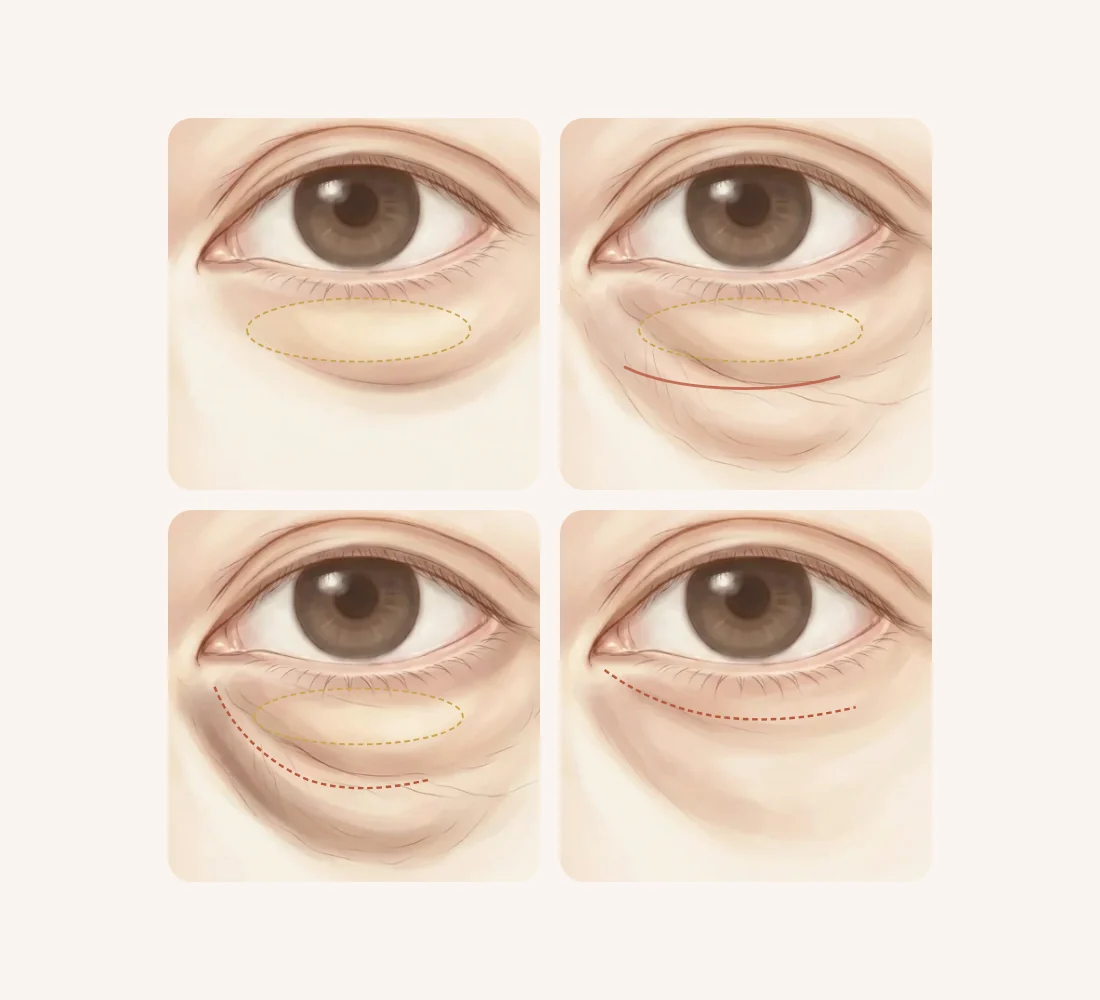
Why do the under-eyes look dark?
Under-eye darkness is often called "dark circles", as if it were one thing. In reality it is usually several different changes seen together. A review (a paper that gathers and summarises many studies) explains dark circles as a problem with several parts working together. They are deep structures such as bone and ligaments, soft tissue such as fat and muscle, and the skin.1
- Shadows made by structure: with age, the bony edge below the eye recedes and the cheeks lose volume. The area around the ligaments that hold skin to bone then looks hollow. When under-eye fat pushes forward above this, a shadow forms below the bulge, especially in the tear trough below the inner corner of the eye.1
- Vessels and muscle showing through thin skin, and puffiness: lower eyelid skin is among the thinnest in the body. The muscle and network of vessels beneath can show through and look dark. Under-eye puffiness that is worse in the morning or after salty food can look purplish.1
- Pigment in the skin: melasma, pigment in the dermis (the deeper layer of the skin) and sun exposure can darken the under-eye skin itself. So can darkening after eczema or contact dermatitis, and some medicines.1
Shadow from structure, and colour
Changing the light gives a clue
If the darkness gets much stronger under overhead light, such as a ceiling lamp, and fades when light shines from the front, shadow, and so structure, plays the larger part.1 If the color looks much the same whatever the direction of the light, pigment or visible vessels are considered as well. Two or more causes are often mixed in one person, so the examination looks at how much each one contributes.
If your under-eyes look like this
What does lower blepharoplasty deal with?
Lower blepharoplasty removes or repositions unneeded under-eye fat and trims loose skin.
From the outside in, the lower lid is made of skin and the orbicularis muscle (the muscle that closes the eye). Next come a membrane that holds back the fat (the orbital septum) and the orbital fat behind it. The whole lid is held horizontally by tendons at the inner and outer corners of the eye, rather like a washing line tied to a post at each end. With age, this support loosens, the membrane weakens so the fat pushes forward, and the skin stretches.
A review lists what should be checked before surgery:4
- How much excess skin and how many fine lines there are
- How much fat bulges, and where
- Swelling over the cheekbone
- How loose the lower lid has become horizontally
- Whether white shows below the iris
- Skin pigment
Horizontal lid firmness and white showing below the iris are hard to judge in a mirror. But they matter especially in lower blepharoplasty that removes skin.
Fat only, or skin as well?
There are two main routes to the under-eye fat:
- Through the inside of the lid: the approach goes through the lining inside the lower lid (the conjunctiva). No scar shows on the outside.
- Through the skin: an incision is made just below the lashes. Loose skin and muscle can be trimmed along with the fat.
Two routes to the under-eye fat
A systematic review (a study that collects all relevant research in a set way and analyses it) of 24 studies concluded that both can be performed safely. The inside approach suits relatively young patients who do not need skin removed, while the skin approach suits those who need a skin incision.2 Fat repositioning without a skin incision is covered separately in the lower eyelid fat repositioning guide.
What is considered first, by under-eye condition
1Fat is the main problem, little loose skin
The fat is treated through the inside of the lid
Inside approach
2Bulging fat with loose skin
Skin-approach surgery trims skin and muscle as well
Lower blepharoplasty
3A bulge with a hollow below
Moving the fat into the groove is considered before removing it
Fat repositioning
4Hollowing more than bulging
Filling with fat grafting or filler can be considered
Filling methods
| Approach | Usually suits | Good to know |
|---|---|---|
| Inside approach (conjunctiva) | Fat is the main problem, with little extra skin | No visible incision, but little effect on loose skin2 |
| Skin approach (lower blepharoplasty) | Bulging fat together with loose skin | Skin and muscle trimmed; lid support needs planning24 |
| Mainly fat removal | Plenty of fat with little hollowing below | Removing a lot can look hollow over time2 |
| Fat repositioning | A bulge with a hollow below | May not fully fill the groove2 |
| Fat grafting or filler | Hollowing more than bulging | Graft survival varies widely; filler can be dissolved12 |
How much fat should be removed?
Surgeons have become much more careful. In the past the focus was on cutting away bulging fat. It then became clear that removing fat alone can leave the eyes sunken over the long term, which can actually look older. So the trend shifted toward keeping and moving the fat.2
Repositioning alone sometimes cannot fully fill the border between the tear trough and the cheek, so fat grafting may be added. The share of grafted fat that survives varies widely, from 20% to 90%, so the result cannot be predicted with certainty.2
What needs the most care when the skin is cut?
In lower blepharoplasty through the skin, the main concern is a change in the position of the lower lid. The lid can pull down so that white shows below the iris, or the outer corner can become rounded. In more severe cases the lid can turn outward (ectropion).24
The lower lid hangs like a clothesline
Why does the lid pull down?
Three causes are given:4
- Too much skin removed
- Scarring in the deeper layers of the lid, such as the septum, pulling on it
- Horizontal looseness of the lower lid that was missed before surgery
Faces where the bone below the eye sits further back, so the lower lid naturally sits low, are known to have a higher risk of this pulling down.4
What is done to reduce it?
To lower this risk, skin-approach surgery now widely includes support: tightening and fixing the outer-corner tendon, or lifting the muscle upward. Since then, reports of the lid pulling down have fallen sharply.2
In a 10-year series of 264 patients who had skin-approach lower blepharoplasty with routine outer-corner support:3
- Lower-lid position problems needing another operation: 3.5%
- Swelling of the conjunctiva (chemosis): 12.1%
- Haematoma (a collection of blood) around the eye: 0.4%
- Minor revisions, for example for small cysts or granulomas along the incision: 11.7%
More recent studies sometimes report symptomatic position problems in about 0.4%. Reviewers also point out, however, that complications are not reported rigorously across lower blepharoplasty studies.2
One author's view is that for East Asian lower blepharoplasty, fat removal through the inside of the lid gives much better results than an outside incision.4 In practice, the inside approach is considered when there is little extra skin, and the skin approach when the skin has clearly stretched. Rather than one method being better, the realistic aim is to match the person's skin and fat.
How does recovery go?
At Bonita Clinic, we perform lower blepharoplasty as surgery under sedation combined with local anesthesia. You return home the same day, and the incision is closed with stitches. The length of recovery and follow-up visits depend on the extent of surgery and on the individual.
Recovery after lower blepharoplasty
- Day of surgerySedation with local anesthesia, home the same day
- Right afterSwelling and bruising: cold compress advice
- While recoveringStitches out; swelling eases, lines look natural
- Settling periodFinal line checked
Right after surgery the under-eye area and the conjunctiva inside the lid can swell. The review explains that swelling of the conjunctiva can press the lower lid down, so settling it early helps.4 As the swelling fades, the under-eye contour shows, and the incision line fades over time. Dry or watery eyes, suddenly blurred vision or severe pain in one eye should be reported right away.
How we approach it at Bonita Clinic
The process has three steps. First come an analysis of the under-eye structure and a design consultation (fat, skin and the cause of the dark circles). Then come tailored lower blepharoplasty (fat removal or repositioning with skin trimming), and recovery and stabilization care.
Treatment options you can discuss in Seoul
Dr. Kwang-Seop Chung, a plastic surgeon certified in Brazil, has led Bonita Clinic since it opened in 1995 and still sees patients himself at the same location. For dark, baggy under-eyes, the options discussed in consultation are:
- An analysis of fat, skin and the cause of the dark appearance
- Lower blepharoplasty with fat removal or repositioning and skin trimming
- Lower eyelid fat repositioning through the inside of the lid when skin laxity is minimal
- Upper blepharoplasty or a brow lift when heaviness above the eye is part of the tired look
Which of these you need, and in what order, is decided only after an examination.
Why the plan and cost differ from case to case
Two people with "dark circles" can need very different treatment. The cause and how much work is needed, rather than the name of the procedure, shape the plan and the cost.
- Fat only, or loose skin as well
- Fat removal, repositioning or both
- Lower-lid support needed or not
- Upper eyelid or brow surgery added
- Anesthesia: sedation with local
- Previous fillers, fat grafts or eye surgery
Final plan and quote after seeing you in person
The final estimate follows an in-person examination of the skin, the fat and the firmness of your lower lids. Photos alone cannot settle how much needs to be done.
What photos can show, and what needs an in-person exam
Photos are especially useful under the eyes, because the way light falls tells a lot. They cannot show how firm the lower lid is.
Photos can show
- Bulges and the groove beneath them
- Shadow under overhead versus front light
- Brown pigment or bluish tone
- Fine lines and loose skin
- Change over time (older photos)
Needs an in-person exam
- Lower lid firmness and horizontal laxity
- White showing below the iris
- Bone support under the eye
- Filler or graft left from earlier treatment
- Dry eye and tear function
Helpful photos: face straight on, looking up, and both sides at 45 degrees, ideally once under ceiling light and once with light from the front, without makeup. You can send us a message with your photos and any earlier under-eye treatment.
Planning your visit and recovery
What is confirmed in advance is limited to the treatment information above: surgery under sedation with local anesthesia, same-day discharge, and stitches. How long you should stay in Seoul, when the stitches come out and how many follow-up visits you need all vary. They depend on the extent of surgery and on whether other eye surgery is combined. These are worked out with you at consultation and can differ from person to person.
At Bonita Clinic, we explain that swelling and bruising are common at first, and how to use cold compresses. The stitches are removed as the swelling settles and the lines start to look natural. The final line is then checked once things have settled. Because the under-eye contour keeps refining while swelling fades, follow-up visits are timed around that process.
After you return home, contact a doctor promptly if the lower lid seems to pull down, the eye will not close comfortably, or redness, pain or discharge increases. Sudden blurred vision or severe pain in one eye needs urgent care. A few dated photos under the same light make it easier for any doctor to judge how healing is going.
Real treatment cases
These photos appear on Bonita Clinic's lower blepharoplasty page. Surgery on other areas, such as the upper eyelids, may have been done at the same time, and results vary from person to person.
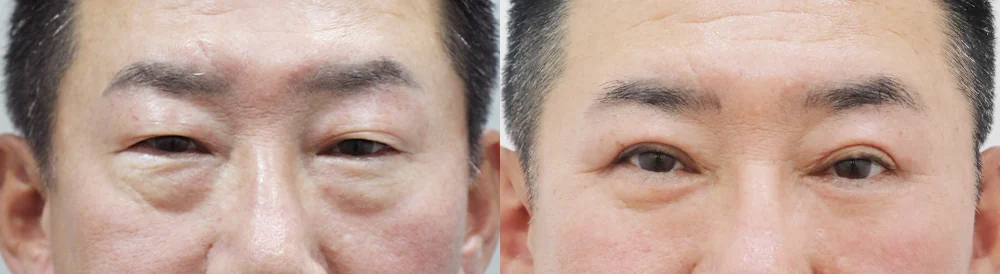
Bulging under-eye fat casting a shadow below (front view)
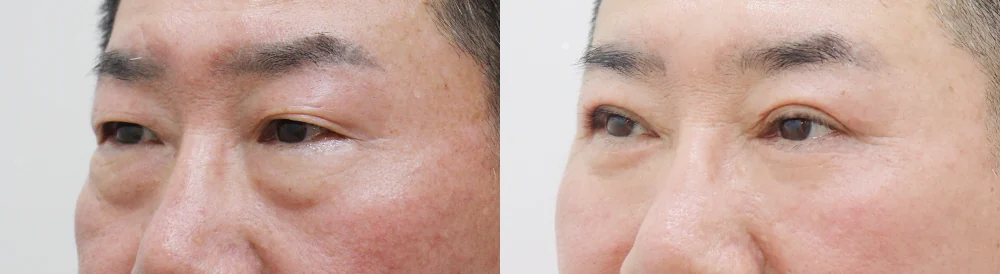
The same case seen from an angle
* Results vary from person to person. Side effects are possible, so please decide after a thorough consultation with a doctor.
Frequently asked questions
I thought it was dark circles. Is lower blepharoplasty right for me?
What looks like dark circles is often a shadow made by bulging fat and sagging skin. If pigment or visible vessels are the main cause, however, surgery alone will not lighten the color much, and skin treatment needs to be considered as well.1 The first step is to find out whether the problem is color or structure.
Isn't it better to just remove under-eye fat?
Removing fat alone can make the area look hollow as you age.2 Repositioning is therefore the default, with part of the fat removed when there is a lot left, depending on the condition.
How is this different from lower eyelid fat repositioning?
Fat repositioning goes through the inside of the lid and moves the fat without a skin incision, so there is no external incision line and no stitches. Lower blepharoplasty also trims loose skin and uses stitches. If fat bulges but there is little loose skin, repositioning is considered; if the skin has stretched too, lower blepharoplasty is.
Will there be a scar?
Skin-approach lower blepharoplasty is usually done through an incision just below the lashes, which often becomes hard to notice over time. The line does remain, though. Small cysts or granulomas along the incision occasionally needed a minor revision.3 Where and how long the incision will be is explained at consultation after your under-eyes are examined.
How long is recovery?
When the stitches come out and how long swelling lasts depend on the surgical method. Even after the early swelling and bruising settle and the stitches are out, the under-eye contour keeps settling for a while. Tell us about any important dates at consultation so the plan can allow for them.
What to prepare before your consultation
- Front, looking-up and 45-degree photos, ideally under both ceiling light and front light
- Whether your under-eyes look different morning and evening, or after salty food
- Earlier under-eye treatments (filler, fat grafting, under-eye surgery, laser) and when they were done
- Dry eye or watery eyes, and whether you wear contact lenses
- Medicines you take regularly, especially for blood pressure and blood thinners
Bonita Clinic is on the 3rd floor of 565 Gangnam-daero, Seocho-gu, Seoul, about 100 m on foot from Exit 8 of Nonhyeon Station (Line 7). You can read more on our Lower Blepharoplasty page and the overview of Eye Surgery for Middle Age. For the approach without a skin incision, see the Lower Eyelid Fat Repositioning page and our guide to lower eyelid fat repositioning. For sagging upper lids, see the guide to upper blepharoplasty.
References (4)
Sources that support the explanations in this article. Study findings describe general trends and do not guarantee individual results.
- Vrcek I, Ozgur O, Nakra T. Infraorbital Dark Circles: A Review of the Pathogenesis, Evaluation and Treatment. J Cutan Aesthet Surg. 2016;9(2):65-72.doi:10.4103/0974-2077.184046Review of infraorbital dark circles: causes (bone and ligament changes casting shadows, muscle and vessels showing through thin skin, fluid, skin pigment), worsening under overhead light, and treatments by cause (camouflage, bleaching, lasers, fillers, fat transfer, lower blepharoplasty)
- Atiyeh B, Chrabieh E, Makkawi K, et al. Transconjunctival or Transcutaneous Approach for Fat-preserving Lower Lid Blepharoplasty?. Plast Reconstr Surg Glob Open. 2025;13(12):e7345.doi:10.1097/GOX.0000000000007345Systematic review of 24 cohort studies: both transconjunctival and transcutaneous approaches can be performed safely; transconjunctival suits younger patients needing no skin excision, a skin incision suits those who need skin removed; fat removal alone leads to hollowing over time; canthal support reduced malposition; complication reporting in the literature is poor
- Codner MA, Wolfli JN, Anzarut A. Primary transcutaneous lower blepharoplasty with routine lateral canthal support: a comprehensive 10-year review. Plast Reconstr Surg. 2008;121(1):241-250.doi:10.1097/01.prs.0000295377.03279.8dTen-year series (abstract) of 264 primary transcutaneous lower blepharoplasties with routine lateral canthal support: lid malposition needing surgery 3.5%, chemosis 12.1%, orbital hematoma 0.4%, minor revisions 11.7%
- Oestreicher J, Mehta S. Complications of blepharoplasty: prevention and management. Plast Surg Int. 2012;2012:252368.doi:10.1155/2012/252368Review of blepharoplasty complications: what to assess before lower blepharoplasty (skin, fat, lid laxity, scleral show), causes of lower lid malposition and ectropion (skin shortage, scarring, overlooked horizontal laxity) and the higher risk with weak midface bone support, managing chemosis, the three factors behind dark circles, and the authors' view on lower blepharoplasty in Asians
About this article
This article separates general medical information from Bonita Clinic's own approach. Because the right decision depends on each person's condition, it is not a substitute for a consultation.
