 KOKorean
 ENEnglish
 JP日本語
JP日本語 CN中文(简体)
 TW中文(繁體)

Under-Eye Bags and Hollows in Seoul: Should the Fat Be Removed or Repositioned?
If you have a bulge with a hollow beneath it, moving the fat is often considered before removing it. That shadow usually comes less from having too much fat than from fat pushing forward while the groove below is empty. Simply removing the fat can make the groove look deeper. Lower eyelid fat repositioning moves the bulging fat into the hollow through the inside of the lower lid, without a skin incision. If the skin is very loose, or there is hollowing without a bulge, another approach may suit you better, so the cause is worked out first. Planning treatment in Seoul? You can send photos first to see which approach may fit your case.
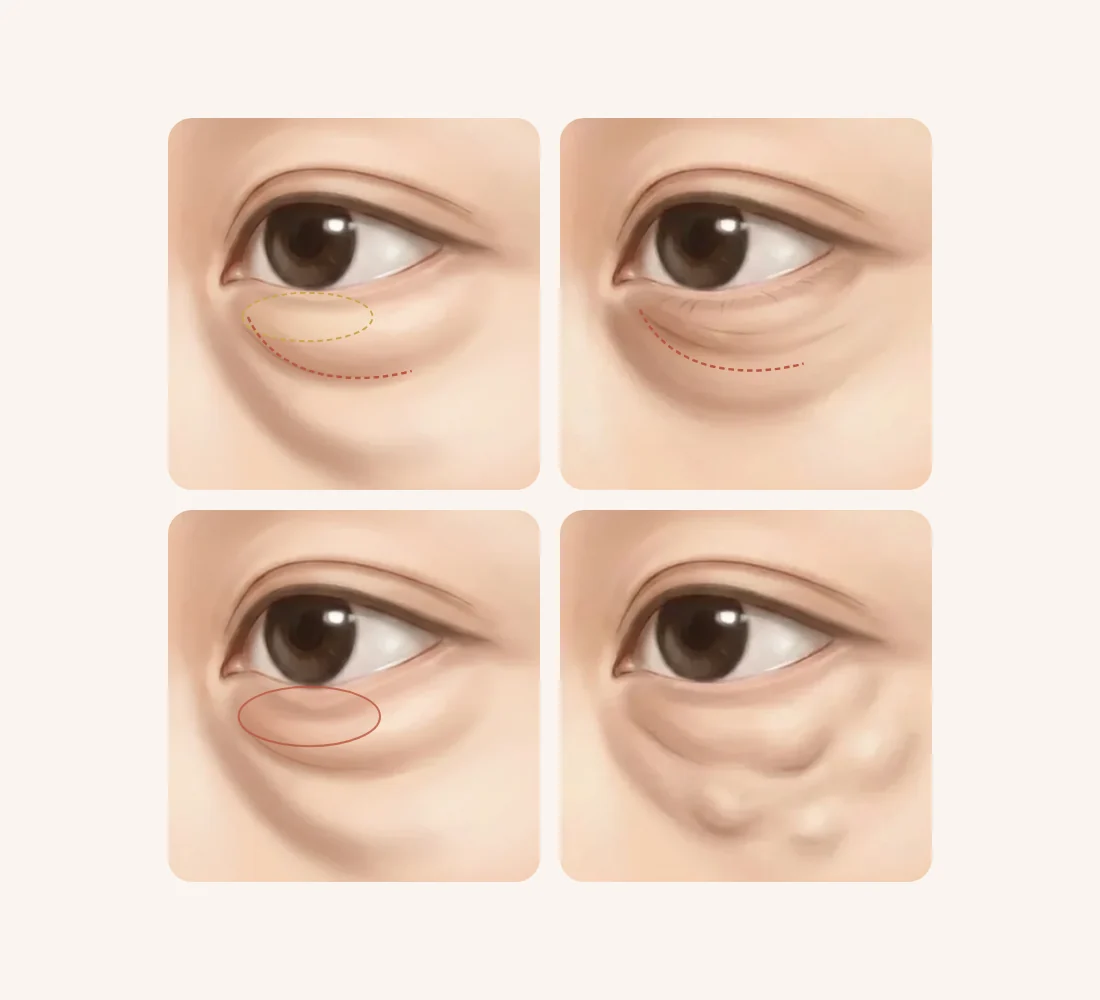
Why do shadows form under the eyes?
Sometimes the mirror shows a puffy area under the eye with a dip right below it. When the top sticks out and the bottom sinks in, the difference in height casts a shadow along the border.
Under-eye changes with age are explained by two things happening together. Fat inside the eye socket (the orbit, the bony hollow that holds the eye) pushes forward, and the cheek tissue moves down. As a result, the bony rim below the eye and the tear trough become more visible.1
Why a shadow forms under the eye
Why does that particular spot look sunken?
There is an anatomical reason the tear trough looks hollow so easily. In an anatomical study, the tear trough was where the muscle around the eye (the orbicularis oculi) attaches directly to bone. Further out, the border between lid and cheek was attached to bone by a ligament (a tough band that ties tissue to bone).2 Because this area is tied to bone, it does not so much sag; rather, the groove shows more as the skin and fat thin and the fat above bulges.2
Put simply, much of the under-eye shadow is a question of where the fat is rather than how much there is. Fat sticks out above, while there is not enough volume below to support the area. Darkness can also come from skin pigment, so the first step is to tell whether colour or structure is the cause.
When a consultation may help
Under-eye concerns have different common causes, and different things to check, depending on how they look.
What is checked, by how it looks now
1A bulge with a hollow below
Fat often pushes forward over an empty groove; both are measured
Fat repositioning
2Hollow and wrinkles after fat removal
Volume was lost with the fat; remaining fat and skin are checked
Revision consultation
3Bulging again after surgery
Remaining fat pushed forward again; the earlier method is checked
Revision consultation
4Lumpy after filler or fat grafting
Material sits unevenly; what remains is checked first
Decided after assessment
Hollowing can also get worse over time. A common cause is volume loss and the cheek tissue moving down, so the extent of the hollow and the thickness of the skin are checked.
What does "moving" the fat mean?
Lower eyelid fat repositioning is done through the conjunctiva (the thin moist lining inside the lower lid). The bulging fat is not cut away. Instead, it is moved over the bony rim below the eye and spread into the hollow groove. The idea comes from a principle about deep grooves. When the groove is deep, moving the fat over the rim onto the front of the upper jaw bone works better than removing it.1
In the cross-section below, the left side is the bulging lid and the right side is the groove.
The path the fat is moved along
Where is the moved fat placed?
The moved fat may be placed in a pocket made under the periosteum (the thin membrane covering bone), or spread on top of it. A review of studies comparing the two found that placing it on top of the periosteum is quicker but brings more swelling, bruising and temporary early unevenness. The final results were reported to be similar.3 The review also notes that, depending on how the moved fat is secured, it can push forward again or shift out of place.3
Does the moved fat stay as it is?
The fat is moved with its blood supply still attached, but some of it may shrink over time. In an early report following 24 patients, how much the moved fat shrank differed from person to person. The contour and texture settled after a recovery period of one to two months.1
Removing, moving or tightening skin: which suits you?
Even with the same "under-eye fat", the right approach depends on how bulging, hollowing and loose skin are mixed.
Removing only vs moving
Approaches for different under-eye concerns
| Approach | Usually suits | Good to know |
|---|---|---|
| Fat removal only | A bulge with little hollowing below | A deep groove can look more sunken |
| Fat repositioning | A bulge and a hollow groove together | Part of the moved fat may shrink |
| With skin excision (lower blepharoplasty) | Loose skin and many fine wrinkles | Leaves an incision line on the skin |
| Filler | Mild hollowing, little bulging | Temporary, so repeat sessions |
The review suggests fat repositioning when the groove is deep, the skin is loose, or a longer-lasting result is wanted. When the change is mild or recovery time is hard to find, hyaluronic acid filler can be considered.3 If fat is bulging, however, filler alone has limited effect. Filler is reported to last about six months to two years, so it needs repeating.3
At Bonita Clinic, repositioning is the default, with part of the fat removed as well where needed. If the skin is loose, lower blepharoplasty, which tightens the lower-lid skin, is considered too; this is covered separately on the Lower Blepharoplasty page and in the lower blepharoplasty guide.
An under-eye surface that has become lumpy after filler or fat grafting can also be assessed. The first step is to find where any remaining filler or fat is and what state it is in, and then the method is chosen. If material of unknown content remains, the guide to eye, glabella and nose filler removal may also help.
How does recovery go?
At Bonita Clinic, we perform lower eyelid fat repositioning as surgery under sedation, and you go home the same day. Because the approach is through the conjunctiva without a skin incision, there are no stitches to remove. How long recovery takes, and how often you return for checks, depends on the extent of surgery and on the individual.
| Stage | Common changes | What the clinic does |
|---|---|---|
| Right after surgery | Swelling and bruising may appear | Explains how to use cold compresses |
| During recovery | Swelling eases and the under-eye area evens out | Checks your progress |
| Settling period | The moved fat settles | Checks the settled contour |
What side effects can occur?
A meta-analysis (a study that pools many studies and recalculates the results) looked at 33 studies and 4,671 patients. The overall complication rate after under-eye fat grafting or repositioning was 11.2%. Broken down:4
- Under-correction or an uneven contour: 6.2%
- Haematoma (a collection of blood), swelling, bruising or oozing: 6.2%
- Another operation: 2.4%
About 11 in 100 people had some problem, large or small, and 2 to 3 had another operation. The review also reports the white of the eye showing below the iris, the lower lid turning outward (ectropion), and infection. Other reported problems are small granulomas (small lumps from inflammation), reduced lid sensation and dry eye.3
Rare but important: bleeding in the eye socket
In a survey of more than 260,000 cosmetic eyelid operations, bleeding in the eye socket occurred in 0.055% and vision loss that did not recover in 0.0045%. These are rare. However, most cases happened within 24 hours of surgery, especially within 3 hours, and were often linked with high blood pressure, aspirin use, vomiting after surgery or increased activity.5
So please:
- Tell us in advance if you take blood pressure medicine or anything that thins the blood.
- Avoid strenuous activity on the day of surgery.
- Contact the clinic immediately if one eye becomes very painful, swollen or hard to see out of.
How we approach it at Bonita Clinic
The order we follow
- 1Find the causeToo much fat, or fat pushed forward?
- 2RepositionThrough the conjunctiva, no skin incision
- 3Fix in placeMoved fat secured to the periosteum
- 4Follow-upCheck how the moved fat has settled
Treatment options you can discuss in Seoul
Since 1995 Bonita Clinic has been at the same address, and Dr. Kwang-Seop Chung, a plastic surgeon board-certified in Brazil, examines and operates on patients himself. For under-eye bags and hollows, the options discussed in consultation are those on our treatment pages:
- Lower eyelid fat repositioning through the conjunctiva, with fixation of the moved fat to the periosteum
- Partial fat removal combined with repositioning where needed
- Lower blepharoplasty when the skin also sags
- Assessment of unevenness after previous filler or fat grafting, or after earlier under-eye surgery
Which of these you need is decided only after an examination.
Why the plan and cost differ from case to case
Two people with "under-eye bags" can need different operations. How much work is needed, not the name, shapes the plan and the cost.
- Bulging only, or bulging with hollows
- Repositioning alone or with partial removal
- Whether loose skin also needs excision
- Previous surgery, filler or fat grafting
- Anesthesia: sedation
Final plan and quote after seeing you in person
A final estimate is given only after an in-person examination, once the amount of fat, the depth of the groove and the skin have been assessed.
What photos can show, and what needs an in-person exam
Photos are useful for a first look. But some key decisions depend on how the lid behaves when you move your eyes and how the tissue feels.
Photos can show
- Bulges and the shadow line below
- Difference between the two sides
- Fine wrinkles and skin texture
- Uneven areas after filler or fat
Needs an in-person exam
- How far fat bulges when looking up
- Depth of the groove under the bulge
- Lower-lid firmness and skin laxity
- Remaining filler or fat, by touch
- Dry eye or other eye conditions
Helpful photos: looking straight ahead, looking up, and both sides at 45 degrees, without makeup, ideally once with light from above so the shadow shows. If you have had filler, fat grafting or previous under-eye surgery, note roughly when. Send your photos and a note of past treatments by message, and we can look at them first.
Planning your visit and recovery
What is confirmed in advance is the treatment information above: surgery under sedation, same-day discharge and no stitches to remove. How long you should stay in Seoul and when to come back for a check depend on the extent of surgery. Both are decided together with you at consultation.
Bleeding in the eye socket is rare, but it usually starts within the first day. So it helps to keep the first evening calm and stay where you can reach the clinic easily. Swelling and bruising are common early on, and the final contour of the moved fat takes longer to judge. Dated photos of your recovery are useful after you return home. Contact a doctor promptly if redness, pain or swelling increases instead of settling, or if your vision changes.
Real treatment cases
These cases appear on Bonita Clinic's lower eyelid fat repositioning page. Results vary from person to person.
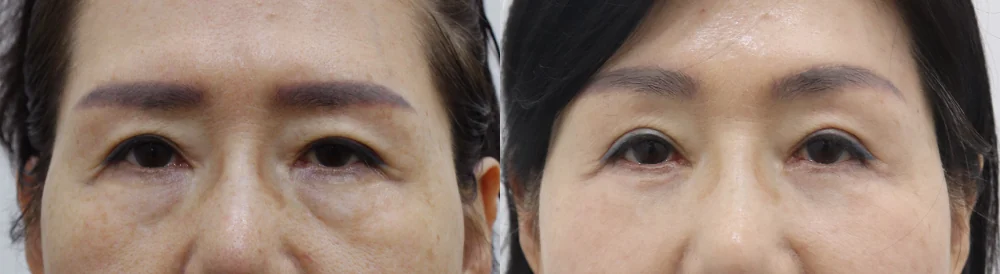
Under-eye bulging with a shadow beneath (front view)
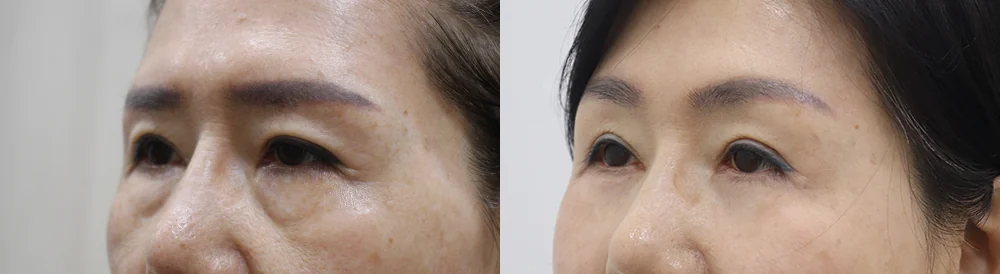
The same case seen from an angle
* Results vary from person to person. Side effects are possible, so please decide after a thorough consultation with a doctor.
Frequently asked questions
Isn't it better to just remove the under-eye fat?
If there is a bulge but almost no hollow below, removal may be suitable. When a hollow is present too, removing fat can make the groove look deeper. So at Bonita Clinic repositioning is the default, with partial removal added depending on your condition.
Will there be a scar?
Because the approach is through the conjunctiva, no incision line shows on the skin. If loose skin is also tightened with lower blepharoplasty, that part leaves an incision line just below the lashes.
Can I have it if my under-eye is lumpy after filler or fat grafting?
Yes, you can be assessed. The method depends on where the remaining filler or fat is and what state it is in, so tell us when, what and how many times you had treatment.
I had fat removed before and now look hollow, or the bulge came back.
Wrinkles and hollowing where fat was removed, or bulging again after surgery, can both be assessed. A revision is a different situation from a first operation. The amount and position of the remaining fat and the earlier technique are checked to see whether there is enough fat to move.
How long is recovery?
How long swelling takes to go down differs from person to person. Bruising and swelling are common early on, and the settled shape of the moved fat can only be judged later. If you have an important event, let us know at consultation.
What to prepare before your consultation
- Your history of under-eye surgery, filler or fat grafting: when, what and how many times
- Medicines you take, especially blood pressure medicine or anything that thins the blood, such as aspirin
- Any dry eye or other eye condition you have been treated for
- Photos looking straight ahead and looking up, plus one with light from above
- Dates of any important events
Bonita Clinic is on the 3rd floor of 565 Gangnam-daero, Seocho-gu, Seoul, about 100 m on foot from Exit 8 of Nonhyeon Station (Line 7). You can read more on our Lower Eyelid Fat Repositioning page. If the skin also sags, see Lower Blepharoplasty and the lower blepharoplasty guide. For upper lids and double eyelids, see Eye Surgery and the guide to double eyelid, canthoplasty and ptosis surgery.
References (5)
Sources that support the explanations in this article. Study findings describe general trends and do not guarantee individual results.
- Goldberg RA. Transconjunctival orbital fat repositioning: transposition of orbital fat pedicles into a subperiosteal pocket. Plast Reconstr Surg. 2000;105(2):743-748.doi:10.1097/00006534-200002000-00044Case series (abstract): under-eye ageing combines orbital fat prolapse with descent of the cheek; when the groove is deep, moving fat over the orbital rim is preferable to removing it; transconjunctival approach and subperiosteal pocket; variable resorption of the moved fat and contour settling after 1–2 months (24 patients)
- Haddock NT, Saadeh PB, Boutros S, Thorne CH. The tear trough and lid/cheek junction: anatomy and implications for surgical correction. Plast Reconstr Surg. 2009;123(4):1332-1340.doi:10.1097/PRS.0b013e31819f2b36Cadaver anatomy study (abstract): the tear trough is where the orbicularis muscle attaches directly to bone, the lid–cheek junction is held by a ligament, and thinning skin and fat plus bulging orbital fat make the groove more visible; basis for the cross-section
- Christodoulou S, Tzamalis A, Tsinopoulos I, Ziakas N. Surgical and Non-Surgical Approach for Tear Trough Correction: Fat Repositioning Versus Hyaluronic Acid Fillers. J Pers Med. 2024;14(11):1096.doi:10.3390/jpm14111096Review (full text): indications for fat repositioning vs hyaluronic acid filler, transconjunctival vs transcutaneous approaches, supraperiosteal vs subperiosteal placement (faster but more swelling, bruising and temporary irregularity; similar final results), fixation, filler duration (6 months to 2 years reported) and surgical complications
- Xu Z, Zheng F, Zhao X, et al. Complications of Fat Grafting and Repositioning for Correction of Lower Eyelid Pouch With Tear Trough Deformity or Lid-Cheek Junction: A Systematic Review. Ann Plast Surg. 2024;93(3):e9-e25.doi:10.1097/SAP.0000000000004022Systematic review and meta-analysis of 33 studies, 4,671 patients (abstract): after under-eye fat grafting or repositioning, total complications 11.2%, under-correction or contour irregularity 6.2%, hematoma, swelling or bruising 6.2%, reoperation 2.4%
- Hass AN, Penne RB, Stefanyszyn MA, Flanagan JC. Incidence of postblepharoplasty orbital hemorrhage and associated visual loss. Ophthalmic Plast Reconstr Surg. 2004;20(6):426-432.doi:10.1097/01.iop.0000143711.48389.c5Survey of 269,433 cosmetic eyelid operations (abstract): orbital hemorrhage 0.055% and visual loss that did not recover 0.0045%; most bleeding occurred within 24 hours, especially the first 3 hours, often with high blood pressure, aspirin use, vomiting or increased activity
About this article
This article separates general medical information from Bonita Clinic's own approach. Because the right decision depends on each person's condition, it is not a substitute for a consultation.
