 KOKorean
 ENEnglish
 JP日本語
JP日本語 CN中文(简体)
 TW中文(繁體)

Double Eyelid, Canthoplasty and Ptosis Surgery in Seoul: Choosing by the Cause, Not Just the Crease
The right operation depends less on the crease you want than on what is shaping your eyes now. If the skin and fat are not thick and you mainly need a crease, a method that forms the line with sutures, without an incision, may suit you. Thick or loose skin points toward an incisional method. If weak eye-opening strength lets the lid cover the iris, a crease alone will not be enough, and ptosis correction is considered. If the length of the eye or the slant of the outer corner is the concern, canthoplasty can be discussed. But it involves an incision, so the scar and the difficulty of reversing it are worth understanding first. Thinking about eye surgery in Seoul? You can send photos first to see which approach may fit your eyes.
Why do eyes look small or sleepy?
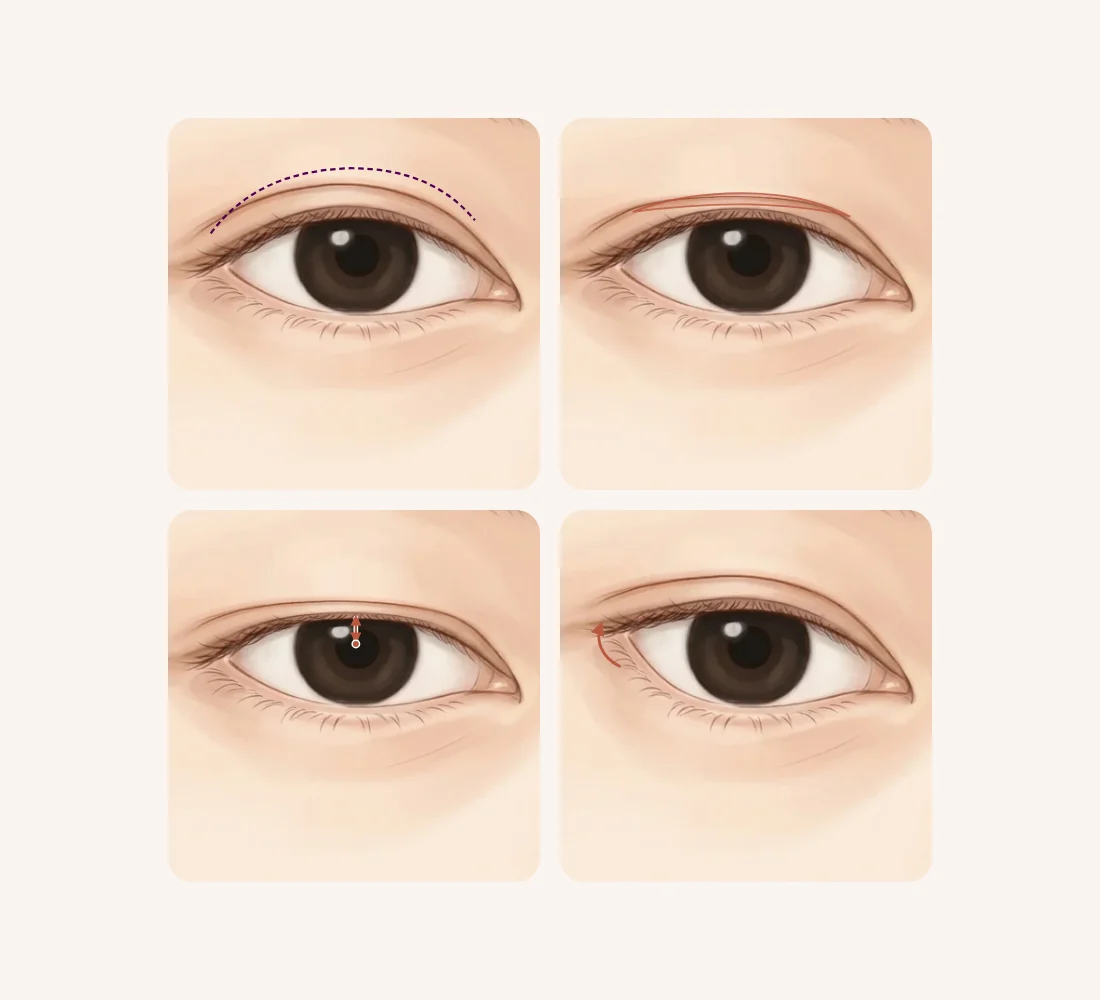
"My eyes look small" and "I look sleepy" sound like the same concern, but the cause differs from person to person. The crease may be absent, or it may have become smaller. Thick upper-lid skin and fat may be covering it. The muscle that opens the eye may be weak, so the lid covers part of the iris. The inner-corner fold and the slant of the outer corner also change how the eyes look. The inner-corner fold (epicanthal fold) is a small fold of skin that covers the inner corner of the eye.
That is why the eye area is assessed in several parts, as in the drawing below. Several causes often overlap in one person.
Parts of the eye that are assessed
Why single eyelids are common in East Asian eyes
There is an anatomical reason. The eye-opening muscle connects to the lid through a broad, flat tendon (the levator aponeurosis). In a lid with a crease, fibres run from this tendon to the skin, so the skin folds along that line when the eye opens. In a lid without a crease, these links are weak or absent.1
Inside the lid there is also a thin membrane that holds the fat in place (the orbital septum). In East Asian eyes it tends to join the tendon lower down, so the fat above it can sit further forward. This is why the upper lid often looks full.1 Epicanthal folds are common too: one review (a paper that gathers and summarises many studies) puts them at 60–90% of East Asian eyelids in some form.1
So "double eyelid surgery" means different work for different eyes. Some eyes only need the crease link. Some need thick skin and fat trimmed as well. Some need the eye-opening strength corrected first.
How a crease forms
Which situation is closest to yours?
The choice becomes clearer when you start from "what is shaping my eyes now" rather than the look you want. The four most common situations look like this.
In these situations, this is considered first
1No crease, and a thin lid
A crease made with sutures, without an incision, is considered first
Diamond Double Eyelid
2Thick or loose skin covers the crease
An incision that also trims skin and fat is considered
Incisional double eyelid
3The lid covers part of the iris
A crease is not enough; eye-opening strength is corrected
Ptosis correction
4A short eye or an upturned outer corner
Canthoplasty is discussed, with scars and limits first
Safety Canthoplasty
Several causes often overlap. One of Bonita Clinic's treatment videos shows a case combining the Diamond Double Eyelid with ptosis correction. If a previous double eyelid has come undone, the first step is to find out why. The method depends on whether the cause was the fixation, loose skin or the muscle.
What double eyelid methods are there?
Double eyelid surgery falls into two broad groups. One forms the crease with sutures without cutting the skin (non-incisional, often called the buried-suture method). The other fixes the crease through a skin incision (incisional).
Suture methods avoid a visible scar. They take less time, recover faster and are easier to revise. But because no skin or fat is removed, they suit lids with excess skin or plenty of fat less well.1 Incisional methods can remove loose skin, muscle and fat at the same time and are generally believed to last longer.1
How often does a crease come undone?
The review puts fading or loss of the crease at 0–3%, more often after suture methods and with absorbable sutures.1 There is also a systematic review (a study that collects all relevant research in a set way and analyses it) of small-incision techniques, covering 13 studies and 4,177 patients. In these techniques, fat is trimmed and the crease fixed through a few short openings. It reported a total complication rate of 5% and crease loss of 2%.2 The crease came undone in about 2 out of 100 people.
| Method | Usually suits | Good to know |
|---|---|---|
| Non-incisional (buried suture) | Thin skin and little fat | Little scar burden, but the crease can loosen1 |
| Diamond Double Eyelid (Bonita Clinic) | A crease without an incision, with fat refined if needed | Thread and beads form the line and are removed at the advised time; studies of this specific method are limited |
| Small incision | Trimming fat with firmer fixation | Leaves short incision marks2 |
| Full incision | Thick or loose skin and plenty of fat | Longer swelling and an incision line1 |
How does the Diamond Double Eyelid work?
Bonita Clinic's Diamond Double Eyelid forms the crease with thread and small beads, without an incision. The steps are:
- The line is designed where the crease should appear.
- Beads are woven closely along the line.
- The thread and beads are removed at the time you are advised.
It is designed to make up for the tendency of buried sutures to loosen. Thick upper-lid fat is refined at the same time so the eyes look lighter. Studies of this specific method are limited, however. Which method suits you is decided at consultation based on lid thickness and fat.
How is ptosis different from a missing crease?
Ptosis means the upper lid sits lower than normal and covers part of the iris when you look straight ahead. It is not a problem of the crease but of eye-opening strength.
Acquired ptosis, which develops with age, is the most common type. Its commonest form is caused by stretching or detachment of the tendon of the eye-opening muscle (the levator aponeurosis).3 Put simply, the connection that lifts the lid becomes slack, so the lid does not rise as far. It is estimated to affect 4.7–13.5% of adults, rising above 20% in people aged 70 and over.3
Ptosis can make you look constantly sleepy or uneven. Studies have found reduced upper visual field even with mild ptosis.3 Lifting the brows with the forehead muscle to help open the eyes is a common compensation.3 If only a crease is created in this situation, the lid can still cover the iris, and the eyes may not look the way you hoped.
What is checked in ptosis
What is measured at the examination?
The examination therefore checks the following.3
- The distance from the centre of the pupil to the upper lid margin: usually 4–5 mm.
- How far the eye-opening muscle can move the lid: this shows how strong the muscle is.
- Whether the lid only looks low because loose skin hangs over it (pseudoptosis): in that case the skin, not the muscle, is the main cause.
Raising one lid can make the other appear lower, so both sides are assessed together.3 The operation chosen depends on muscle strength. In an analysis of 1,519 patients, 8.7% needed another operation, mainly because the lid ended up too high (over-correction) or not high enough (under-correction).3
Ptosis correction at Bonita Clinic
At Bonita Clinic, correction uses either the non-incisional natural adhesion method or the incisional method, depending on the case. The incisional method follows these steps:
- An incision is made along the crease.
- Drooping skin and muscle are trimmed.
- The eye-opening muscle (levator) is found and connected to the skin.
- The incision is closed.
The aims are to relieve the way the drooping lid blocks your view and to reduce the strain on the forehead when opening the eyes.
Heavy lids from loose skin with age can look similar to ptosis but are handled differently. If loose skin is the main cause, see the upper blepharoplasty guide; if a lowered brow makes the lids heavy, see the direct brow lift guide.
What is canthoplasty, and what should you know first?
Canthoplasty changes the horizontal length of the eye or the slant of its corners. It is named by where it is done:
- Inner-corner surgery (epicanthoplasty): reduces the fold covering the inner corner.
- Outer-corner surgery (lateral canthoplasty): makes the eye look longer toward the outer corner.
- Lowering the outer corner: turns an upturned outer corner downward to soften the look.
Where canthoplasty is done
Scars and limits of canthoplasty
Some surgeons regard the epicanthal fold as a normal feature and correct it only on request, while others prefer to address it with double eyelid surgery.1 The main concerns with epicanthoplasty are a visible scar at the inner corner and a web-like pull of the skin.1
One hospital analyzed seven years of complaints about eyelid surgery. Epicanthoplasty drew many complaints about asymmetry and scarring, and scar complaints were more frequent than after double eyelid surgery.5 In a study of 45 patients, lateral canthoplasty lengthened the eye by about 2.9 mm on average. However, the authors said the risk of complications such as injury to the lashes and the lid's oil glands (small glands that add oil to the tears) still needed study.4
So canthoplasty has less evidence behind it than double eyelid surgery and is hard to reverse once done. This is worth knowing before you decide.
Safety Canthoplasty at Bonita Clinic
Bonita Clinic's Safety Canthoplasty follows these steps:
- The outer corner is designed to suit the shape of your eye.
- A C-shaped incision turns and lowers an upturned outer corner.
- The lowered corner is fixed with dissolvable sutures, and the incision is closed.
Fixation to reduce re-adhesion is the principle, although studies comparing this specific method are hard to find. Because it involves an incision, many people worry about scarring. The actual course is shown in the before-and-after photos on the treatment page.
How does recovery go?
At Bonita Clinic, we perform the Diamond Double Eyelid, Safety Canthoplasty and ptosis correction as surgery under local anesthesia or sedation. Discharge is on the same day, and stitches are part of the procedure. When stitches come out and how long the swelling lasts depend on the method and on the individual.
Recovery, and when to think about revision
- Right after surgerySwelling and bruising; cold-pack guidance
- During recoveryStitches (or thread and beads) removed; swelling eases and the crease looks more natural
- Settling periodThe final crease is checked
- If revision is consideredAfter the tissue settles; one review suggests 6 to 9 months before correcting asymmetry
What side effects can occur?
As with any surgery, bleeding, infection and inflammation can occur. The most common problem after double eyelid surgery is asymmetry, reported at up to 35% in the review.1 Other known problems include:1
- A crease that ends up too high (6–7%)
- A hollow upper lid after heavy fat removal
- Ptosis from injury to the eye-opening muscle
In the complaints analysis, 41.7% of complaints after primary double eyelid surgery concerned asymmetry, followed by crease shape, scars and a high crease.5 A complaint is not the same as a medical complication, but these findings show what is worth checking before surgery.
What if the two sides look different right after surgery?
Swelling often settles unevenly at first, so early asymmetry does not necessarily remain. On the other hand, if your brow height or eye-opening strength already differs between the sides, some difference can persist after surgery. This is why existing differences are checked together before the operation.
How we approach it at Bonita Clinic
Treatment options you can discuss in Seoul
Bonita Clinic opened in 1995 and has stayed at the same location, where Dr. Kwang-Seop Chung, board-certified in plastic surgery in Brazil, sees each patient himself. The eye surgery options on the clinic's treatment page are:
- Diamond Double Eyelid: a crease formed with thread and beads without an incision, with upper-lid fat refined where needed
- Safety Canthoplasty: inner- and outer-corner surgery, including lowering an upturned outer corner with a C-shaped incision and dissolvable-suture fixation
- Ptosis correction: the non-incisional natural adhesion method or the incisional method, depending on the case
- Revision when a previous double eyelid has come undone, after the tissue has settled
Which of these you need, alone or combined, is decided only after an examination.
Why the plan and cost differ from case to case
"Eye surgery" can mean a single crease or several procedures together. How much work is needed shapes both the plan and the cost.
- Double eyelid, ptosis, canthoplasty or a combination
- Non-incisional or incisional
- Whether upper-lid fat is refined
- Primary surgery or revision
- Anesthesia: local or sedation
Final plan and quote after seeing you in person
A final estimate is given only after an in-person examination, once eye-opening strength, lid thickness and any previous surgery have been assessed.
What photos can show, and what needs an in-person exam
Photos are a good start for the shape of the crease and the corners. Eye-opening strength and tissue thickness, however, need to be examined in person.
Photos can show
- Crease height, shape and asymmetry
- How much the lid covers the iris
- Inner fold and outer-corner slant
- Brow position with eyes open
Needs an in-person exam
- Strength of the eye-opening muscle
- Skin and fat thickness
- True ptosis or loose skin
- Scar tissue from earlier surgery
- Dry eye and the eye surface
Helpful photos: eyes open and relaxed, looking straight ahead; eyes gently closed; and looking up. Take them without makeup or lash extensions. If you have had eye surgery before, note what was done and when. You can send us the photos and a short surgical history by message.
Planning your visit and recovery
What is confirmed in advance is the treatment information above: surgery under local anesthesia or sedation, same-day discharge and stitches. How long you should stay in Seoul, and when the stitches (or the thread and beads) are removed, depend on the method and the scope. These are planned together with you at consultation.
Swelling and bruising are common early on, and the crease looks more natural as the swelling settles; the final crease is judged later. After you return home, contact a doctor promptly if redness, heat, pain or discharge increases instead of settling, or if your vision changes. Dated photos of your recovery help any doctor who sees you later, including if revision is ever discussed.
Frequently asked questions
Doesn't the buried suture method come undone easily?
Suture methods are known to lose the crease more often than incisional methods. The Diamond Double Eyelid is designed to make up for this by forming the line with thread and beads. Thick lids or very loose skin may suit an incisional method better, however, so this is decided together at consultation.
I'm worried about canthoplasty scars.
Canthoplasty involves an incision, so a scar can remain. One study found more scar complaints after inner-corner surgery than after double eyelid surgery. Tell us if you scar easily or have had canthoplasty before, so we can consider it together. The actual course is shown in the before-and-after photos on the treatment page.
My double eyelid has come undone. When can I have revision?
Revision is done once the tissue has settled after the previous surgery. First the cause is identified: the fixation method, loose skin or the eye-opening muscle. The method is chosen accordingly. Knowing when and how you were operated on helps.
How can I tell ptosis from simply loose skin?
If gently lifting the loose skin shows the lid margin at a normal height, loose skin is the more likely cause. If the lid still covers the iris with the skin lifted, a problem with eye-opening strength is suspected. The examination measures lid height and muscle movement to tell them apart.
How long is recovery?
When stitches come out and how long swelling lasts depend on the method. Non-incisional methods generally recover faster, while incisional surgery, ptosis correction and canthoplasty can swell for longer. If an important event is coming up, mention it at consultation so the schedule can allow for it.
What to prepare before your consultation
- Your main concern: a smaller crease, a sleepy look, a blocked view or the shape of the outer corner
- When and how any previous eye surgery (double eyelid, canthoplasty, ptosis) was done
- Eye-related history such as contact lens use, dry eye or thyroid disease
- Photos without makeup: eyes open looking ahead, eyes closed, and looking up
- The crease you would like, and the look you do not want
Bonita Clinic is on the 3rd floor of 565 Gangnam-daero, Seocho-gu, Seoul, about 100 m on foot from Exit 8 of Nonhyeon Station (Line 7). You can read more on our Eye Surgery page. For upper lids that have become loose with age, see Upper Blepharoplasty and the upper blepharoplasty guide. For a lowered brow, see the direct brow lift guide, and for under-eye bags and hollows, Lower Eyelid Fat Repositioning and the under-eye fat guide.
References (5)
Sources that support the explanations in this article. Study findings describe general trends and do not guarantee individual results.
- Nguyen MQ, Hsu PW, Dinh TA. Asian Blepharoplasty. Semin Plast Surg. 2009;23(3):185-197.doi:10.1055/s-0029-1224798Review (full text): anatomy of the East Asian upper lid (weak links between the levator aponeurosis and skin, low septal fusion with fat lying forward, epicanthal folds in 60–90%), pros, cons and indications of suture and incisional methods, crease loss in 0–3% (more common with sutures), complications such as asymmetry (up to 35% reported), high crease (6–7%), hollowing and ptosis, a 6–9 month wait before revising asymmetry, and scarring and webbing concerns with epicanthoplasty
- Yu P, Chen S, Gu T, et al. Small-Incisional Techniques for Double-Eyelid Blepharoplasty: A Systematic Review. Aesthetic Plast Surg. 2023;47(3):1067-1075.doi:10.1007/s00266-022-03154-5Systematic review of 13 studies, 4,177 patients (abstract): small-incision double eyelid techniques had a total complication rate of 5% and crease loss of 2%, acceptable compared with non-incisional and full-incision methods
- Bacharach J, Lee WW, Harrison AR, Freddo TF. A review of acquired blepharoptosis: prevalence, diagnosis, and current treatment options. Eye (Lond). 2021;35(9):2468-2481.doi:10.1038/s41433-021-01547-5Review (full text): in acquired ptosis the commonest form is age-related stretching or detachment of the levator aponeurosis; adult prevalence 4.7–13.5% (over 20% at 70+); upper visual field loss and compensatory brow raising; MRD1, levator function and pseudoptosis from loose skin; choice of surgery; 8.7% reoperation among 1,519 patients. The authors disclose support from a manufacturer of a ptosis eye drop
- Su X, Chen D, Zhuang J, et al. A 7-year analysis of complaints related to Asian blepharoplasty. J Cosmet Dermatol. 2025;24(3):e16271.doi:10.1111/jocd.16271Seven-year analysis of complaints after eyelid surgery at one hospital (full text): asymmetry was the leading complaint after primary double eyelid surgery (41.7%), followed by crease shape, scars and high crease; scar complaints were more frequent after epicanthoplasty than double eyelid surgery. Complaints are not the same as complications, and data come from one centre
- Lee EJ, Lew DH, Song SH, Lee MC. Aesthetic Lateral Canthoplasty Using Tarso-Conjunctival Advancement Technique. J Craniofac Surg. 2017;28(1):40-45.doi:10.1097/SCS.0000000000003181Retrospective study of 45 patients (abstract): aesthetic lateral canthoplasty lengthened the eye by about 2.9 mm on average, but the risk of complications such as injury to lashes and meibomian glands needs further study; the evidence for canthoplasty is limited
About this article
This article separates general medical information from Bonita Clinic's own approach. Because the right decision depends on each person's condition, it is not a substitute for a consultation.
