 KOKorean
 ENEnglish
 JP日本語
JP日本語 CN中文(简体)
 TW中文(繁體)

Drooping Nose Tip Correction in Seoul: Why Lifting the Tip Alone Is Rarely Enough
Lifting the tip on its own is often not enough. A drooping tip usually comes from several causes at once. They include long or weak tip cartilages and a long lower end of the septum (the wall dividing the inside of the nose). A muscle that pulls the tip down when you smile and thick skin also play a part. So the right correction depends on which of these matters most in your nose. The basis of correction is to redirect the drooping tip cartilage and hold it with a support structure; the muscle that pulls the tip down is assessed separately, when the drop on smiling is clear. The angle is not simply "the higher the better"; it is set by looking at the bridge, the nasolabial angle and how the tip moves when you smile. If you are considering surgery in Seoul, you can send profile photos at rest and while smiling to see which approach may fit your case.
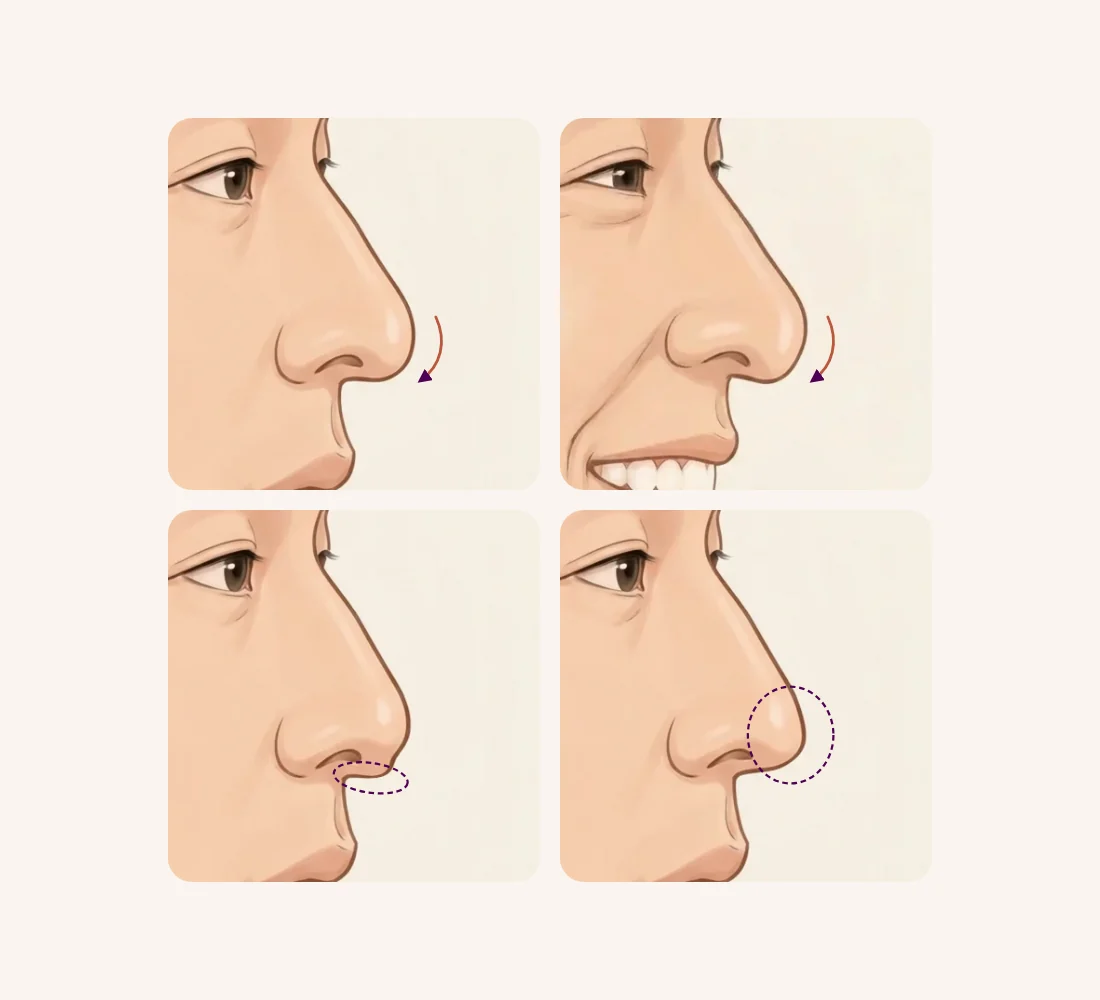
What does a drooping nose tip look like?
In Korea a nose whose tip points down toward the lip, like an arrowhead in profile, is often called "arrow nose" (*hwasal-ko*). In medical terms it is a drooping (ptotic) nasal tip. The angle where the nose meets the upper lip, the nasolabial angle, is usually narrow, and the line from the bridge to the tip bends downward abruptly. Many people notice that the tip drops further when they smile or talk.
What makes a tip droop
A review (a paper that gathers and summarizes earlier research) of long noses with drooping tips in East Asian patients describes features that often appear together. The tip is pushed downward, large and mobile, and the angle between the columella and the lip is narrow. There may be a dorsal hump or a shallow angle between forehead and nose, and the skin is often thick and oily. The authors note that a drooping tip gives an older-looking appearance and looks worse when smiling.1 They also point out that East Asian noses typically have thick tip skin and soft tissue (the soft layers under the skin). The tip cartilages (lower lateral cartilages) are less developed, and the columella and alar base are low-set.1
A drooping tip often comes with a dorsal hump, but the two are different problems. A hump is about the bridge sticking out; a drooping tip is about the direction and angle of the tip. If the hump is your main concern, see our guide to hump nose surgery. If the tip is round or wide rather than low, the nose tip surgery guide is a better starting point.
Signs you can check in a mirror
What you see points to different possible causes, and to different things to check at the clinic.
If you see this
1In profile, the tip points toward the lip
Tip cartilages may be long or sagging; the nasolabial angle, nose length and tip direction are checked
Tip cartilage
2The tip drops further when you smile
A muscle may pull it down; rest and smiling are compared
Muscle
3The columella hangs low
The end of the septum may be long; columella and nostril rims are compared
Septum end
4A heavy tip that is easily pressed down
Thick skin or weak support; skin and cartilage spring are checked
Skin and support
If there is a bump in the middle of the bridge, a dorsal hump is present too. Then the flow of the whole line from bridge to tip is assessed.
What pulls the tip down?
The causes fall into two groups:1
- Static causes: the shape and position of the cartilage and septum
- Dynamic causes: facial muscles that pull on the tip when you make expressions
One by one:
- Tip cartilages: the outer limbs of the lower lateral cartilages (lateral crura) may be too long and stand vertically. Or the whole cartilage may sit low, with a weak attachment to the front corner of the septum. Either way, the tip tilts downward.1
- Lower end of the septum: if the lower (caudal) end of the septum is long, it pushes the columella and tip down.1
- Skin: thick skin and soft tissue are listed as a factor that makes correction harder in its own right.1
- Muscles: the depressor septi nasi pulls the tip down from below, while the levator labii superioris alaeque nasi lifts the alar base. Working together, they make the tip look lower when you smile, and they can help the droop return after surgery.1
The review concludes that most drooping tips involve several of these causes at once, so correcting only one part rarely satisfies patients.1
Does the muscle that pulls the tip down always need cutting?
Because the tip drops when they smile, many people wonder whether simply cutting the muscle would solve it. Looking at how the muscle is actually shaped and at the research, however, calls for a more careful judgment.
An anatomical study of 55 cases shows that the depressor septi nasi differs from person to person. It attached fully to the orbicularis oris (the ring muscle around the mouth) in 62%; in 22% it attached to the periosteum (the sheet covering bone) and partly to the orbicularis oris; and in 16% it was absent or barely present.2 The same team detached and moved the muscle during surgery in 62 patients whose tip dropped and upper lip shortened on smiling, and reported that the tip–lip imbalance improved in 88%.2
A later systematic review (a study that gathers all relevant research by a set method) of 175 anatomical cases and 821 surgically treated patients was more cautious. Anatomical descriptions and surgical techniques varied between studies, and objective data did not show any one method to be better. The studies agreed that the muscle attaches to the inner limbs of the tip cartilages (medial crura) and nearby soft tissue. Cutting this connection is the basis for treating tip drop on smiling.3
That said, the muscle does not have to be cut in every drooping tip correction. At Bonita Clinic, repositioning the drooping tip cartilage is the center of the correction. We compare how the tip changes at rest and in a broad smile, and decide whether to treat the muscle as well when its pull is clearly strong.
How much should the tip be lifted?
The nasolabial angle is the angle between the axis of the nostril and the upper lip. A range of 90 to 120 degrees is commonly quoted, but this range has been described as arbitrary. In a US study, profile photos of 10 men and 10 women who had had rhinoplasty were altered in 4-degree steps and shown to 16 raters. The angles they preferred averaged about 96 degrees for men and about 98 degrees for women. That is a much narrower range than usually quoted, with little difference between the sexes.4
These results cannot be applied to every face. The sample and raters were limited, and the angle that suits someone depends on facial shape, ethnicity and personal taste. What the study does show is that more lift is not automatically better. Lifting the tip too far can make the nostrils prominent or the nose look short. The aim is not a target number but an angle at which the bridge, tip and upper lip read as one continuous line.
How does the correction match the cause?
Correcting a drooping tip is not a single "tip lift." The basic principle is to turn the downward-pointing tip cartilage upward and fix it to a support structure so the new position does not easily slip back. On top of that, steps are chosen and combined for the causes that are present. The review sets out four principles:1
- Correct the cartilage and septum.
- Hold the new position with a support structure.
- Weaken the forces that pull the tip down.
- Reduce excess soft tissue.
Here is what each technique does, and what to know about it:
| Technique | What it does | Good to know |
|---|---|---|
| Repositioning the tip cartilages | Advances, overlaps or shortens the lateral crura to rotate the tip upward | A strut or similar support is needed to hold the new position1 |
| Trimming the caudal septum | Shortens a long septal end and sutures the columella to it | Sutures can cut through tissue over time, so slight overcorrection may be planned1 |
| Columellar strut graft | Places cartilage between the medial crura to support the tip | In a comparative trial, projection and rotation fell more than with a septal extension graft5 |
| Septal extension graft | Extends the septum with cartilage to fix the tip position | Held position better, but the tip was less flexible front to back5 |
| Depressor septi nasi release | Detaches or repositions the muscle that pulls the tip on smiling | Muscle anatomy varies; no method has been shown to be superior23 |
What is the support made of?
For the choice of support, a randomized trial of 60 patients is useful. Septal extension grafts kept tip projection and rotation better than columellar struts, but made the tip stiffer front to back. With both grafts, the largest loss of projection and rotation happened in the first month, followed by a slight further decrease.5
A firmer framework holds position better, but at the cost of some natural tip movement. Which balance suits you depends on how far the tip droops, the state of the cartilage and the thickness of the skin.
What are recovery and the realistic limits?
At Bonita Clinic, we perform drooping tip correction as surgery under sedation combined with local anesthesia, and you can go home the same day without a hospital stay. Stitches are removed at a follow-up visit we schedule for you. The length of recovery and the number of check-ups differ with the scope of the operation and with each person. Swelling and bruising are expected at first, and the tip shape settles gradually as the swelling goes down.
Limits worth knowing
- The angle seen right after surgery does not stay exactly the same. As in the trial above, projection and rotation can decrease somewhat, especially in the first month, and planning takes this into account.5
- With thick skin, changes to the cartilage show less on the surface. The review names thick skin as a cause of unsatisfying correction of a drooping tip.1
- When the muscles pulling on the tip are strong, part of the droop can return over time.1
- Surgery around the tip and nasal base can change how the upper lip moves when you smile. One study looked at 76 patients after columellar struts, extended spreader grafts (lengthened thin strips of cartilage along the bridge) and depressor septi nasi release. Their upper front teeth showed less on smiling.6 If your smile matters to you, mention it at consultation.
- Any surgery, whatever the method, can cause swelling, bleeding, inflammation, infection or nerve injury, and recovery and results differ from person to person.
How we approach it at Bonita Clinic
The order we follow
- 1AnalysisDegree of droop, nasolabial angle, bridge line, tip cartilage
- 2Expression checkTip movement at rest and when smiling
- 3Structural correctionTip cartilage repositioning, bridge–tip angle
- 4Recovery and follow-upTissue stabilization, fixation, swelling care
The actual surgical plan is decided after an in-person consultation.
Treatment options you can discuss in Seoul
Bonita Clinic has treated patients at the same location since opening in 1995, and Dr. Kwang-Seop Chung, a board-certified plastic surgeon in Brazil, sees patients himself. For a drooping tip, what you can discuss at consultation is the approach described on our treatment page:
- Analysis of the droop, the nasolabial angle and bridge line, the tip cartilage structure, and tip movement when your expression changes
- Surgery that repositions the tip cartilage and plans the angle between bridge and tip
- Recovery care focused on tissue stabilization, fixation, swelling and follow-up
If you also have a hump or a wide, round tip, these are assessed together; see Dorsal Hump Rhinoplasty and Nasal Tip Rhinoplasty. Which steps you need is decided only after an examination.
Why do the plan and cost differ from person to person?
Two people who both describe a "drooping tip" can need quite different operations. What shapes the plan, and therefore the cost, is which causes are present and how much needs to be done.
- Which causes are present: cartilage, septum, muscle, skin
- Whether a hump or bridge line is corrected at the same time
- Whether cartilage grafts are needed for support
- Anesthesia: sedation with local
- Skin thickness and soft tissue
- Previous nose surgery or fillers
Final plan and quote after an in-person exam
A final estimate is given only after an in-person examination, once the causes and the extent of surgery are clear. Photos help narrow down the options; the extent of surgery is settled only at an examination.
What can photos show, and what needs an in-person exam?
Photos are a good way to start, because a drooping tip is largely about profile and movement. They cannot show what is happening inside the nose.
Photos can show
- Tip direction in profile
- Rough nasolabial angle
- How much the tip drops on smiling
- A hump on the bridge
- Nostril show from the front
Needs an in-person exam
- Strength and shape of the tip cartilage
- Length of the caudal septum
- Skin and soft tissue thickness
- Muscle pull, felt and watched live
- Breathing and septum inside the nose
Helpful photos: front view, both profiles and both 45-degree views at rest, plus a profile while smiling broadly, all in good light without heavy makeup. Photos from before any earlier nose procedure help if you have had one. You can send us a message with your photos and a short description of what you would like to change and what you would like to keep.
Planning your visit and recovery
What is confirmed in advance is the treatment information above: surgery under sedation with local anesthesia, same-day discharge, and stitches. How long you should stay in Seoul, when the stitches come out and how many follow-up visits you need depend on the extent of surgery. An example is whether the bridge is corrected at the same time. So these are planned together with you at consultation.
Expect swelling and bruising at first, with the tip shape settling gradually. Because tip projection and rotation change most in the early weeks,5 it is worth discussing at consultation how follow-up during this period fits around your trip. After you return home, contact a doctor promptly if pain, redness, swelling or bleeding increases instead of settling. Taking dated profile photos at rest and when smiling makes it easier for any doctor to follow your progress.
Real treatment cases
These cases are from our drooping tip rhinoplasty page. Results vary from person to person.
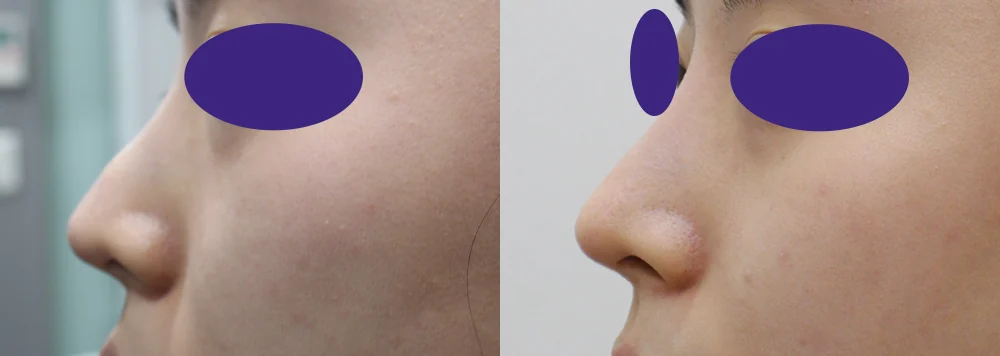
In profile, the tip pointed downward
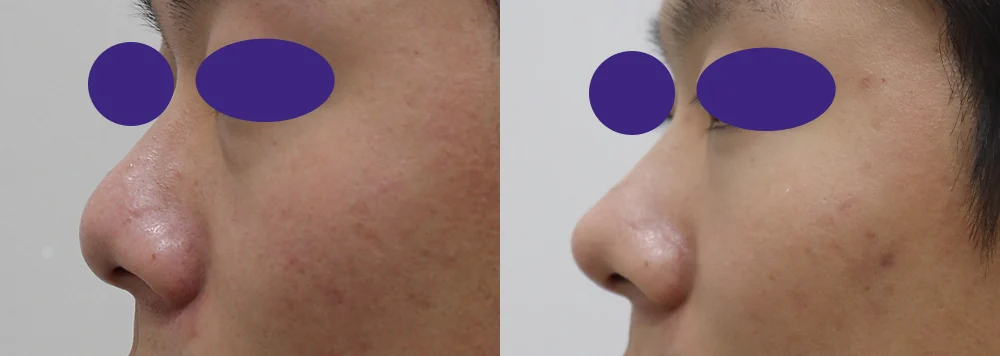
In profile, a heavy tip angled downward
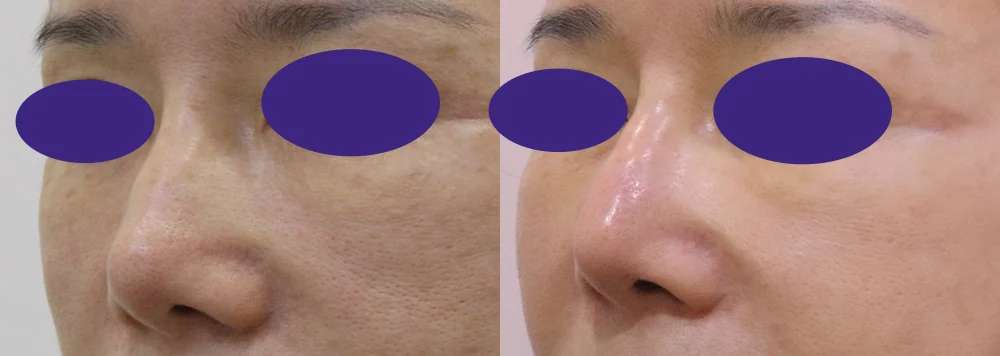
The nose tip seen from an angle
* Results vary from person to person. Side effects are possible, so please decide after a thorough consultation with a doctor.
Frequently asked questions
Can't the surgeon just lift the tip?
Lifting the tip alone can break the line with the bridge or expose the nostrils, which can look artificial. A drooping tip often comes with a narrow nasolabial angle. And the right correction depends on whether the cartilage, the septum, the muscle or the skin is the main cause. That is why the bridge and tip are planned together.
My tip only drops when I smile. Is that something surgery addresses?
A tip that drops and an upper lip that shortens on smiling can be related to the pull of the depressor septi nasi.2 But this muscle varies between people, and no treatment method has been shown to be better.3 So the difference between rest and smiling is examined in person before deciding whether to treat the muscle.
Will the tip drop again over time?
Some loss of projection and rotation after surgery is usual, and in a comparative trial the change was greatest in the first month.5 How well the position holds depends on the support structure, the strength of the muscles and the thickness of the skin. These are taken into account when planning.
I also have a hump. Can both be corrected?
A hump and a drooping tip often occur together. Lowering only the bridge can make the tip look even lower, so the bridge and tip are assessed together. See Dorsal Hump Rhinoplasty and the hump nose surgery guide for more.
Where will the scars be?
The incisions are mostly hidden inside the nostrils or placed on the columella (the strip between the nostrils). The resulting scars are cared for so they become less visible with time.
What to prepare before your consultation
- Front, profile and 45-degree photos, plus a profile photo while smiling
- What you want to change and what you do not (for example, the tip direction but not the length)
- Any previous nose surgery, fillers or thread procedures, with approximate dates
- Breathing problems such as a blocked nose or rhinitis
- Whether the position of your upper lip or gum show when smiling concerns you
Bonita Clinic is on the 3rd floor of 565 Gangnam-daero, Seocho-gu, Seoul, about 100 m on foot from Exit 8 of Nonhyeon Station (Line 7). You can read more on our Drooping Tip Rhinoplasty page. For surgery that addresses the bridge, tip and alar base together, see the full rhinoplasty guide.
References (6)
Sources that support the explanations in this article. Study findings describe general trends and do not guarantee individual results.
- Park SG, Jeong H, Ye CH. Multifactorial approaches for correction of the drooping tip of a long nose in East Asians. Arch Plast Surg. 2014;41(6):630-637.doi:10.5999/aps.2014.41.6.630Review (full text): features of the long, drooping-tip nose in East Asians (thick skin, underdeveloped cartilage, narrow angle), static causes (lateral crura, caudal septum, skin) and dynamic causes (depressor septi nasi, levator labii superioris alaeque nasi), the principle of correcting several causes together, specific techniques and reasons for recurrence
- Rohrich RJ, Huynh B, Muzaffar AR, et al. Importance of the depressor septi nasi muscle in rhinoplasty: anatomic study and clinical application. Plast Reconstr Surg. 2000;105(1):376-383.doi:10.1097/00006534-200001000-00061Anatomical study and patient series (abstract): three variants of the depressor septi nasi in 55 cadavers (62%, 22%, 16%) and improvement in 88% of 62 patients after release and transposition of the muscle
- Sinno S, Chang JB, Saadeh PB, Lee MR. Anatomy and surgical treatment of the depressor septi nasi muscle: a systematic review. Plast Reconstr Surg. 2015;135(5):838e-848e.doi:10.1097/PRS.0000000000001169Systematic review (abstract) of 175 cadaver specimens and 821 patients: the muscle inserts on the medial crura and nearby soft tissue; surgical methods vary and none has been shown to be objectively superior
- Armijo BS, Brown M, Guyuron B. Defining the ideal nasolabial angle. Plast Reconstr Surg. 2012;129(3):759-764.doi:10.1097/PRS.0b013e3182402e12Photo-rating study (abstract): the often-quoted 90–120 degree nasolabial angle is arbitrary; 16 raters preferred about 96 degrees for men and about 98 degrees for women, a narrower range
- Kucukguven A, Çelik M, Altunal SK, Kocer U. Nasal Tip Flexibility and Stability: Comparison of Septal Extension Grafts and Columellar Strut Grafts in a Prospective Trial. Plast Reconstr Surg. 2024;154(2):313-322.doi:10.1097/PRS.0000000000011132Randomized trial of 60 patients (abstract): septal extension grafts held tip projection and rotation better than columellar struts but were less flexible; both lost the most projection and rotation in the first month
- Pi H, Kurlander DE, Guyuron B. Effects of the Rhinoplasty Maneuvers on Upper Lip Position and Incisor Show. Aesthetic Plast Surg. 2017;41(1):135-139.doi:10.1007/s00266-016-0760-4Retrospective study of 76 patients (abstract): upper incisor show on smiling decreased after columellar struts, extended spreader grafts and depressor septi nasi release, so nasal surgery can affect upper lip position
About this article
This article separates general medical information from Bonita Clinic's own approach. Because the right decision depends on each person's condition, it is not a substitute for a consultation.
