 KOKorean
 ENEnglish
 JP日本語
JP日本語 CN中文(简体)
 TW中文(繁體)

Dorsal Hump Rhinoplasty in Seoul: Why Shaving the Bump Is Only Part of the Plan
Shaving off only the bump can reduce the hump in profile but leave the bridge looking low, the tip looking droopier, or the middle of the nose too narrow. A hump is usually a bend formed by the lower nasal bones together with the septal cartilage beneath them (the cartilage wall that divides the inside of the nose). So how much to lower it has to be decided together with the depth of the radix, the position of the tip and your facial proportions. That is why a consultation looks at the proportions of the whole nose, and at breathing, before the height of the hump. If you are considering surgery in Seoul, you can send profile photos first to see which approach may fit your nose.
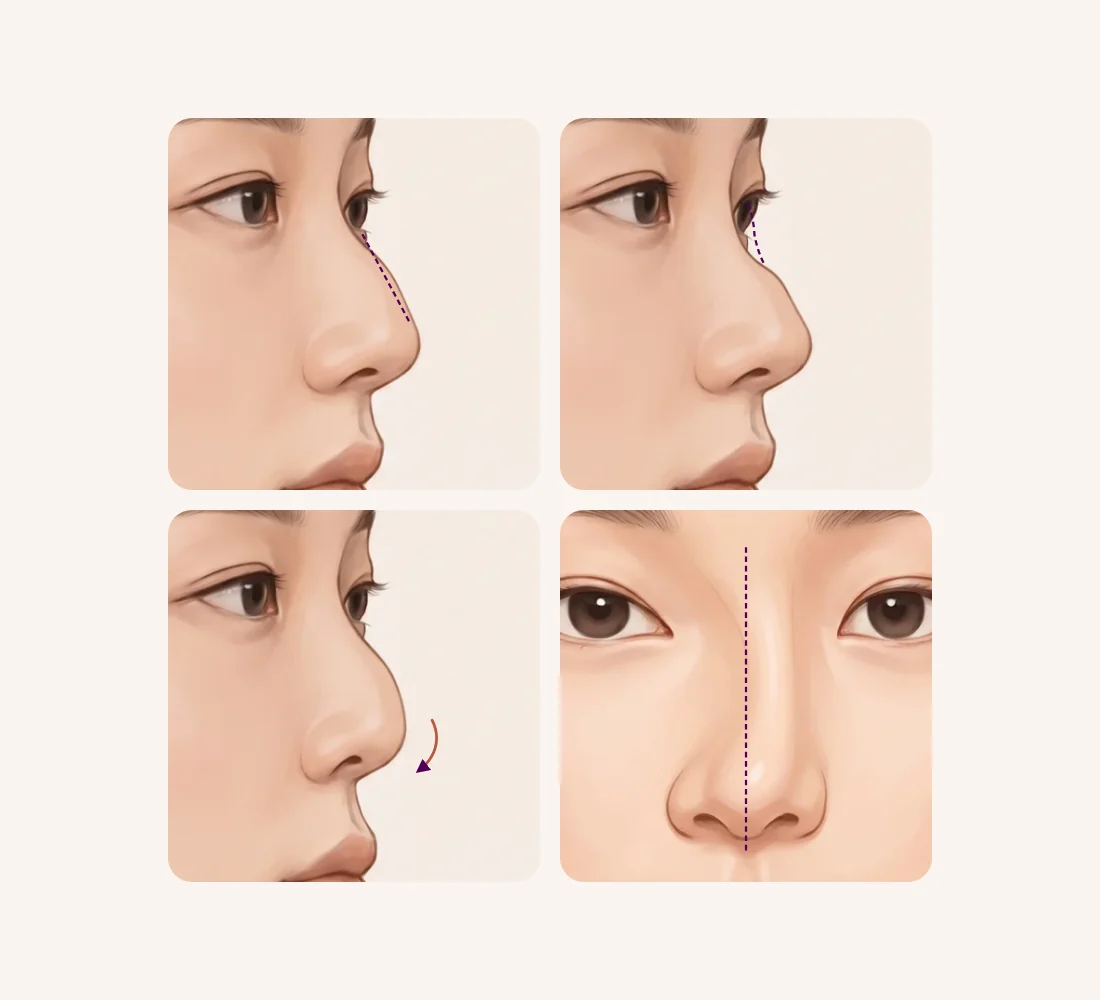
Is a hump bone or cartilage?
The nose is often described in three parts:
- Top: the nasal bones
- Middle: the "middle vault", a roof formed by the septal cartilage and the upper lateral cartilages on either side of it. The septal cartilage is the cartilage wall that divides the inside of the nose
- Bottom: the alar cartilages, which shape the tip
A dorsal hump is a rise in the bridge where the lower nasal bones meet the middle vault.
Where does a hump form?
Many people think of a hump as "a bump of bone", but CT scans (X-ray images that show cross-sections of the body) of the bridge tell a slightly different story. In a study of 67 white patients who wanted surgery for a hump, the apex of the hump sat over the septal cartilage in every patient. The lower nasal bones contributed to the hump, but the ethmoid (a thin bone deeper inside the nose) rarely formed part of it. The hump averaged 1.8 mm in height (range 1.1–3.8 mm).1 A multicenter study (one run by several hospitals together) of 600 people from six population groups, including East Asians, found the same. In most cases there was no ethmoid bone under the hump, and the apex lay over septal cartilage.2
These findings show that lowering a hump is often not just filing down bone; it means working on the cartilage roof of the bridge as well. That roof is connected to the narrowest entrance of the airway, the internal nasal valve, so changing the shape also touches breathing.3
Why can the same hump look bigger on one face?
How a profile looks is not decided by the height of the hump alone. A low radix between the eyes makes the hump look more prominent. A tip that droops downward makes the curve of the bridge stand out more. So even with humps of the same height, how much to lower differs from person to person.
A review (a paper that gathers and summarizes earlier research) of nasal deformities in East Asians lists a convex bridge as one of the typical types. It explains that, across several types including the hump nose, supporting or building up the bridge is a central concept.4 When the radix and bridge are low overall, shaving only the hump may straighten the profile but leave the whole nose looking low and wide.
The common situations look like this:
Dorsal hump: which case is yours?
1A clear hump, with height to spare
Lowering the hump is the main step
Hump reduction
2A low radix makes the hump look big
Lower less, and consider building up the radix and bridge
Radix and bridge
3A drooping tip makes the hump stand out
Correcting tip height and angle is considered too
Drooping tip correction
4A crooked bridge or blocked nose
The septum and airway are assessed too
Crooked nose surgery
For a drooping tip, see our drooping tip correction guide; for a bridge that leans to one side, see the crooked nose guide.
What can happen if only the bump is shaved?
Most problems after hump reduction relate to how much was removed, and how:
- Uneven removal, or taking too much or too little, can leave irregularities on the bridge.
- If the cartilage roof collapses, an inverted-V shadow can appear on the lower bridge when seen from the front.
- The middle of the nose can become too narrow.3
To reduce these problems, a step-by-step method has been described. Bone and cartilage are not cut away as a single block. First the upper lateral cartilages are separated from the septum. Then the septum and bone are lowered a little at a time, checking by touch. At the end, the width and line of the bridge are refined if needed. Spreader grafts (thin strips of cartilage placed between the bridge cartilages), sutures (stitches that hold a shape) and osteotomies (cutting bone so it can be moved) are used. The same paper stresses preserving the horizontal part of the upper lateral cartilages. This helps keep the airway entrance open and protects the lines of the bridge seen from the front.3
More recently, "dorsal preservation" techniques have also been used. They lower the bridge while keeping its structure, instead of cutting the hump off. A meta-analysis (a study that pools the results of many studies) of 9 studies and 1,364 patients found similar results with both approaches, and fewer late complications reported with preservation. But it concluded that the conventional approach suits cases needing major structural change, and that more research is needed.6 We describe this here as general medical information. Which approach fits depends on what your hump is made of and your bridge height, judged at an examination.
How do the approaches differ?
Here are the approaches considered in hump surgery, side by side.
| Approach | Considered when | Good to know |
|---|---|---|
| Lowering the hump | A clear hump and enough bridge height | Bone and cartilage lowered step by step |
| Refining width and line | The bridge looks wide or open after lowering | Osteotomy, spreader grafts or sutures |
| Building up the radix or bridge | A low radix makes the hump stand out | Adding may matter more than removing |
| Repositioning the tip | A drooping tip exaggerates the hump | Tip support and angle planned together |
| Dorsal preservation | Selected cases with a smaller hump | Long-term evidence is still building |
Hump surgery usually combines lowering, refining and balancing in one operation. For example, the cartilage part of the hump may be lowered slightly, a widened bridge narrowed, and a drooping tip lifted. Doing only one step strongly can change the profile but leave something awkward from the front or at 45 degrees. So the plan is checked from all three directions: front, side and 45 degrees.
How does recovery go?
At Bonita Clinic, we perform dorsal hump rhinoplasty as surgery under sedation combined with local anesthesia. It is a same-day procedure, with stitches. Right after surgery there is swelling and bruising, so a nasal splint (a support that holds the shape) stays in place and cold compresses are used. Both the splint and the stitches come out while you recover. While the main swelling goes down, pressure on the nose, such as from glasses, is avoided. How long recovery takes, and how often you come back, depends on how much is done and on you.
How recovery usually unfolds
- Day of surgerySedation with local anesthesia; home the same day
- Right afterSwelling and bruising; splint on, cold packs
- RecoveringSplint and stitches removed; no glasses pressure
- First monthStudy average: about two-thirds of swelling gone
- Around 6 monthsStudy average: about 95% gone
- SettlingLast tip swelling fades; final shape shows
When swelling was measured with 3D imaging in 40 patients after a primary open rhinoplasty (a first nose surgery in which a small cut across the columella lets the surgeon open the nose), about two-thirds of it was calculated to go in the first month, 95% by six months and 97.5% by one year.5 The curve is an average across many people, so individuals differ. Residual swelling of the tip lasts longest, and the final shape appears as it fades.
Side effects to know about
- Any surgery, whatever the method, can cause swelling, bleeding, inflammation, infection or nerve injury.
- Hump surgery can add small irregularities or asymmetry of the bridge, a bridge that looks lower than expected, or a change in how breathing feels.3
- Working on the nasal bones can cause bruising that spreads around the eyes.
- If the result differs from what you hoped, whether to operate again is usually decided only after the swelling has fully settled.
How we approach it at Bonita Clinic
Treatment options you can discuss in Seoul
Bonita Clinic opened in 1995, and Dr. Kwang-Seop Chung, a board-certified plastic surgeon trained in Brazil, has operated at the clinic since then. For a dorsal hump, the consultation can cover:
- Analysis of hump protrusion, tip position, nasolabial angle, profile line and facial proportions
- Correction of the protruding part of the bridge, planned together with the balance of tip and bridge
- Tip work when a drooping tip makes the hump look larger
- Assessment of breathing and the septum, and how they fit into the plan
- Combining hump correction with wider changes, such as in full rhinoplasty, when the whole proportion of the nose is the concern
Why do the plan and cost vary?
"I want my hump removed" can mean a short, focused procedure or a combination of bridge, radix and tip work. The scope of what needs to be done, not the label, is what shapes the plan and the cost.
- How much bone and cartilage the hump contains
- Whether the radix or bridge needs building up
- Whether the tip needs repositioning
- Narrowing or reinforcing the middle of the bridge
- Previous nose surgery, filler or implants
- Anesthesia: sedation with local
Quote given after examining you in person
A final estimate is given once the in-person examination has shown what your hump is made of, whether the radix or tip needs attention, and how your airway looks. Before that, any figure would be guesswork.
What can photos show, and what needs an in-person exam?
Photos are very useful for understanding your profile before you travel. They cannot show how much of the hump is cartilage, how thick the skin is, or how well the tip is supported.
Photos can show
- Where the hump sits on your profile
- How deep the radix is between the eyes
- Tip position at rest and when smiling
- Bridge width and symmetry from the front
Needs an in-person exam
- How much of the hump is bone or cartilage
- Skin thickness over the bridge and tip
- Tip support and cartilage strength
- Septum and airway (breathing)
- Fillers or implants already in the nose
Helpful photos are taken in even light without makeup: front-on, both sides at 45 degrees, and full profile from both sides. Add a profile while smiling, which shows whether the tip drops. Let us know whether you want a completely straight line or would prefer to keep a slight curve, and whether you have any nasal blockage. You can send us a message with your photos and questions before planning your trip.
Planning your visit and recovery
What is fixed in advance is limited to the treatment information above: surgery under sedation with local anesthesia, same-day discharge, stitches, and a nasal splint at first. When the splint and stitches come off, how long to stay in Seoul and when to check in again are decided with you at consultation. They depend on the planned scope of surgery and may vary from person to person.
Plan for visible swelling and possible bruising in the first days, and for avoiding glasses or other pressure on the nose while the main swelling goes down. Because tip swelling lasts longest, photos taken in the first weeks are not a fair picture of the final shape. The study average above suggests most swelling has gone by about six months.5
After you return home, contact a doctor promptly if pain, redness, heat, bleeding or discharge increases instead of settling, or if breathing becomes noticeably worse. Dated photos of your recovery help any doctor who sees you later, and help us when you send an update.
Real treatment cases
These cases appear on Bonita Clinic's dorsal hump rhinoplasty page. Results vary from person to person.
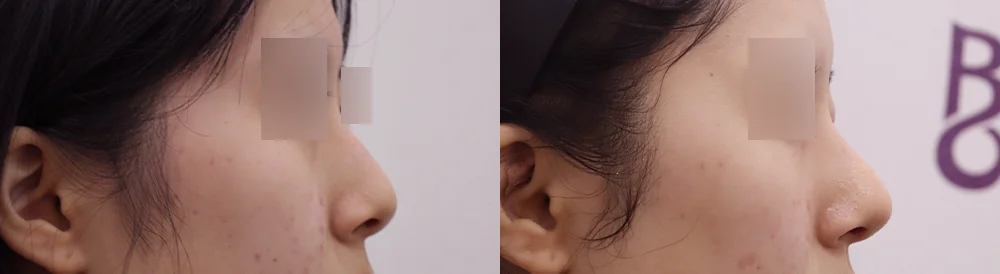
A bump rising in the middle of the bridge in profile
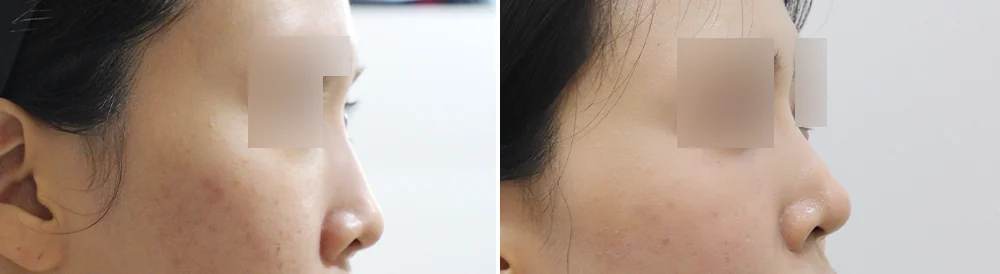
A bridge curving outward in profile
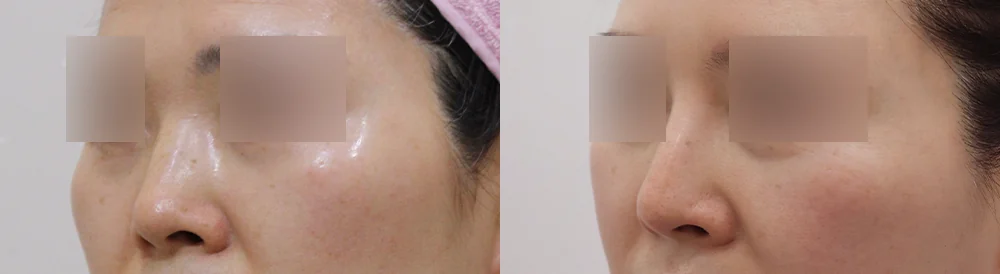
A hump standing out in a three-quarter view
* Results vary from person to person. Side effects are possible, so please decide after a thorough consultation with a doctor.
Frequently asked questions
My hump is small. Can it just be lowered a little?
Even a small hump is handled differently depending on whether it is bone or cartilage underneath, and where the radix and tip sit. In the CT study, the average hump in people seeking surgery was 1.8 mm high.1 Differences this small shape the whole profile. So the smaller the change, the more precise the planning needs to be, and on some faces building up the radix suits better than lowering.
Won't my nose look lower once the hump is gone?
It can, which is why the hump is never assessed on its own. With a low radix, the plan may lower less and build up the radix or bridge instead. With a drooping tip, lifting the tip is considered. Whether you want a completely straight profile or a slight natural curve is agreed at consultation.
Can hump surgery affect breathing?
Lowering the cartilage roof can narrow the internal nasal valve, the airway entrance.3 So nasal blockage, rhinitis and septal deviation are checked before surgery, and support for the cartilage roof is planned when needed. If a deviated septum was already blocking your nose, correcting the hump and the septum together is considered.
Where will the scars be?
Nose surgery scars are mostly inside the nostrils or on the columella (the strip of skin between the nostrils), and at Bonita Clinic we care for them so they fade over time. Whether incisions stay inside the nose or include a small columellar cut depends on how much needs to be corrected.
When will I see the final shape?
Residual swelling remains after the splint and stitches are removed, so the shape in the first weeks is not the result. On average, most swelling has gone by about six months, with a little more over the first year.5 The tip settles last; taking photos along the way makes progress easier to compare.
What to prepare before your consultation
- Front, profile and 45-degree photos, plus a smiling profile
- The profile you would like: completely straight, or with a slight curve
- Any blocked nose, rhinitis, snoring or past nasal injury
- Previous nose surgery, fillers or thread treatments
- Whether you wear glasses every day, so recovery can be planned around them
You will find Bonita Clinic about 100 m from Exit 8 of Nonhyeon Station on Line 7, on the 3rd floor at 565 Gangnam-daero, Seocho-gu, Seoul. More on the procedure is on our Dorsal Hump Rhinoplasty page. If the bridge leans to one side, see Crooked Nose Rhinoplasty and the crooked nose guide. For tip shape, see the nasal tip guide, and for an overall change, the full rhinoplasty guide.
References (6)
Sources that support the explanations in this article. Study findings describe general trends and do not guarantee individual results.
- Rodrigues Dias D, Cardoso L, Santos M, et al. The Caucasian Hump: Radiologic Study of the Osteocartilaginous Vault versus Surface Anatomy. Clinical Implications in Structured and Preservation Rhinoplasty. Plast Reconstr Surg. 2021;148(3):523-531.doi:10.1097/PRS.0000000000008213CT study (abstract) of 67 Caucasian patients seeking hump surgery: the hump apex lay over septal cartilage in all; the lower nasal bones contribute, the ethmoid plate rarely; mean hump height 1.8 mm (1.1–3.8 mm)
- Rodrigues Dias D, Santos M, Sharafi M, et al. Nasal Dorsum Anatomy of Major Different Ethnicities-Surgical Implications: A Multicenter Radiologic Study. Plast Reconstr Surg. 2024;154(4):760-770.doi:10.1097/PRS.0000000000011238Multicenter CT study (abstract) of 600 people from six populations including East Asians (254 with a hump): in most, no ethmoid bone under the hump and the apex over septal cartilage; S-shaped nasal bones associated with a hump
- Rohrich RJ, Muzaffar AR, Janis JE. Component dorsal hump reduction: the importance of maintaining dorsal aesthetic lines in rhinoplasty. Plast Reconstr Surg. 2004;114(5):1298-1308.doi:10.1097/01.prs.0000135861.45986.cfTechnique paper (abstract): problems after hump reduction (irregularities from uneven, excessive or insufficient removal, inverted-V deformity, midvault narrowing), the five-step component method, and preserving the upper lateral cartilages for the internal valve
- Jang YJ, Moon H. Special Consideration in Rhinoplasty for Deformed Nose of East Asians. Facial Plast Surg Clin North Am. 2021;29(4):611-624.doi:10.1016/j.fsc.2021.06.009Review (abstract) of nasal deformities in East Asians, including the convex dorsum, describing bridge augmentation as a central concept even for the hump nose
- Pavri S, Zhu VZ, Steinbacher DM. Postoperative Edema Resolution following Rhinoplasty: A Three-Dimensional Morphometric Assessment. Plast Reconstr Surg. 2016;138(6):973e-979e.doi:10.1097/PRS.00000000000027603D volumetric study (abstract) of 40 primary open rhinoplasty patients: about two-thirds of swelling resolves in the first month, 95% by 6 months and 97.5% by 1 year (retrospective, average curve)
- Khatib M, Skorochod R, Wolf Y. Comparison of Dorsal Preservation Rhinoplasty and Dorsal Hump Reduction Rhinoplasty: A Systematic Review and Meta-Analysis of Postoperative Outcomes. Aesthetic Plast Surg. 2026;50(17):6994-7006.doi:10.1007/s00266-026-06105-6Meta-analysis (abstract) of 9 studies and 1,364 patients: dorsal preservation and hump reduction broadly comparable, fewer late complications reported with preservation, conventional reduction appropriate when substantial reshaping is needed; more research needed
About this article
This article separates general medical information from Bonita Clinic's own approach. Because the right decision depends on each person's condition, it is not a substitute for a consultation.
