 KOKorean
 ENEnglish
 JP日本語
JP日本語 CN中文(简体)
 TW中文(繁體)

Full Rhinoplasty in Seoul: How the Bridge Material and Tip Support Are Chosen
The bridge is raised with either a synthetic implant or your own tissue, chosen according to skin thickness, the height you want and any previous nose surgery. The tip is commonly supported with your own cartilage, taken from the septum (the wall dividing the inside of the nose) or the ear. In studies, the overall complication rates of implants and your own cartilage were not very different, but the kinds of problems differ, so neither is better for everyone. Because the bridge, tip, alae and nose–lip angle affect one another, the starting point is deciding which parts to change and which to keep. If you are considering surgery in Seoul, you can send photos from several angles first to see which approach may fit your case.
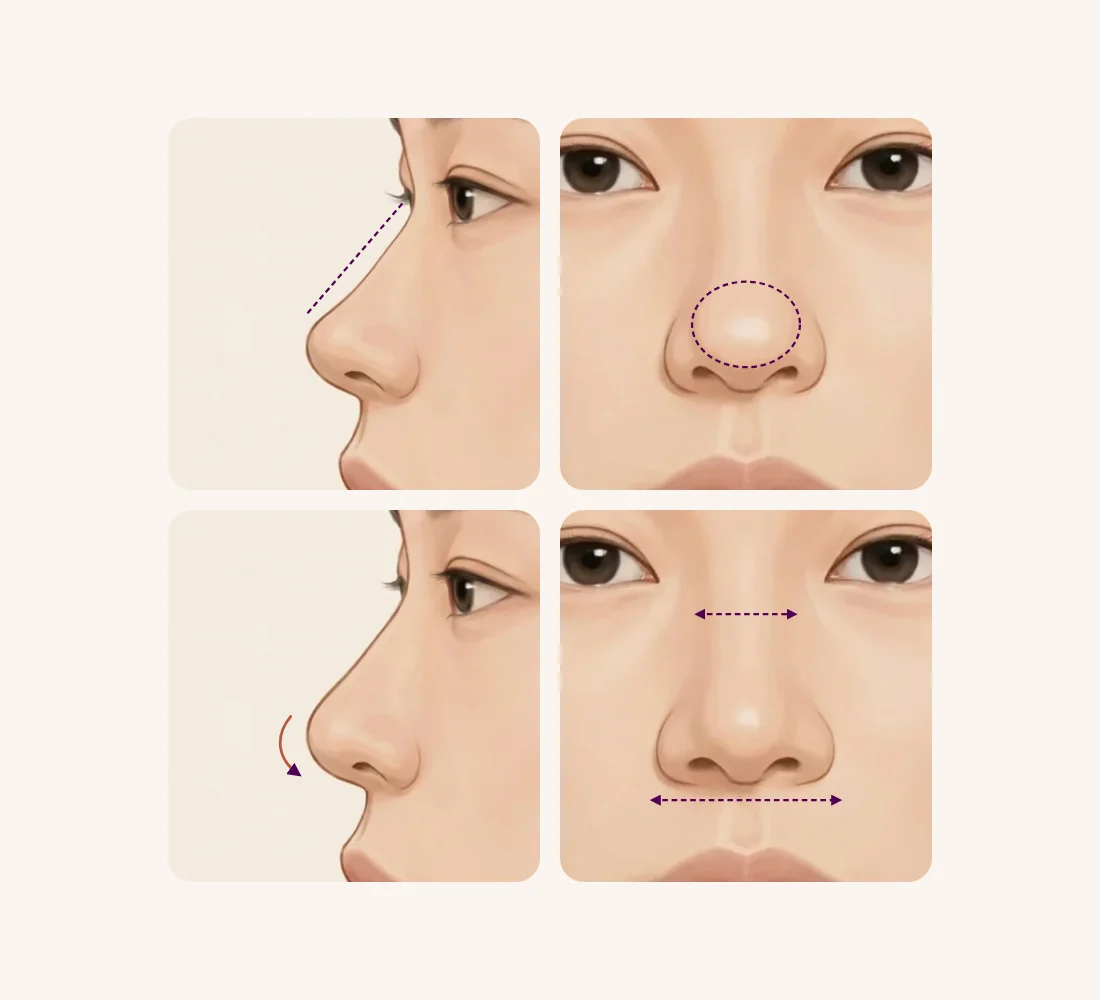
What does a full rhinoplasty cover?
A full rhinoplasty is different from surgery that only raises the bridge. It plans several parts of the nose together, in one operation. There are four main parts. They are the height and width of the bridge and the support and direction of the tip. The others are the alae (the "wings" around the nostrils) and the angle between the nose and the upper lip. That angle is called the nasolabial angle.
What a full rhinoplasty looks at
If the alae are wide or the nasal bones are spread apart, other steps may be added. Alar reduction makes the alae smaller, and an osteotomy cuts the nasal bones so they can be moved inward. Both can be done in the same operation. So what differs from person to person is not the name of the surgery but the combination: which parts change, and by how much.
Why not change just one part?
Because changing one part can make the others look out of place. For example, if only the bridge is raised and the tip support stays the same, the line from bridge to tip can look unnatural. If only the tip is lifted, it may not match a low bridge.
That does not mean everything is changed. Parts that do not need surgery are left alone, so consultation begins by separating what you want to change from what you want to keep.
Which case is closest to yours?
The parts that are usually addressed depend on your concern. Here are four common cases.
Parts usually addressed for each concern
1If the bridge looks low and flat
Bridge height and width are set with an implant or your own tissue
Bridge material
2If the tip is round or low
Tip cartilage and support are assessed together
Nose tip surgery
3If the tip seems to droop
The tip angle and the nose–lip angle are assessed together
Drooping tip correction
4If the alae or upper bridge are wide
Alar reduction or osteotomy may be added
Alar · bone narrowing
Some cases are not in the drawing:
- If your nose looks short for your face: nose length and tip position are assessed together. This is explained in the tip support section below.
- If you are unhappy with an earlier nose surgery: the remaining cartilage and tissue must be checked first. See the full revision rhinoplasty guide.
For more detail on each part, see the nose tip surgery guide, the drooping tip correction guide and the alar reduction and bone narrowing guide.
What layers is the nose made of?
Under the visible surface, the nose is built in layers. The layer where surgery is done, and the layer where material is placed, can affect blood vessels and swelling.
From the surface inward, the nasal bridge has:
- Skin
- Subcutaneous fat (the fat just under the skin)
- A layer formed by the nasal muscles and their fascia (a thin sheet that wraps muscle)
- The periosteum (a thin sheet covering bone) and the perichondrium (a sheet covering cartilage)
- The nasal bones and cartilage
- The lining inside the nose
In an anatomical study of 15 specimens that also included tissue examination, the main arteries, veins and lymphatic vessels of the nose ran above the muscle-and-fascia layer, apart from the lateral nasal veins. Lymphatic vessels are thin tubes that carry extra fluid away, so they are linked to swelling. In the same study, dissecting in the loose layer just beneath the muscle-and-fascia layer preserved lymphatic flow and gave lower tip swelling scores than dissection that disrupted it.1 Dissection means carefully lifting tissue to make room for surgery. In other words, the layer in which surgery is done affects both blood supply and swelling.
Material used to raise the bridge is usually placed beneath the periosteum. To correct a saddle nose (a bridge that dips like a saddle), placing an implant in a pocket under the periosteum is described as the conventional method.3
The thickness of the skin and soft tissue covering the material also matters. A meta-analysis (a study that pools the results of many studies) of synthetic implant complications concludes that synthetic materials suit people with thicker skin better than those with thinner skin.2 As item 4 in the drawing below shows, thin covering skin lets material show through more easily.
Bridge cross-section: where material goes
What is used to raise the bridge?
There are two broad kinds of material:
- Synthetic implants: silicone, expanded polytetrafluoroethylene (ePTFE, often known by the brand name Gore-Tex) and high-density polyethylene
- Your own tissue: rib cartilage, or dermis (the deep layer of skin) or fascia
Silicone is the most widely used synthetic material in Asia. It is easy to carve, and easy to remove if a problem arises. But silicone has no pores, so the body builds a fibrous capsule (a thin wall of tissue) around it.2
Complications reported in studies
Complications are problems that can happen after surgery. Here is what studies have reported:
- A meta-analysis of 27 studies (3,803 patients) of bridge augmentation with synthetic implants found complications overall in 2.75% and infection in 1.91%. Revision surgery was needed in 6.40%, and this varied widely between studies, from 0 to 21%. For silicone, infection and shifting of the implant were the main reasons for revision.2
- The same meta-analysis explains that an infected synthetic implant usually needs revision surgery, whereas an infection involving your own tissue can often be controlled with antibiotics.2
- A meta-analysis of 30 studies (1,013 patients, followed for 22 months on average) compared rib cartilage with synthetic implants. It found complications overall in 7.1%: 7.8% with synthetic implants and 6.9% with your own cartilage. The most common problems were revision to correct the shape (4.1%), infection (2.1%), warping of the cartilage (1.6%) and hypertrophic scars, meaning thick raised scars (1.6%).3
Taken together, these studies suggest that the overall difference between the two groups is not large, but the type of problem differs. Synthetic implants often have to be removed if they become infected or shift. Your own cartilage can warp, or part of it can be absorbed by the body and shrink, and there is a separate donor site where it was taken from.23 Because the studies differ in patients and follow-up, these numbers cannot be turned directly into one person's risk.
| Material | Advantages | Good to know |
|---|---|---|
| Silicone implant | Easy to carve and to remove | Capsule forms; revision if infected or shifted |
| ePTFE | Some tissue ingrowth holds it | Usually removed if infected |
| Own rib cartilage | Fewer infections and exposures | Warping, absorption, donor site |
| Septal or ear cartilage | Own cartilage for tip support | Limited amount; not enough for a tall bridge |
Why is the tip supported with your own cartilage?
The tip is not a place for a rigid plate like the bridge. Its shape comes from cartilage that holds it up, much like tent poles hold up a tent, and from the direction that support takes.
East Asian noses are described as having tight skin and weak, scant cartilage. This makes a round, small or short nose more common.3 For this reason the tip is often supported with your own cartilage, from the septum (the wall dividing the inside of the nose) or from the ear. Septal and ear cartilage are limited in amount, however, and are often not enough to build a tall bridge on their own.
How far to project the tip, and which way to turn it, is decided by looking at several things together. These are the nasolabial angle, the length of the nose and how the tip moves when you smile. If your nose looks short for your face, nose length and tip position are planned in this same step.
Correcting a drooping tip and choosing between support structures is covered in our drooping tip correction guide. Refining the shape of the tip itself is covered in the nose tip surgery guide.
How long does swelling take to go down?
At Bonita Clinic, we perform full rhinoplasty as surgery under sedation or general anesthesia. You go home on the day of surgery, and stitches are placed. Recovery time and follow-up visits depend on the scope of surgery and your condition. You also return on a set schedule to have your progress checked, even after the splint (the support that holds the new shape) comes off.
Swelling hides the result for some time. When nose volume was measured with 3D scans in 40 patients after a first (primary) rhinoplasty, taking the volume at 1 to 2 weeks as the starting point, about two-thirds of the swelling went down within the first month. About 95% was gone by 6 months and about 97.5% by 1 year.4 The shape right after surgery is not the final result, and judging the outcome takes time.
How swelling settles
- Right after surgeryPeak swelling and bruising; splint in place
- 1–2 weeksBaseline when the study first measured volume
- First monthAbout two-thirds of swelling gone
- 6 monthsAbout 95% gone
- 1 yearAbout 97.5%; the rest fades very slowly
Limits and possible side effects
- Synthetic implants can become infected, shift or show through the skin. These problems often lead to revision surgery.2
- Your own cartilage can warp, or part of it can be absorbed and shrink. The donor site also needs its own recovery.3
- Asymmetry and revision: revision rates varied widely between studies.2 It is worth accepting in advance that one operation may not meet every expectation.
- Any surgery, whatever the method, can cause swelling, bleeding, inflammation, infection or nerve injury. Recovery and results differ from person to person.
What is discussed first at consultation?
So much can be changed in a full rhinoplasty that deciding first what to change and what to keep really matters. The more specifically you describe the changes you want, the changes you do not want, and any earlier nose surgery, the clearer the plan becomes.
There is one more thing worth thinking about. Body dysmorphic disorder is a condition in which worry about appearance becomes so strong that it affects daily life. In a meta-analysis of 18 studies (2,132 people seeking rhinoplasty), the pooled proportion meeting criteria for this condition was 32.7%. Results varied greatly between studies and between regions, however. The authors advise clinicians to look for it, because surgery may be unnecessary or bring little satisfaction in such cases.5 This is why consultation includes checking together whether the change you hope for is realistic.
How we approach it at Bonita Clinic
Your own surgical plan is set only after you have been examined in person.
Treatment options you can discuss in Seoul
Bonita Clinic opened in 1995 and has stayed at one location, where Dr. Kwang-Seop Chung, who qualified as a plastic surgeon in Brazil, performs the consultations and surgery himself. For a full rhinoplasty, the options described on our treatment page are:
- Raising the bridge with an implant or your own tissue, with height and width set to your face
- Tip support built from your own septal or ear cartilage
- Alar reduction and nasal bone osteotomy in the same operation when the alae are wide or the bones spread apart
- Planning from front, profile and 45-degree photos, skin thickness and cartilage condition, with scheduled follow-up visits after the splint is removed
Which parts are included, and which bridge material fits, is decided only after an examination. If you have had nose surgery before, see our Full Revision Rhinoplasty page.
Why do the plan and cost differ from person to person?
"Full rhinoplasty" covers a wide range of operations. The parts included, the materials and the anesthesia shape the plan, and therefore the cost.
- Which parts change: bridge, tip, alae, bones
- Bridge material: implant or your own tissue
- Cartilage grafts for tip support and their source
- Anesthesia: sedation or general
- Previous nose surgery or fillers
- Skin thickness and breathing problems
Final plan and quote after an in-person exam
A final estimate is given only after an in-person examination, once the parts to be treated and the materials are decided. Photos give a sense of direction; they do not settle the scope.
What can photos show, and what needs an in-person exam?
Photos are useful for proportions and lines. What lies under the skin has to be felt and examined.
Photos can show
- Bridge height and profile line
- Tip shape and direction
- Rough nasolabial angle
- Alar width
- Balance with forehead and chin
Needs an in-person exam
- Skin and soft tissue thickness
- Cartilage strength and septum
- Breathing and inside of the nose
- Implants or scarring from past surgery
- Which material suits you
Helpful photos: front, both profiles and both 45-degree views, plus a view from below showing the nostrils. Take them in even light and without contouring makeup. Older photos help if you have had nose surgery or fillers. You can send us a message with your photos and a short note on what you would like to change and what you would like to keep.
Planning your visit and recovery
What is confirmed in advance is the treatment information above: surgery under sedation or general anesthesia, same-day discharge, stitches, and scheduled follow-up after the splint is removed. How long you should stay in Seoul, when the splint and stitches come off and how many visits you need depend on the scope of surgery and the materials used. These are planned together with you at consultation.
Most swelling goes down gradually over months,4 so the shape you see when you leave Seoul is not the final result. After you return home, contact a doctor promptly if redness, warmth, pain or discharge increases, or if an implant seems to shift or show through the skin. Infections involving implants often need surgical treatment.2 Dated photos from the same angles make it easier for any doctor to follow your recovery.
Real treatment cases
These cases appear on Bonita Clinic's full rhinoplasty page. Results vary from person to person.
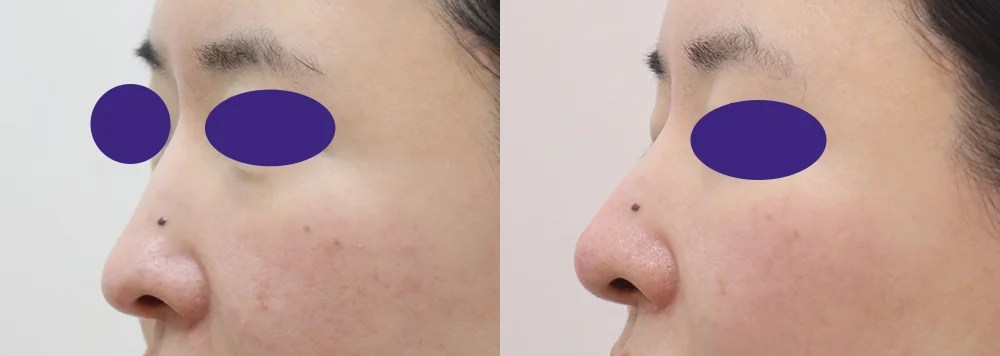
In profile, a bridge that looked low
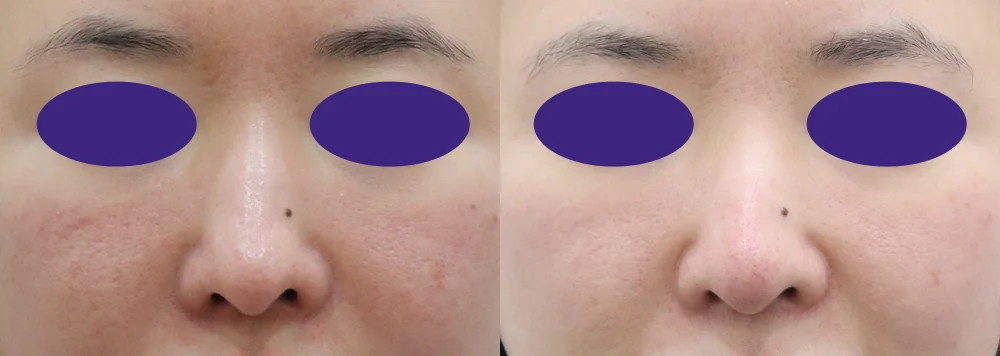
Bridge and tip seen from the front
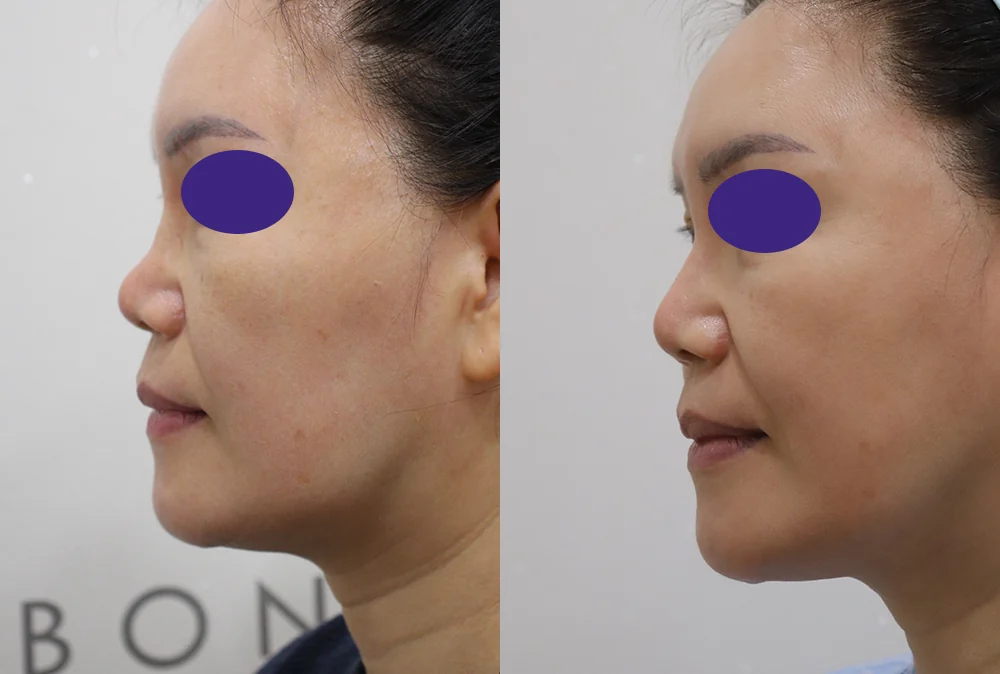
Profile showing the whole face
* Results vary from person to person. Side effects are possible, so please decide after a thorough consultation with a doctor.
Frequently asked questions
Can't I just have my bridge raised?
Changing only the bridge can upset its balance with the tip, the alae and the nasolabial angle. So these parts are assessed together against your facial proportions. That does not mean every part is changed; the examination decides which parts actually need surgery.
Which is better, an implant or my own cartilage?
Neither is better for everyone. In studies the overall complication rates were not very different. But implants often have to be removed if they become infected or shift, while your own cartilage can warp or be absorbed and needs a donor site.23 The choice depends on skin thickness, the height you want and any previous surgery.
When will the swelling go down?
In a 3D measurement study, about two-thirds of the swelling went down in the first month, most of it by 6 months, and a little more by 1 year.4 It varies between people and with the extent of surgery, so the final shape is judged over time.
Where will the scars be?
Incisions are mostly placed inside the nostrils and on the columella (the strip of skin between the nostrils). So the scars sit there, and they are cared for so they fade with time. If the alae are reduced as well, there may also be incision lines around the alae.
I have had nose surgery before. Is full rhinoplasty still possible?
With earlier surgery, the remaining cartilage and tissue need to be checked first, so the plan differs from a first operation. See our Full Revision Rhinoplasty page and the full revision rhinoplasty guide.
What to prepare before your consultation
- Front, profile, 45-degree and from-below photos
- Which parts you want to change and which to keep, and how much change you want
- Any previous nose surgery, fillers or thread procedures, with approximate dates
- Breathing problems such as a blocked nose or rhinitis
- Whether you tend to form keloids or thick scars, and any medicines you take
Bonita Clinic is on the 3rd floor of 565 Gangnam-daero, Seocho-gu, Seoul, about 100 m on foot from Exit 8 of Nonhyeon Station (Line 7). You can read more on our Full Rhinoplasty page. If a hump on the bridge is your main concern, see Dorsal Hump Rhinoplasty and the hump nose surgery guide.
References (5)
Sources that support the explanations in this article. Study findings describe general trends and do not guarantee individual results.
- Toriumi DM, Mueller RA, Grosch T, et al. Vascular anatomy of the nose and the external rhinoplasty approach. Arch Otolaryngol Head Neck Surg. 1996;122(1):24-34.doi:10.1001/archotol.1996.01890130020003Cadaver, histology and small clinical study (abstract): the main vessels and lymphatics of the nose run superficial to the musculoaponeurotic layer; dissection in the loose plane beneath it preserves lymphatic flow and gives lower tip swelling scores; basis for the cross-section
- Keyhan SO, Ramezanzade S, Yazdi RG, et al. Prevalence of complications associated with polymer-based alloplastic materials in nasal dorsal augmentation: a systematic review and meta-analysis. Maxillofac Plast Reconstr Surg. 2022;44(1):17.doi:10.1186/s40902-022-00344-8Meta-analysis of 27 studies, 3,803 patients (full text): with synthetic dorsal implants, overall complications 2.75%, infection 1.91%, revision 6.40% (0–21% across studies); capsule formation with silicone; infected implants usually need revision whereas tissue-graft infections are often managed with antibiotics; synthetic materials suit thicker skin better
- Hudise JY, Aldhabaan SA, Aldosari BF. Complications of the nasal dorsum reconstruction using autologous or alloplastic grafts: evidence from systematic review and meta-analysis. Braz J Otorhinolaryngol. 2022;88(3):406-420.doi:10.1016/j.bjorl.2020.07.001Meta-analysis of 30 studies, 1,013 patients, mean follow-up 22 months (full text): overall complications 7.1% (synthetic 7.8%, rib cartilage 6.9%); revision 4.1%, infection 2.1%, warping 1.6%, hypertrophic scars 1.6%; features of the East Asian nose; subperiosteal implant placement
- Pavri S, Zhu VZ, Steinbacher DM. Postoperative Edema Resolution following Rhinoplasty: A Three-Dimensional Morphometric Assessment. Plast Reconstr Surg. 2016;138(6):973e-979e.doi:10.1097/PRS.00000000000027603D volumetric study of 40 primary rhinoplasty patients (abstract): from a 1–2 week baseline, about two-thirds of swelling resolved by 1 month, 95% by 6 months and 97.5% by 1 year; basis for the recovery timeline
- Nabavizadeh SS, Naseri R, Sadeghi E, et al. Prevalence of body dysmorphic disorder in rhinoplasty candidates: A systematic review and meta-analysis. Health Sci Rep. 2023;6(8):e1495.doi:10.1002/hsr2.1495Meta-analysis of 18 studies, 2,132 rhinoplasty candidates (full text): pooled body dysmorphic disorder prevalence 32.7% with very high heterogeneity and regional differences; clinicians should screen to avoid unnecessary surgery and dissatisfaction
About this article
This article separates general medical information from Bonita Clinic's own approach. Because the right decision depends on each person's condition, it is not a substitute for a consultation.
