 KOKorean
 ENEnglish
 JP日本語
JP日本語 CN中文(简体)
 TW中文(繁體)

Alar Reduction and Nasal Bone Narrowing in Seoul: Which One Does a Wide Nose Need?
It depends on where the width starts. If the upper bridge is wide, the cause is often the width of the nasal bones themselves, or bones left apart after hump removal. Then osteotomy, cutting and moving the bones inward (nasal bone narrowing), is considered. If the nostril wings flare outward or the alar base is wide, alar reduction is considered. When both are present they may be addressed together, with the bridge width, alar width and tip kept in proportion. If you are considering surgery in Seoul, you can send front and from-below photos first to see which approach may fit your case.
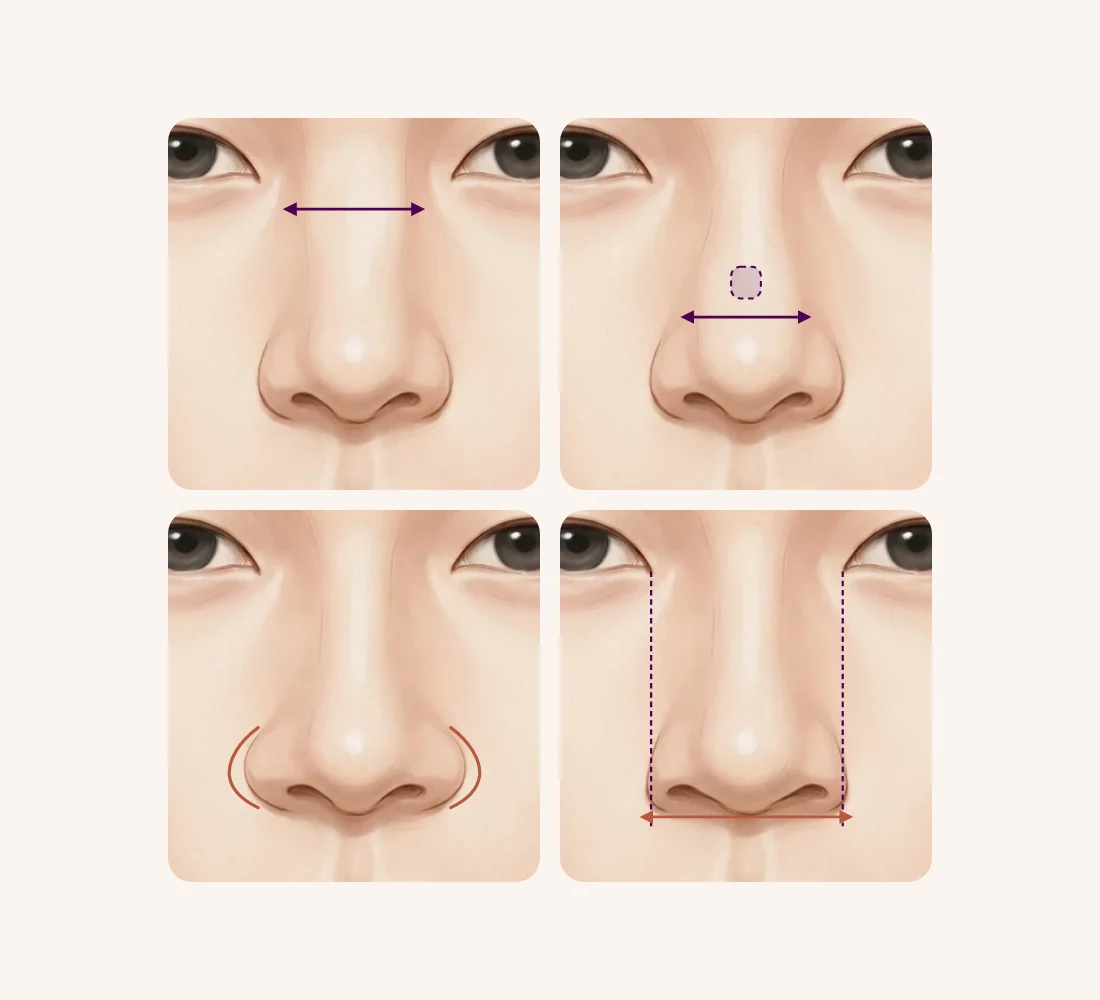
Why does a nose look wide?
Many people describe the same concern, "my nose looks wide from the front," but the width can start in different places:
- The nasal bones that form the upper part of the bridge may be broad.
- After a hump has been removed, the two bones may have been left apart.
- The nostril wings (alae) may flare outward, or the base where they meet the face may itself be wide.
- In some noses the lower part looks broad because the tip cartilage and skin are thick.
Where a nose can look wide from the front
Each cause calls for a different fix, so the starting point is to work out where the width comes from.
Even "wide nasal bones" is not a single problem. One study set out a step-by-step plan for osteotomies (controlled cuts that move the nasal bones). It stresses the difference between a broad dorsum, the top of the bridge, and a broad bony base, where the bones meet the cheeks. It treated 53 patients in three groups:1
- A broad base: lateral osteotomies only
- A broad base and dorsum: lateral and medial oblique osteotomies
- A broad dorsum alone: medial oblique osteotomies only
Reading the width from the front
What you see points to where the width usually comes from, and to what is checked at the clinic.
If you see this
1A broad, flat bridge below the brows
Bone width, thickness and asymmetry are checked; osteotomy is considered
Bone narrowing
2A bridge that widened after hump removal
The earlier removal and bone position are checked; osteotomy to close the gap is considered
Open roof
3Nostril wings that bulge outward
Alar thickness and flare on smiling are checked; alar reduction is considered
Alar reduction
4A wide alar base and nostril floor
The ratio to the inner eye-corner distance and nostril shape are checked
Alar base
If the lower nose looks broad and bulbous, the tip cartilage and skin may be the cause. Then the tip cartilage shape and skin thickness are checked, and it is assessed separately as described in the nose tip surgery guide.
What are nasal bone width and the "open roof"?
The two nasal bones meet at the top of the bridge like a roof. Removing a hump cuts off the peak of this roof. It can leave a flat gap between the bones, known as an open roof. Left open, the bridge looks wide and flat. That is why osteotomies to move the bones inward are often planned together with hump removal. If the hump itself is your main concern, our guide to hump nose surgery covers it in detail.
When the bones are left apart after hump removal
A common problem with osteotomies is that the width of the dorsum does not narrow as much as hoped. In a study that combined anatomical research on 9 cases with the treatment of 53 patients, a medial oblique osteotomy placed on the outer side of the peak of the open roof narrowed the dorsum most. A lateral osteotomy was not needed to reduce dorsal width alone. After 15 to 32 months, bone width was satisfactory in all but 3 of the 53 patients, one of whom had revision surgery.1 Which cut is made, and where, therefore shapes how much narrowing is possible.
You may hear that East Asian nasal bones are short and wide. But a CT comparison (X-ray images that show cross-sections) of 64 Korean and 27 white adults found something different. The bridge and its cartilage part were longer in the white group. But there was no significant difference in nasal bone length, nasal height, tip projection or septal area (the septum is the wall dividing the inside of the nose).2 Rather than relying on generalizations by ethnicity, the length, width and thickness of each person's nasal bones need to be checked directly.
How can the nostrils look wide?
Wide-looking nostrils also come in two forms:
- The alae bulge outward (alar flare).
- The base where the alae attach, and the nostril floor, are wide.
Often both are present. Alar width is commonly compared with the distance between the inner corners of the eyes (intercanthal distance).3
A systematic review (a study that gathers all relevant research by a set method) covered 22 studies on nostril surgery (1,599 patients). Excision (cutting away a small piece) was used in 45.5%, cinching sutures that draw the alar bases together in 40%, and combinations in the rest. For excessive flaring, alar wedge resection (removing a small wedge) was chosen in 92% of cases. For a wide base, the method depended on the other features present. In 795 of the 1,599 patients, nostril surgery was done at the same time as rhinoplasty.4
The nose from below: ways to narrow the alae
A study at a university hospital in Korea looked at 73 patients who had combined nostril sill and alar excision. The ratio of alar width to intercanthal distance fell on average from 1.07 to 1.04. Of 60 patients with flaring, 45 (75%) no longer had it afterward, and horizontally shaped nostrils fell from 29% to 3%. Complications occurred in 4 patients: one alar deformity, one under-corrected asymmetry and two under-corrected flares.3 Results were generally good. But a change from 1.07 to 1.04 also shows how small, and how fine, these adjustments are.
How is the approach chosen?
It helps to see where the work is done. The nasal bones are cut and moved; the alae are narrowed by removing a little skin or drawing them together with sutures.
Which osteotomy, and where (example)
Here is how the methods compare:
| Method | Suits | Good to know |
|---|---|---|
| Lateral osteotomy | Broad bony base | May not narrow the dorsum enough |
| Medial oblique osteotomy | Broad dorsum | Narrowing depends on placement |
| Medial and lateral | Broad dorsum and base, open roof | Wider cuts, careful planning |
| Alar wedge excision | Outward flare | Scar in the alar–cheek crease |
| Nostril sill excision | Wide base and nostrils | Too much can distort nostril shape |
| Cinching suture | Narrowing the base without excision | Sometimes combined with excision |
In short, width in the upper bridge changes only when the bones are moved, and width at the nostrils changes only when the alae are addressed. Narrowing the bones while leaving wide alae can upset the balance between top and bottom. Narrowing only the alae can make the bridge look relatively wide. Whether to do one or both is decided by looking at bridge width, alar width and the tip together.
What should I expect during recovery?
At Bonita Clinic, we perform alar reduction and nasal bone narrowing as surgery under sedation combined with local anesthesia; you go home the same day, and stitches are used. How long recovery takes and how often you need to come back depend on how much is done and on your own healing.
- Swelling and bruising around the eyes: after nasal bone osteotomies, eyelid swelling and bruising around the eyes are common. A meta-analysis (a study that pools the results of many studies) compared osteotomy techniques. As the main early effects, it measured eyelid swelling, bruising around the eyes and pain within the first 3 days and on day 7. Their severity differed between techniques.5
- Breathing: lateral osteotomies can narrow the internal nasal valve, the narrowest part of the nasal airway. A study measured 30 patients before and 6 weeks after surgery. The valve area decreased in every patient after lateral osteotomy, with no difference between the two techniques compared.6 If your nose is already blocked, mention it before surgery.
- Scars: alar wedge excision leaves an incision in the crease where the ala meets the cheek; nostril sill excision leaves one inside the nostril floor. In the Korean study above, alar deformity and under-correction of asymmetry or flare occurred in a few patients.3
- Residual width and asymmetry: the bones may not come together fully, or some difference between sides may remain. In the osteotomy study above, 3 of 53 patients were not satisfied with bone width and one had revision surgery.1
- Any surgery, whatever the method, can cause swelling, bleeding, inflammation, infection or nerve injury, and recovery and results differ from person to person.
How we approach it at Bonita Clinic
The actual surgical plan is decided after an in-person consultation.
Treatment options you can discuss in Seoul
Since opening in 1995, Bonita Clinic has stayed at the same location, where Dr. Kwang-Seop Chung, certified as a plastic surgeon in Brazil, sees patients himself. For a wide-looking nose, the options described on our treatment page are:
- Nasal bone narrowing (osteotomy), with medial and lateral cuts planned together and matched to any hump removal
- Alar reduction, with the bridge width set in proportion to the alae and tip
- Analysis of bone width and asymmetry, bridge-to-alar ratio, skin and bone thickness before planning
- Recovery care focused on tissue stabilization, fixation, swelling and left–right balance
Which of these you need, and whether they are combined with other nose surgery, is decided only after an examination. Surgery that addresses the bridge, tip and alae together is described on our Full Rhinoplasty page.
Why do the plan and cost differ from person to person?
"Make my nose narrower" can mean very different operations. The plan and the cost depend on where the width comes from and how many parts need to be addressed.
- Which part is wide: bones, open roof, alae, alar base
- Osteotomy, alar reduction, or both
- Hump removal or other nose surgery at the same time
- Previous nose surgery and scarring
- Asymmetry or breathing problems to address
- Anesthesia: sedation with local
Final plan and quote after an in-person exam
A final estimate is given only after an in-person examination, once it is clear which parts need surgery. Photos can point to a likely direction, but the scope is only set in person.
What can photos show, and what needs an in-person exam?
Width is easy to see in photos, which makes them a good starting point. Bone thickness, earlier surgical changes and the airway are not.
Photos can show
- Bridge width from the front
- Alar width and flare
- Nostril shape from below
- Visible asymmetry
- Flare when smiling
Needs an in-person exam
- Nasal bone width and thickness
- Gaps or steps from earlier surgery
- Alar thickness and skin
- Internal valve, septum, breathing
- Which osteotomy fits
Helpful photos: front, both 45-degree views, both profiles and a view from below showing the nostrils, in even light and without contouring makeup. If you have had a hump removed before, photos from before that surgery help. You can send us a message with your photos and a note on which part looks wide to you.
Planning your visit and recovery
What is confirmed in advance is the treatment information above: surgery under sedation with local anesthesia, same-day discharge, and stitches. How long you should stay in Seoul, when the stitches come out and how many follow-up visits you need depend on whether osteotomy, alar reduction or both are done. These are planned together with you at consultation.
Because bruising and swelling around the eyes are common after osteotomies,5 it is sensible to keep the early days after surgery free of important events and photos. Alar incisions have stitches, and how their removal fits your trip is part of the planning conversation. After you return home, contact a doctor promptly if pain, redness, swelling, bleeding or a blocked nose gets worse instead of settling. Dated front and below-view photos make it easier for any doctor to follow your progress.
Real treatment cases
These cases are from our alar reduction and nasal bone narrowing page. Results vary from person to person.
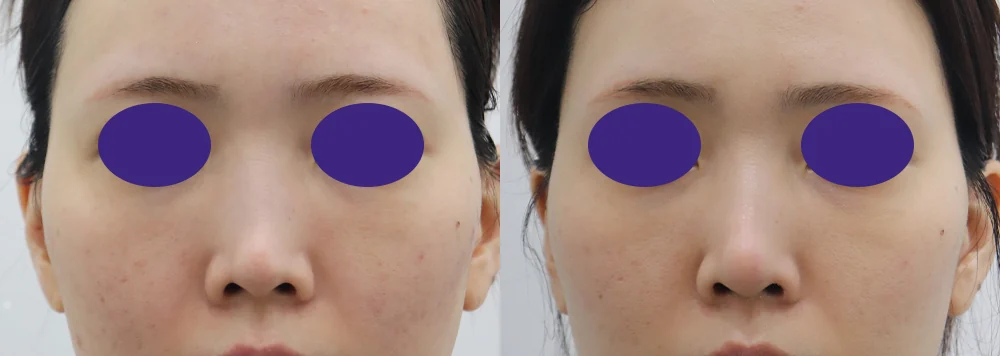
Bridge and alae seen from the front
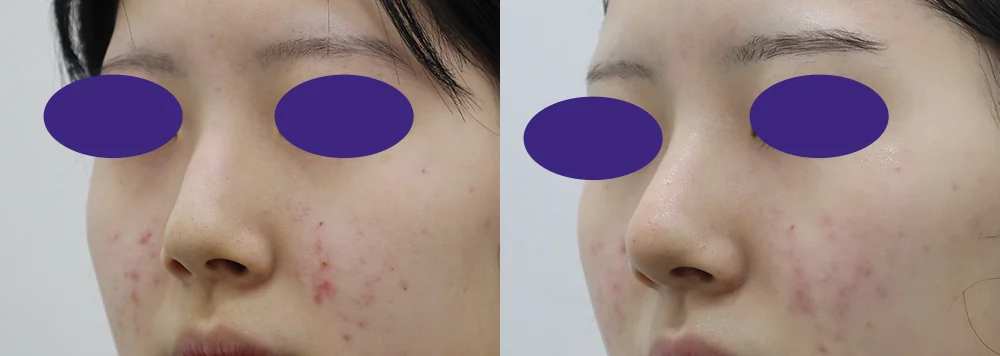
Bridge and alae seen from an angle
* Results vary from person to person. Side effects are possible, so please decide after a thorough consultation with a doctor.
Frequently asked questions
My bridge is wide. Can't the skin on top just be thinned?
When the width comes from the nasal bones, thinning the skin and soft tissue (the soft layers under the skin) rarely changes it. Osteotomy to move the bones is considered instead. Whether the dorsum or the bony base is wide changes which osteotomy fits, so this is distinguished at examination.1
Will osteotomy leave a step or bumps?
A lateral osteotomy alone can leave the bones incompletely closed or leave a step. That is why the medial and lateral cuts are planned together. Whether any difference between sides remains is checked as the swelling settles.
Will the alar reduction scar be visible?
Alar wedge excision leaves a line in the crease where the ala meets the cheek, and nostril sill excision leaves one inside the nostril. Both sites tend to be less noticeable, but a scar can remain, and it is managed so that it fades over time.
Will narrowing the nasal bones affect my breathing?
Lateral osteotomies have been shown to narrow the internal nasal valve.6 If you already have a blocked nose or a deviated septum, breathing is checked before surgery and taken into account in the plan.
Can this be done together with hump surgery?
Yes. Removing a hump often leaves the bones apart, so osteotomies are commonly planned in the same operation, matched to the amount of hump removed. Surgery that addresses the bridge, tip and alae together is covered in our full rhinoplasty guide.
What to prepare before your consultation
- Front, 45-degree, profile and from-below photos
- Which part looks wide to you: the upper bridge, the alae or the tip
- Any previous nose surgery, especially hump removal, with approximate dates
- Breathing problems such as a blocked nose, rhinitis or snoring
- Dates when visible bruising around the eyes would be a problem for you
Bonita Clinic is on the 3rd floor of 565 Gangnam-daero, Seocho-gu, Seoul, about 100 m on foot from Exit 8 of Nonhyeon Station (Line 7). You can read more on our Alar Reduction & Nasal Bone Narrowing page. If the lower nose looks bulbous, see Nasal Tip Rhinoplasty and the nose tip surgery guide.
References (6)
Sources that support the explanations in this article. Study findings describe general trends and do not guarantee individual results.
- Gruber R, Chang TN, Kahn D, Sullivan P. Broad nasal bone reduction: an algorithm for osteotomies. Plast Reconstr Surg. 2007;119(3):1044-1053.doi:10.1097/01.prs.0000252504.65746.18Cadaver study and patient series (abstract): a classification of broad nasal bones separating dorsal width from bony base width, the osteotomy for each type, how the position of a medial oblique osteotomy in an open roof changes narrowing, and 53 patients followed for 15–32 months (3 unsatisfied, 1 revision)
- Kim NG, Park SW, Park HO, et al. Are differences in external noses between whites and Koreans caused by differences in the nasal septum?. J Craniofac Surg. 2015;26(3):922-926.doi:10.1097/SCS.0000000000001367CT comparison of 64 Korean and 27 white adults (abstract): the bridge was longer in white adults, but nasal bone length, nasal height, tip projection and septal area did not differ significantly; basis for not repeating the generalization that East Asian nasal bones are short
- Kim JH, Park JP, Jang YJ. Aesthetic Outcomes of Alar Base Resection in Asian Patients Undergoing Rhinoplasty. JAMA Facial Plast Surg. 2016;18(6):462-466.doi:10.1001/jamafacial.2016.0800Retrospective study of 73 Korean patients (abstract): combined sill and alar excision reduced the alar-to-intercanthal ratio from 1.07 to 1.04, corrected flaring in 75% and reduced horizontal nostrils from 29% to 3%; 4 complications
- Gandolfi S, Laloze J, Chaput B, et al. Nostril Surgery: Indications, Surgical Procedures and Outcomes-A Systematic Review of Published Cases. Aesthetic Plast Surg. 2020;44(6):2219-2229.doi:10.1007/s00266-020-01911-ySystematic review of 22 studies and 1,599 patients (abstract): excision 45.5%, cinching sutures 40%, combinations; wedge resection for flaring (92%); method for a wide base depends on associated features; 795 done with rhinoplasty
- Tsikopoulos A, Tsikopoulos K, Doxani C, et al. Piezoelectric or Conventional Osteotomy in Rhinoplasty? A Systematic Review and Meta-Analysis of Clinical Outcomes. ORL J Otorhinolaryngol Relat Spec. 2020;82(4):216-234.doi:10.1159/000506707Meta-analysis (abstract): eyelid edema, periorbital bruising and pain measured within 3 days and on day 7 as the main early effects of nasal osteotomy, differing by technique; not used to recommend any device
- Helal MZ, El-Tarabishi M, Magdy Sabry S, et al. Effects of rhinoplasty on the internal nasal valve. Ann Plast Surg. 2010;64(5):649-657.doi:10.1097/SAP.0b013e3181dba865Study of 30 patients (abstract): acoustic rhinometry and CT showed a smaller internal nasal valve after lateral osteotomy in every patient at 6 weeks, with no difference between the two techniques
About this article
This article separates general medical information from Bonita Clinic's own approach. Because the right decision depends on each person's condition, it is not a substitute for a consultation.
