 KOKorean
 ENEnglish
 JP日本語
JP日本語 CN中文(简体)
 TW中文(繁體)

Crooked Nose Surgery in Seoul: Why Shape and Breathing Are Corrected Together
Sometimes only the visible bridge is straightened. Then a septum that is still bent inside (the wall that divides the nose into left and right) can gradually pull the nose to one side again. The approach depends on whether the bend is in the nasal bones, the septum or its front edge, and how far it goes. When the septum is blocking your breathing, shape and function are corrected within the same plan. Blockage can also come from rhinitis or enlarged turbinates, so the causes are separated before surgery. If you are considering treatment in Seoul, you can send front and from-below photos with a note about your breathing to see which approach may fit.
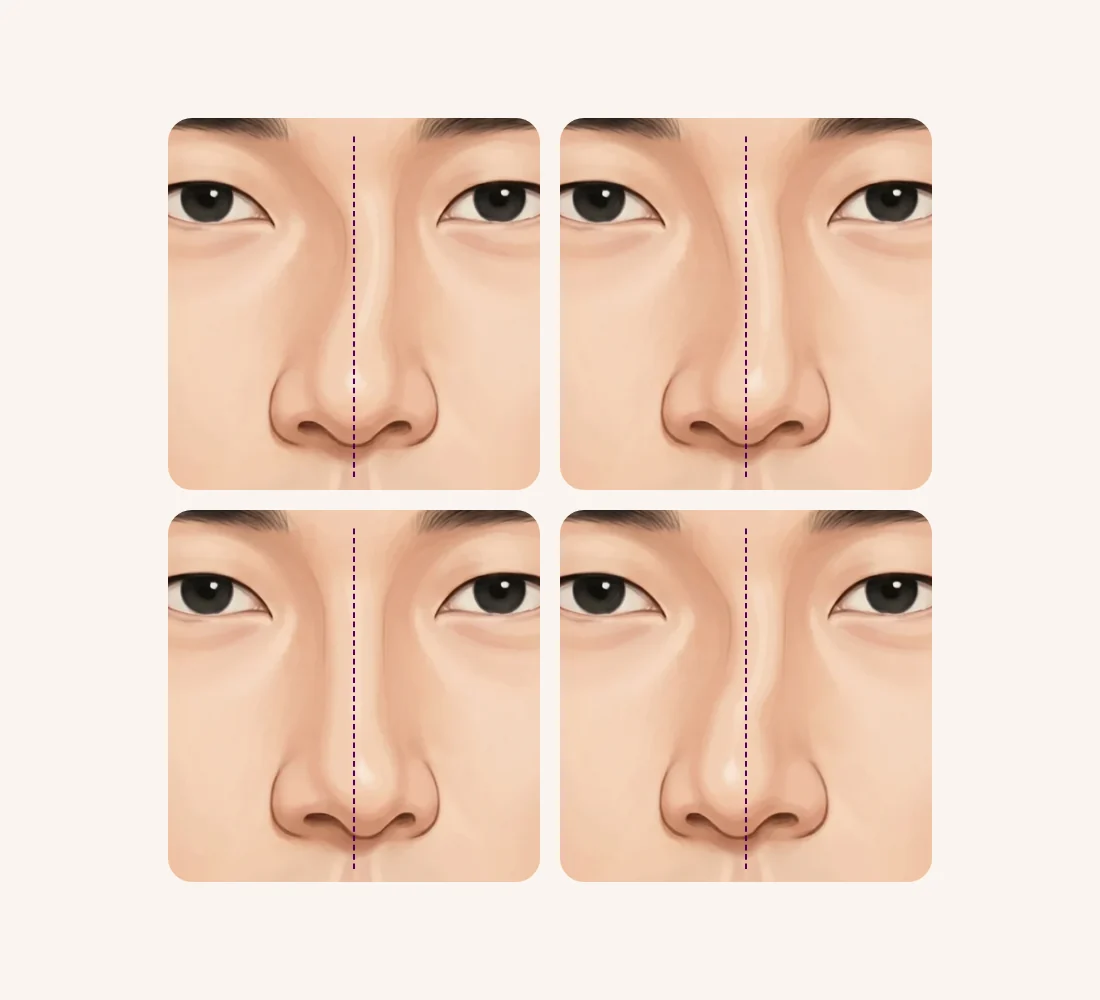
Where is a crooked nose actually bent?
Down the middle of the nose runs a wall that divides the inside into left and right. This wall is called the septum. Its front part is cartilage and its back part is bone. It supports the bridge above, and the columella (the strip between the nostrils) and tip below. That is why a bridge that looks crooked from the outside is rarely a problem of the nasal bones alone: the septum underneath is usually bent too.
It helps to think of three areas:
- The nasal bones, which form the upper bridge
- The septum and upper lateral cartilages (the cartilages on either side of the mid-bridge), which form the "middle vault"
- The front (caudal) edge of the septum, which supports the columella and tip
Some noses lean gently to one side along their whole length. Others change direction in an S-shape from the bridge to the tip. The causes vary too: a crooked nose can follow an injury such as a nasal fracture, develop without any obvious cause as you grow, or return after previous nose surgery.
What changes depending on where the bend is?
The correction considered depends on where the nose is bent. Here are four common situations.
Where the bend is changes the approach
1If the upper bridge (bone) tilts
Osteotomy repositions the nasal bones
Osteotomy
2If the middle of the bridge bends
Septal correction, with support grafts if needed
Septal correction
3If the columella and tip are off-center
The front edge is repositioned and supported
Front edge
4If several places bend in an S-shape
Osteotomy, septal work and grafts are combined
Combination
Each case has something to keep in mind:
- Moving bone alone may let bent cartilage pull the nose back.
- When the middle is corrected, the airway entrance is checked at the same time.
- The front edge of the septum is a difficult area that tends to bend back.
- When several places are bent, symmetry is checked at each step.
The front edge of the septum is a particularly tricky area. When it bends, the relationship between the tip and the columella shifts, so tip position and symmetry change with it. Even a small leftover bend there can cause marked blockage.6 If the tip looks off-center from the front, or the two nostrils differ in size when seen from below, this area deserves a close look.
Why are shape and breathing assessed together?
Most crooked noses involve both appearance and breathing (function). A classic paper on the deviated nose describes it as a case where airway blockage and the cosmetic problem frequently both have to be solved.1 The clinical practice guideline on rhinoplasty (recommendations experts draw up from the evidence) takes the same view. It recommends that every rhinoplasty candidate be assessed for nasal blockage before surgery, and be told how surgery might affect breathing.2
Not every blocked nose is caused by the septum, though. A Korean study looked at patients whose blockage remained after septal surgery. Besides a leftover septal bend, it listed three other causes. One is missed nasal valve problems (a narrow or weak airway entrance inside the nose). The others are under-treated turbinate enlargement (swollen shelf-like tissue on the side walls inside the nose) and worsening allergic rhinitis.6 So separating these causes before surgery is part of the plan.
Does septal correction really help breathing?
A Dutch trial randomly divided 203 adults with nasal blockage and a deviated septum into two groups. One group had septal surgery (with turbinate surgery where needed); the other had non-surgical care such as medication. At 12 months, the surgery group had better health-related quality of life scores (72.2 vs 63.9), and the difference lasted up to 24 months. In the surgery group, one patient developed a septal abscess (a pocket of pus) and two a septal perforation (a hole in the septum).3
A multicenter study (one run by several hospitals together) followed 59 people with at least three months of blockage that had not improved with medication. The NOSE symptom score (higher means worse) fell from 67.5 before surgery to 23.1 at three months and stayed there at six months. Use of nasal medication also went down.4
For blockage caused by a narrow or weak nasal valve, many studies support functional rhinoplasty (nose surgery to improve breathing). But most are observational studies with a low level of evidence, and more rigorous research is needed.5
To sum up, these studies are general evidence about blockage caused by a deviated septum. They do not directly describe the results of crooked nose surgery that also reshapes the outside, and individual results depend on the cause and degree of blockage.
Why can the nose bend back if only the outside is straightened?
Bent cartilage tends to spring back toward its old shape even after it has been straightened. This "memory" is hard to break.6 If only the outer bridge is reshaped while the septum stays bent, the inner structure can gradually pull the nose to one side again. One study looked at 74 people who needed a second septal operation. The most common site of leftover bending was the front edge of the septum (44.6%), followed by several sites at once (20.3%).6
The principles described for correcting a crooked nose are therefore:1
- Release all the forces pulling the septum to one side.
- Straighten it while leaving enough of a strut along the bridge and at the front (the supporting edges of the septum) to hold the nose up.
- Rebuild support that lasts.
- Reduce enlarged turbinates, and move the bones with controlled osteotomies (planned cuts in the bone so it can be moved).
On the other hand, weakening the front edge too much in the effort to remove a bend can lead to a saddle-shaped bridge or a drooping tip.6
How is the surgical plan built?
How a crooked nose plan comes together
- 1Shape and breathingFront-view symmetry, blockage and rhinitis
- 2Inner structuresBone deviation, septal condition and curve
- 3Plan by causeOsteotomy, septal correction, cartilage support
- 4SurgeryRelease the pull and realign the central axis
- 5Recovery and follow-upSymmetry and breathing rechecked as swelling fades
One crooked nose often needs several techniques:
- If the upper bones tilt, osteotomy brings them back to the midline.
- If the septum is bent, septal correction realigns the central axis.
- If support is weak, a cartilage graft braces it.
- Finally, the bridge and tip are shaped for left-right balance.
If there is also a hump on the bridge, the height and balance issues explained in our dorsal hump guide are handled in the same plan.
How does recovery go, and what are the limits?
At Bonita Clinic, crooked nose rhinoplasty is surgery under sedation with local anesthesia, with no overnight stay, and there are stitches. Swelling and bruising right after surgery are managed with a nasal splint (a support that holds the shape) and cold compresses, and the splint and stitches come off during recovery. Pressure on the nose from glasses and the like is avoided until the main swelling goes down. The final shape appears as the last swelling in the tip fades. How long this takes, and how often you need to come in, depends on the extent of correction and on you.
Breathing is judged over time, just like shape. The guideline recommends checking satisfaction with both appearance and nasal function at least 12 months after rhinoplasty.2 Early swelling can make the nose feel stuffier at first, so the result is not judged by how it feels in those weeks.
Limits and side effects to know about
- If the facial skeleton itself is asymmetric, making the nose alone fully symmetric is difficult.
- Because of cartilage memory, a small bend can remain or come back.6
- As with any surgery, swelling, bleeding, inflammation, infection and nerve injury are possible.
- With septal surgery, complications such as septal perforation or abscess are reported, though uncommon.3
How we approach it at Bonita Clinic
Treatment options you can discuss in Seoul
Bonita Clinic has been in the same place since 1995, and Dr. Kwang-Seop Chung, its director and a plastic surgeon board-certified in Brazil, performs the surgery. For a crooked nose, a consultation can cover:
- Assessment of nasal bone deviation, symmetry, septal condition and curvature
- Review of blockage and rhinitis symptoms, injury history and previous surgery
- Osteotomy to reposition the nasal bones and septal correction to realign the center
- Cartilage grafts to reinforce support when needed
- Bridge and tip design for balance, combined with hump correction if a hump is also present
Why do the plan and cost vary?
Two people who both say "my nose is crooked" may need very different operations: one may need only the bones moved, another septal reconstruction with grafts. What drives the plan and the cost is where the bend is and what is causing any blockage.
- Where the bend is: bones, septum, front edge or several
- How much bone repositioning is needed
- Whether cartilage support grafts are needed
- What is causing the blockage
- Previous injury, surgery or implants
- Anesthesia: sedation with local
Quote given after examining you in person
A final estimate is given after the in-person examination has shown where the nose is bent, what the septum looks like inside, and what part breathing plays. Before that, any number would be a guess.
What can photos show, and what needs an in-person exam?
Photos tell us a lot about the outside of a crooked nose. The septum, the turbinates and how the nasal valve behaves when you breathe can only be judged by examining you.
Photos can show
- How far the bridge leans from the front
- Tip and columella position from below
- Nostril size difference
- How the shape changed (older photos)
Needs an in-person exam
- Septal bend inside the nose
- Turbinate swelling and rhinitis
- Valve collapse on breathing in
- Bone position and cartilage strength
- Implants or grafts from past surgery
Useful photos: a straight-on front view with your head level, a view from below looking up at the nostrils, both profiles and both 45-degree views, in even light. Older photos from before an injury help too. Please also tell us which side feels blocked, when it is worse, and which nasal sprays or allergy medicines you use. You can send us a message with your photos and questions before you plan the trip.
Planning your visit and recovery
Settled in advance is only the treatment information above. Surgery is under sedation with local anesthesia, with same-day discharge and stitches. A nasal splint is used at first and removed with the stitches during recovery. When that happens, how long to stay in Seoul and when to come back are decided with you at consultation according to the planned correction, and may vary.
Expect swelling, possible bruising and a stuffy feeling in the first days. Avoid pressing glasses on your nose until the main swelling settles. Because breathing and symmetry are judged over months rather than weeks,2 it helps to keep notes on how your breathing feels as well as dated photos.
Once home, contact a doctor promptly if bleeding, pain, swelling or discharge increases, if you develop a fever, or if one side becomes completely blocked and painful. These can signal problems such as a collection of blood or infection in the septum. Your notes and photos will help any doctor who sees you.
Frequently asked questions
Will crooked nose surgery also fix my blocked nose?
The blockage may come from a deviated septum. In that case, a randomized trial and a prospective study (one that follows patients forward in time) found that septal correction improved symptoms and quality of life.34 If it comes from rhinitis or swollen turbinates, straightening the septum alone may not be enough. That is why the cause is separated before surgery, and both the expected change and what may remain are explained.
I have rhinitis. Can I still have surgery?
Rhinitis does not rule out surgery, but surgery does not remove rhinitis itself. In the research, septal correction was offered for blockage that had not improved enough with medication.4 Tell us which allergy medicines and sprays you use, especially decongestant sprays used over a long period. The guideline lists this as something to check before surgery.2
My nose became crooked again after a previous surgery.
That can be assessed too. We first check whether inner structures such as the septum are pulling the nose, not just the outer shape. In the revision study, a leftover bend at the front edge of the septum was the most common finding.6 If a bridge implant has tilted to one side, the approach is different; see our nasal implant revision guide.
Will my nose be completely straight?
The aim is balance with the midline of your face. Bent cartilage tends to return toward its old shape, and faces themselves have left-right differences, so a small asymmetry may remain.6 Final shape and breathing are judged once the swelling has largely gone.
Where will the scars be?
With crooked nose surgery at Bonita Clinic, scars are mostly inside the nostrils and on the columella, and we care for them so they fade over time. A small columellar incision is often added when the septum needs extensive work or the tip needs more support.
What to prepare before your consultation
- Which side is blocked and when it is worse (lying down, seasons, colds)
- Allergy medicines and nasal sprays you use, and for how long
- Any nasal injury and when it happened; previous nose surgery or implants
- Whether you snore or have been told you stop breathing in your sleep (the guideline recommends checking this before surgery2)
- Front and from-below photos, plus older photos if the shape changed
The clinic is a short walk, about 100 m, from Exit 8 of Nonhyeon Station on Line 7: 3rd floor, 565 Gangnam-daero, Seocho-gu, Seoul. More on the process is on our Crooked Nose Rhinoplasty page. If a hump is also a concern, see Dorsal Hump Rhinoplasty and the dorsal hump guide; for changing the overall proportions, see the full rhinoplasty guide.
References (6)
Sources that support the explanations in this article. Study findings describe general trends and do not guarantee individual results.
- Rohrich RJ, Gunter JP, Deuber MA, Adams WP Jr. The deviated nose: optimizing results using a simplified classification and algorithmic approach. Plast Reconstr Surg. 2002;110(6):1509-1523.doi:10.1097/01.PRS.0000029975.08760.25Classic paper (abstract): a deviated nose often requires solving both airway obstruction and appearance; principles include releasing all deforming forces on the septum, straightening it while keeping dorsal and caudal struts, restoring support, reducing enlarged turbinates and controlled osteotomies
- Ishii LE, Tollefson TT, Basura GJ, et al. Clinical Practice Guideline: Improving Nasal Form and Function after Rhinoplasty. Otolaryngol Head Neck Surg. 2017;156(2_suppl):S1-S30.doi:10.1177/0194599816683153Clinical practice guideline (abstract): assess nasal obstruction before rhinoplasty, discuss expectations, check comorbidities such as sleep apnea and long-term decongestant spray use, explain effects on breathing and possible future surgery, and document satisfaction with appearance and function at 12 months or later
- van Egmond MMHT, Rovers MM, Hannink G, et al. Septoplasty with or without concurrent turbinate surgery versus non-surgical management for nasal obstruction in adults with a deviated septum: a pragmatic, randomised controlled trial. Lancet. 2019;394(10195):314-321.doi:10.1016/S0140-6736(19)30354-XRandomized controlled trial (abstract) of 203 adults with a deviated septum and obstruction: quality of life score at 12 months 72.2 with septoplasty vs 63.9 without (difference 8.3), sustained to 24 months; one septal abscess and two perforations in the surgical group
- Stewart MG, Smith TL, Weaver EM, et al. Outcomes after nasal septoplasty: results from the Nasal Obstruction Septoplasty Effectiveness (NOSE) study. Otolaryngol Head Neck Surg. 2004;130(3):283-290.doi:10.1016/j.otohns.2003.12.004Prospective multicenter study (abstract) of 59 people with at least 3 months of blockage despite medication: NOSE score fell from 67.5 to 23.1 at 3 months, maintained at 6 months; high satisfaction and less medication use
- Rhee JS, Arganbright JM, McMullin BT, Hannley M. Evidence supporting functional rhinoplasty or nasal valve repair: A 25-year systematic review. Otolaryngol Head Neck Surg. 2008;139(1):10-20.doi:10.1016/j.otohns.2008.02.007Systematic review (abstract) of 44 studies on functional rhinoplasty for nasal valve obstruction: mostly level 4 evidence but generally supportive; studies with comparison groups and objective measures are needed
- Lee DJ, Jo H, Kwon HN, et al. Causes and management of persistent septal deviation after septoplasty. Sci Rep. 2022;12(1):19574.doi:10.1038/s41598-022-23772-yRetrospective study (full text) of 74 revision septoplasty patients in Korea: residual deviation most often at the caudal septum (44.6%); caudal deviation affects tip position and symmetry; cartilage bending memory is hard to break; weakening the caudal septum risks saddle nose and tip ptosis; other causes of persistent blockage (valve, turbinates, rhinitis)
About this article
This article separates general medical information from Bonita Clinic's own approach. Because the right decision depends on each person's condition, it is not a substitute for a consultation.
