 KOKorean
 ENEnglish
 JP日本語
JP日本語 CN中文(简体)
 TW中文(繁體)

Flying After Rhinoplasty in Seoul: How Soon Can You Fly Home?
No single day after rhinoplasty is right for everyone; when you can fly depends on the extent of surgery and how your recovery is going. Early on, the splint and stitches still need to come off and bleeding and swelling need checking, and an aviation medicine review advises extra caution about flying soon after ear, nose and throat surgery. In the cabin, lower pressure makes the air in the ears and sinuses expand, and sitting for hours raises the risk of a blood clot in the leg veins. At Bonita Clinic, your return date is planned with you at consultation, around the extent of surgery, your recovery, and the splint removal and follow-up check.

What should you weigh up before flying after rhinoplasty?
If you are having rhinoplasty in Seoul and flying home afterwards, the first thing you probably want to know is how many days you need to wait. There is no single number that fits everyone. Recovery after refining only the tip is different from recovery after reshaping the bridge and nasal bones, or after surgery that uses rib cartilage. So before talking about dates, it helps to understand what a flight actually asks of a body that has just had nose surgery. Once you know that, planning the trip becomes much easier.
There are four main things to think about:
- Wounds and nosebleeds: while the incisions inside the nose and on the columella (the strip of skin between the nostrils) heal, some bleeding can appear.
- Splint and stitches: the splint (a firm cover that holds the new shape of the nose) and the stitches still need to come off, and your nose needs to be checked.
- Pressure changes: cabin pressure is lower than on the ground, so pressure changes inside the ears and in the air spaces within the facial bones.
- Sitting for a long time: long-haul flights raise the risk of a blood clot (a lump of blood that has set inside a vein) in the legs.
Each of these matters at a different stage of recovery and in a different way. The cards below show situations that commonly come up before departure.
If this is you before your flight
1The splint and stitches are still on
Removal and a check-up are built into your return date
Recovery schedule
2A nosebleed keeps coming back
Have it checked before departure and review the travel date
Bleeding
3Your nose feels stuffy and your ears block easily
Ask in advance how to clear your ears and which medicines are allowed
Cabin pressure
4Your flight is longer than 4 hours
Move often, and discuss stockings or other prevention with your doctor
Clot prevention
What happens to your nose in the first weeks after surgery?
At Bonita Clinic, full rhinoplasty is performed under sedation or general anesthesia, and you go home the same day without a hospital stay. There are stitches, and after the splint is removed you come back on a set schedule so we can check your progress. How long recovery takes, and how many follow-up visits you need, depend on the extent of surgery and on you as an individual. Even within nose surgery the approach varies: nasal tip surgery on its own, for example, is done under sedation combined with local anesthesia.
Right after surgery, swelling and bruising appear, and the inside of the nose swells, so breathing through it can feel blocked. While the wounds heal, a little bleeding can show. This early period is exactly the one that matters most when you plan your flight home.
How often do problems happen after rhinoplasty? A systematic review (a study that gathers all the relevant research by a set method) put numbers on it. Across 36 eligible studies, bleeding was reported in 0 to 4.1% of patients, infection in 0 to 4%, and wound separation in 0 to 5%, depending on the study.2 Put simply, most people do not have these problems, but a few in every hundred may have bleeding or an infection. That is why these numbers matter for travel: being near the clinic that operated on you when something happens is very different from being several hours into a flight.
Swelling also does not disappear all at once. After rhinoplasty it goes down slowly over months, and swelling at the tip is the last to settle. We have charted a study that measured this with 3D imaging in our dorsal hump surgery guide. It is normal to fly home with some swelling left, and how you watch the remaining swelling at home matters just as much.
From surgery to after you get home: the usual recovery flow
- Day of surgeryHome the same day · splint holds the shape
- First few daysSwelling and bruising · stuffy nose, some bleeding possible
- Splint and stitches offRemoved at a set visit, nose checked
- Check-up, then homeBleeding, wounds and swelling reviewed before flying
- Months afterRemaining swelling fades slowly as the shape settles
What is the cabin environment like for your body?
Planes fly high, but the cabin is pressurized so the air does not get as thin as it is outside. Even so, it is not the same as being on the ground. According to a review of medical issues in commercial air travel, cabin pressure at cruising altitude is similar to the air pressure at about 1,500 to 2,400 meters above sea level.1 Just as a sealed snack bag puffs up on a mountain, gases take up more space when pressure drops. The same review explains that gas in the body's air-filled spaces expands by about 30% at these cabin pressures.1
These air-filled spaces include the middle ear, the small air chamber behind the eardrum, and the sinuses, the air pockets inside the bones of the forehead and cheeks. Normally they connect to the outside through narrow passages, so pressure balances by itself. If a passage does not open well, the pressure inside and outside differs, and you may feel fullness or pain.
The cabin air itself has an effect too. The review notes that passengers and crew complain of dry eyes and a stuffy nose in connection with cabin air quality.1 If your nose already feels blocked after surgery, this discomfort may feel stronger.
What happens to the nose and ears in the cabin
There is also something we do not know. We could not find a study that directly measured how much cabin pressure adds to swelling in a nose that has just been operated on. So rather than worrying vaguely about pressure, it is more practical to plan around the factors with evidence behind them: bleeding, ear pressure and long hours of sitting.
Why do your ears feel blocked on a plane?
Pressure in the middle ear is balanced by the Eustachian tube, a narrow tube that runs from the middle ear to the upper part of the throat behind the nose. When you swallow or yawn and feel your ears "pop", that is the tube opening.
A review of ear barotrauma (ear injury from pressure change) explains that problems arise when the Eustachian tube fails to equalize the pressure between the middle ear and the outside. It can happen on the way up, but it is more common on descent. Symptoms are a feeling of fullness, ear pain and muffled hearing; in severe cases the eardrum can tear.6
The Eustachian tube opens into the nasopharynx, the space where the back of the nose meets the throat. So if you fly while your nose still feels stuffy after surgery, it helps to know ahead of time how you will clear your ears before landing. One point needs care. Pinching your nose and blowing hard to "pop" your ears presses on the operated nose and builds pressure inside it. Please ask at your pre-departure check-up whether this is allowed so soon after surgery. You can start with methods that leave the nose alone, such as swallowing and yawning.
Do decongestant pills or nasal sprays help?
The same review summarizes three randomized controlled trials (studies that split people into groups at random to compare them), and the results were mixed. Oral pseudoephedrine, a decongestant pill, reduced ear pain in adults who often had ear pain when flying, but it did not help children. An oxymetazoline nasal spray taken 30 minutes before descent made no clear difference.6 After nose surgery, even putting a spray inside the nose needs a separate decision based on how the wounds are healing. So please do not choose any medicine yourself; follow your prescription and the advice you were given.
What if your nose bleeds before or during the flight?
A little spotting after surgery is treated differently from bleeding that does not stop. At your check-up before departure, we look at whether the bleeding has stopped and whether the wounds are stable. If bleeding is still coming back, it is wiser to postpone the flight and review the plan, because getting medical care on board is difficult.
If your nose bleeds during the flight:
- Do not tip your head back. Sit upright and lean slightly forward so blood does not run down the back of your throat.
- Hold clean gauze or a tissue lightly under your nose. Do not blow or rub your nose.
- Follow the advice you received after surgery on whether, and where, to press your nose.
- If the bleeding does not stop or is heavy, tell the cabin crew and get medical care as soon as you land.
One more point is worth knowing. Medicines that prevent clots, such as heparin injections or aspirin, make blood clot less easily and can increase bleeding. Soon after surgery, clot prevention and bleeding risk have to be weighed against each other. Do not start any of these medicines without talking to the team that operated on you.
Long-haul flights and blood clots: does this apply after nose surgery?
When a clot forms in a deep vein of the leg, it is called deep vein thrombosis. If a piece breaks off and blocks a blood vessel in the lungs, it is called a pulmonary embolism. When you sit still for a long time, the calf muscles do not work, blood moves slowly in the leg veins, and this sets the stage for a clot.
Inside the calf vein when you sit for hours
The link between travel and blood clots has been studied in a meta-analysis (a study that combines and recalculates the results of earlier studies). It pooled 14 studies including 4,055 people with clots. Travelers had about twice the clot risk of people who did not travel. When studies with a biased choice of comparison group were left out, the figure was about 2.8 times. The risk also rose by about 26% for every additional 2 hours of air travel.3 In plain terms, the longer the flight, the longer blood sits in the leg veins, and the higher the risk. All the studies in this analysis were carried out in Western countries.3
What about rhinoplasty itself? A study of US insurance claims looked at 55,287 people who had rhinoplasty between 2007 and 2016. Clots occurred in 111 of them.5 That is about 0.2%, or roughly 1 in 500 people, so it is a rare complication. But the risk was not the same for everyone. People who had had a clot before had the highest risk, with odds about 53 times higher (an odds ratio of 52.8; an odds ratio compares the chance of a clot between two groups). The odds were about 4.6 times higher when rib cartilage was taken during surgery, about 2.65 times higher at ages 41 to 60 and about 2.4 times higher at ages 61 to 74. Inflammatory bowel disease (a long-lasting inflammation of the gut) also raised the risk.5 Because the study looked back through US insurance records, its figures may not carry over directly to patients from other countries.5
Blood clots after rhinoplasty: how rare, and what raises the risk
Guidelines reflect this. The American Society of Hematology's 2018 guideline (practice recommendations a specialist society makes after reviewing the evidence) deals separately with travel lasting more than 4 hours. For people without risk factors, it suggests not using compression stockings, clot-prevention injections or aspirin. For people at clearly higher risk, such as those who have recently had surgery, it suggests compression stockings or a preventive dose of low-molecular-weight heparin (an injection that helps prevent clots).4 These are conditional recommendations based on very low certainty evidence.4 So whether you need stockings or injections is decided with your doctor, based on the extent of your surgery, the length of the flight and your own risk factors.
So when can you fly? Is there a fixed number of days?
The aviation medicine review mentioned above lists situations in which flying is generally advised against. That list includes ear, nose and throat surgery within the previous 10 to 14 days, grouped together with gastrointestinal, chest and neurological surgery.1 However, the list groups many operations together as a general rule. It was not set by studying rhinoplasty on its own. It is more accurate to read it not as "after this day, everything is fine", but as a reminder that roughly the first two weeks after surgery are a time to be more careful about flying.
Your actual schedule depends on several conditions:
- Extent of surgery: recovery after refining only the tip differs from recovery after work on the nasal bones or surgery with rib cartilage. A nose that has been operated on before, as in revision surgery, is watched more closely during recovery.
- How recovery is going: whether bleeding has stopped, the wounds have closed well, and swelling and pain are easing.
- Flight conditions: whether the flight is over 4 hours, and whether a stopover makes the whole journey longer.
- Your personal clot risk: a previous clot, age, obesity, hormone medicines (the pill or hormone therapy) and pregnancy are considered together.45
At your pre-departure check-up, how is your nose doing?
- Bleeding has stopped and wounds are stableFly home as planned, once confirmed at the check-up
- Bleeding keeps returning, or pain and swelling are getting worseAnother check before departure · review the travel date
- Previous clot · rib cartilage used · flight over 4 hoursDiscuss walking, stockings and other prevention in advance
At Bonita Clinic, we look at these conditions together at your consultation and plan your return date around the splint removal and follow-up check.
How should you look after yourself on the plane?
The aviation medicine review notes that drinking water, cutting down on alcohol and caffeine, changing position, walking and calf exercises rest more on common sense than on evidence.1 Compression stockings have somewhat more support, from an analysis that pooled several trials.1
- Move often: while seated, flex your ankles up and down to work your calf muscles. When it is safe, walking in the aisle also helps.1
- Choose your seat: clots have been reported more often in seats away from the aisle (window and middle seats), where passengers tend to move less.1 An aisle seat makes it easier to get up and move.
- Drink water: stay well hydrated and cut down on alcohol and caffeine.1
- Compression stockings: graduated compression stockings with an ankle pressure of about 17 to 30 mmHg are described as reducing clot risk during air travel.1 Soon after surgery, talk to your doctor first about whether to wear them and which kind to choose.4
- Protect your nose: do not blow or rub it. Make sure glasses or a face mask do not press on the bridge, and keep following your aftercare instructions during the flight.
- Clear your ears: when the plane starts to descend, swallow or yawn to balance the pressure in your ears.
- Keep medicines with you: carry prescribed medicines in your cabin bag, and ask in advance how to time your doses when you change time zones.
What should you watch for after you get home?
Recovery continues after you return. Do not wait to get medical care if you notice any of the following:
- A nosebleed that does not stop, or heavy bleeding
- Pain, redness or swelling that is getting worse instead of better, or a fever
- One leg becoming swollen and painful, or sudden breathlessness and chest pain. These can be signs of a clot and need emergency care.
Clots do not only appear right after the flight. The systematic review behind the guideline counted clots with symptoms that appeared within 4 weeks of a flight longer than 4 hours.4 So keep an eye on leg swelling or pain and on breathlessness for several weeks after you arrive.
When you see a doctor at home, tell them the date of surgery, what was done (bridge, tip, nasal bones, and whether cartilage was used) and the medicines you are taking. If you were given a copy of your surgical records, bring it. Please also let Bonita Clinic, where you had your surgery, know what the doctor found.
Taking front and profile photos on set dates, in the same light and from the same angles, makes it easier for you to follow how the swelling settles and for any doctor to review your progress. Because the remaining swelling fades over months, there is no need to judge the result by how your nose looks right after you return.
Rhinoplasty options you can discuss in Seoul
Bonita Clinic has been at the same location since opening in 1995, and Dr. Kwang Sub Jung, a board-certified plastic surgeon (Brazil), has seen patients here throughout. The options you can discuss at consultation are the ones described on our treatment pages:
- Full rhinoplasty: the bridge, tip, alar base and nasolabial angle are planned together in proportion to your face. The bridge is shaped with an implant or your own tissue, and the tip is supported with your own cartilage, such as septal or ear cartilage. Wide nostrils or splayed nasal bones can be reduced or narrowed in the same operation. See Full Rhinoplasty.
- Revision rhinoplasty: the previous surgery, any implant, remaining cartilage and scar tissue are assessed first. When needed, the structure is rebuilt with your own cartilage, such as ear, septal or rib cartilage. See Full Revision Rhinoplasty.
- Nasal tip surgery: the cause of a round, wide, low or drooping tip is analyzed, and the tip is reshaped with its support in mind. See Nasal Tip Rhinoplasty.
Which of these suits you, and how long your recovery is likely to take, is decided only after an examination.
Why do the plan and cost differ from person to person?
Two people who both ask for "rhinoplasty" can need very different operations, and very different recovery times in Seoul. What shapes the plan, and therefore the cost, is how much needs to be done and with what.
- Extent: bridge, tip, alar base, nasal bones
- Bridge material: implant or your own tissue
- Cartilage source: septum, ear or rib
- First surgery or revision
- Anesthesia: sedation or general
- Follow-up visits needed before flying home
Final plan and quote after an in-person exam
A final estimate is given only after an in-person examination, once the extent of surgery is clear. Photos help narrow down the options; the extent of surgery, and with it the length of your stay, is settled at an examination.
What can photos show, and what needs an in-person exam?
Photos are a good way to start. They show the shape of your nose and your concerns clearly. But they cannot show how thick your skin is, how strong your cartilage is, or what is happening inside your nose.
Photos can show
- Bridge height and line in profile
- Tip shape and direction
- Width of the nostrils and bridge
- Visible changes from earlier surgery
- Facial balance from several angles
Needs an in-person exam
- Skin thickness over the tip
- Cartilage strength and support
- Septum and breathing inside the nose
- Scar tissue or implant from earlier surgery
- Bleeding and clot risk from your history
Helpful photos: front, both profiles and both 45-degree views, taken in good light without heavy makeup. If you have had nose surgery before, photos from before that surgery also help. Along with your photos, please tell us what you would like to change and what you would like to keep, your rough travel dates and flight length, and whether you have ever had a blood clot. You can send us a message with your photos and questions before planning your trip to Seoul.
How we approach it at Bonita Clinic
How we plan your return date
- 1ConsultationWe hear your goals, past surgery and flight plans, then set the extent and recovery schedule
- 2SurgerySedation or general anesthesia · home the same day
- 3Follow-upSet visits continue after the splint comes off
- 4Flying homeAfter bleeding, wounds and swelling are checked
Real treatment cases: full rhinoplasty
These are full rhinoplasty cases from Bonita Clinic, the treatment this guide is based on. We could not confirm the time since surgery for each photo, so it is not stated. Results vary from person to person.
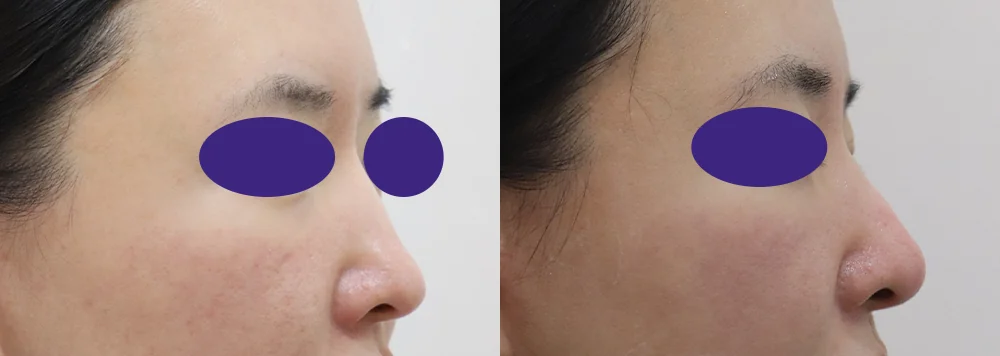
The bridge and tip from side and oblique angles
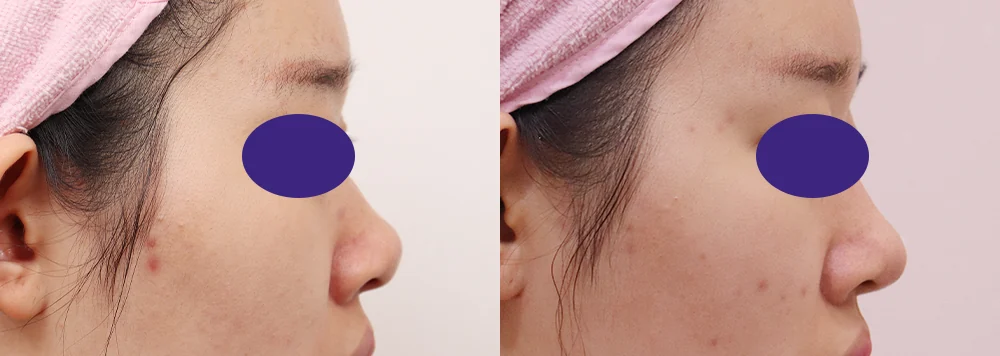
The bridge line and tip angle in profile
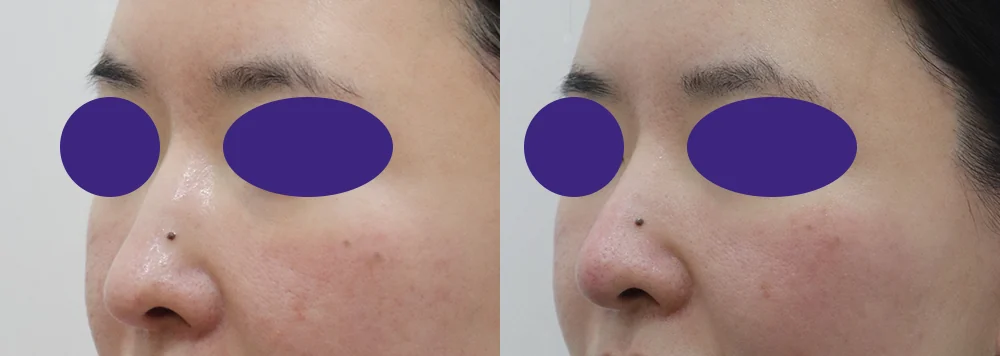
The bridge and tip from an angle
* Results vary from person to person. Side effects are possible, so please decide after a thorough consultation with a doctor.
Frequently asked questions
Can I fly with my nasal splint still on?
What matters is less the splint itself than the removal and check-up visit that is still ahead of you. When the splint comes off depends on the extent of surgery and how you are healing. At Bonita Clinic, you come back on set dates after the splint is removed so we can check your progress, so your return date is planned around these visits. If your travel dates are fixed for some reason, please tell us at consultation. We take those dates into account when planning the extent of surgery and your recovery.
Will flying make my nose more swollen?
Lower cabin pressure makes the air in spaces such as the sinuses and middle ear expand.1 But we found no study that measured how much a flight adds to swelling after rhinoplasty. Swelling normally fades slowly over months, so small changes in the days after a flight are hard to judge. If swelling keeps getting worse, or comes with pain or redness, see a doctor.
Do I have to wear compression stockings?
Not everyone needs them. For travel longer than 4 hours, the American Society of Hematology guideline suggests not using stockings for people without risk factors, and suggests stockings or preventive injections for people at clearly higher risk, such as after recent surgery. The certainty of this evidence is very low.4 One study also found a higher risk when rib cartilage was used or when a person had had a clot before,5 so it is wise to decide with your doctor before departure.
Can I use a nasal spray if my ears hurt on the plane?
Studies of decongestant pills and nasal sprays for ear pain on flights have had mixed results.6 After nose surgery, even using a spray inside the nose has to be judged by how the wounds are healing. Do not use one on your own; ask at your pre-departure check-up which medicines and methods you can use. It is also worth asking about pinching your nose and blowing to clear your ears.
What should I do if a problem appears after I get home?
If a nosebleed does not stop, pain, redness or swelling keeps getting worse, or you develop a fever, see a doctor near you. If one leg becomes swollen and painful, or you suddenly become short of breath, you need emergency care. Tell the doctor the date and extent of your surgery and the medicines you take, and please also let Bonita Clinic, where you had your surgery, know what the doctor found.
What to prepare before your consultation
- Your rough return date, flight length and any stopovers
- Whether you have ever had a blood clot, the medicines you take (including the pill, hormone medicines or blood thinners) and any medical conditions
- Any previous nose surgery or fillers with approximate dates, and your surgical records if you have them
- Front, profile and 45-degree photos
- What you want to change and what you want to keep
Bonita Clinic is on the 3rd floor of 565 Gangnam-daero, Seocho-gu, Seoul, about 100 m on foot from Exit 8 of Nonhyeon Station (Line 7). For the surgery itself, see our Full Rhinoplasty page and the full rhinoplasty guide. If you are correcting an earlier operation, see Full Revision Rhinoplasty and the revision rhinoplasty guide. For surgery on the tip alone, see Nasal Tip Rhinoplasty and the nasal tip guide.
References (6)
Sources that support the explanations in this article. Study findings describe general trends and do not guarantee individual results.
- Silverman D, Gendreau M. Medical issues associated with commercial flights. Lancet. 2009;373(9680):2067-2077.doi:10.1016/S0140-6736(09)60209-9Review of medical issues in commercial flights (full text, PMC): cabin pressure at cruise equals about 1,524–2,438 m altitude, gas in body cavities expands by about 30%, complaints of dry eyes and stuffy nose linked to cabin air, a table of contraindications that includes ear, nose and throat surgery within 10–14 days (no source given for the table), and long-haul clot prevention: hydration, less alcohol and caffeine, changing position and walking, calf exercises, 17–30 mmHg compression stockings; clots were more frequent in non-aisle seats
- Sharif-Askary B, Carlson AR, Van Noord MG, Marcus JR. Incidence of Postoperative Adverse Events after Rhinoplasty: A Systematic Review. Plast Reconstr Surg. 2020;145(3):669-684.doi:10.1097/PRS.0000000000006561Systematic review of 36 studies (abstract): adverse events after rhinoplasty reported as ranges, including bleeding 0–4.1%, infection 0–4%, wound separation 0–5% and need for revision 0–10.9%
- Chandra D, Parisini E, Mozaffarian D. Meta-analysis: travel and risk for venous thromboembolism. Ann Intern Med. 2009;151(3):180-190.doi:10.7326/0003-4819-151-3-200908040-00129Meta-analysis of 14 studies with 4,055 clot cases (abstract): travelers had a relative risk of 2.0 (2.8 when studies with referred controls were excluded), with 18% higher risk per 2 hours of any travel and 26% per 2 hours of air travel; all studies were from Western countries
- Schünemann HJ, Cushman M, Burnett AE, et al. American Society of Hematology 2018 guidelines for management of venous thromboembolism: prophylaxis for hospitalized and nonhospitalized medical patients. Blood Adv. 2018;2(22):3198-3225.doi:10.1182/bloodadvances.2018022954American Society of Hematology guideline (recommendations 17–19 read in the PMC full text): for travel over 4 hours, no stockings, heparin or aspirin for people without risk factors; stockings or preventive low-molecular-weight heparin for people at substantially increased risk such as recent surgery or a previous clot (conditional recommendations, very low certainty evidence)
- Okland TS, Wadhwa H, Patel PN, Most SP. Risk of Venous Thromboembolism Following Rhinoplasty. Aesthet Surg J. 2021;41(7):NP728-NP734.doi:10.1093/asj/sjaa427US insurance claims study (abstract): 111 clots among 55,287 rhinoplasty patients in 2007–2016 (70 deep vein thromboses, 41 pulmonary embolisms); odds ratios: previous clot 52.8, central line 19.6, rib cartilage graft 4.6, age 41–60 2.65, inflammatory bowel disease 2.6, age 61–74 2.4
- Mirza S, Richardson H. Otic barotrauma from air travel. J Laryngol Otol. 2005;119(5):366-370.doi:10.1258/0022215053945723Review of ear barotrauma from air travel (abstract): caused by failure of the Eustachian tube to equalize pressure, more often on descent; fullness, pain and hearing loss, rarely eardrum perforation; of three randomized trials, oral pseudoephedrine helped adults but not children, and oxymetazoline spray before descent showed no significant benefit
About this article
This article separates general medical information from Bonita Clinic's own approach. Because the right decision depends on each person's condition, it is not a substitute for a consultation.
