 KOKorean
 ENEnglish
 JP日本語
JP日本語 CN中文(简体)
 TW中文(繁體)

Lifting After Facial Filler Removal in Seoul: Treating Hollows and Sagging Once the Material Is Out
After filler or other material is removed, the face often shows two things at once. There is a hollow where the volume used to be, and sagging of skin that was stretched by the material for years. Bonita Clinic looks at the two separately and follows a simple order: restore volume first, then decide whether lifting is needed. Hollows are filled with your own fat, fat sagging under the jawline is removed by liposuction, and fine lines and firmness are supported with dissolvable threads and lasers. Any remaining material or inflammation is dealt with first, and whether everything is done on one day or in stages depends on your condition. If you are planning treatment in Seoul, you can send photos and the dates of your injections and removal first.
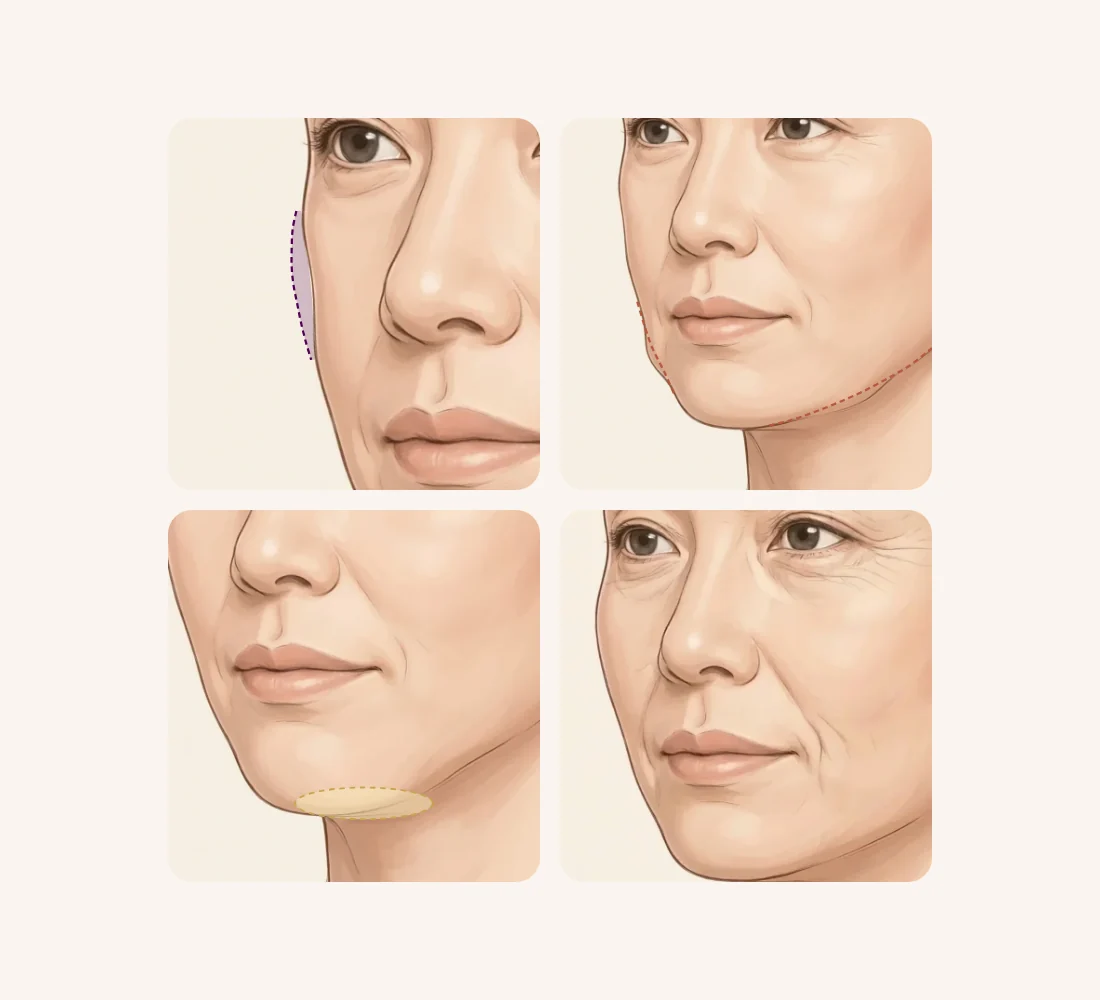
What is left in the face after filler is removed?
When filler or a material of unknown content is taken out of the face, two changes are usually left behind together:
- A hollow: the space the material used to fill is now empty, so the area dips.
- Sagging: skin and soft tissue (the fat and thin sheets under the skin) that were stretched by the material for years now droop, because what held them up is gone.
It is a bit like a balloon: when the air comes out, the stretched rubber wrinkles. A study of surgery for complications of non-degradable filler also explains that removing the material often leaves a clear defect (an area where tissue is missing), which makes reconstruction difficult.1
Age-related changes are added on top
Facial aging does not have just one cause. It comes from gravity, gradual loss of bone (bone resorption), loss of elasticity and fat under the skin shifting position, all working together. That is why one view holds that restoring the face's three-dimensional volume should be the first goal when trying to restore a youthful face.3
One report described 50 patients who had non-degradable filler removed together with a facelift (surgery that lifts the skin and the layers beneath it) and fat grafting. Most came in many years after their injections to correct a sagging face.2 This is why a face after filler removal has to be looked at for both "where the material came out" and "the sagging that has developed in the meantime."
Why volume first, and lifting second?
Even when the skin has loosened after the material is out, Bonita Clinic does not lift straight away. Volume is restored first, and the need for lifting is decided afterwards.
The reason is this. Once a hollow is filled, skin that looked loose is often supported again to some degree. Then only the sagging that remains needs lifting, which looks more natural. If the skin is pulled while the lost volume is left as it is, the hollow stays and the contour can simply look flatter.
Multi Lifting is not a fixed package. The method is chosen and combined according to what problem is left.
Choosing a method by what is left
1If one cheek is hollow and the sides differ
The volume difference is measured and reduced with your own fat
Fat grafting
2If the skin loosened after removal
Volume is restored first; whether to lift is decided afterwards
Volume first
3If fat sags under the jawline
It is removed with a special cannula (thin tube), no incisions
Jaw liposuction
4If fine lines show along smile lines or under the eyes
Dissolvable threads are placed densely, like a mesh, for firmness
Dissolvable threads
What is checked before any lifting?
Before lifting is added, the first things checked are material that remains and inflammation. It is the same order as repairing a house: you stop the leak before you put up new wallpaper.
A study of 160 people who had non-degradable filler removed pointed out that even after careful removal, tiny particles that cannot be seen may remain, and they can become a seed for infection or inflammation. For that reason, anyone who had an infection in the previous three months was not operated on. Patients who developed a sudden infection had the pus drained and were treated with antibiotics, and the remaining material was removed and the area rebuilt six months later.1
In the report of 50 patients, too, only people with no signs of infection on the skin were operated on. When pus had collected, draining it came first rather than fat grafting, and before surgery MRI and ultrasound were used to check the type, amount and location of the material.2
Bonita Clinic follows the same order. If filler or foreign material remains, it is located by ultrasound and removed. Remaining adhesions (skin stuck to the tissue below) and scars are dealt with before moving on to lifting.
The order at Bonita Clinic
- 1Clear firstUltrasound check, removal, adhesions and scars
- 2Volume firstDecide where lost volume needs filling
- 3Jaw liposuctionFat sagging below the jawline
- 4Fat graftingTo reduce side-to-side differences
- 5Threads and laserFine lines, firmness, texture and marks
- 6Balance checkAt rest and with expressions, side by side
Only the steps you need are chosen. Remaining differences are fine-tuned once things have settled
What does the evidence say about each method?
| Method | What studies reported | Good to know |
|---|---|---|
| Facial fat grafting | 43 studies, 4,577 patients: mean volume retained 41.63% (mean follow-up 13.9 months), complications 2.27%4 | Most complications were asymmetry and an irregular surface4 |
| Thread lifting | 26 studies pooled: swelling 35%, dimpling 10%, altered sensation 6%, visible or palpable threads 4%, infection 2%5 | Dissolvable threads had less altered sensation and extrusion than non-absorbable ones5 |
| Removal + facelift + fat grafting (surgery) | In 50 patients: seroma 4, temporary facial nerve weakness 4, thick scars 5, infection 22 | A surgical option considered for deep sagging or large defects |
A seroma, listed in the table, is clear fluid collecting where surgery was done.
Fat grafting: check and top up, rather than aiming for exact in one go
A systematic review (a study that gathers earlier studies by a set method and looks at them again) covered 43 studies of facial fat grafting with 4,577 patients. On average 41.63% of the grafted volume remained (mean follow-up 13.9 months).4 A little under half of the moved fat was still there after a little over a year.
Complications were uncommon, but most of them were asymmetry (74 of 104) and an uneven skin surface (14). These happen when too little or too much fat is grafted, or when it does not take hold evenly (graft take means the moved fat settles and survives).4 The proportion that remains also varies between studies. It is more realistic to check the balance once things have settled and top up, rather than trying to get it exactly right at once.
Dissolvable threads: a light recovery, but limited staying power
Dissolvable threads mean a lighter recovery, but the effect has limits in how long it lasts. A meta-analysis (a study that pools the results of many studies and recalculates them) looked at 26 thread-lift studies. Satisfaction right after treatment was 98%, but it fell to 88% later on.5 Almost everyone was satisfied at first, but fewer were as time went by.
People over 50 also had more dimpling (16% vs 5.6%) and infection (5.9% vs 0.7%).5 The authors advised explaining in advance that the effect may not last long.5
Deep sagging: a facelift is compared as well
If sagging is deep, or the defect left by removal is large, methods without incisions have limits. Surgeons abroad have reported removing non-degradable filler together with a facelift that lifts the deeper layers and with tissue transfer.1 A facelift is often a better fit for deep sagging and neck lines.
Whatever the method, faces are naturally a little different on each side. The aim is not identical sides but reducing the differences that the material and sagging have made larger.
How we approach it at Bonita Clinic
What happens on the day, and during recovery?
At Bonita Clinic, we class Multi Lifting after foreign material removal as a non-surgical treatment. It is done under sedation with local anesthesia, you go home the same day, and there are stitches only if fat grafting is done. Recovery can differ depending on whether removal is done on the same day, and from person to person.
Recovery roughly goes like this. Right after treatment, swelling and bruising are managed with compression. As they settle, the contours on each side become clear, and balance is checked once the grafted fat and lifting have settled, with fine touch-ups only if needed.
Treatment options you can discuss in Seoul
Since opening in 1995 at the same address, Bonita Clinic has been led by Dr. Kwang-Seop Chung, a board-certified plastic surgeon (Brazil) who examines every patient himself. After filler or foreign material removal, or when material still remains, consultation covers:
- Ultrasound to check for remaining material, then removal and treatment of adhesions and scars
- Restoring volume first, then deciding whether lifting is needed
- Jaw liposuction without incisions for fat below the jawline
- Fat grafting to reduce differences between the two sides
- Dissolvable threads for fine lines and firmness, and two or three combined lasers for texture
- Checking balance at rest and with expressions, with fine touch-ups if needed
If sagging is deep, a facelift may be discussed instead. Which steps fit, and in what order, is decided after an examination.
Why does the plan and cost differ from person to person?
"Lifting after filler removal" can mean one step or six. What shapes the plan and the cost is what remains to be done.
- Whether material still needs removing
- How large and where the hollows are
- Which steps: jaw liposuction, fat, threads, laser
- Same-day treatment or separate stages
- Inflammation that must settle first
- Deep sagging that may suit a facelift instead
Final plan and quote after an in-person exam and ultrasound
A final estimate is given after the in-person examination, once remaining material, hollows and the lifting steps are clear.
What can photos show, and what needs an in-person exam?
Photos show contour and asymmetry well. What remains under the skin needs an examination.
Photos can show
- Hollows and uneven contours
- Asymmetry at rest and when smiling
- Sagging along the jawline and folds
- How the face changed (older photos)
Needs an in-person exam
- Whether material remains (ultrasound)
- Active or recent inflammation
- Skin thickness and laxity
- Adhesions and scarring under the skin
- How much fat is available to graft
Helpful photos: front, both sides at 45 degrees and profile, in even light without makeup, plus the same views while smiling. Photos from before the injections show your original face, and photos taken before and after the removal help us see what changed. You can send us a message with your photos and the dates of injection and removal.
Planning your stay and recovery
The confirmed details are those above: sedation with local anesthesia, going home the same day, and stitches only with fat grafting. If material still has to be removed, or if removal and lifting are staged, more than one visit may be needed. How long to stay in Seoul and when to return are planned with you at consultation.
After you return home, contact a doctor promptly if redness, heat, pain or discharge appears at a removal site, since material left behind can flare up later. Keep dated photos at rest and smiling from the same angles to compare at follow-up.
Real treatment cases
These cases appear on Bonita Clinic's Multi Lifting after Filler Removal page. Results vary from person to person.
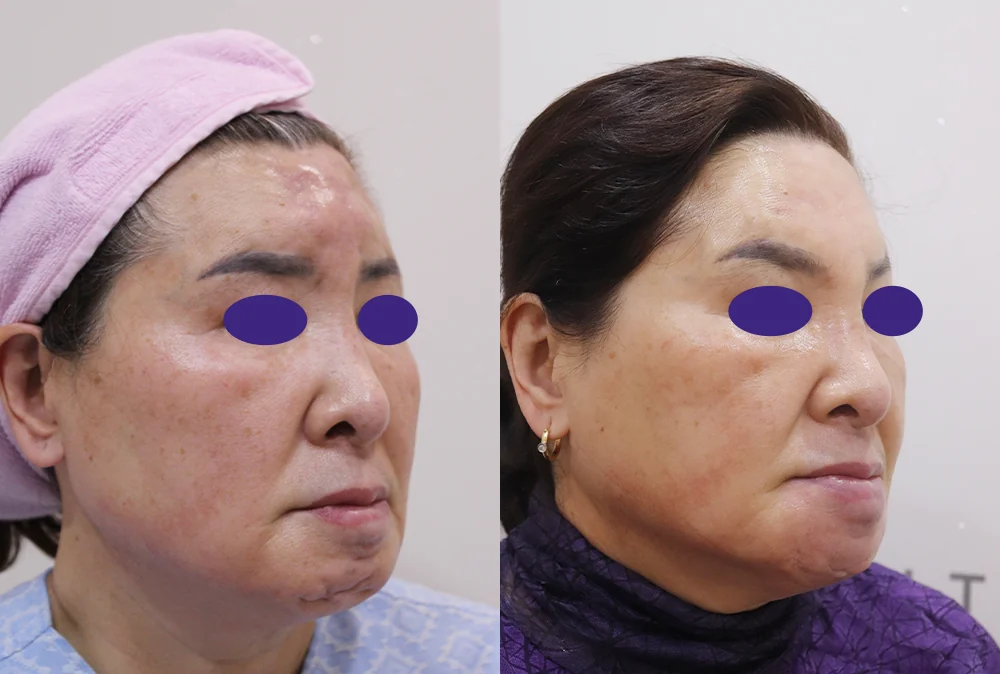
A raised area on the forehead and an uneven contour under the jaw (angled view)
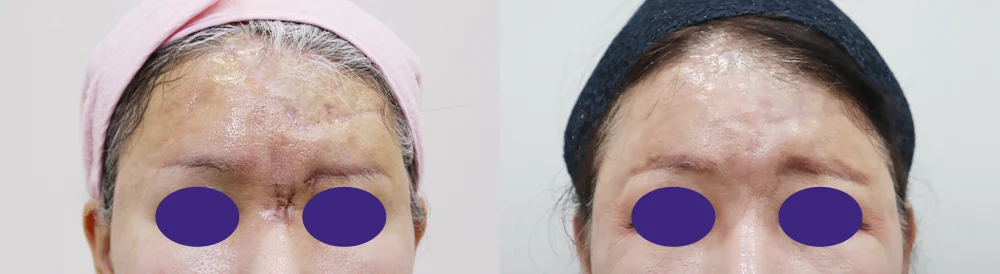
Uneven skin with marks on the forehead and between the brows
* Results vary from person to person. Side effects are possible, so please decide after a thorough consultation with a doctor.
Frequently asked questions
Can lifting be done on the same day as filler removal?
Depending on your condition, both may be done in one session, or in stages after the removal site has settled. If there is inflammation or a lot of material remains, removal and calming the inflammation come first, and lifting is safer later.12
How long should I wait after removal?
There is no fixed interval. It depends on whether swelling and inflammation have settled and whether material remains. As an example, one study of non-degradable filler removal with reconstruction excluded anyone who had an infection in the previous three months.1
Can grafted fat clump or become lumpy?
Complications of facial fat grafting are reported as uncommon, but the most frequent were asymmetry and an uneven surface.4 That is why fat is placed in portions and topped up only where needed once it has settled.
Do dissolvable threads have side effects?
They can. Pooled studies list swelling as the most common, followed by dimpling, altered sensation, visible or palpable threads and infection. Dissolvable threads had lower rates of altered sensation and extrusion than non-absorbable threads.5
When is a facelift the better choice?
Bonita Clinic generally considers a facelift better suited than non-incisional methods when sagging is deep or neck lines are marked. Surgeons have also reported combining a facelift with tissue transfer when removal leaves a large defect.1 The decision is made at consultation after looking at how much the face has sagged and why.
Before your consultation
- For each area, what was injected and when, and when, where and how much was removed (bring any operation record)
- Whether you were told material remains, and any recent swelling or redness
- Medicines you take regularly, and any important dates coming up
Bonita Clinic is on the 3rd floor of 565 Gangnam-daero, Seocho-gu, Seoul, about 100 m on foot from Exit 8 of Nonhyeon Station (Line 7). Read more on our Multi Lifting after Filler Removal page. For removing material that remains in the forehead, chin or cheeks, see Forehead, Chin & Cheek Revision and the guide to forehead, chin and cheek filler removal. If scars are also involved, see Multi Lifting after Scar Removal and the guide to combining scar treatment and lifting. For deeper sagging, see Multi Lifting and Face Lift.
References (5)
Sources that support the explanations in this article. Study findings describe general trends and do not guarantee individual results.
- Ghoraba S, Loucas M, Loucas R. Management of Permanent Filler Complications Using Deep-Plane Facelift and Temporoparietal Fascial Flap Reconstruction: A Retrospective Study. Aesthet Surg J Open Forum. 2025;7:ojaf106.doi:10.1093/asjof/ojaf106Retrospective study of 160 patients treated with filler removal, deep-plane facelift and fascial flap: removal often leaves defects, microscopic particles can remain and seed infection, recent infection excluded, staged reconstruction after acute infection, limited long-term evidence for reconstruction methods; a surgical approach unlike Bonita Clinic's non-surgical lifting
- Gadallah A, Etman AG, Mamdouh Abd Elhalim M. Facial Contouring after Permanent Filler Removal with Combined Facelift and Fat Grafting: A Case Series. Plast Reconstr Surg Glob Open. 2023;11(12):e5456.doi:10.1097/GOX.0000000000005456Case series of 50 patients with filler removal, facelift and fat grafting: most presented years later with drooping, surgery only without signs of infection, abscesses drained first, ultrasound and MRI before surgery, complication counts
- Coleman SR, Grover R. The anatomy of the aging face: volume loss and changes in 3-dimensional topography. Aesthet Surg J. 2006;26(1S):S4-S9.doi:10.1016/j.asj.2005.09.012Review (abstract) on the ageing face: gravity, bone resorption, reduced elasticity and fat redistribution, with three-dimensional volume restoration as a primary goal
- Gornitsky J, Viezel-Mathieu A, Alnaif N, et al. A systematic review of the effectiveness and complications of fat grafting in the facial region. JPRAS Open. 2019;19:87-97.doi:10.1016/j.jpra.2018.12.004Systematic review of facial fat grafting, 43 studies and 4,577 patients: mean retention 41.63% at a mean 13.9 months, complications 2.27%, mostly asymmetry and surface irregularity
- Niu Z, Zhang K, Yao W, et al. A Meta-Analysis and Systematic Review of the Incidences of Complications Following Facial Thread-Lifting. Aesthetic Plast Surg. 2021;45(5):2148-2158.doi:10.1007/s00266-021-02256-wMeta-analysis (abstract) of 26 thread-lift studies: rates of swelling, dimpling, altered sensation, visible threads, infection and extrusion; fewer problems with dissolvable threads; more dimpling and infection over 50; satisfaction falling from 98% to 88%
About this article
This article separates general medical information from Bonita Clinic's own approach. Because the right decision depends on each person's condition, it is not a substitute for a consultation.
