 KOKorean
 ENEnglish
 JP日本語
JP日本語 CN中文(简体)
 TW中文(繁體)

Scar Treatment and Lifting in Seoul: Can They Be Combined, and Which Comes First?
They can be planned together, but the scar usually comes first. If the skin under a scar is stuck to the tissue below (an adhesion) or a dent remains, that spot does not move with the skin around it. Lifting or filling around it can then leave the scar behind and make it more noticeable. At Bonita Clinic the scar is repaired first so the skin can move freely, and lifting with fat grafting, dissolvable threads or laser is added on top. Whether this happens on the same day or in stages depends on the scar and the skin. Identical sides cannot be promised, so differences are reduced step by step while comparing the face at rest and when smiling. If you are planning treatment in Seoul, you can send photos at rest and smiling first.
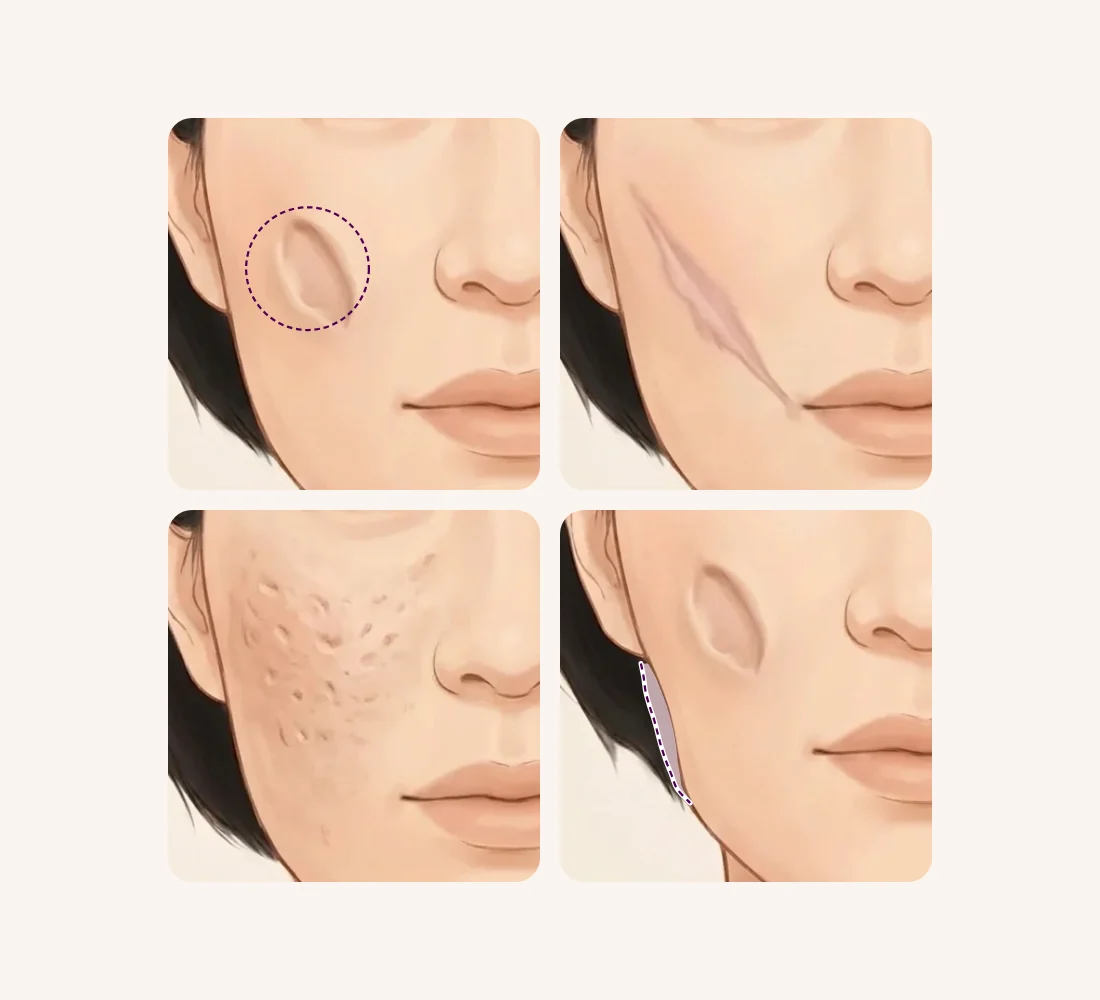
How does a scar upset the balance of the face?
A facial scar is more than a mark or a line. Scars left by acne, accidents, surgery or the removal of injected material can change the shape of the face and the way it moves. One cheek may look sunken, or one side may look stiff when you smile. The picture below brings together, on one face, the areas this guide talks about.
Scars change the balance of the face in three main ways.
1. Depressed scars: the skin is held down
A depressed scar is often stuck to the tissue beneath it. This is called an adhesion. Picture tough fibrous bands pulling the skin downward.
Cutting these bands with a fine needle is called subcision (adhesion release). The paper that first described it explains that the dent rises once the bands are released. It is then supported by connective tissue (tough tissue that forms as a wound heals).1 Put the other way round, a spot that is still tethered tends not to follow when the surrounding skin is lifted or filled.
2. Scars that widen or pull
When a scar is pulled from both sides (tension), the inflammatory phase of healing, when the wound is red and swollen, lasts longer. This makes the scar more likely to widen or thicken. A scar broken into short zigzag segments also matures faster than a long straight one; "maturing" means the redness fades and the scar softens and settles.4 That is why scars on flat areas such as the cheek are reshaped in a different direction from those along creases on the forehead or around the smile lines.4
3. Volume missing under the scar
Where tissue has been lost, the area dips and casts a shadow, and one cheek can look sunken compared with the other. Such areas can be filled with fat moved from your own body (autologous fat grafting). A systematic review (a study that gathers earlier studies by a set method and looks at them again) covered 26 studies with 905 patients. The patients had fat grafted into scar tissue, and the review reported improvements in scar appearance, skin quality and pain, as well as in volume and three-dimensional contour.2
Why a scar can look worse when you smile
The adhesion is also why a scar can stand out more when you smile or talk. The skin around it moves while the tethered spot stays put, so the difference looks larger than at rest. This is why Bonita Clinic compares progress side by side, at rest and with expressions.
Why is the scar treated first?
Bonita Clinic's principle is "scar first, then Multi Lifting." Multi Lifting means combining the methods a person needs to treat sagging and hollows. These are chosen from fat grafting, dissolvable threads, laser and liposuction.
The order matters for a simple reason. If you pin one spot of a piece of fabric and then pull it, the rest smooths out but the pinned spot stays dimpled. The face behaves in a similar way: if the skin is lifted while an adhesion remains, the scar stays held down and can become more noticeable. So adhesions are released first so the skin can move, hollows are filled and wide scars are narrowed; only then, in our view, does lifting sit naturally on top.
There is more than one way to treat the scar itself:
- Surgical scar revision can improve mature scars when it is done at the right time and chosen for the scar's condition and location.4
- In an international consensus, 26 dermatologists and plastic surgeons from several countries pooled their views on the evidence. They named lasers a first-line treatment, meaning one to consider first, for traumatic scars and contractures (scars that tighten and pull).3
- If the area under a scar has sunk, fat grafting can restore volume and contour, although the quality of the studies behind it is still described as low.2
What is done first, by type of scar
1If the scar is depressed and pulling
A fine needle cuts the bands under the skin so it can move again
Adhesion release
2If the scar has spread wide
The scar is narrowed and reshaped in a direction that suits the area
Scar revision
3If the surface is uneven and marks remain
Two or three lasers, chosen for the skin, refine texture and color
Combined laser
4If the area under the scar has sunk
Your own fat is moved in to fill the lost volume
Fat grafting
After the scar: how are sagging and hollows treated?
Once the scarred area can move, the next step is the balance of the whole face. The method depends on the concern, and the strength of the evidence differs from method to method.
Dissolvable threads: support, not a long-lasting lift
Thread lifting needs a careful look at the evidence. A systematic review examined thread lifts that use threads with small barbs (barbed sutures) to hook and pull sagging tissue. It concluded that little or no new evidence on effectiveness or safety had been added over about a decade. In most of the included studies, the lift did not last long. The two studies reporting longer effects were sponsored by thread manufacturers.5
Bonita Clinic places dissolvable threads densely in a mesh pattern, which is not the same technique as in those studies. Even so, it is more realistic to see threads as support for fine lines and firmness than as a long-lasting lift on their own.
Fat grafting: part of it is absorbed
Fat grafting is used to fill hollows under scars and differences in volume between the two sides, and many reports describe improvement of the scar itself.2 Part of the grafted fat is absorbed by the body, and the part that takes hold remains. So we plan the amount with that in mind and top up if needed.
Deep sagging: compared with a facelift
At Bonita Clinic, we find that deep sagging or marked neck lines are often better suited to a surgical facelift than to methods without incisions. If a facelift feels like too much, or you want a lighter recovery, Multi Lifting after scar repair can be an option.
Either way, faces are naturally a little different on each side. The aim is not identical sides but reducing the differences that scars and sagging have made larger.
Same day, or in stages?
At Bonita Clinic, scar treatment and lifting are sometimes done in one session, and sometimes in stages once the repaired area has settled. The order is decided at consultation from the state of the scar and the skin, taking into account:
- Whether the scar is still red and firming up, or already mature; surgical revision is mainly described for mature scars4
- Whether you tend to form keloids (scars that grow red and thick beyond the original wound) or thick scars. These carry a high risk of coming back unless surgery is followed by additional treatment4
- Whether there is active inflammation, such as acne, which is calmed before the area is treated
- Where fat will be taken from, how much is needed, and when your important dates are
In short: if a scar is still changing or inflamed, it is calmed first; if it has settled, we look at whether lifting can follow on the same day.
From scar repair to checking balance
- Scar repairRelease, fill and narrow the scar
- Right afterSwelling and bruising; compression advice
- RecoveringSide-to-side contours emerge as swelling fades
- SettlingBalance checked once fat and lifting settle
- If neededFine touch-ups after comparing rest and smile
At Bonita Clinic, Multi Lifting after scar removal is classed as a non-surgical treatment. Treatment uses sedation plus local anesthesia with same-day discharge, and stitches are needed only when fat grafting is part of the plan. These details can differ from person to person.
How we approach it at Bonita Clinic
Treatment options you can discuss in Seoul
Bonita Clinic has been in the same place since 1995, and Dr. Kwang-Seop Chung, a board-certified plastic surgeon (Brazil) with 31 years in plastic surgery and scar restoration, sees each patient himself. For scars combined with sagging or volume loss, the options discussed are:
- Scar repair: releasing adhesions, filling depressions, narrowing wide scars
- Jaw liposuction without incisions for fat under the jawline
- Fat grafting to reduce differences in volume between the two sides
- Dissolvable threads for fine lines and firmness
- Combined lasers (two or three types) for texture and marks
- Checking balance at rest and with expressions, with fine touch-ups if needed
Not everyone needs every step. Which ones fit, and in what order, is decided after an examination.
Why does the plan and cost differ from person to person?
Two people with "acne scars and sagging" may need very different combinations. What shapes the plan and the cost is how many steps are needed and how they are spread over time.
- Number, type and depth of scars
- Whether adhesions must be released or scars narrowed
- Fat grafting: areas and amount
- Which lifting steps: threads, laser, jaw liposuction
- One session or staged visits
- Keloid tendency or active acne to manage first
Final plan and quote after an in-person exam
A final estimate is given after the in-person examination, once the scar repair, the lifting steps and their order are clear.
What can photos show, and what needs an in-person exam?
Photos are good at showing where scars are and how the face looks when it moves. How the scar behaves under the skin needs a hands-on exam.
Photos can show
- Where the scars are, their color and width
- Depressions and shadows in good light
- Asymmetry at rest and when smiling
- Jawline and cheek contour from the side
Needs an in-person exam
- How firmly the scar is tethered
- Whether the scar is mature or still active
- Skin thickness and laxity
- Keloid or thick-scar tendency
- How much fat is available to graft
Helpful photos: front, both sides at 45 degrees and profile, taken in even daylight without makeup, plus the same views while smiling and while speaking. Older photos from before the scar or before sagging began help set a realistic goal. You can send us a message with your photos and a short note on the cause and age of the scars.
Planning your stay and recovery
The confirmed details are those above: sedation with local anesthesia, going home the same day, and stitches only with fat grafting. Whether everything is done in one session or in stages, how long to stay in Seoul and how many follow-up visits are needed are planned with you at consultation. Please tell us about any important dates.
Right after treatment, we manage swelling and bruising with compression. As the swelling settles, the contours on each side become clear. Balance is checked once the grafted fat and lifting have settled, with fine touch-ups only if needed.
After you return home, contact a doctor if redness, heat, pain or discharge increases at treated areas or where fat was taken. Keep taking dated photos at rest and smiling, from the same angles, so that progress can be compared fairly at follow-up.
Real treatment cases
These cases appear on Bonita Clinic's Multi Lifting after Scar Removal page. Results vary from person to person.
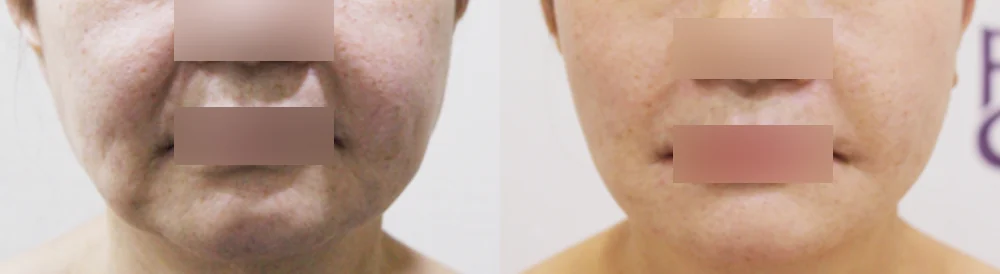
Many depressed scars on the cheeks with deep lines around the mouth
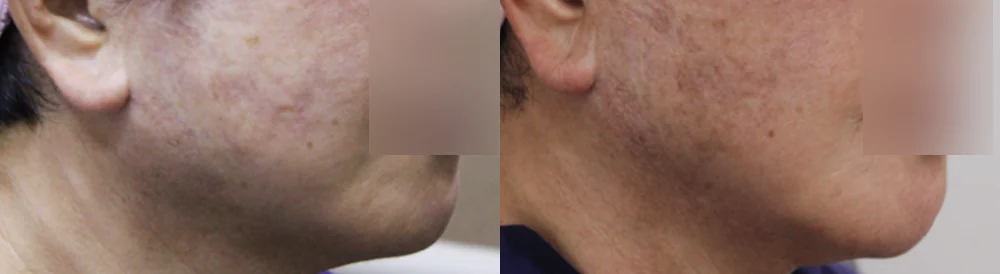
Uneven, pitted skin on the side of the cheek (profile)
* Results vary from person to person. Side effects are possible, so please decide after a thorough consultation with a doctor.
Frequently asked questions
I had scar treatment recently. Can I add lifting now?
Often yes, but it depends on the scar. If it is still red and firming up, it is usually better to continue after the repaired area has settled. If the tissue allows, both can be done in one session. The order is agreed at consultation.
I have many acne scars. Will fat grafting alone fix them?
Fat grafting can fill volume lost under scars and has been reported to improve the scars themselves, but the quality of the evidence is still low.2 Tethered scars also need to be released first, and surface texture needs laser treatment, so several methods are usually combined.13
How long do dissolvable thread results last?
It depends on your skin and what else is done. Pooled studies show that the lifting effect of threads tends not to last long.5 Threads are therefore planned as support for fine lines and firmness rather than as a lasting lift.
I tend to get keloids. Is this still possible?
Please tell us at consultation. Keloids and thick scars carry a high risk of coming back after surgical revision unless additional treatment follows.4 The extent of incisions and needle work, and the aftercare, are planned around that risk.
Will both sides of my face match exactly afterwards?
No. Faces are naturally a little different on each side, and a scarred area rarely becomes identical to the skin around it. The goal is to reduce the differences that scars and sagging have made larger. Once the face has settled, it is compared at rest and with expressions, and touched up only as needed.
Before your consultation
- The cause and age of each scar (acne, accident, surgery, removal of injected material)
- Scar treatments so far (laser, injections, excision) and any lifting or fat grafting, with dates
- Whether scars have ever become raised, red and thick, or formed keloids
- Medicines you take regularly, and any important dates coming up
Bonita Clinic is on the 3rd floor of 565 Gangnam-daero, Seocho-gu, Seoul, about 100 m on foot from Exit 8 of Nonhyeon Station (Line 7). Read more on our Multi Lifting after Scar Removal page. For sagging after filler or foreign material removal, see Multi Lifting after Filler Removal and the guide to lifting after filler removal. For sagging without scars, see Multi Lifting and Face Lift, and for treating depressed or incision scars on the face, see Facial Depressed & Incision Scars.
References (5)
Sources that support the explanations in this article. Study findings describe general trends and do not guarantee individual results.
- Orentreich DS, Orentreich N. Subcutaneous incisionless (subcision) surgery for the correction of depressed scars and wrinkles. Dermatol Surg. 1995;21(6):543-549.doi:10.1111/j.1524-4725.1995.tb00259.xOriginal description of subcision (abstract): releasing the tissue under a depressed scar with a fine needle lifts the depression, helped by connective tissue formed during healing
- Negenborn VL, Groen JW, Smit JM, et al. The Use of Autologous Fat Grafting for Treatment of Scar Tissue and Scar-Related Conditions: A Systematic Review. Plast Reconstr Surg. 2016;137(1):31e-43e.doi:10.1097/PRS.0000000000001850Systematic review (abstract) of 26 studies and 905 patients: fat grafting improved scar appearance, skin quality, pain, volume and contour, but the level of evidence is low
- Seago M, Shumaker PR, Spring LK, et al. Laser Treatment of Traumatic Scars and Contractures: 2020 International Consensus Recommendations. Lasers Surg Med. 2020;52(2):96-116.doi:10.1002/lsm.23201International Delphi consensus of 26 experts (abstract): lasers are a first-line treatment for traumatic scars and contractures
- Ogawa R. Surgery for scar revision and reduction: from primary closure to flap surgery. Burns Trauma. 2019;7:7.doi:10.1186/s41038-019-0144-5Review of scar revision surgery: mature scars improve with appropriate timing; tension prolongs inflammation; segmented scars mature faster; different approaches for flat cheeks and creased areas; keloids need adjuvant therapy to avoid recurrence
- Gülbitti HA, Colebunders B, Pirayesh A, et al. Thread-Lift Sutures: Still in the Lift? A Systematic Review of the Literature. Plast Reconstr Surg. 2018;141(3):341e-347e.doi:10.1097/PRS.0000000000004101Systematic review of barbed thread lifts (abstract): little new evidence on efficacy or safety, very limited durability in most studies, positive studies industry-sponsored; a different technique from mesh-placed dissolvable threads
About this article
This article separates general medical information from Bonita Clinic's own approach. Because the right decision depends on each person's condition, it is not a substitute for a consultation.
